
Absolute Encoders Market Size by Type, Application, End User Industry, Region – Revenue Pool Analysis, Margin Structure Assessment, Capital Flow Trends, Competitive Benchmarking & Forecast to 2032
Overview
The Absolute Encoder Market was valued at USD 1.50 billion in 2024 and is expected to grow at a compound annual growth rate of 7.1% between 2025 and 2032. reaching nearly USD 2.60 Bn.
Absolute encoders are electro-mechanical devices and are commonly known as feedback devices that provide true or absolute angular position at every point of rotation of the encoder. The Absolute encoders are used to retain position information even if power is disconnected from the encoder.
The Absolute Encoder Market is a vital segment of the industrial automation industry, offering sensors that provide unique position values for each shaft location, ensuring high precision in motion control systems. The market is witnessing robust growth due to the increasing demand for advanced automation in manufacturing, robotics, aerospace, and medical equipment. Availability of compact and high-resolution encoders has improved with rapid technological advancements. Rising demand stems from industrial digitization, while supply remains steady due to strong production capabilities in countries like Germany, Japan, and China. Asia-Pacific dominates the market, led by China's industrial expansion, followed by North America and Europe.
Major key players include Heidenhain, Renishaw, Honeywell, TE Connectivity, and Rockwell Automation. End users contributing significantly to market growth are in the automotive, industrial robotics, and healthcare sectors, where absolute encoders enable precise motion control, fault detection, and real-time monitoring, making them indispensable in next-generation smart manufacturing systems.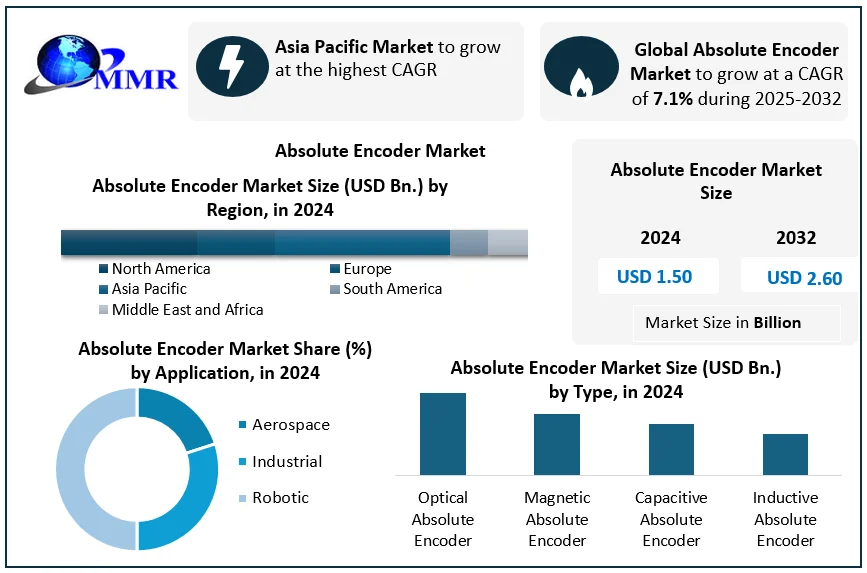 To know about the Research Methodology:- Request Free Sample Report
Industrial Automation, Robotics, and High-Precision Applications to Drive Absolute Encoder Market Growth
The absolute encoders market has been seeing remarkable growth over the past few years. A surge in the adoption of absolute encoders for applications such as radiation therapy, industrial Automation, Advancements in robotics and CNS Machine, microelectronics, satellite communications, surgical robotics, and many other applications is being major driving factor behind the growth of the market. Increasing demand for absolute encoders for sensor devices in motor speed applications, high-accuracy positioning and position control applications, growing market for industrial robots, increased usage of advanced automation industrial appliances and control systems, and increasing adoption of industrial automation are expected to improve the growth of the market during the forecast period.
Absolute encoder provides some benefits such as higher resolution options, enhanced system reliability, non-volatile memory, and high accuracy, which are ultimately propelling the growth of the market. However, the high costs of an absolute encoder than an incremental encoder are a major restraining factor that could hamper the growth of the market.
Industry 4.0, Healthcare, and IoT Integration to Create the Absolute Encoder Market
The absolute encoder market presents several promising opportunities driven by increasing automation across industries. One of the major opportunities lies in the adoption of Industry 4.0 and smart factories, where absolute encoders are essential for precise motion control and real-time feedback. The expanding robotics and automation sector, especially in logistics, automotive, and semiconductor manufacturing, offers significant growth potential. There is also rising demand for medical equipment and healthcare devices, where accuracy and safety are critical. The growing trend of miniaturization and integration of encoders with wireless and IoT technologies opens up avenues for innovation. Moreover, the emerging economies in Asia-Pacific, Latin America, and Africa offer untapped markets due to increased industrialization and infrastructure development.
Additionally, the transition from incremental to absolute encoders in legacy systems offers a strong replacement and upgrade market. Overall, technological advancements and the shift toward intelligent automation will continue to create lucrative opportunities for market players.
High Costs, Integration Complexity, and Environmental Limits to Create in the Absolute Encoder Market Challenges
The absolute encoder market experiences several challenges that could hinder its growth. One major challenge is the high cost of advanced absolute encoders compared to incremental encoders, which can limit adoption among small and medium-sized enterprises. Complexity in integration with existing automation systems and the need for specialized technical expertise also create barriers for some end users. Environmental limitations, such as sensitivity to dust, moisture, and extreme temperatures, can affect the performance and lifespan of encoders in harsh industrial settings. Additionally, rapid technological changes require constant innovation and can make existing products obsolete quickly, increasing R&D pressure on manufacturers. The market also faces challenges related to supply chain disruptions and the availability of high-quality raw materials and electronic components. Furthermore, the lack of standardized protocols for communication and compatibility among different encoder systems can pose interoperability issues, affecting smooth deployment across diverse applications.
Investment, Expertise, and System Compatibility Hurdles to Create Restraints for the Absolute Encoder Market
The absolute encoder market faces several restraints that may limit its expansion. A primary restraint is the high initial investment and maintenance cost associated with absolute encoders compared to incremental alternatives, which can deter cost-sensitive industries. Additionally, the complex installation process and the requirement for skilled professionals can slow down adoption, especially in regions with limited technical infrastructure. The limited awareness among small-scale industries about the long-term benefits of absolute encoders also acts as a barrier. Furthermore, the market faces restraints from compatibility issues with older machinery and systems, which may require complete system upgrades, increasing overall costs. Supply chain constraints, particularly for high-precision components, and fluctuations in raw material prices can also impact production and pricing strategies. Lastly, in highly regulated industries like aerospace and healthcare, strict compliance standards and lengthy certification processes may delay product deployment and innovation.
Absolute Encoders Market Segment Analysis
By Type, Optical absolute encoders dominated the market in 2024 and are projected to witness fast growth at a CAGR of xx% during the forecast period 2025-2032. Due to their superior precision, high resolution, and reliability, they are ideal for applications requiring accurate position tracking. They excel in clean, controlled environments such as industrial automation, robotics, and semiconductor manufacturing, where even minor errors can disrupt operations. These encoders are widely used in Asia-Pacific and North America, particularly in sectors like electronics, automotive, medical devices, and aerospace. Their mature technology and seamless integration with digital control systems support advanced automation and Industry. As a result, optical encoders are the preferred choice for industries demanding accuracy, speed, and long-term performance.
By application, the Robotics segment dominated the market in 2024 and is expected to maintain its dominance at a CAGR of xx% during the forecast period. A surge in the adoption of absolute encoders in surgery and industrial robotics is attributed to the growth of the market. In the manufacturing industry, robotics arms are widely used to perform tasks such as paint spraying, welding, and assembling, and in healthcare, it is generally used to perform remote surgery. Thus, the growing requirement for high quantity and more accurate positional information and data from robotic arms is making more demand for absolute encoders in the robotics equipment industry across the globe.
In addition, home-assistance robots are other emerging applications increasing demand for absolute encoders in the market. For applications in consumer as well as industrial markets, absolute encoders are an ideal choice over other encoders as they can be used for applications ranging from automated gates to factory automation, owing to their cost-effective and highly precise way of determining position.
Absolute Encoders Market Regional Analysis
The Asia Pacific held the largest market share in 2024 and is expected to maintain its dominance at a CAGR of xx% during the forecast period. Economies such as China, Japan, South Korea, and India are the major key contributors behind the growth of the market. The growth is attributed to the growing market for industrial robotics across the region.
Absolute encoders are widely used in numerous applications in electronic and automated control systems to use in the automotive, manufacturing, and construction industries. Countries such as China, Japan, and India account for the largest market share in the manufacturing industries. China is the world leader in the manufacturing sector.
The objective of the report is to present a comprehensive analysis of the Global Absolute Encoders Market, including all the stakeholders of the industry. The past and current status of the industry, with forecasted market size and trends, are presented in the report, with the analysis of complicated data in simple language. The report covers all the aspects of the industry with a dedicated study of key players that includes market leaders, followers, and new entrants. PORTER, SVOR, PESTEL analysis with the potential impact of micro-economic factors of the market has been presented in the report. External as well as internal factors that are supposed to affect the business positively or negatively have been analysed, which will give a clear futuristic view of the industry to the decision-makers.
The report also helps in understanding the Global Absolute Encoders Market dynamics, structure by analyzing the market segments and projects the Global Absolute Encoders Market. Clear representation of competitive analysis of key players by Application, price, financial position, Product portfolio, growth strategies, and regional presence in the Global Absolute Encoders Market makes the report an investor’s guide.
Absolute Encoders Market Competitive Landscape
The absolute encoders market is globally competitive, with key players and manufacturers spread across major industrial regions. Countries like Germany, the USA, Japan, the UK, and Switzerland dominate due to strong technological foundations. Major key players include HEIDENHAIN (Germany), Renishaw (UK), Baumer (Switzerland), Rockwell Automation (USA), Omron Corporation (Japan), and Schneider Electric (France). These companies lead in manufacturing high-precision absolute encoders for automation, robotics, and medical equipment. Germany, Japan, and the USA are prominent exporters, supplying encoders to industrial markets globally, while India, China, and several Southeast Asian countries are major importers due to their growing automation sectors.
China is rapidly emerging as both a manufacturer and exporter, producing low-cost encoders that challenge Western dominance. Regionally, Europe and Asia-Pacific lead the market, followed by North America. Competitive strategies include innovation, localized manufacturing, and strategic partnerships to meet rising demand in smart manufacturing and digital automation systems.
Absolute Encoders Market Trends
Technology Integration & Industry
Integration with IoT, robotics, and automation systems is driving demand for smart absolute encoders that provide real-time feedback and enable predictive maintenance.
Advanced Sensing Technologies
High-resolution and multi-turn encoders using optical or magnetic sensing enhance precision and reliability in demanding industrial applications.
Wireless & Contactless Technology
Wireless encoders are gaining popularity for their ease of installation and reduced maintenance, especially in rotating or moving parts where wired connections are impractical.
Customized Solutions for Niche Applications
Manufacturers are offering tailored encoder solutions for specific industries such as medical devices, defense, and aerospace, meeting specialized performance and environmental requirements.
Absolute Encoders Market Development
In 2025, Dynapar expanded its AI25 EtherNet/IP encoder line, offering rugged, stainless-steel housings with up to 22-bit single-turn and 12-bit multi-turn resolution—ideal for harsh industrial settings.
In 2024, optical encoders, which include absolute models, continued to dominate due to their high resolution and precision, driven by rapid automation in robotics, CNC machines, and medical devices, particularly across Asia-Pacific, where robot density is surging.
USA (Dynapar, 2024–2025) Introduced connected rugged encoders with high resilience and Ethernet/IP/EtherCAT connectivity suited for harsh environments and Industry 4.0 networks.
Japan (Nikon, 2025) Pioneered battery-free multi-turn encoders with all-solid-state batteries and smart diagnostics.
Absolute Encoders Market Scope: Inquire before buying
| Global Absolute Encoders Market | |||
|---|---|---|---|
| Report Coverage | Details | ||
| Base Year: | 2024 | Forecast Period: | 2025-2032 |
| Historical Data: | 2019 to 2024 | Market Size in 2024: | USD 1.50 Bn. |
| Forecast Period 2025 to 2032 CAGR: | 7.1% | Market Size in 2032: | USD 2.60 Bn. |
| Segments Covered: | by Type | Optical Absolute Encoder Magnetic Absolute Encoder Capacitive Absolute Encoder Inductive Absolute Encoder |
|
| by Application | Robotic Industrial Automation Aerospace |
||
| by End User Industry | Manufacturing Automotive Healthcare |
||
Absolute Encoders Market, by Region
North America (United States, Canada, and Mexico)
Europe (UK, France, Germany, Italy, Spain, Sweden, Austria, and the Rest of Europe)
Asia Pacific (China, South Korea, Japan, India, Australia, Indonesia, Malaysia, Vietnam, Taiwan, Bangladesh, Pakistan, and Rest of APAC)
Middle East and Africa (South Africa, GCC, Egypt, Nigeria, and Rest of ME&A)
South America (Brazil, Argentina, Rest of South America)
The Absolute Encoders Market Key Players are
North America
1. Rockwell Automation (USA)
2. Honeywell International Inc. (USA)
3. Sensata Technologies (USA)
4. Dynapar Corporation (USA)
5. BEI Sensors (USA)
6. US Digital (USA)
7. Allied Motion Technologies Inc. (USA)
Europe
1. HEIDENHAIN GmbH (Germany)
2. SICK AG (Germany)
3. Baumer Group (Switzerland)
4. Pepperl+Fuchs (Germany)
5. ifm electronic GmbH (Germany)
6. Kübler Group (Germany)
7. Eltra S.p.A. (Italy)
Asia-Pacific
1. Omron Corporation (Japan)
2. Panasonic Industrial Devices (Japan)
3. Tamagawa Seiki Co., Ltd. (Japan)
4. Shanghai Siko Automation (China)
5. Tokyo Cosmos Electric Co., Ltd. (TOCOS - Japan)
6. Baumer India Pvt. Ltd.
7. Hokuyo Automatic Co., Ltd. (Japan)
Rest of the World
1. Hengstler (part of Fortive – USA, global operations)
1. TE Connectivity (global, strong in emerging markets)
2. Avago Technologies (Singapore/global)
3. Contrinex (Switzerland/global reach)
4. TR Electronic (Canada/Brazil presence)
5. LIka Electronic (Italy/global)
6. Position Fraba (global, with strong presence in Latin America & Africa)
Frequently Asked Questions:
1. Which region has the largest share in the Global Absolute Encoders Market?
Ans: Asia Pacific held the highest share in 2024.
2. What is the growth rate of the Global Absolute Encoders Market?
Ans: The Global Absolute Encoders Market is growing at a CAGR of 7.1% during the forecasting period 2025-2032.
3. What is the scope of the Global Absolute Encoders Market report?
Ans: The Global Absolute Encoders Market report helps with the PESTEL, PORTER, COVID-19 Impact analysis, Recommendations for Investors & Leaders, and market estimation of the forecast period.
4. Who are the key players in the Global Absolute Encoders Market?
Ans: The important key players in the Global Absolute Encoders Market are – Honeywell International Inc. (USA), Sensata Technologies (USA), Dynapar Corporation (USA), BEI Sensors (USA), US Digital (USA), Allied Motion Technologies Inc. (USA), HEIDENHAIN GmbH (Germany), SICK AG (Germany), Baumer Group (Switzerland), Pepperl+Fuchs (Germany), ifm electronic GmbH (Germany), Kübler Group (Germany), Eltra S.p.A. (Italy), Omron Corporation (Japan), Panasonic Industrial Devices (Japan), Tamagawa Seiki Co., Ltd. (Japan), Shanghai Siko Automation (China)
5. What is the study period of this Market?
Ans: The Global Absolute Encoders Market is studied from 2025 to 2032.