
5G Core Market Size – Industry Structure Evaluation, Demand Drivers Analysis, Regional Growth Analysis and Identification, Competitive Positioning Review & Global Market Size Forecast to 2032
Overview
Global 5G Core Market size was valued at USD 4.3 Bn in 2025 and is expected to reach USD 63.17 Bn by 2032, at a CAGR of 46.79% during a forecast period.
5G Core Market Overview and Dynamics:
The 5G Core is the core of a mobile network as ultra-connectivity turns into market versatility and coverage differentiation. This ensures safe and consistent network connectivity and access to its facilities, specifies infrastructure consistency, and enforces it through a strategy that allows for service separation and limits wide-area mobility inside the network. It builds and distributes different slices using virtualization techniques such as micro-services and cloud native, such as mMTC (massive machine-type communications), URLLC (ultra-reliability and low latency communication), and eMBB (electronic machine-type communications) (enhanced mobile broadband).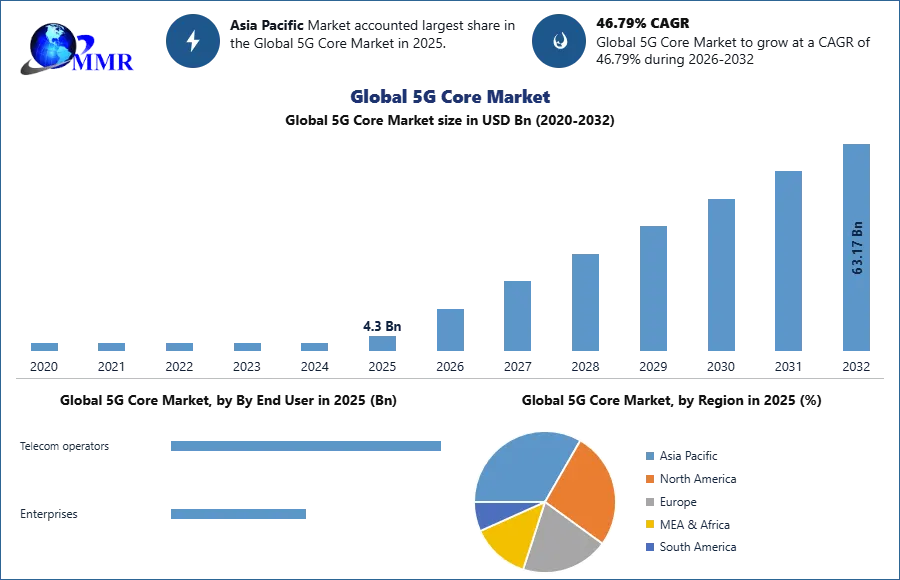
To know about the Research Methodology :- Request Free Sample Report
Accelerated Growth of Smart Infrastructure:
The rate at which 5G is deployed around the globe will determine how rapidly it becomes the major technology of smart cities. According to the United Nations, by 2050, this figure will have risen to 68 %. By the same year, the continued movement of people from rural to urban regions, combined with global population increase, will have added another 2.5 billion people to the world's largest cities. Telecommunications infrastructure, as well as its application for public safety, are vital to the success of smart city projects.
The mMTC was Made Possible by Industry 4.0.
The growing adoption of the Internet of Things (IoT) and ongoing advances in Machine-to-Machine (M2M) communication networks are altering a variety of industries by connecting all types of devices, appliances, systems, and services. IoT is one of the many use cases supported by 5G core-enabled 5G, allowing communication between massive numbers of sensors and connected devices. The evolution of 5G technology is projected to accelerate in order to meet these needs for growing IoT applications, which are categorized as huge machine-type communication and mission-critical applications.
Concerns about Data Security in the 5G Core Network:
5G security will become increasingly important as 5G services spread throughout the bulk of the world's economies in the coming years. Much of the conversation has centered on the security risks that 5G poses as major network operators roll out new services around the world. The security of telecom networks is a top issue for governments. While 5G opens up opportunities in areas such as healthcare, manufacturing, and transportation, the reality is that it is becoming a more enticing target for cyber criminals as the threat surface and the consequences of any damage increases.
5G Core Market Segment Analysis:
Global 5G Core Market are segmented into Components, Solutions, Network Functions and End user.
Based on Solutions, the managed services segment accounted for a dominant share of over 58.44% in 2025. In global 5G core market, managed services outsource an entire network or a portion of it on a proactive management basis to improve network operations and cut costs. Network security, storage, desktop, server, hosting, apps, and mobile device management are all outsourced through these services. Most suppliers are unable to provide a standalone solution and associated services to consumers since the 5G core market is still in its early stages. This causes them to handle a few services from suppliers who are experienced in offering those services in order to provide the essential services to the clients.
By End user, the cloud segment is expected to grow at the largest CAGR of nearly xx% during the forecast period. This growth is driven by the fact that the 5G Core Market is completely software-based and cloud-native.
Asia-Pacific market is expected to register a CAGR of 47.23% during the 2022-2029:
In 2025, Asia Pacific (APAC) is expected to hold the largest share of the global 5G Core market and maintain its lead throughout the forecast period. The region’s dominance is primarily driven by rapid 5G network rollouts in countries such as China, Japan, and South Korea, supported by strong government initiatives promoting digital infrastructure, smart cities, and Industry 4.0. The high population density in China and India further amplifies demand for ultra-fast connectivity, IoT applications, and cloud-based services. APAC is also home to leading telecom equipment manufacturers like Huawei, Samsung, and ZTE, which accelerates deployment and technology adoption. In contrast, North America and Europe grow steadily due to advanced infrastructure and enterprise adoption but face slower nationwide deployment and smaller population-driven demand, giving APAC a clear edge in market share.
Key Development:
Key players operating in the 5G Core market are involved in adopting sustainable strategies to gain competitive edges such as new product launches, partnerships, collaborations, and agreements. Such as:
In March 2021, Nokia has enhanced Telenet cloud services with 5G core tech. The scope of this partnership will also include design, deployment, and integration services.
In March 2021, Ericsson has announced the introduction of a 5G core policy studio to help networks become smarter. The tool manages every core network policy from a central location and is fully integrated with Ericsson's dual-mode 5G core. The 5G core policy studio tool is a central provisioning engine that works at the heart of the network. Through a simple to use GUI, you can control and access any policy that manages various 4G and 5G services (graphical user interface).
In January 2021, for the efficient utilisation of 5G millimeter-wave spectrum, NEC Corporation announced the development of millimeter-wave distributed antennas (MIMO) (28GHz band). The challenges of shielding and diffraction of propagation routes for indoor mobile communications employing millimeter-wave communication have been handled with this newly created product. This technology uses the company's proprietary massive MIMO technology, which combines a large number of separate antennas to enable high-speed, high-capacity communications with consistent communication quality.
The objective of the report is to present a comprehensive analysis of the 5G Core Market to the stakeholders in the industry. The past and current status of the industry with the forecasted market size and trends are presented in the report with the analysis of complicated data in simple language. The report covers all the aspects of the industry with a dedicated study of key players that include market leaders, followers, and new entrants.
PORTER, PESTEL analysis with the potential impact of micro-economic factors of the market have been presented in the report. External as well as internal factors that are supposed to affect the business positively or negatively have been analyzed, which will give a clear futuristic view of the industry to the decision-makers.
The reports also help understand the 5G Core Market dynamic and structure by analyzing the market segments and projecting the 5G Core Market size. Clear representation of competitive analysis of key players by product, price, financial position, product portfolio, growth strategies, and regional presence in the 5G Core Market make the report investor’s guide.
Global 5G Core Market Scope: Inquire before buying
| Global 5G Core Market | |||
|---|---|---|---|
| Report Coverage | Details | ||
| Base Year: | 2025 | Forecast Period: | 2026-2032 |
| Historical Data: | 2020 to 2025 | Market Size in 2025: | 4.3 USD Bn |
| Forecast Period 2026-2032 CAGR: | 46.79% | Market Size in 2032: | 63.17 USD Bn |
| Segments Covered: | by Components | Solutions Services |
|
| by Solutions | Professional services Managed Services |
||
| by Network Functions | AMF SMF UPF PCF NEF NRF UDM AUSF AF NSSF Others |
||
| By End User | Telecom operators Enterprises |
||
Key Players/Competitors Profile, Covered in Global 5G Core Market Report, From A Strategic Perspective.
1. Huawei
2. Nokia
3. Samsung
4. ZTE
5. Ericsson
6. Affirmed Networks
7. Cisco
8. Mavenir
9. NEC Corporation
10. Oracle
11. Athonet
12. Casa Systems
13. CumuCore
14. Druid Software
15. Hewlett Packard Enterprise
16. IPLOOK
17. Metaswitch Networks
18. VMware
19. Red Hat
20. MotiveWave
21. Juniper Networks
22. Intel
23. InterDigital
24. Rakuten Symphony
25. Telefonica Tech