
5G Base Station Market - Industry Structure Evaluation, Demand Drivers Analysis, Growth Analysis and Identification, Competitive Positioning Review & Market Size Forecast to 2032
Overview
The 5G Base Station Market size was valued at USD 39.67 Billion in 2025 and the total 5G Base Station revenue is expected to grow at a CAGR of 37.2% from 2026 to 2032, reaching nearly USD 363.10 Billion.
The global 5G Base Station market report is a comprehensive analysis of the industry, market, and key players. The report has covered the market by demand and supply-side by segments.
The global 5G Base Station report also provides trends by market segments, technology, and investment with a competitive landscape.
Overview of 5G Base Station:
A 5G base station is a fixed communication point that communicates with a single or more antenna as part of a network's wireless telephone system. It consists of a wireless receiver and a short-range transceiver that includes an antenna and analog-to-digital converters (ADCs) for digitally converting radio frequency signals. Other wireless devices are connected to a central hub by a 5G network base station. Various equipment, such as a 5G base station power amplifier, which converts signals from RF antennas to BUU cabinets, is included in a look at 5G base-station architecture (baseband unit in wireless stations).
 To know about the Research Methodology :- Request Free Sample Report
5G Base Station Market Key Dynamics:
The 5G networks are predicted to be faster than the 4G networks, with better capacity, quicker data speeds, and lower latency, resulting in the widespread acceptance of 5G technology among customers. Furthermore, rising demand for increased bandwidth among consumers and organizations for a variety of applications like entertainment, virtual meetings, IoT, and cloud-based services, among others, is expected to propel the global 5G base station market forward.
The recent adoption of revolutionary technology such as advanced antenna systems (AAS) has made large-scale deployments of 5G mobile networks viable. AAS is a useful tool for improving end-user coverage, capacity, and experience using MIMO and beam-forming techniques. Major network developments are being driven by the emerging trend of networked devices, rising consumer electronics usage, and rising per capita data consumption. Adoption of 5G technology is a possible solution for meeting such needs. Consumers are willing to invest in modern services such as 5G technology when their per capita income and disposable income rise.
A typical 5G base station consumes about double the amount of electricity as 4G networks. Furthermore, high investment and considering the impact rules governing the deployment of 5G base stations are some of the primary factors that may act as challenges to the market's growth over the projection period.
Use Cases and Applications for 5G in the Early Stages:
China is now leading the way in 5G network development, with more than 400 5G-related innovative applications in transportation, logistics, manufacturing, and health care expected in the first half of 2020. At the same time, the introduction of 5G services has increased the demand for base stations. The rise in mobile data consumption, low-latency applications such as self-driving cars, remote surgeries, and smart manufacturing, and large-scale M2M (smart cities) necessitates an increase in 5G base stations. The construction of these base stations is projected to provide several advantages, including investment stability, value chain development, and interdisciplinary cooperation between telecommunications and other industries.
5G Base Station Market Segment Overview:
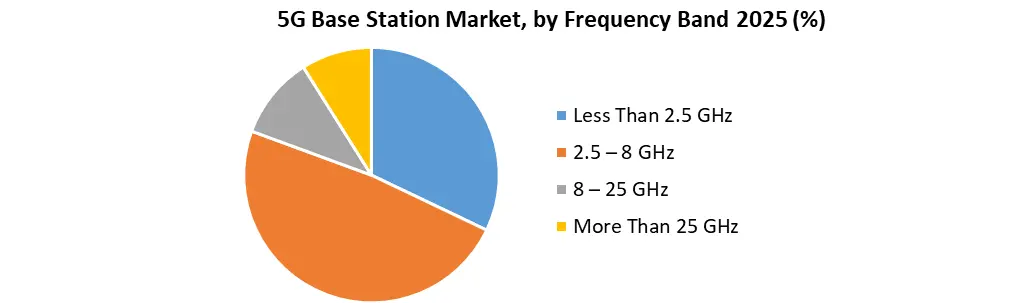
Based on the frequency band, the global 5G base station market has been segmented into less than 2.5 GHz, 2.5 – 8 GHz, 8 – 25 GHz, and more than 25 GHz. In 2025, the segment with more than 25 GHz had the biggest market share, followed by the segment with 8GHz to 25GHz. More spectrum is needed to deliver a consistent 5G grade service over the long term, which is boosting demand for the 8GHZ to 25GHZ frequency band.
5G Base Station Market Recent Developments
| Date | Company | Development | Impact |
|---|---|---|---|
| 01 March 2026 | Huawei | Huawei launched its comprehensive U6GHz portfolio at MWC Barcelona 2026, comprising advanced macro AAU sites and small cell products featuring an Ultra-Large Antenna Array (ELAA) design and 400 MHz bandwidth. | This portfolio delivers a substantial infrastructure upgrade by unlocking 100 Gbps downlink capacities for 5G-Advanced networks while laying a seamless hardware transition path toward 6G architectures. |
| 05 February 2026 | Ministry of Communications (India) | The Indian Government announced that Telecom Service Providers across the nation had successfully installed over 5.18 Lakhs (518,854) 5G Base Transceiver Stations (BTSs) as of December 31, 2025. | This milestone expands 5G infrastructure availability to 99.9% of Indian districts and over 1.12 lakh villages, significantly boosting regional market scale for sub-6 GHz base station hardware. |
| 11 June 2025 | Vodafone Idea / Samsung Electronics | Vodafone Idea partnerned with Samsung Electronics to commercially roll out 5G services in Bengaluru, deploying Samsung's compact, energy-efficient 32T32R Massive MIMO radios and virtualized Central Units (vCUs). | The collaboration significantly optimizes network capacity and mobile broadband throughput across high-density IT hubs while actively reducing power consumption for more sustainable macro cell operations. |
| 02 June 2025 | Ericsson / Telstra | Ericsson and Telstra achieved a commercial world-first by deploying the AIR 3284 triple-band FDD Massive MIMO radio, consolidating three distinct mid-band frequencies into a single physical unit. | This breakthrough architecture doubles downlink capacity and triples uplink capability, heavily elevating cell-edge performance and providing a foundational, future-ready platform for 5G-Advanced services. |
5G Base Station Market Regional Insights:
Asia Pacific dominated the global 5G base station market in 2025. Suppliers of 5G base stations were benefited from the rapid development of 5G technology. Huawei, Ericsson, Nokia, ZTE, and Samsung are among the world's leading suppliers. In 2025, these five vendors control almost 96.12 % of the global market. China has installed around 12 times as many 5G base stations as the United States. China built more 5G base stations in three months than the United States did in three years. In April 2021, according to the Chinese military's official website, at an elevation of 5,374 meters, China had built a 5G signal base at the Ganbala radar station in Tibet's remote Himalayan region, which is the world's highest manually operated radar station.
By 2025, the Asia-Pacific (APAC) region and the United States are expected to account for half of all worldwide 5G connections (US). In the case of the European Union (EU), the percentage is 30.12%. The EU lags behind other regions in the race for global high tech supremacy because the region's goals for digital sovereignty are still imprecise and dilatory.
In comparison, most APAC countries have seen significant government engagement and investment to speed up the implementation of 5G.
For example, the government of South Korea has made numerous attempts to push for 5G, the most recent of which was the formation of a task force to facilitate the growth of 5G coverage into rural areas. The effective deployment of 5G in APAC has been aided by strong collaboration between local governments and industry players.
Recent Launches:
T-Mobile:
T-Mobile announced a commercial debut in March 2019 with friendly customers on the 3.6 GHz frequency. For this launch, the operator had set up 25 base stations in remote areas. At the end of 2019, the first 5G smartphones became available. In July 2020, the operator reported that its 5G network was operational in 600 places across Austria, covering more than 20% of the country's homes and businesses.
A1:
In November 2020, A1 Bulgaria launched its 3.6 GHz 5G network in Sofia, the country's capital. According to the operator, the network was able to deliver 1 Gbps download speeds and can reach Sofia's key residential and business sectors.
Orange:
On December 3, 2020, Orange France inaugurated its commercial 5G mobile network in 15 cities, including Le Mans, Angers, Nice, Marseille, and Clermont Ferrand. More than 160 towns were expected to be covered by the 3.5 GHz 5G network by the end of 2020, with data speeds three to four times faster than 4G LTE. Each municipality was included in the official coverage list if its 5G outdoor population coverage rate hits more than 75 % or higher, according to Orange.
The objective of the report is to present a comprehensive analysis of the Global 5G Base Station Market to the stakeholders in the industry. The past and current status of the industry with the forecasted market size and trends are presented in the report with the analysis of complicated data in simple language. The report covers all the aspects of the industry with a dedicated study of key players that include market leaders, followers, and new entrants.
PORTER, SVOR, PESTEL analysis with the potential impact of micro-economic factors of the market have been presented in the report. External as well as internal factors that are supposed to affect the business positively or negatively have been analysed, which will give a clear futuristic view of the industry to the decision-makers.
The report also helps in understanding the Global 5G Base Station Market dynamics, structure by analyzing the market segments and project the global 5G Base Station market size. Clear representation of competitive analysis of key players By Component, price, financial position, product portfolio, growth strategies, and regional presence in the Global 5G Base Station Market make the report investor’s guide.
5G Base Station Market Scope: Inquire before buying
| Global 5G Base Station Market | |||
|---|---|---|---|
| Report Coverage | Details | ||
| Base Year: | 2025 | Forecast Period: | 2026-2032 |
| Historical Data: | 2020 to 2025 | Market Size in 2025: | USD 39.67 Bn. |
| Forecast Period 2026 to 2032 CAGR: | 37.2 % | Market Size in 2032: | USD 363.10 Bn. |
| Segments Covered: | by Component | Remote Radio Unit (RRU) Small Cells Macro Cells Baseband Processing Unit (BPU) MIMO Fiber Optic Cables |
|
| by Core Network Technology | Software Defined Network (SDN) Network Function Virtualization |
||
| by Area | Rural Urban |
||
| by Type | Fixed Control Temporary Base Station Others |
||
| by Frequency Band | Less Than 2.5 GHz 2.5 – 8 GHz 8 – 25 GHz More Than 25 GHz |
||
| by End-Use Application | Telecommunication Companies Cloud & Data Center Memory & Storage Security Companies |
||
Global 5G Base Station Market, by Region
Asia Pacific (China, South Korea, Japan, India, Australia, Indonesia, Malaysia, Vietnam, Taiwan, Bangladesh, Pakistan and Rest of APAC)
Europe (UK, France, Germany, Italy, Spain, Sweden, Austria and Rest of Europe)
North America (United States, Canada and Mexico)
Middle East and Africa (South Africa, GCC, Egypt, Nigeria and Rest of ME&A)
South America (Brazil, Argentina Rest of South America)
Leading Companies in the 5G Base Station Industry
1. Huawei Technologies Co., Ltd.
2. ZTE Corporation
3. Telefonaktiebolaget LM Ericsson
4. Nokia Corporation
5. Samsung
6. NEC Corporation
7. Alpha Networks Inc.
8. Airspan Networks
9. CommScope
10. Motorola Solutions, Inc.
11. Fujitsu, Qualcomm
12. Orange
13. Verizon
14. AT&T
15. LG
Frequently Asked Questions:
1. Which region has the largest share in 5G Base Station Market?
Ans: Asia Pacific region holds the highest share in 2025.
2. What was the Global 5G Base Station Market size in 2025?
Ans: The Global 5G Base Station Market size was USD 39.67 Billion in 2025.
3. What is scope of the 5G Base Station market report?
Ans: 5G Base Station Market report helps with the PESTEL, PORTER, Recommendations for Investors & Leaders, and market estimation of the forecast period.
4. Who are the key players in 5G Base Station market?
Ans: The important key players in the 5G Base Station Market are – Huawei Technologies Co., Ltd., ZTE Corporation, Telefonaktiebolaget LM Ericsson, Nokia Corporation, Samsung.