2D Materials Market by Type, End User and Region - Global Market Size Estimation, Industry-Wide Analysis, Competitive Landscape Assessment & Long-Term Forecast to 2032

3.9%
CAGR (2026-2032)
2.63 USD Bn.
Market Size
325
Report Pages
140
Market Tables

Overview

The 2D Materials Market size was valued at USD 2.63 Billion in 2025 and the total 2D Materials revenue is expected to grow at a CAGR of 3.9% from 2026 to 2032, reaching nearly USD 3.44 Billion.

Two-dimensional materials consist of a single layer of atoms in a crystal-like structure. These materials are variations of various elements or compounds, like atomic layers of graphite oxide. The properties of 2D materials contain high conductivity of heat and electricity, resistance to corrosion, transparency to light, and flexibility, and are ideal for applications in the electronics and semiconductor segments.2D Materials MarketTo know about the Research Methodology :- Request Free Sample Report
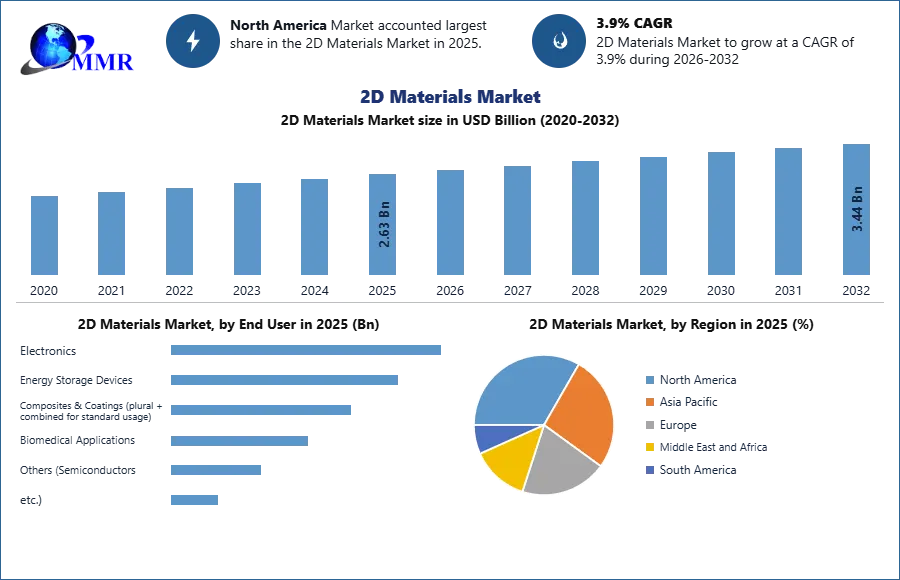
The 2D materials market is driven by an increase in the use of renewable energy, an increase in the use of 2D materials in hydrogen fuel cells in electric automobiles, cost-cutting initiatives, environmentally friendly norms, and pollution-free regulations by governments. Investing in research and development activities develops the scope for the 2D materials market many major key players are investing in R&D to develop new technology of 2D material products, which drives growth. The increasing demand for 2D materials in various industries like healthcare, Aerospace, and electronics, and the Growing demand for transparent displays, solar modules, and devices is making significant investments in production. The growth is boosted by advancements in the graphene domain and the innovation of developing 2D materials.

Major players like Graphenea, Haydale Graphene Industries, and Versarien are key players in the 2D Materials Market. 2D materials like graphene and transition metal dichalcogenides serve diverse sectors including electronics and energy storage. The 2D materials market is shaped by technological innovations, increased demand from various industries, and new application areas. Additionally, the market dynamics are influenced by the impacts of the COVID-19 pandemic, with the Asia Pacific region having significant growth in the 2D Materials Market.

2D Materials Market Dynamics:

Growing Research and Development Activities in the 2D Materials Market

Major manufacturers and governments are investing in research and development activities to develop the scope of applications for 2D materials and increase scalability and cost-effectiveness. Advancements in manufacturing technologies challenge the manufacture of 2D materials, with high manufacturing charges and limits. The demand for 2D materials in various productions, such as electronics, energy storage, and healthcare, is driving the growth of the 2D materials market. Asia Pacific region is making significant investments in industries, which is driving the surge of 2D materials. Governments are increasingly focusing on eco-friendly norms and pollution-free regulations, which is expected to boost the demand for 2D materials in various applications, and also wide applications in industries the growing demand for 2D materials in manufactures such as energy storage, biomedical technologies, electronics, composites & coatings, and wastewater treatment is driving the 2D Materials Market growth.

High Manufacturing Costs and Lack of Standardization and Regulations

The production of 2D materials is expensive, and the scale of the manufacturing process is limited, also standardization and regulations, restrain the 2D Materials Market growth. In such a situation, competition from other innovative materials in the 2D materials market faces struggles. Material like quantum dots and carbon nanotubes limit the 2D materials market growth, materials are given competition in the technology market. Environmental concerns and Technology challenges the 2D materials market with specific effects for several applications. Disposal of 2D materials impacts environmental concerns.

Electronic Gadgets are Rising the Opportunities in 2D Materials Market

The growing 2D Materials Market is driven by technological trends and the surging desire for compact electronic gadgets. Ultra-thin atomic sheets are key in crafting electronic elements like transistors. With a rising trend for miniaturized electronics and flexible tech, the 2D Materials Market is gaining momentum. The ascent of the Internet of Things and the push for wearable increase momentum, presenting substantial growth avenues. Nanotechnology advances and the quest for superior electronic goods intensifies, and the 2D Materials Market stands to take advantage.

2D Materials Market Segment Analysis:

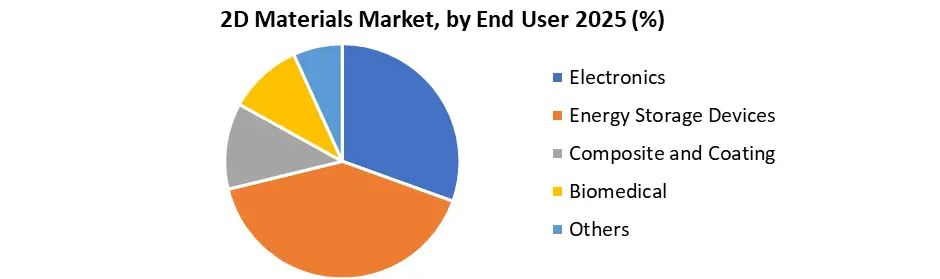
By Type, Graphene is a major material in the market, with a growing demand for its use in various applications. The global market for graphene materials is expected to be USD 1.64 billion by 2032, at a CAGR of 27% during the forecast period. The graphene segment have a major share in 2025. As the production and processing of graphene have advanced, manufacturers are eager to establish supplies, integrate graphene into existing processes, and explore new uses of graphene in industry applications, including electronics, thermal management, and structural uses. In 2025, Graphene nanomaterial researchers and key player leaders in Los Angeles, California, to explore new graphene-based solutions for use in industrial applications.2D Materials Market1By End-User, The composite and coatings segment is expected to dominate the 2D market in the forecast period, with a market value of USD 1.25 billion by 2032. The composite and coatings segment led the 2D materials market in 2025 around 33.2 % of the market share. PPG Industries, Axalta Coating Systems, NanoXplore, 2D Materials Pte Ltd, and other various industries have significant market share in the 2D Materials Market. In the electronics segment, the displays industries are driving the market growth during the forecast period. Development of novel materials that are not only flexible but also keep specific electrical properties like insulation, semiconduction, or conductivity. 2D materials, including graphene, hexagonal boron nitride, and transition metal dichalcogenides, are gaining traction in research circles. Remarkable electrical, optical, and mechanical attributes, make them premium and flexible electronics. The focus now lies in understanding the growth challenges of these materials and harnessing their potential in display technologies.2D Material Market by End User
2D Materials Market Regional Insights:

North America Holds a Significant Revenue Share in 2D Materials Market

The North American 2D Materials Market has the highest market share. Factors such as the presence of numerous dominant players within the country and rising production volumes of automobiles are expected to propel the market's demand. Additionally, favorable government policies and increasing investments by private and public organizations add to the US 2D materials market during the forecast period.

Asia Pacific is expected to dominate the global Market during the forecast period in terms of sales and revenue. Emerging economies like India, China, and Japan are making significant investments in industries like transportation, energy storage, composites, textiles, and others, which are driving the market. Factors such as a budding semiconductor industry in the region and increasing manufacturing industries are expected to increase the  Market scope in Asia Pacific. Rising demand for automation in various manufacturers of 2D materials drives the growth of the market in the Asia Pacific during the forecast period.

Competitive Landscapes:

Graphenea's New Sustainable Graphene-based Solutions for Environmental Challenges

GIANCE, a new EU research project, officially commenced on October 1st, , marking a significant step toward environmental challenges with innovative solutions. GIANCE (Graphene Alliance for Sustainable Multifunctional Materials to Tackle Environmental Challenges) is designed to be a robust catalyst is fully equipped by major industries to elevate GRM to the next level of applications to strengthen companies in terms of competitiveness and growth potential in line with the needs of EU and global markets. GIANCE is strategically designed to maximize its impact on industries and society at large, making substantial contributions to the evolving field of graphene and related materials.

Recent Industry Developments

Exact Date Company Development Impact
14 January 2026 BeDimensional The company successfully demonstrated that few-layer hexagonal Boron Nitride (hBN) can effectively destroy persistent PFAS contaminants in collaboration with Rice University. This breakthrough expands the 2D materials market into the environmental remediation sector, providing a high-efficiency solution for chemical decontamination.
28 November 2025 BeDimensional The company presented the first industrial implementation of Graphene Heating Paint in a real-world energy-efficient infrastructure project in Genoa. This marks a strategic commercialization milestone for graphene-enhanced coatings, offering up to 40% energy savings compared to traditional heating systems.
06 October 2025 Aero Materials Aero Materials launched a new ultra-light nanomaterial consisting of 99.9% air, derived from Graphene Flagship spearhead research. The launch introduces next-generation light-weighting solutions for the aerospace and automotive industries, enhancing fuel efficiency through advanced 2D composites.
31 July 2025 Graphene Flagship The 2D-PRINTABLE project established a comprehensive library of 2D materials specifically for ink fabrication, including p-type and n-type semiconductors. This development standardized the supply of functional 2D inks, accelerating the adoption of printed electronics and flexible wearable devices.

2D Materials Market Scope: Inquire before buying

2D Materials Market
Report Coverage Details
Base Year: 2025 Forecast Period: 2026-2032
Historical Data: 2020 to 2025 Market Size in 2025: 2.63 USD Billion
Forecast Period 2026-2032 CAGR: 3.9% Market Size in 2032: 3.44 USD Billion
Segments Covered: by Type Graphene
Hexagonal Boron Nitride
Black Phosphorus
Germanene
Silicene
Others (Stanene, MXenes, etc.)
by End User Electronics
Energy Storage Devices
Composites & Coatings (plural + combined for standard usage)
Biomedical Applications
Others (Semiconductors, etc.)
by Application Transistors
Sensors
Batteries & Supercapacitors
Photonics & Optoelectronics
Flexible Electronics
Others

By Region

Asia Pacific (China, South Korea, Japan, India, Australia, Indonesia, Malaysia, Vietnam, Taiwan, Bangladesh, Pakistan and Rest of APAC)
Europe (UK, France, Germany, Italy, Spain, Sweden, Austria and Rest of Europe)
North America (United States, Canada and Mexico)
Middle East and Africa (South Africa, GCC, Egypt, Nigeria and Rest of ME&A)
South America (Brazil, Argentina Rest of South America)

2D Materials Market key players

  1. Samsung Advanced Institute of Technology
  2. Planar Tech Ltd.
  3. LG Chem Ltd
  4. Sixth Element Materials Technology
  5. AIXTRON SE
  6. ACS Material LLC
  7. Cambridge Nanosystems Ltd
  8. NanoXplore Inc.
  9. CVD Equipment Corporation
  10. Black Swan Graphene Inc.
  11. Thomas Swan & Co. Ltd
  12. Directa Plus
  13. Haydale Graphene Industries Plc
  14. Avanzare Innovacion
  15. Global Graphene Group
  16. First Graphene Ltd
  17. NanoXplore Inc.
  18. Versarien plc
  19. Talga Resources Ltd
  20. Paragraf Ltd
  21. Graphjet Technology Sdn. Bhd.
  22. XG Sciences
  23. Angstron Materials
  24. Vorbeck Materials
  25. Applied Graphene Materials

Table of Contents

1. 2D Materials Market Introduction
1.1. Study Assumption and Market Definition
1.2. Scope of the Study
1.3. Executive Summary
2. Global 2D Materials Market: Competitive Landscape
2.1. MMR Competition Matrix
2.2. Competitive Landscape
2.3. Key Players Benchmarking
2.3.1. Company Name
2.3.2. Business Segment
2.3.3. End-user Segment
2.3.4. Revenue (2025)
2.3.5. Company Locations
2.4. Leading 2D Materials Market Companies, by market capitalization
2.5. Market Structure
2.5.1. Market Leaders
2.5.2. Market Followers
2.5.3. Emerging Players
2.6. Mergers and Acquisitions Details
3. 2D Materials Market: Dynamics
3.1. 2D Materials Market Trends by Region
3.1.1. North America 2D Materials Market Trends
3.1.2. Europe 2D Materials Market Trends
3.1.3. Asia Pacific 2D Materials Market Trends
3.1.4. Middle East and Africa 2D Materials Market Trends
3.1.5. South America 2D Materials Market Trends
3.2. 2D Materials Market Dynamics by Region
3.2.1. North America
3.2.1.1. North America 2D Materials Market Drivers
3.2.1.2. North America 2D Materials Market Restraints
3.2.1.3. North America 2D Materials Market Opportunities
3.2.1.4. North America 2D Materials Market Challenges
3.2.2. Europe
3.2.2.1. Europe 2D Materials Market Drivers
3.2.2.2. Europe 2D Materials Market Restraints
3.2.2.3. Europe 2D Materials Market Opportunities
3.2.2.4. Europe 2D Materials Market Challenges
3.2.3. Asia Pacific
3.2.3.1. Asia Pacific 2D Materials Market Drivers
3.2.3.2. Asia Pacific 2D Materials Market Restraints
3.2.3.3. Asia Pacific 2D Materials Market Opportunities
3.2.3.4. Asia Pacific 2D Materials Market Challenges
3.2.4. Middle East and Africa
3.2.4.1. Middle East and Africa 2D Materials Market Drivers
3.2.4.2. Middle East and Africa 2D Materials Market Restraints
3.2.4.3. Middle East and Africa 2D Materials Market Opportunities
3.2.4.4. Middle East and Africa 2D Materials Market Challenges
3.2.5. South America
3.2.5.1. South America 2D Materials Market Drivers
3.2.5.2. South America 2D Materials Market Restraints
3.2.5.3. South America 2D Materials Market Opportunities
3.2.5.4. South America 2D Materials Market Challenges
3.3. PORTER's Five Forces Analysis
3.4. PESTLE Analysis
3.5. Technology Roadmap
3.6. Regulatory Landscape by Region
3.6.1. North America
3.6.2. Europe
3.6.3. Asia Pacific
3.6.4. Middle East and Africa
3.6.5. South America
3.7. Key Opinion Leader Analysis For 2D Materials Industry
3.8. Analysis of Government Schemes and Initiatives For 2D Materials Industry
3.9. 2D Materials Market Trade Analysis
3.10. The Global Pandemic Impact on 2D Materials Market
4. 2D Materials Market: Global Market Size and Forecast by Segmentation (in USD Billion) 2025-2032
4.1. 2D Materials Market Size and Forecast, by Type (2025-2032)
4.1.1. Graphene
4.1.2. Hexagonal Boron Nitride
4.1.3. Black Phosphorus
4.1.4. Germanene
4.1.5. Silicene
4.1.6. Others (Stanene, MXenes, etc.)
4.2. 2D Materials Market Size and Forecast, by End User (2025-2032)
4.2.1. Electronics
4.2.2. Energy Storage Devices
4.2.3. Composites & Coatings (plural + combined for standard usage)
4.2.4. Biomedical Applications
4.2.5. Others (Semiconductors, etc.)
4.3. 2D Materials Market Size and Forecast, by Application (2025-2032)
4.3.1. Transistors
4.3.2. Sensors
4.3.3. Batteries & Supercapacitors
4.3.4. Photonics & Optoelectronics
4.3.5. Flexible Electronics
4.3.6. Others
4.4. 2D Materials Market Size and Forecast, by Region (2025-2032)
4.4.1. North America
4.4.2. Europe
4.4.3. Asia Pacific
4.4.4. Middle East and Africa
4.4.5. South America
5. North America 2D Materials Market Size and Forecast by Segmentation (in USD Billion) 2025-2032
5.1. North America 2D Materials Market Size and Forecast, by Type (2025-2032)
5.1.1. Graphene
5.1.2. Hexagonal Boron Nitride
5.1.3. Black Phosphorus
5.1.4. Germanene
5.1.5. Silicene
5.1.6. Others (Stanene, MXenes, etc.)
5.2. North America 2D Materials Market Size and Forecast, by End User (2025-2032)
5.2.1. Electronics
5.2.2. Energy Storage Devices
5.2.3. Composites & Coatings (plural + combined for standard usage)
5.2.4. Biomedical Applications
5.2.5. Others (Semiconductors, etc.)
5.3. North America 2D Materials Market Size and Forecast, by Application (2025-2032)
5.3.1. Transistors
5.3.2. Sensors
5.3.3. Batteries & Supercapacitors
5.3.4. Photonics & Optoelectronics
5.3.5. Flexible Electronics
5.3.6. Others
5.4. North America 2D Materials Market Size and Forecast, by Country (2025-2032)
5.4.1. United States
5.4.1.1. United States 2D Materials Market Size and Forecast, by Type (2025-2032)
5.4.1.1.1. Graphene
5.4.1.1.2. Hexagonal Boron Nitride
5.4.1.1.3. Black Phosphorus
5.4.1.1.4. Germanene
5.4.1.1.5. Silicene
5.4.1.1.6. Others (Stanene, MXenes, etc.)
5.4.1.2. United States 2D Materials Market Size and Forecast, by End User (2025-2032)
5.4.1.2.1. Electronics
5.4.1.2.2. Energy Storage Devices
5.4.1.2.3. Composites & Coatings (plural + combined for standard usage)
5.4.1.2.4. Biomedical Applications
5.4.1.2.5. Others (Semiconductors, etc.)
5.4.1.3. United States 2D Materials Market Size and Forecast, by Application (2025-2032)
5.4.1.3.1. Transistors
5.4.1.3.2. Sensors
5.4.1.3.3. Batteries & Supercapacitors
5.4.1.3.4. Photonics & Optoelectronics
5.4.1.3.5. Flexible Electronics
5.4.1.3.6. Others
5.4.2. Canada
5.4.2.1. Canada 2D Materials Market Size and Forecast, by Type (2025-2032)
5.4.2.1.1. Graphene
5.4.2.1.2. Hexagonal Boron Nitride
5.4.2.1.3. Black Phosphorus
5.4.2.1.4. Germanene
5.4.2.1.5. Silicene
5.4.2.1.6. Others (Stanene, MXenes, etc.)
5.4.2.2. Canada 2D Materials Market Size and Forecast, by End User (2025-2032)
5.4.2.2.1. Electronics
5.4.2.2.2. Energy Storage Devices
5.4.2.2.3. Composites & Coatings (plural + combined for standard usage)
5.4.2.2.4. Biomedical Applications
5.4.2.2.5. Others (Semiconductors, etc.)
5.4.2.3. Canada 2D Materials Market Size and Forecast, by Application (2025-2032)
5.4.2.3.1. Transistors
5.4.2.3.2. Sensors
5.4.2.3.3. Batteries & Supercapacitors
5.4.2.3.4. Photonics & Optoelectronics
5.4.2.3.5. Flexible Electronics
5.4.2.3.6. Others
5.4.3. Mexico
5.4.3.1. Mexico 2D Materials Market Size and Forecast, by Type (2025-2032)
5.4.3.1.1. Graphene
5.4.3.1.2. Hexagonal Boron Nitride
5.4.3.1.3. Black Phosphorus
5.4.3.1.4. Germanene
5.4.3.1.5. Silicene
5.4.3.1.6. Others (Stanene, MXenes, etc.)
5.4.3.2. Mexico 2D Materials Market Size and Forecast, by End User (2025-2032)
5.4.3.2.1. Electronics
5.4.3.2.2. Energy Storage Devices
5.4.3.2.3. Composites & Coatings (plural + combined for standard usage)
5.4.3.2.4. Biomedical Applications
5.4.3.2.5. Others (Semiconductors, etc.)
5.4.3.3. Mexico 2D Materials Market Size and Forecast, by Application (2025-2032)
5.4.3.3.1. Transistors
5.4.3.3.2. Sensors
5.4.3.3.3. Batteries & Supercapacitors
5.4.3.3.4. Photonics & Optoelectronics
5.4.3.3.5. Flexible Electronics
5.4.3.3.6. Others
6. Europe 2D Materials Market Size and Forecast by Segmentation (in USD Billion) 2025-2032
6.1. Europe 2D Materials Market Size and Forecast, by Type (2025-2032)
6.2. Europe 2D Materials Market Size and Forecast, by End User (2025-2032)
6.3. Europe 2D Materials Market Size and Forecast, by Application (2025-2032)
6.4. Europe 2D Materials Market Size and Forecast, by Country (2025-2032)
6.4.1. United Kingdom
6.4.1.1. United Kingdom 2D Materials Market Size and Forecast, by Type (2025-2032)
6.4.1.2. United Kingdom 2D Materials Market Size and Forecast, by End User (2025-2032)
6.4.1.3. United Kingdom 2D Materials Market Size and Forecast, by Application (2025-2032)
6.4.2. France
6.4.2.1. France 2D Materials Market Size and Forecast, by Type (2025-2032)
6.4.2.2. France 2D Materials Market Size and Forecast, by End User (2025-2032)
6.4.2.3. France 2D Materials Market Size and Forecast, by Application (2025-2032)
6.4.3. Germany
6.4.3.1. Germany 2D Materials Market Size and Forecast, by Type (2025-2032)
6.4.3.2. Germany 2D Materials Market Size and Forecast, by End User (2025-2032)
6.4.3.3. Germany 2D Materials Market Size and Forecast, by Application (2025-2032)
6.4.4. Italy
6.4.4.1. Italy 2D Materials Market Size and Forecast, by Type (2025-2032)
6.4.4.2. Italy 2D Materials Market Size and Forecast, by End User (2025-2032)
6.4.4.3. Italy 2D Materials Market Size and Forecast, by Application (2025-2032)
6.4.5. Spain
6.4.5.1. Spain 2D Materials Market Size and Forecast, by Type (2025-2032)
6.4.5.2. Spain 2D Materials Market Size and Forecast, by End User (2025-2032)
6.4.5.3. Spain 2D Materials Market Size and Forecast, by Application (2025-2032)
6.4.6. Sweden
6.4.6.1. Sweden 2D Materials Market Size and Forecast, by Type (2025-2032)
6.4.6.2. Sweden 2D Materials Market Size and Forecast, by End User (2025-2032)
6.4.6.3. Sweden 2D Materials Market Size and Forecast, by Application (2025-2032)
6.4.7. Austria
6.4.7.1. Austria 2D Materials Market Size and Forecast, by Type (2025-2032)
6.4.7.2. Austria 2D Materials Market Size and Forecast, by End User (2025-2032)
6.4.7.3. Austria 2D Materials Market Size and Forecast, by Application (2025-2032)
6.4.8. Rest of Europe
6.4.8.1. Rest of Europe 2D Materials Market Size and Forecast, by Type (2025-2032)
6.4.8.2. Rest of Europe 2D Materials Market Size and Forecast, by End User (2025-2032)
6.4.8.3. Rest of Europe 2D Materials Market Size and Forecast, by Application (2025-2032)
7. Asia Pacific 2D Materials Market Size and Forecast by Segmentation (in USD Billion) 2025-2032
7.1. Asia Pacific 2D Materials Market Size and Forecast, by Type (2025-2032)
7.2. Asia Pacific 2D Materials Market Size and Forecast, by End User (2025-2032)
7.3. Asia Pacific 2D Materials Market Size and Forecast, by Application (2025-2032)
7.4. Asia Pacific 2D Materials Market Size and Forecast, by Country (2025-2032)
7.4.1. China
7.4.1.1. China 2D Materials Market Size and Forecast, by Type (2025-2032)
7.4.1.2. China 2D Materials Market Size and Forecast, by End User (2025-2032)
7.4.1.3. China 2D Materials Market Size and Forecast, by Application (2025-2032)
7.4.2. S Korea
7.4.2.1. S Korea 2D Materials Market Size and Forecast, by Type (2025-2032)
7.4.2.2. S Korea 2D Materials Market Size and Forecast, by End User (2025-2032)
7.4.2.3. S Korea 2D Materials Market Size and Forecast, by Application (2025-2032)
7.4.3. Japan
7.4.3.1. Japan 2D Materials Market Size and Forecast, by Type (2025-2032)
7.4.3.2. Japan 2D Materials Market Size and Forecast, by End User (2025-2032)
7.4.3.3. Japan 2D Materials Market Size and Forecast, by Application (2025-2032)
7.4.4. India
7.4.4.1. India 2D Materials Market Size and Forecast, by Type (2025-2032)
7.4.4.2. India 2D Materials Market Size and Forecast, by End User (2025-2032)
7.4.4.3. India 2D Materials Market Size and Forecast, by Application (2025-2032)
7.4.5. Australia
7.4.5.1. Australia 2D Materials Market Size and Forecast, by Type (2025-2032)
7.4.5.2. Australia 2D Materials Market Size and Forecast, by End User (2025-2032)
7.4.5.3. Australia 2D Materials Market Size and Forecast, by Application (2025-2032)
7.4.6. Indonesia
7.4.6.1. Indonesia 2D Materials Market Size and Forecast, by Type (2025-2032)
7.4.6.2. Indonesia 2D Materials Market Size and Forecast, by End User (2025-2032)
7.4.6.3. Indonesia 2D Materials Market Size and Forecast, by Application (2025-2032)
7.4.7. Malaysia
7.4.7.1. Malaysia 2D Materials Market Size and Forecast, by Type (2025-2032)
7.4.7.2. Malaysia 2D Materials Market Size and Forecast, by End User (2025-2032)
7.4.7.3. Malaysia 2D Materials Market Size and Forecast, by Application (2025-2032)
7.4.8. Vietnam
7.4.8.1. Vietnam 2D Materials Market Size and Forecast, by Type (2025-2032)
7.4.8.2. Vietnam 2D Materials Market Size and Forecast, by End User (2025-2032)
7.4.8.3. Vietnam 2D Materials Market Size and Forecast, by Application (2025-2032)
7.4.9. Taiwan
7.4.9.1. Taiwan 2D Materials Market Size and Forecast, by Type (2025-2032)
7.4.9.2. Taiwan 2D Materials Market Size and Forecast, by End User (2025-2032)
7.4.9.3. Taiwan 2D Materials Market Size and Forecast, by Application (2025-2032)
7.4.10. Rest of Asia Pacific
7.4.10.1. Rest of Asia Pacific 2D Materials Market Size and Forecast, by Type (2025-2032)
7.4.10.2. Rest of Asia Pacific 2D Materials Market Size and Forecast, by End User (2025-2032)
7.4.10.3. Rest of Asia Pacific 2D Materials Market Size and Forecast, by Application (2025-2032)
8. Middle East and Africa 2D Materials Market Size and Forecast by Segmentation (in USD Billion) 2025-2032
8.1. Middle East and Africa 2D Materials Market Size and Forecast, by Type (2025-2032)
8.2. Middle East and Africa 2D Materials Market Size and Forecast, by End User (2025-2032)
8.3. Middle East and Africa 2D Materials Market Size and Forecast, by Application (2025-2032)
8.4. Middle East and Africa 2D Materials Market Size and Forecast, by Country (2025-2032)
8.4.1. South Africa
8.4.1.1. South Africa 2D Materials Market Size and Forecast, by Type (2025-2032)
8.4.1.2. South Africa 2D Materials Market Size and Forecast, by End User (2025-2032)
8.4.1.3. South Africa 2D Materials Market Size and Forecast, by Application (2025-2032)
8.4.2. GCC
8.4.2.1. GCC 2D Materials Market Size and Forecast, by Type (2025-2032)
8.4.2.2. GCC 2D Materials Market Size and Forecast, by End User (2025-2032)
8.4.2.3. GCC 2D Materials Market Size and Forecast, by Application (2025-2032)
8.4.3. Nigeria
8.4.3.1. Nigeria 2D Materials Market Size and Forecast, by Type (2025-2032)
8.4.3.2. Nigeria 2D Materials Market Size and Forecast, by End User (2025-2032)
8.4.3.3. Nigeria 2D Materials Market Size and Forecast, by Application (2025-2032)
8.4.4. Rest of ME&A
8.4.4.1. Rest of ME&A 2D Materials Market Size and Forecast, by Type (2025-2032)
8.4.4.2. Rest of ME&A 2D Materials Market Size and Forecast, by End User (2025-2032)
8.4.4.3. Rest of ME&A 2D Materials Market Size and Forecast, by Application (2025-2032)
9. South America 2D Materials Market Size and Forecast by Segmentation (in USD Billion) 2025-2032
9.1. South America 2D Materials Market Size and Forecast, by Type (2025-2032)
9.2. South America 2D Materials Market Size and Forecast, by End User (2025-2032)
9.3. South America 2D Materials Market Size and Forecast, by Application (2025-2032)
9.4. South America 2D Materials Market Size and Forecast, by Country (2025-2032)
9.4.1. Brazil
9.4.1.1. Brazil 2D Materials Market Size and Forecast, by Type (2025-2032)
9.4.1.2. Brazil 2D Materials Market Size and Forecast, by End User (2025-2032)
9.4.1.3. Brazil 2D Materials Market Size and Forecast, by Application (2025-2032)
9.4.2. Argentina
9.4.2.1. Argentina 2D Materials Market Size and Forecast, by Type (2025-2032)
9.4.2.2. Argentina 2D Materials Market Size and Forecast, by End User (2025-2032)
9.4.2.3. Argentina 2D Materials Market Size and Forecast, by Application (2025-2032)
9.4.3. Rest Of South America
9.4.3.1. Rest Of South America 2D Materials Market Size and Forecast, by Type (2025-2032)
9.4.3.2. Rest Of South America 2D Materials Market Size and Forecast, by End User (2025-2032)
9.4.3.3. Rest Of South America 2D Materials Market Size and Forecast, by Application (2025-2032)
10. Company Profile: Key Players
10.1. Samsung Advanced Institute of Technology
10.1.1. Company Overview
10.1.2. Business Portfolio
10.1.3. Financial Overview
10.1.4. SWOT Analysis
10.1.5. Strategic Analysis
10.1.6. Scale of Operation (small, medium, and large)
10.1.7. Details on Partnership
10.1.8. Regulatory Accreditations and Certifications Received by Them
10.1.9. Awards Received by the Firm
10.1.10. Recent Developments
10.2. Planar Tech Ltd.
10.3. LG Chem Ltd
10.4. Sixth Element Materials Technology
10.5. AIXTRON SE
10.6. ACS Material LLC
10.7. Cambridge Nanosystems Ltd
10.8. NanoXplore Inc.
10.9. CVD Equipment Corporation
10.10. Black Swan Graphene Inc.
10.11. Thomas Swan & Co. Ltd
10.12. Directa Plus
10.13. Haydale Graphene Industries Plc
10.14. Avanzare Innovacion
10.15. Global Graphene Group
10.16. First Graphene Ltd
10.17. Versarien plc
10.18. Talga Resources Ltd
10.19. Paragraf Ltd
10.20. Graphjet Technology Sdn. Bhd.
10.21. XG Sciences
10.22. Angstron Materials
10.23. Vorbeck Materials
10.24. Applied Graphene Materials
11. Key Findings
12. Industry Recommendations
13. 2D Materials Market: Research Methodology
14. Terms and Glossary

Custom Market Research Services

We Will Customise The Research For You, In Case The Report Listed Above Does Not Meet With Your Requirements