
Germany Robotic Vacuum Cleaner Market Size by Product Type, Operation Mode, Price, Charging Type, Distribution Channel and End User
Overview
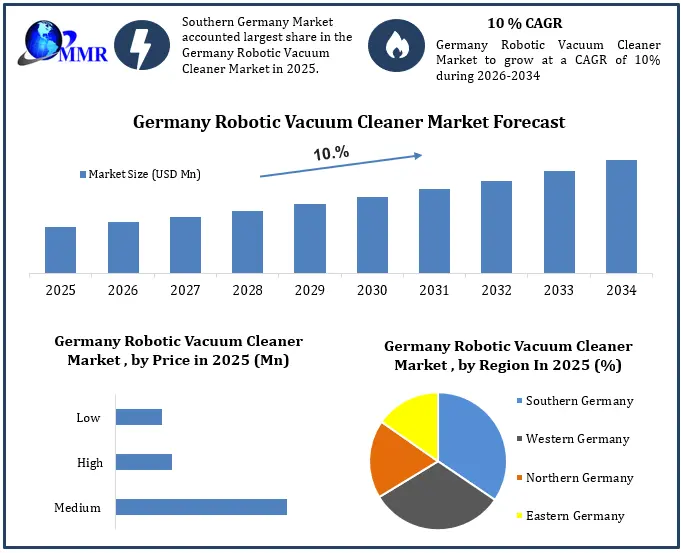
The Germany Robotic Vacuum Cleaner Market is estimated to be valued at USD 475.40 Million in 2025 and is expected to touch USD 936.05 Million in 2034, recording a CAGR of 10%.
Germany Robotic Vacuum Cleaner Market Definition
The Germany Robotic Vacuum Cleaner Market encompasses automated cleaning appliances designed to perform vacuuming, sweeping, and mopping with minimal human intervention. These products incorporate technologies such as LiDAR, AI navigation, sensors, cameras, obstacle detection, mapping, and smart connectivity for efficient floor cleaning. The market covers the manufacturing, distribution, and sale of robotic vacuum cleaners through e-commerce platforms, electronics retailers, appliance stores, and specialty channels. Demand is driven by smart-home adoption, convenience, automation, advanced cleaning performance, and growing interest in self-emptying, self-cleaning, and app-controlled systems.
| Parameter | Value |
| Market Size (Base Year 2025) | USD 475.40 Million |
| Forecast Market Size (2034) | USD 936.05 Million |
| CAGR (2026-2034) | 10% |
| Base Year | 2025 |
| Forecast Period | 2026-2034 |
| Historical Period | 2020-2025 |
Germany Robotic Vacuum Cleaner Market Overview
The Germany Robotic Vacuum Cleaner Market is an important European market for automated floor-care appliances, supported by increasing consumer demand for convenience, smart-home technology, premium household appliances, and time-saving cleaning solutions. Demand is shifting toward products with advanced navigation, multifunctional cleaning, and higher levels of automation, creating strong market potential for technology-focused manufacturers.
Western Germany represents a major demand center, supported by higher purchasing power, dense urbanization, developed retail infrastructure, and strong adoption of smart household technologies. The market also presents opportunities in premium robotic cleaners, smart-home connectivity, automated mopping, self-emptying systems, and energy-efficient products, while manufacturers address gaps in affordability, reliability, and after-sales support.
The market is evolving toward AI-enabled and highly autonomous cleaning solutions, with manufacturers competing through improved navigation accuracy, stronger cleaning performance, longer battery life, intelligent obstacle recognition, and automated maintenance features. This development creates opportunities for both established brands and new entrants to differentiate their products and capture demand across residential and commercial applications.
The report provides market size, market forecast, competitive analysis, segment insights, consumer trends, technology assessment, regional analysis, and investment opportunities, helping businesses evaluate demand patterns, identify market gaps, assess competitive positioning, and make informed decisions regarding product development, pricing, distribution expansion, and technology investment.
Germany Robotic Vacuum Cleaner Market Growth and Forecast Analysis
To know about the Research Methodology :- Request Free Sample Report
Germany Robotic Vacuum Cleaner Historical Market Size (2020-2025)
| Year | Market Size (USD MN) | Growth Rate (YoY) |
| 2020 | 291.29 | 9.22% |
| 2021 | 319.84 | 9.80% |
| 2022 | 355.02 | 11.00% |
| 2023 | 397.98 | 12.10% |
| 2024 | 439.37 | 10.40% |
| 2025 | 475.42 | 8.20% |
Germany Robotic Vacuum Cleaner Market Key Findings
• Market Growth: The market reaches USD 936.05 Million by 2034, reflecting strong expansion from 2025.
• Technology Focus: AI navigation, LiDAR, smart mapping, and automated cleaning are driving product development.
• Leading Product: Floor Robotic Vacuum Cleaners remain the leading product segment.
• Residential Demand: Residential users account for the largest share of market demand.
• Product Trend: Demand is shifting toward vacuum-and-mop systems, self-emptying, and fully automated cleaning.
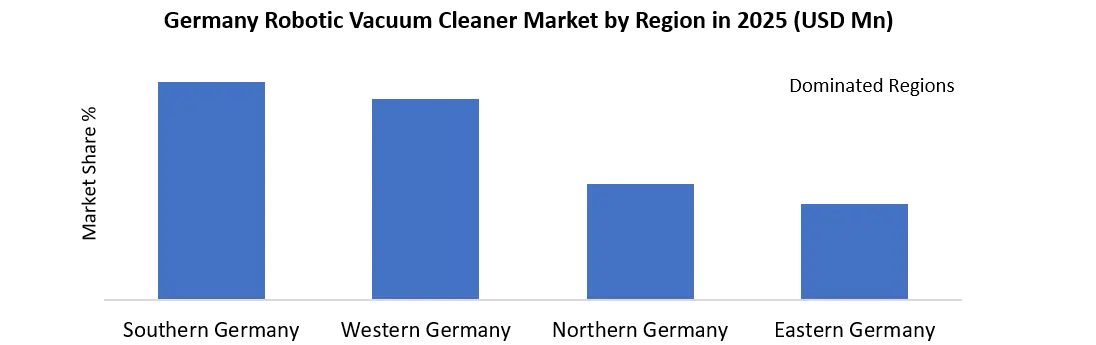
• Regional Hub: Southern Germany represents the leading regional market.
• Distribution Trend: Online channels are gaining importance as consumers compare features, prices, and reviews.
• Consumer Demand: Convenience, cleaning performance, automation, durability, and smart connectivity remain key purchase factors.
Germany Robotic Vacuum Cleaner Market Consumer Insights & Demand Analysis
| Consumer Dimension | Key Insights | Market Implication |
| Quality & Durability Priority | German consumers are among Europe's most quality-focused; purchasing decisions driven by product longevity, cleaning thoroughness, and manufacturing quality over feature novelty | Premium brands Miele and Vorwerk Kobold command strong loyalty; 5-year warranty offers standard expectation; low return rates vs. European average |
| Sustainability Consciousness | Germany's exceptional environmental awareness (Umweltbewusstsein) creates significant demand for energy-efficient, repairable, and recyclable robotic vacuum designs | EU Energy Label A-rated models preferred; brands emphasizing repairability and German-market-compatible recycling take-back programs outperform |
| Data Privacy (GDPR Compliance) | German consumers among Europe's most privacy-sensitive; GDPR-compliant data storage and explicit consent for AI mapping data are significant purchase factors for camera-navigating models | German retailers require clear GDPR compliance labeling; brands demonstrating EU data residency for mapping data gain trust advantage |
| Systematic Research Behavior | German buyers extensively research purchases via Stiftung Warentest (Germany's authoritative consumer testing organization) ratings before committing | Stiftung Warentest 'Gut' or 'Sehr Gut' rating is highest-value marketing asset in German market; brands invest significantly in achieving test certification |
Germany Robotic Vacuum Cleaner Market Dynamics
Germany Robotic Vacuum Cleaner Market Drivers
Rising Adoption of Smart Home Automation and AI-Enabled Cleaning Technologies
The Germany Robotic Vacuum Cleaner Market is shaped by the rising popularity of smart-home appliances, growing demand for convenient domestic help, and technical advancements that facilitate robotic floor cleaning. Germanic housewives are increasingly interested in connected devices that could be controlled from a mobile app and help with scheduled cleaning. The tendency is explained by technical progress allowing for the creation of robotic vacuums with advanced positioning technologies and artificial intelligence.
Moreover, the current level of Germany’s urbanization is associated with high standards of living and implies growing demand for technical devices in home automation. The robotic vacuum cleaner market in Germany is also influenced by a broad variety of functions that modern appliances can provide. Multiple models offer mopping, auto-charging, and self-emptying dustpan technologies. Consumers’ preferences lean towards multifunctional devices with vacuuming, mopping, and smart technologies. As a result, modern vacuums can address a variety of needs in the domestic sphere and replace traditional cleaning equipment.
Germany Robotic Vacuum Cleaner Market Restraints
High Initial Cost and Replacement-Cycle Limitations
The Germany Robotic Vacuum Cleaner Market anticipates restraints in the form of the high initial cost of robotic vacuums with advanced functions and a short replacement cycle that reduces the need for new products. Most robotic vacuum cleaners with superior cleaning abilities, navigation technology, mopping, docking, and self-care mechanisms come at a high price, which limits the target market’s purchasing power. Moreover, the initial investment for robotic vacuums can be expensive, especially when compared to the cost of regular vacuum cleaners. Additionally, people who buy robotic vacuums might be hesitant to replace their devices after several years since they are used to the convenience of robotic vacuums. Replacement-cycle restraint is evident in the fact that people only buy a new robotic vacuum cleaner if it can meet their cleaning requirements.
Germany Robotic Vacuum Cleaner Market Opportunities
Expansion of Multifunctional and Connected Robotic Cleaning Solutions
The Germany Robotic Vacuum Cleaner Market offers opportunities through multifunctional and connected robotic vacuums that provide vacuuming, mopping, dirt disposal, surface recognition, and self-maintenance. The manufacturers offer opportunities as companies that can cater to the needs of different floor types, home sizes, and cleaning demands while integrating robotic vacuums with smart-home technologies. The rising need for personalized cleaning solutions also creates opportunities for the development of products that offer room setting, scheduling, and application-specific cleaning. Similarly, there is potential for meeting the demand for premium cleaning solutions with enhanced mapping solutions, artificial intelligence, and self-care features while expanding distribution channels and providing accessories and consumables that enhance sustainability and support post-sale services.
Germany Robotic Vacuum Cleaner Market Challenges
Technical Reliability, Data Security, and After-Sales Requirements
The Germany Robotic Vacuum Cleaner Market expects challenges in terms of technical reliability, data security, and post-sale obligations. Robotic vacuum cleaners have to maneuver around furniture, stairs, thresholds, cables, carpets, and other obstacles while providing cleaning solutions, which makes them difficult to maintain and service. Similarly, the need to connect robotic vacuums to other devices via the Internet introduces technical and security problems, including reliability, compatibility, cybersecurity, and data privacy. Additionally, battery drain, sensor malfunctions, navigation problems, and technical failures present significant challenges to manufacturers and consumers. Finally, companies that sell robotic vacuum cleaners must invest in post-sale services and maintenance to ensure reliability, customer satisfaction, and sustainability.
Germany Robotic Vacuum Cleaner Market Segment Analysis
Germany Robotic Vacuum Cleaner Market, by Product Type
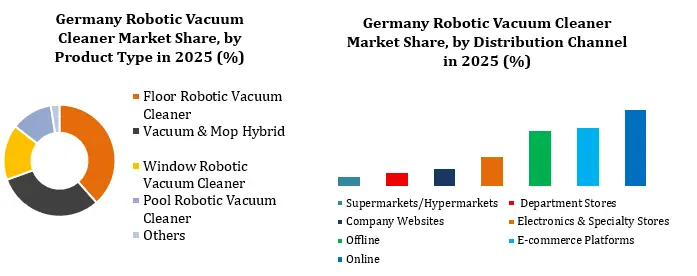
The Germany Robotic Vacuum Cleaner Market, by product type, is segmented into Floor Robotic Vacuum Cleaner, Vacuum & Mop Hybrid, Window Robotic Vacuum Cleaner, Pool Robotic Vacuum Cleaner, and Others. It is driven by the Floor robotic vacuum cleaners that cater to the demand for automating the cleaning of dust, dirt, hair, etc., in apartments, single-family homes, multi-room houses, and other structures with carpets and hard floors. Vacuum and mop hybrids are rising due to the inclination toward a cleaning appliance that performs both vacuuming and mopping, with some featuring automated mop washing and drying, water-flow control, carpet detection, and other modes.
Window robotic vacuum cleaners are preferred in residential and commercial buildings with large surface coverage of glass, whereas robotic vacuum cleaners for pools are utilized in private swimming pools, hotels, wellness resorts, and sports clubs with swimming facilities. The Others category comprises other robotic cleaning machines for surfaces and specialized structures with unique cleaning needs, influenced by their availability, technical specifications, cleaning scope and capabilities, convenience, and cost-benefit advantages over traditional cleaning methods and tools.
Germany Robotic Vacuum Cleaner Market, by Distribution Channel
The Germany Robotic Vacuum Cleaner Market, by distribution channel, is divided into Online and Offline channels. The online distributors comprise company websites and e-commerce platforms offering a wide range of products with information on their technical specifications, price ranges, customer reviews, and buying options with delivery services. In contrast, company websites offer after-sales services such as accessories, spare parts, service centers, and warranty claims. Offline distributors are represented by department stores, supermarkets and hypermarkets, electronics and specialty stores, and others, primarily offering robotic vacuum cleaners, accessories, and customer support.
Electronics and specialty stores are inclined to feature robotic vacuum cleaners with mid-range and higher prices that require professional counseling and support from staff knowledgeable in the products’ specifications and technologies. Supermarkets and hypermarkets provide access to a wide range of robotic vacuum cleaners through aggressive marketing and convenient shopping and billing options, whereas Others comprise independent appliance and home-electronics retailers, dealers, home improvement stores, and hardware specialty shops.
Germany Robotic Vacuum Cleaner Market Segment Analysis
Germany Robotic Vacuum Cleaner Market Regional Analysis
The Germany Robotic Vacuum Cleaner Market is geographically concentrated in economically developed, highly urbanized, and digitally connected regions, with Southern and Western Germany accounting for the largest portion of demand. However, there is no publicly available authoritative dataset that reports robotic-vacuum revenue by German federal state for 2025. Therefore, the regional shares below are market-modelled estimates, derived from Germany-specific robotic-vacuum research and regional indicators such as household numbers, purchasing power, urbanization, smart-home adoption, and retail infrastructure. This distinction is important if the figures are being used in a formal market report. Germany's overall market is estimated at USD 475.40 million in 2025, consistent with the market size you are using. Recent industry sources confirm strong German demand for robotic vacuum cleaners: NIQ/GfK reported about 850,000 additional units sold in Germany in 2024, with revenue reaching €507 million, up more than 25% year over year.
Germany Robotic Vacuum Cleaner Market Competitive Landscape
Germany Robotic Vacuum Cleaner Market Key Players & Benchmarking
| Company Name | Headquarters | Market Position |
| Roborock | Beijing, China | Premium technology-focused player |
| Dreame Technology | Suzhou, China | Fast-growing premium player |
| ECOVACS | Suzhou, China | Established robotic-cleaning specialist |
| iRobot | Bedford, Massachusetts, USA | Established robotic-vacuum brand |
| Xiaomi | Beijing, China | Mass-market smart-home player |
| Vorwerk | Wuppertal, Germany | German premium household-appliance player |
| Bosch | Gerlingen, Germany | Established German appliance brand |
| Miele | Gütersloh, Germany | Premium German appliance brand |
| Samsung Electronics | Suwon, South Korea | Premium electronics and smart-home player |
| Eufy (Anker Innovations) | Changsha, China | Value-to-premium smart-home cleaning player |
Germany Robotic Vacuum Cleaner Market Technology & Innovation Trends
| Innovation Area | Current Trend | Market Impact |
| EU Ecodesign-Compliant Engineering | Energy-Efficient, Brushless Motors and Replaceable Components for Compliance with EU Ecodesign and Right to Repair Regulations. | Supports regulatory compliance, energy efficiency, and product durability. |
| HEPA H13 Medical-Grade Filtration | Sealed HEPA H13 Filters to Remove Fine Dust Particles, Allergens, and PM2.5 | Strengthens demand among allergy-conscious German households. |
| Stiftung Warentest-Optimized Cleaning Performance | Developers have improved the cleaning effectiveness on carpets, hard floors, corners, and overall performance in accordance with German testing protocols. | Strong test ratings can improve consumer trust and retail demand. |
| GDPR-Compliant Edge AI Processing | On-Board AI Processes Mapping and Navigation Data Instead of Using Third-Party Cloud Storage. | Addresses German privacy concerns and strengthens adoption of connected robots. |
| Right to Repair Modularity | Replaceable Batteries, Brushrolls, Filters, and Other Parts Promote Product Longevity. | Reduces ownership costs and aligns with German preferences for durability and repairability. |
Germany Robotic Vacuum Cleaner Market Scope: Inquire before buying
| Germany Robotic Vacuum Cleaner Market | |||
|---|---|---|---|
| Report Coverage | Details | ||
| Base Year: | 2025 | Forecast Period: | 2026-2032 |
| Historical Data: | 2020 to 2025 | Market Size in 2025: | USD 475.40 Mn. |
| Forecast Period 2026 to 2032 CAGR: | 10% | Market Size in 2032: | USD 936.05 Mn. |
| Segments Covered: | by Product Type | Floor Robotic Vacuum Cleaner Vacuum & Mop Hybrid Window Robotic Vacuum Cleaner Pool Robotic Vacuum Cleaner Others |
|
| by Operation Mode | Fully Autonomous Semi-Autonomous Remote Controlled |
||
| by Price | High Medium Low |
||
| by Charging Type | Automatic Docking & Self-Charging Manual Charging Battery-Swapping Systems |
||
| by Distribution Channel | Online Company Websites E-Commerce Platforms Offline Department Stores Supermarkets Electronics & Specialty Stores Other |
||
| by End User | Residential Apartments Single-Family Homes Larg Commercial Hospitality Retail & Shopping Centres Healthcare Facilities Offices & Corporate Facilities Airports & Transportation Hubs Industrial Warehouses Manufacturing Facilities Other Industrial Sites |
||
Frequently Asked Questions (FAQs)
1. What is the current size of the Germany Robotic Vacuum Cleaner Market?
The Germany Robotic Vacuum Cleaner Market is valued at USD 475.40 million in 2025 and is projected to reach USD 936.05 million by 2034, at a 10% CAGR.
2. What are the key factors driving the Germany Robotic Vacuum Cleaner Market?
The market is driven by smart-home adoption, AI-enabled navigation, demand for convenience, multifunctional cleaning, self-emptying technology, and app-based connectivity.
3. Which application segment holds the largest share of the Germany Robotic Vacuum Cleaner Market?
The Residential segment holds the largest share, supported by increasing adoption of automated cleaning solutions in German households.
4. Which region dominates the Germany Robotic Vacuum Cleaner Market?
Southern Germany holds the largest regional share in the market, according to the regional analysis provided.
5. Who are the major players operating in the Germany Robotic Vacuum Cleaner Market?
Major companies include Roborock, Dreame Technology, ECOVACS, iRobot, Xiaomi, Vorwerk, Bosch, Miele, Samsung Electronics, and Eufy (Anker Innovations). Dreame and Roborock are among the leading robotic-vacuum players in Germany.