
Fuel Flexible Boiler Market by Type, by Application, Regional Insights,Competitive Landscape and Forecast 2034
Overview
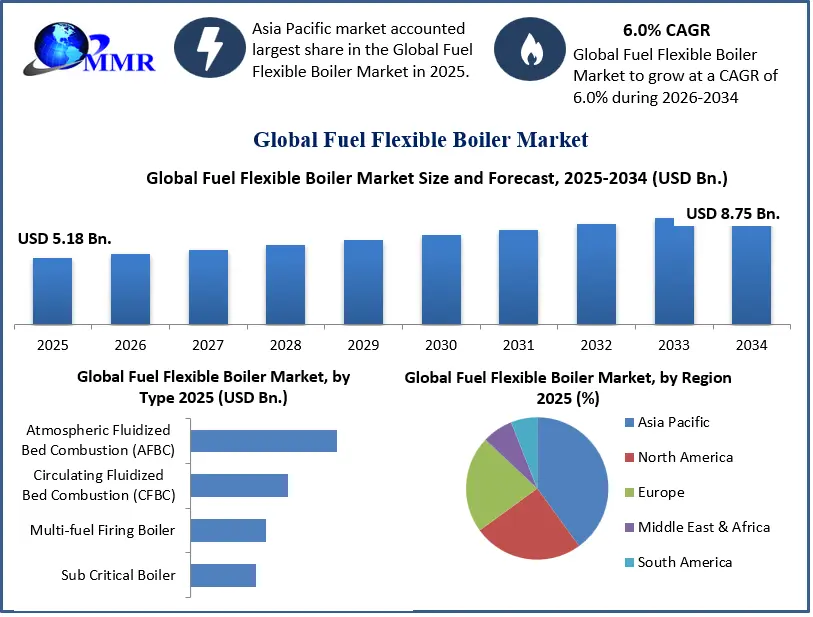
The Fuel Flexible Boiler Market Size was valued at USD 5.18 Billion in 2025 and is estimated to grow at a CAGR of 6% over the forecast period, reaching USD 8.75 Billion by 2034.
Fuel Flexible Boiler Market Overview:
A fuel flexible boiler is a boiler system designed to operate with different fuel types, including natural gas, coal, biomass, oil, waste-derived fuels, and other suitable energy sources. The Fuel Flexible Boiler Market covers the manufacturing, installation, and use of these adaptable boiler systems for steam generation, process heating, and power generation. The market matters because fuel flexibility helps industries manage fuel availability, energy costs, supply disruptions, and changing emission requirements while maintaining reliable thermal operations.
The market is changing as industrial energy demand, fuel diversification, biomass utilization, energy security, and cleaner combustion technologies become more important. Power generation companies, manufacturing plants, chemical and petrochemical facilities, refineries, food processing companies, pulp and paper producers, and other energy-intensive industries are key buyers of fuel flexible boilers. Leading manufacturers such as Babcock & Wilcox, Mitsubishi Heavy Industries, General Electric, Siemens Energy, and ANDRITZ are developing boiler and combustion technologies that support greater fuel flexibility and improved operating efficiency. Government energy-transition policies and agencies such as the International Energy Agency also emphasize fuel diversification, energy efficiency, renewable energy integration, and reduced emissions, creating opportunities for flexible steam and heat generation systems. Asia Pacific presents strong opportunities because of industrialization, power demand, manufacturing activity, and investment in efficient energy infrastructure.
MMR's research provides a detailed view of the Fuel Flexible Boiler Market, covering market segmentation, fuel types, boiler technologies, applications, end users, regional trends, competitive landscape, market drivers, restraints, opportunities, and challenges. The research identifies opportunities arising from biomass fuel adoption, waste-to-energy projects, industrial boiler modernization, co-firing technologies, cleaner combustion systems, energy efficiency improvements, digital boiler monitoring, and demand for reliable multi-fuel energy systems. It also helps manufacturers, suppliers, investors, and industrial users understand changing fuel preferences, regional demand patterns, technology developments, and areas with stronger growth potential.
Fuel Flexible Boiler Market Growth and Share Analysis
To know about the Research Methodology :- Request Free Sample Report
Fuel Flexible Boiler Key Highlights
• The Fuel Flexible Boiler Market is driven by rising demand for boilers that can operate with different fuel types while maintaining reliable and efficient performance.
• Asia Pacific held the leading position in the Fuel Flexible Boiler Market in 2025, supported by industrial development, power generation projects, and growing energy demand.
• Circulating Fluidized Bed Combustion and Atmospheric Fluidized Bed Combustion technologies remain important for applications requiring flexible fuel handling and efficient combustion.
• Increasing focus on emission reduction and cleaner energy generation is encouraging boiler manufacturers to develop advanced combustion, control, and fuel switching technologies.
• Industrial facilities and power generation plants are adopting fuel flexible boiler systems to improve operational reliability and manage changes in fuel availability and cost.
• Boiler modernization, retrofit projects, and replacement of older heating systems are creating new opportunities for fuel flexible boiler manufacturers.
• Leading companies are strengthening their market position through advanced boiler technology, customized solutions, fuel conversion capabilities, digital monitoring, and after sales services.
Fuel Flexible Boiler Market Dynamics
Rising Need for Fuel Diversification Is Driving Demand for Fuel Flexible Boilers
Fuel flexibility is becoming an important purchasing factor for industrial facilities and power producers that need to manage changes in fuel availability, quality, and cost. Fuel flexible boilers can operate with combinations of coal, natural gas, biomass, oil, waste-derived fuels, and other combustible sources, allowing operators to avoid depending on a single fuel supply. In 2025, Asia Pacific accounted for 40% of the market, followed by North America at 25% and Europe at 22%, reflecting strong demand across industrial and power-generation facilities with diverse fuel conditions. The ability to switch fuels while maintaining steam and heat production is particularly valuable in countries such as China, India, Japan, and other Asian industrial economies where fuel sourcing differs by location.
High Installation Costs and Complex Fuel Handling Systems Restrain Market Adoption
The high upfront cost of fuel flexible boilers remains a major restraint, particularly for small and medium-sized industrial facilities. Multi-fuel operation requires specialized burners, fuel feeding equipment, storage arrangements, combustion controls, ash management, and emission-control systems, making installation more complex than a single-fuel boiler. Existing facilities may also require structural modifications when converting conventional boilers to multi-fuel operation, increasing installation time and engineering costs. The challenge becomes more significant when facilities need to handle fuels with different moisture content, heating values, ash characteristics, and combustion behavior, as these differences can require additional control and monitoring systems to maintain stable operation. Research on coal, biomass, and ammonia co-firing also shows that changing fuel combinations can affect carbon monoxide, nitrogen oxide, and nitrous oxide emissions, demonstrating the need for careful combustion management.
Boiler Retrofitting and Integration of Alternative Fuels Create New Market Opportunities
The replacement and modernization of older boiler installations provide a strong opportunity for fuel flexible boiler manufacturers and engineering service providers. Many industrial facilities can use retrofit projects to introduce multi-fuel combustion, improved heat recovery, digital combustion controls, and lower-emission operating systems without replacing the complete thermal infrastructure. Another opportunity is the integration of biomass, biogas, waste-derived fuels, and other lower-carbon fuel sources, allowing facilities to adjust their fuel mix as energy policies and fuel availability change.
Maintaining Stable Combustion and Emission Control Across Multiple Fuels Remains a Key Challenge
Operating one boiler with multiple fuels requires precise control of combustion temperature, air supply, fuel feed rate, pressure, and emissions because every fuel has different physical and chemical characteristics. Biomass, for example, can have higher moisture and different ash properties than coal, while gas and liquid fuels require different combustion arrangements. Research into coal, biomass, and ammonia co-firing has shown that changing fuel ratios can influence carbon monoxide and nitrogen oxide emissions, making continuous monitoring and advanced combustion control important for reliable operation. Manufacturers therefore need to balance fuel flexibility, thermal efficiency, equipment life, emission performance, and operating stability rather than simply increasing the number of fuels that a boiler can burn.
Fuel Flexible Boiler Market Key Trends:
| Market Trend | Description |
| Shift Toward Lightweight Paper Formats | Paper manufacturers are focusing on thinner grades that use less fiber while still providing adequate strength for packaging, printing, wrapping, and other applications. Lightweighting is becoming an important way for producers and packaging companies to reduce material consumption and transportation weight without changing the basic function of the paper. |
| Growth of Paper-Based Packaging Alternatives | Brands are increasingly testing thin and lightweight paper formats as alternatives to certain plastic packaging applications. The focus is moving beyond simply replacing plastic with paper toward developing paper structures that provide the required protection while remaining suitable for recycling. |
| Development of Recyclable Barrier Coatings | Paper producers are investing in surface treatments that provide resistance to moisture, grease, and other substances without creating major problems during recycling. New research is also examining adhesive-free and plastic-free sealing methods, showing that barrier performance and recyclability are becoming closely connected product-development priorities. |
| Higher Focus on Recovered Fiber and Circular Material Use | Recycling is moving toward higher-quality recovery rather than simply collecting paper waste. Recent industrial trials have demonstrated the technical feasibility of producing paper and board from lightweight packaging waste, creating opportunities to use recovered fiber in applications where quality requirements can be met. |
| Conversion of Paper Mill Capacity Toward Higher-Value Grades | Paper manufacturers are adjusting production capacity as traditional graphic paper faces pressure from digital communication. Mills are increasingly considering packaging, tissue, and specialty grades as alternative uses for existing production assets, creating a more selective product mix across the paper industry. |
| Greater Attention to Production Cost Efficiency | Volatility in fiber, energy, chemicals, and transportation costs is pushing paper manufacturers to improve mill efficiency and control production expenses. Companies are increasingly using operational improvements, automation, and data-based production management to protect margins rather than relying only on higher selling prices. |
Fuel Flexible Boiler Market Segment Analysis:
Based on Type, the Fuel Flexible Boiler Market is segmented into Circulating Fluidized Bed Combustion (CFBC), Atmospheric Fluidized Bed Combustion (AFBC), Multi-fuel friend boiler, and Sub Critical boiler. The Atmospheric Fluidized Bed Combustion (AFBC) segment dominates the Fuel Flexible Boiler Market by holding the maximum market shares. As the Atmospheric Fluidized Bed Combustion AFBC Boilers can be operated efficiently with a variety of fuels. Therefore, even fuels like flotation slimes, washer rejects and agriculture waste can be burnt efficiently. Hence the Atmospheric Fluidized Bed Combustion (AFBC) segment dominates the Fuel Flexible Boiler Market during the forecast period.
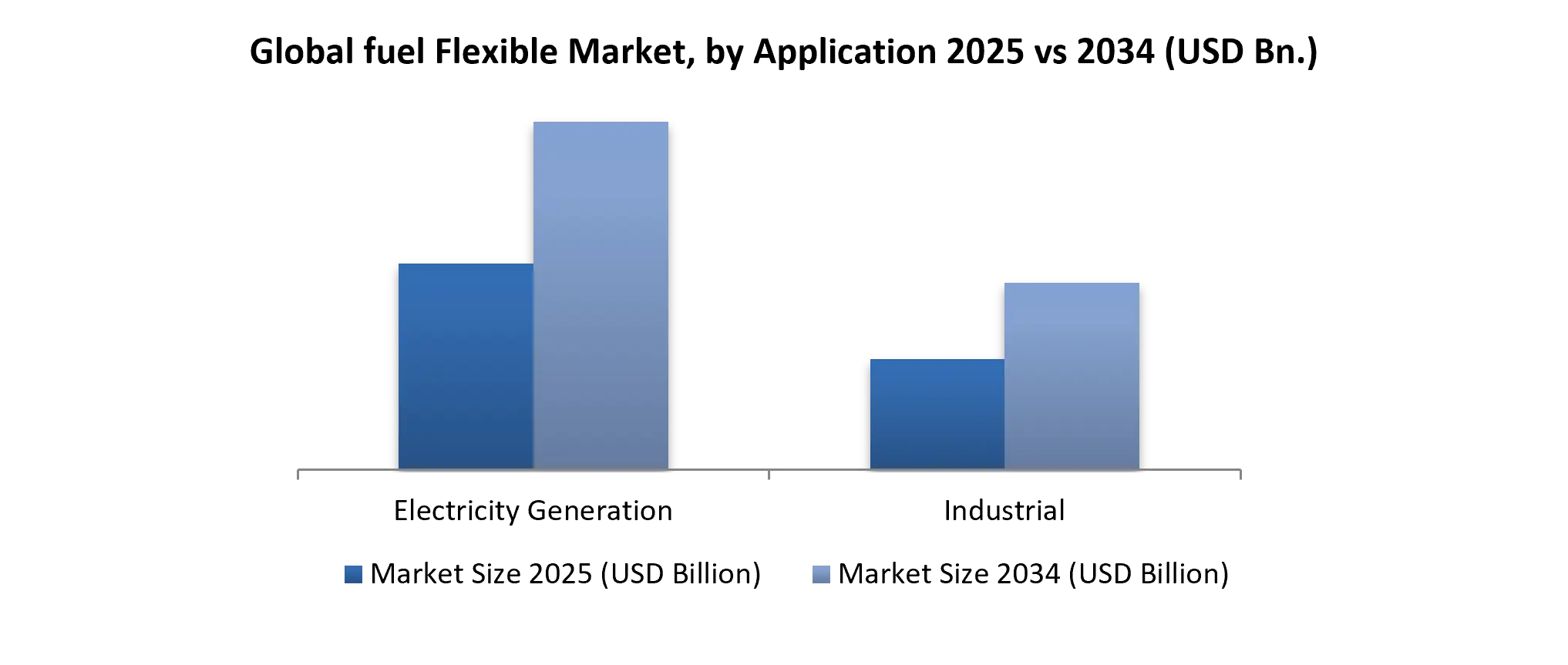
Based on Application, the Fuel Flexible Boiler Market is segmented into Industrial and Electricity generation. The Electricity generation segment dominates the Fuel Flexible Boiler Market by holding the maximum market share. Boilers are used in power plants to produce high pressured steam so that the plant can generate electricity. Therefore, the boiler takes in energy from some form of fuel such as coal, natural gas, or nuclear fuel to heat water into steam. Hence, the Electricity generation segment dominates the Fuel Flexible Boiler Market by holding the maximum market share.
 Fuel Flexible Boiler Market Regional Insights:
Asia Pacific is the leading region in Fuel Flexible Boiler Market, which benefits from strong industrial activity, large electricity generation requirements, and the need to use different fuel sources according to local availability. China, India, Japan, South Korea, Australia, Indonesia, Malaysia, and Vietnam are important demand centers, with industrial facilities and power producers looking for boilers that can handle changing fuel conditions. The region also has a significant base of existing thermal and industrial boiler installations, creating opportunities for replacement, modernization, and fuel-flexibility upgrades.
North America represents a mature market where fuel flexible boiler demand is closely connected with energy security, fuel switching, industrial efficiency, and modernization of existing boiler systems. The United States remains the major contributor, supported by its large industrial base and established power infrastructure, while Canada provides additional demand from industrial processing and energy-related applications. Manufacturers are increasingly focused on combustion control, efficient fuel utilization, and retrofit solutions that allow existing facilities to respond to changes in fuel economics without major changes to their operating systems.
Europe has strict emission requirements, energy-efficiency programs, and the growing use of renewable and alternative fuels in industrial and power applications. Germany, the United Kingdom, France, Italy, Spain, and other European countries are encouraging technologies that can improve fuel-use efficiency while supporting lower-emission operations. Fuel flexible boilers are gaining attention where facilities need to combine conventional fuels with biomass and other alternative fuel sources, particularly in industrial plants and heating systems that require reliable steam and thermal energy.
South America is developing as an opportunity-driven market, with Brazil playing an important role because of its large agricultural and sugar-processing industries and availability of biomass-based fuels. Fuel flexible boilers can help industrial facilities use locally available fuels while maintaining dependable steam generation. Demand is also supported by modernization of industrial equipment, energy-efficiency initiatives, and the need to reduce dependence on a single fuel source. Other countries in the region provide additional opportunities through industrial processing, food production, and power-generation projects.
Middle East and Africa present a developing opportunity for Fuel Flexible Boiler Market suppliers as industrialization, power infrastructure development, and energy diversification increase the need for adaptable thermal systems. Countries such as Saudi Arabia, the United Arab Emirates, South Africa, and Egypt are creating demand through industrial projects, power facilities, and modernization programs. Fuel flexibility is particularly relevant for facilities operating in locations where fuel availability, supply infrastructure, and energy costs can vary, while modular boiler designs can support projects where infrastructure requirements differ between established industrial centers and developing markets.
Fuel Flexible Boiler Market Competitive Landscape
The Fuel Flexible Boiler Market has strong competition among established boiler manufacturers, power equipment companies, and industrial heating technology providers, with companies focusing on fuel flexibility, high thermal efficiency, low-emission combustion, advanced boiler controls, and reliable operation across power generation and industrial applications. Key players include General Electric Company, Siemens AG, Mitsubishi Heavy Industries, Babcock & Wilcox Enterprises, Doosan Enerbility, Bharat Heavy Electricals Limited, Thermax Limited, Alfa Laval, Andritz AG, Harbin Electric Company, Dongfang Electric Corporation, Shanghai Electric Group, thyssenkrupp Industries India, Kawasaki Heavy Industries, and Toshiba Energy Systems & Solutions. Companies are strengthening their competitive position through new fuel-flexible boiler technologies, boiler modernization, combustion optimization, emission-control solutions, digital monitoring, and customized systems that can handle multiple fuel sources such as coal, biomass, natural gas, and other industrial fuels. The competitive landscape also reflects growing demand for efficient multi-fuel boilers, circulating fluidized bed combustion technology, flexible fuel firing systems, and retrofit solutions, while manufacturers compete through technology development, project execution capabilities, service networks, and long-term maintenance support.
Fuel Flexible Boiler Market Recent development
| Company | Month/ 2026 | Recent Development |
| Babcock & Wilcox | April 2026 | Babcock & Wilcox secured more than USD 21 million in awards for fuel switching technologies in the United States. The projects focus on coal to natural gas conversion and support more flexible and lower emission operation of existing power plants. |
| Mitsubishi Heavy Industries | July 2026 | Mitsubishi Power received orders to supply key boiler components for converting existing heavy oil fired boilers at the Jeddah South and Shuqaiq power plants in Saudi Arabia into dual fuel boilers capable of switching between and co firing natural gas and heavy oil. |
| Bharat Heavy Electricals Limited | July 2026 | BHEL issued a tender for modification of a 210 MW steam generator at GSECL Wanakbori TPS. The work includes boiler pressure parts, fuel firing systems, milling systems and modifications to enable flexible operation at 40 percent TMCR load without oil support. |
| Mitsubishi Heavy Industries | March 2026 | Mitsubishi Heavy Industries Asia Pacific received a contract for boiler retrofit work at the Tuas South Incineration Plant in Singapore. The project includes boiler tube modifications and refurbishment intended to improve reliable operation and extend plant service life. |
| Babcock & Wilcox | March 2026 | Babcock & Wilcox received full notice to proceed on a USD 2.4 billion power generation project involving four 300 MW natural gas fired boilers and steam turbine generator systems for Applied Digital AI factory campuses. |
Fuel Flexible Boiler Market Scope: Inquire before buying
| Fuel Flexible Boiler Market | |||
|---|---|---|---|
| Report Coverage | Details | ||
| Base Year: | 2025 | Forecast Period: | 2026-2034 |
| Historical Data: | 2020 to 2025 | Market Size in 2025: | US $ 5.18 Bn. |
| Forecast Period 2026 to 2034 CAGR: | 6% | Market Size in 2034: | US $ 8.75 Bn. |
| Segments Covered: | by Type | Circulating Fluidized Bed Combustion (CFBC) Atmospheric Fluidized Bed Combustion (AFBC) Multi-fuel firing boiler, Sub Critical boiler |
|
| by Application | Industrial Electricity generation |
||
Fuel Flexible Boiler Market, by Region
North America (United States, Canada and Mexico)
Europe (UK, France, Germany, Italy, Spain, Sweden, Austria, Turkey, Russia and Rest of Europe)
Asia Pacific (China, India, Japan, South Korea, Australia, ASEAN and Rest of APAC)
Middle East and Africa (South Africa, GCC, Egypt, Nigeria and Rest of ME&A)
South America (Brazil, Argentina, Columbia and Rest of South America)
Fuel Flexible Boiler Market, Key Players are
1. Alfa Laval AB
2. Andritz AG
3. Babcock and Wilcox Enterprises Inc.
4. Bharat Heavy Electricals Limited
5. Doosan Enerbility Co. Ltd.
6. Mitsubishi Heavy Industries Ltd.
7. Siemens AG
8. Siemens Energy AG
9. General Electric Company
10. Thermax Limited
11. Dongfang Electric Corporation
12. Harbin Electric Company Limited
13. Shanghai Electric Group Co. Ltd.
14. Toshiba Energy Systems and Solutions Corporation
15. Kawasaki Heavy Industries Ltd.
16. Larsen and Toubro Limited
17. thyssenkrupp Industries India Pvt. Ltd.
18. Walchandnagar Industries Limited
19. Cheema Boilers Limited
20. Zhengzhou Boiler Group Co. Ltd.
21. AE and E Nanjing Boiler Co. Ltd.
22. Parker Boiler Co.
23. Rajdeep Boiler Pvt. Ltd.
24. Forbes Marshall
25. ISGEC Heavy Engineering Limited
26. John Cockerill
27. John Wood Group PLC
28. Sumitomo Heavy Industries Ltd.
29. IHI Corporation
30. JFE Engineering Corporation
31. Mitsubishi Power Ltd.
32. Ansaldo Energia S.p.A.
33. Bharat Forge Limited
34. Doosan Corporation
35. FLSmidth and Co. A/S
36. Valmet Oyj
37. CMI Energy
38. Hurst Boiler and Welding Co. Inc.
39. Superior Boiler
40. Clayton Industries
41. Miura Co. Ltd.
42. Bosch Industriekessel GmbH
43. Viessmann Climate Solutions SE
44. Forbes Marshall Pvt. Ltd.
45. Thermax Babcock and Wilcox Energy Solutions Pvt. Ltd.
46. Rentech Boiler Systems Inc.
47. Indeck Group
48. Victory Energy Operations LLC
49. Alstom SA
50. Fluor Corporation
Frequently Asked Questions:
1. Which region has the largest share in Global Fuel Flexible Boiler Market?
Answer: Asia Pacific region held the highest share in 2025.
2. What is the growth rate of Global Fuel Flexible Boiler Market?
Answer: The Global Fuel Flexible Boiler Market is growing at a CAGR of 6.0% during the forecast period 2026-2034.
3. What is the scope of the Global Fuel Flexible Boiler Market report?
Answer: The Global Fuel Flexible Boiler Market report covers PESTEL, PORTER, COVID-19 Impact analysis, recommendations for investors and leaders, and market estimation for the forecast period.
4. Who are the key players in Global Fuel Flexible Boiler Market?
Answer: The important key players in the Global Fuel Flexible Boiler Market are Babcock and Wilcox Enterprises Inc., Bharat Heavy Electricals Limited, Mitsubishi Heavy Industries Ltd., Siemens AG, General Electric Company, Thermax Limited, Doosan Enerbility Co. Ltd., Alfa Laval AB, Andritz AG, and Larsen and Toubro Limited.
5. What is the study period of this Market?
Answer: The Global Fuel Flexible Boiler Market is studied from 2020 to 2034.