Flywheel Energy Storage System Market by Application and Region – Global Market Size Estimation, Industry-Wide Analysis, Competitive Landscape Assessment & Long-Term Forecast to 2034

7.52%
CAGR (2026-2034)
405.94 USD Mn.
Forecast Market Size
311
Report Pages
145
Market Tables

Overview

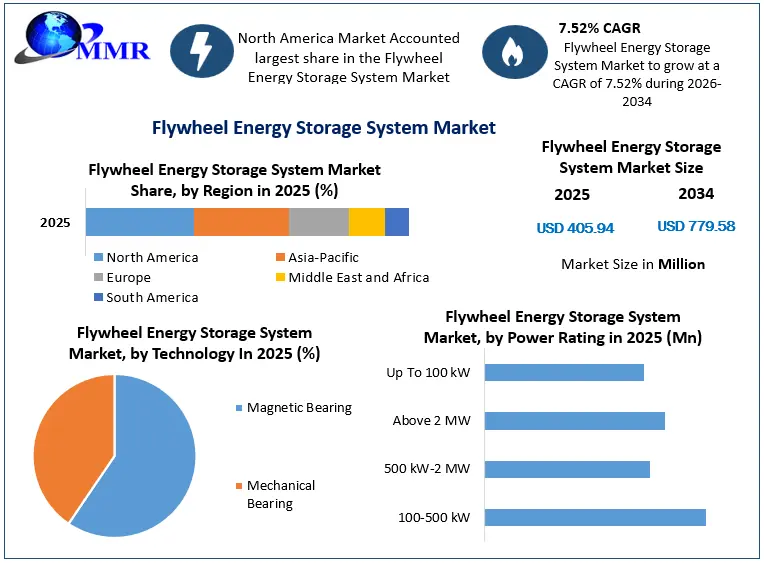
The Flywheel Energy Storage System Market was valued at US $ 405.94 Mn. in 2025, and it is expected to reach US $ 779.58 Mn. by 2034 with a CAGR of 7.52% during the forecast period.

Flywheel Energy Storage System Market Overview:

Flywheel energy storage (FES) systems operate by spinning a flywheel at a high frequency and storing energy in the form of rotary energy in the device. When the energy is captured, the fly-rotational wheel's speed is reduced as a result of the energy savings principle; adding more power to the device causes the fly-wheel speed to increase. The modern FES systems are generally made up of composites of high-performance carbon-fiber rotors suspended by magnet bearings and rotating at speeds ranging from 20,000 to over 50,000 rpm in a vacuum environment.

These flywheels can reach their energy capacity significantly faster than any other form of storage, in a couple of minutes. A flywheel is supported by a motor-generator rolling element bearing in a typical setup. To reduce friction and energy loss, the float wheel and often the engine generator are placed in a vacuum chamber. The first generation of flywheel energy storage systems features a large steel flywheel rotating on mechanical lockers.

Flywheel Energy Storage System Market Snapshot

Flywheel Energy Storage System Market SnapTo know about the Research Methodology :- Request Free Sample Report

Key Trends:

Flywheel implementation for military operations.

Flywheels are in high demand for military operations and ground vehicles, as well as weapons, navigation, communications, and their associated intelligence systems. Vehicles, systems, and many sorts of weapons in the military all require energy to function properly. Flywheels appear to be an appropriate energy storage method in this case. Also, a flywheel energy storage technology increases system stability and improves current absorption in power systems. As a result, the market for flywheel energy storage systems is dominated by the electrification of military systems.

Flywheel Energy Storage System Market Dynamics:

The demand for a reliable and clean electrical source is growing.

Over the forecast period, the market is expected to be driven by rising demand for energy storage systems across various industries, as well as the implementation of favorable regulatory policies surrounding clean power generation and lowering reliance on fossil-fuel-based power sources. Flywheel is a stable energy storage solution in developing countries with unreliable grid infrastructure and high electricity bills, as well as on islands where grids rely on biofuels and diesel generators. Flywheel storage is used in combination with renewable wind and solar power in remote locations, eliminating the inconsistent nature of renewable energy while delivering a constant power supply to the grid or other facilities.

High cost & limited duration.

When it comes to storing energy, the technology has significant advantages over batteries. Unlimited daily cycle capacity, no chemical reaction, no capacity degradation, and great round-trip efficiency are the benefits of the FES system. However, factors such as the high cost and short lifespan of flywheel power are likely to hamper market growth throughout the forecast period.

Enormous R&D investments.

Industry players are investing extensively in research and development to find a solution to technology's high maintenance costs. Manufacturers are concentrating on improving the geometry and metallurgical qualities of flywheel rotors, as well as the chemical composition and refinement of low-carbon steel alloy processes. Thus, it is likely to present lucrative growth opportunities for the market during the forecast period.

Flywheel Energy Storage System Market Segment Analysis:

Based on End Use, the Flywheel Energy Storage System Market is segmented into six types as follows, Uninterruptible Power Supply (UPS), Distributed Energy Generation (DEG), Automotive, Data Center, Defense, and Aerospace.

In 2025, the UPS segment was dominant and held the largest market share of xx% of the overall market share and the segment is expected to experience significant growth over the forecast period. This is mostly related to an increase in demand for a continuous electricity supply across all industries to operate electrical devices and equipment without interruption. Furthermore, UPSs are in high demand thanks to the growing need for adequate power backup solutions, particularly in developing nations where power outages are common.

The data center segment held a considerable market share of xx%. Furthermore, the segment is expected to maintain its dominance over the forecast period. This is expected to be related to the rapid deployment of flywheels by huge IT organizations, such as Google, at their massive data centers, the number of which is growing. Flywheels offer instant electricity to connected systems in the case of a transient power interruption, giving backup generators time to start.

Flywheel Energy Storage System Market Regional Insights:

In 2025, North America was the dominant region and held the highest share 78% of the Market. In terms of revenue and power capacity, it is the largest market for flywheel energy storage systems, with the United States accounting for the majority of regional market share. Flywheels are used in combination with renewable energy sources in the United States to provide storage capacity and balance the inconsistent nature of renewables. Also, power generation accounts for around 40% of carbon emissions in the United States. As a result, renewable technologies like flywheel energy generation and storage are expected to effectively reduce carbon emissions.

In terms of capacity, Europe was the second-largest regional segment in 2025 and is expected to rise significantly throughout the forecast period. Government programmes that promote clean energy generation and storage have given the market a significant uplift. Flywheel technology is used in a range of applications in the United Kingdom, Germany, and France.

The Asia Pacific market is likely to grow because of frequent power disruptions in developing economies such as China and India. Flywheels have a long lifespan and are unaffected by the number of charge cycles. These properties make it a reliable energy storage solution for a variety of end-use applications, including Asia Pacific economies' ever-growing industrial and commercial sectors.

Increasing demand for distributed power generation, combined with rising renewable energy adoption in various Asia Pacific countries is expected to accelerate regional market growth. Operators store excess renewable energy in flywheel systems and use it for local power generation and grid power supply during peak demand periods.

Flywheel Energy Storage System Market Recent Developments:

Date Company Development Impact
20 May 2025 Kawasaki Heavy Industries, Ltd. (KHI) The company signed an MOU extension with Amber Kinetics to promote KHI's Virtual Synchronous Generator technology alongside Amber's Flywheel Energy Storage System (FESS). The collaborative system addresses modern power grid volatility and optimizes grid stability by effectively mimicking traditional generators to manage intermittent renewable energy sources.
24 May 2025 Amber Kinetics Inc. The company unveiled its new containerized Flywheel Energy Storage System at the Miramar Airshow for specialized above-ground deployment. This development enables modular, rapid deployment testing at the Rapid Integration and Commercialization Unit to improve localized energy resilience.
15 June 2025 Active Power Inc. The company formally introduced its next-generation flywheel UPS systems specifically tailored for the expanding Asia Pacific industrial and commercial markets. The rollout delivers upgraded operational performance and dependable backup power solutions to combat power interruptions within highly critical mission sectors.
18 August 2025 Beacon Power LLC The company initiated its advanced flywheel energy storage project expansion across the Asia Pacific region. The project focuses on fulfilling urgent demands for grid frequency regulation and smoothing out renewable energy integration across developing power sectors.
22 September 2025 Dumarey Group The company successfully deployed its advanced Green Power Peak Power 200 flywheel energy system at Dubai Harbour. The system provides crucial peak-shaving support for heavy-duty industrial applications, significantly advancing local decarbonization and infrastructure efficiency.
15 October 2025 Indian Energy LLC The company finalized a strategic partnership with Amber Kinetics to deploy high-capacity containerized flywheel energy storage units. This initiative delivers long-duration mechanical storage assets to bolster sovereignty and clean energy independence across Native American tribal communities.

The objective of the report is to present a comprehensive analysis of the Flywheel Energy Storage System Market to the stakeholders in the industry. The past and current status of the industry with the forecasted market size and trends are presented in the report with the analysis of complicated data in simple language. The report covers all the aspects of the industry with a dedicated study of key players that include market leaders, followers, and new entrants.

PORTER, PESTEL analysis with the potential impact of micro-economic factors of the market have been presented in the report. External as well as internal factors that are supposed to affect the business positively or negatively have been analyzed, which will give a clear futuristic view of the industry to the decision-makers.

The report also helps in understanding the Flywheel Energy Storage System Market dynamics, structure by analyzing the market segments and project the Flywheel Energy Storage System Market size. Clear representation of competitive analysis of key players by product, price, financial position, product portfolio, growth strategies, and regional presence in the Flywheel Energy Storage System Market make the report investor’s guide.

Flywheel Energy Storage System Market Scope: Inquire before buying

Flywheel Energy Storage System Market
Report Coverage Details
Base Year: 2025 Forecast Period: 2026-2034
Historical Data: 2020 to 2025 Market Size in 2025: 405.94 USD Billion
Forecast Period 2026-2034 CAGR: 7.52% Market Size in 2034: 779.58 USD Billion
Segments Covered: by Technology Magnetic Bearing
Mechanical Bearing
by Power Rating 100-500 kW
500 kW-2 MW
Above 2 MW
Up To 100 kW
by Energy Storage Capacity Up To 25 kWh
25–50 kWh
51–100 kWh
Above 100 kWh
by Rotor Material Carbon Fiber Composite
Steel Alloy
Hybrid Composite Materials
by Deployment Grid-Connected
Off-Grid
by End User Utilities
Industrial
Commercial
Telecommunication
Transportation
Data Centers
Government & Defense
Others

Flywheel Energy Storage System Market Region

North America (United States, Canada and Mexico)
Europe (UK, France, Germany, Italy, Spain, Sweden, Austria and Rest of Europe)
Asia Pacific (China, South Korea, Japan, India, Australia, Indonesia, Malaysia, Vietnam, Taiwan, Bangladesh, Pakistan and Rest of APAC)
Middle East and Africa (South Africa, GCC, Egypt, Nigeria and Rest of ME&A)
South America (Brazil, Argentina Rest of South America)

Flywheel Energy Storage System Market Key Players

1. Amber Kinetics
2. Beacon Power
3. Active Power
4. Piller Power Systems
5. Stornetic GmbH
6. VYCON
7. Kinetic Traction Systems
8. Energiestro
9. Teraloop Oy
10. QuinteQ Energy
11. Adaptive Balancing Power GmbH
12. BC New Energy (BNE)
13. Dumarey Group
14. ABB
15. Siemens
16. Hitachi Energy
17. Schneider Electric
18. SOCOMEC
19. Parker Hannifin
20. Pentadyne Power Corporation
21. Zooz Power
22. S4 Energy
23. Dumarey Group
24. Arteche
25. Langley Holdings plc
26. Others

Frequently Asked Questions:

1. Which region has the largest share in Global Flywheel Energy Storage System Market?
Ans: North America region held the highest share in 2025.

2. What is the growth rate of Global Flywheel Energy Storage System Market?
Ans: The Global Flywheel Energy Storage System Market is growing at a CAGR of 7.52% during forecasting period 2026-2034.

3. What is scope of the Global Flywheel Energy Storage System Market report?
Ans: Global Flywheel Energy Storage System Market report helps with the PESTEL, PORTER, COVID-19 Impact analysis, Recommendations for Investors & Leaders, and market estimation of the forecast period.

4. Who are the key players in Global Flywheel Energy Storage System Market?
Ans: The important key players in the Global Flywheel Energy Storage System Market are – Active Power, Amber Kinetics Inc., Beacon Power LLC., Calnetix Technologies, LLC., Piller Group GmbH, Powerthru, Vycon, Inc., Stornetic GmbH, Energiestro, Oxto Energy, Langley Holding PLC, Schwungrad Energie Ltd., Phillips Service Industries Inc., Kinetic Traction Systems, Beijing Qifeng, Punch Flybrid, BC New Energy, and Others

5. What is the study period of this Market?
Ans: The Global Flywheel Energy Storage System Market is studied from 2025 to 2034.

Table of Contents

A1. Executive Market Landscape and Industry Overview 1.1. Global Flywheel Energy Storage System Market Size (USD Bn.and volume in kilowatts), 2025–2032 1.2. Global flywheel energy storage market growth outlook through 2032 1.3. Supply-demand equilibrium assessment across flywheel storage value chains 1.4. Market attractiveness evaluation under global energy transition initiatives 1.5. Grid modernization trends supporting flywheel storage deployment globally 1.6. Future industry outlook through 2032 strategic forecasting framework A2. Global Flywheel Energy Storage System Market Dynamics 2.1. Flywheel Energy Storage System Market Trends 2.2. Flywheel Energy Storage System Market Dynamics 2.2.1. Drivers 2.2.2. Restraints 2.2.3. Opportunities 2.2.4. Challenges 2.3. PORTER’s Five Forces Analysis 2.3.1. Supplier power 2.3.2. Buyer power 2.3.3. Threat of substitutes 2.3.4. Threat of new entrants 2.3.5. Competitive rivalry 2.4. PESTLE Analysis A3. Flywheel Energy Storage Ecosystem and Value Chain Analysis 3.1. Integrated flywheel ecosystem structure across energy storage operations 3.2. Upstream raw material sourcing assessment for flywheel manufacturing 3.3. Midstream assembly and integration operational efficiency analysis globally 3.4. Downstream utilization trends across commercial energy storage applications 3.5. Margin distribution analysis across flywheel value chain participants 3.6. Operational bottlenecks affecting long-term industry sustainability globally A4. Flywheel System Pricing and Cost Structure Assessment 4.1. Historical flywheel system pricing trends during 2020–2026 globally 4.2. Manufacturing cost benchmarking across integrated production facilities worldwide 4.3. Raw material pricing volatility affecting profitability and competitiveness 4.4. Energy inflation impact on operational expenditures across facilities 4.5. Procurement optimization strategies reducing long-term manufacturing costs globally 4.6. Future pricing outlook under energy storage transition initiatives A5. Sustainability and Carbon Reduction Performance Analysis 5.1. Carbon reduction benefits across flywheel energy storage deployments 5.2. Lifecycle emission assessment across flywheel manufacturing operations worldwide 5.3. Environmental sustainability initiatives supporting storage commercialization globally 5.4. Circular economy integration within flywheel operational ecosystems globally 5.5. Material recycling trends supporting sustainable storage deployment strategies 5.6. Net-zero roadmap influencing future storage investment priorities worldwide A6. Regulatory Framework and Energy Storage Policy Intelligence 6.1. Energy storage mandates supporting flywheel adoption expansion globally 6.2. Government incentives accelerating storage commercialization activities worldwide 6.3. Grid modernization policies influencing flywheel deployment initiatives globally 6.4. Environmental compliance standards affecting manufacturing sustainability globally 6.5. Electricity market regulations impacting storage operational frameworks worldwide 6.6. Future policy outlook supporting long-term storage commercialization globally A7. Flywheel Technology and Engineering Innovation Analysis 7.1. Advanced rotor technologies improving flywheel storage efficiency globally 7.2. Magnetic bearing innovations enhancing operational performance worldwide 7.3. Vacuum enclosure advancements reducing energy losses significantly globally 7.4. Artificial intelligence integration supporting system optimization globally 7.5. Research innovation pipeline accelerating next-generation storage commercialization 7.6. Future technology roadmap transforming flywheel storage operations worldwide A8. Supply Chain and Distribution Network Intelligence 8.1. Global flywheel supply chain structure and framework analysis 8.2. Transportation infrastructure assessment supporting equipment distribution worldwide 8.3. Strategic storage capabilities improving long-term supply continuity globally 8.4. Logistics optimization initiatives reducing transportation expenditures worldwide globally 8.5. Cross-border trade flow assessment across storage operations globally 8.6. Supply disruption risks affecting future operational sustainability worldwide A9. Energy Storage Demand and Adoption Trend Assessment 9.1. Grid stabilization demand supporting flywheel market growth globally 9.2. Renewable integration initiatives increasing flywheel deployment worldwide globally 9.3. Industrial power quality applications supporting storage utilization growth 9.4. Transportation electrification trends accelerating flywheel adoption globally worldwide 9.5. Decarbonization commitments driving advanced storage commercialization globally 9.6. Future adoption outlook through 2032 market forecasting assessment A10. Investment and Strategic Opportunity Intelligence 10.1. Global investment trends across flywheel storage infrastructure worldwide 10.2. Venture capital participation within advanced storage industries globally 10.3. Infrastructure financing opportunities supporting storage expansion initiatives globally 10.4. Risk-return benchmarking across flywheel investment portfolios worldwide globally 10.5. Public-private partnerships accelerating storage ecosystem development globally 10.6. Long-term investment outlook through 2032 market evaluation framework A11. Grid Stability and Frequency Regulation Assessment 11.1. Frequency regulation applications supporting flywheel deployment globally worldwide 11.2. Grid balancing capabilities improving power reliability performance globally 11.3. Ancillary service opportunities enhancing storage market attractiveness globally 11.4. Fast response technologies supporting grid operational efficiency worldwide 11.5. Energy resilience initiatives strengthening storage deployment strategies globally 11.6. Future commercialization outlook for grid stabilization technologies worldwide A12. Patent Landscape and Innovation Benchmarking Analysis 12.1. Patent filing trends across flywheel storage technology industries 12.2. Research collaboration initiatives supporting innovation commercialization activities worldwide 12.3. Intellectual property benchmarking among leading storage innovators globally 12.4. Innovation pipeline assessment for next-generation flywheel technologies worldwide 12.5. Commercialization readiness evaluation across emerging storage platforms globally 12.6. Future innovation outlook shaping industry competitiveness worldwide globally A13. Market Dynamics and Industry Challenge Assessment 13.1. High capital costs affecting deployment scalability globally worldwide 13.2. Technology adoption barriers impacting market expansion initiatives globally 13.3. Infrastructure limitations restricting operational scalability across installations globally 13.4. Energy storage competition affecting flywheel competitiveness worldwide globally 13.5. Policy uncertainty risks influencing long-term investment strategies worldwide 13.6. Operational performance challenges affecting commercialization sustainability globally A14. ESG and Clean Energy Transition Intelligence 14.1. ESG investment priorities reshaping storage commercialization strategies globally 14.2. Decarbonization targets accelerating flywheel storage adoption worldwide globally 14.3. Clean energy transition trends influencing storage deployment globally 14.4. Sustainability benchmarking across energy storage operational ecosystems worldwide 14.5. Renewable integration supporting low-carbon infrastructure development globally 14.6. Future carbon neutrality roadmap through 2032 transformation period A15. Trade Flow and Import Export Assessment 15.1. Global flywheel trade flow across industrial supply chains 15.2. Import dependency risks affecting manufacturing operations globally worldwide 15.3. Export competitiveness benchmarking among storage producing economies globally 15.4. Strategic storage infrastructure supporting uninterrupted supply continuity globally 15.5. Cross-border transportation efficiency supporting equipment trade globally worldwide 15.6. Future trade outlook through 2032 forecasting framework globally A16. Industrial Infrastructure and Capacity Utilization Analysis 16.1. Existing flywheel infrastructure assessment across production facilities globally 16.2. Capacity utilization benchmarking among integrated manufacturing operations worldwide 16.3. Infrastructure modernization initiatives supporting productivity enhancement globally 16.4. Operational scalability assessment across storage production ecosystems worldwide 16.5. Manufacturing efficiency optimization improving operational sustainability globally worldwide 16.6. Future infrastructure outlook supporting industry expansion worldwide globally A17. Renewable Energy Integration and Energy Security Analysis 17.1. Renewable energy adoption supporting flywheel deployment globally worldwide 17.2. Energy security initiatives accelerating storage commercialization globally worldwide 17.3. Grid flexibility integration supporting sustainable energy transition worldwide 17.4. Strategic diversification trends improving long-term energy resilience globally 17.5. Storage investments supporting operational sustainability across energy systems 17.6. Future energy transition outlook through 2032 assessment framework A18. Storage Infrastructure and Transportation Analysis 18.1. Bulk equipment storage infrastructure assessment across facilities globally 18.2. Transportation network optimization improving supply chain efficiency worldwide 18.3. Rail logistics trends supporting storage equipment distribution globally 18.4. Marine transportation developments accelerating international trade globally worldwide 18.5. Infrastructure initiatives supporting commercial equipment movement globally worldwide 18.6. Future transportation outlook supporting industry expansion worldwide globally A19. Procurement and Sourcing Strategy Assessment 19.1. Strategic procurement trends across flywheel manufacturing companies globally 19.2. Supplier diversification strategies improving procurement sustainability worldwide globally 19.3. Long-term sourcing contracts supporting manufacturing continuity globally worldwide 19.4. Strategic inventory management improving supply-demand balance globally worldwide 19.5. Future sourcing outlook supporting market competitiveness worldwide globally 19.6. Energy resilience awareness supporting flywheel adoption globally worldwide 19.7. Grid modernization initiatives increasing storage utilization worldwide globally 19.8. Industrial sustainability commitments accelerating storage demand globally worldwide 19.9. Technology awareness campaigns influencing future market expansion worldwide 19.10. Clean energy trends reshaping storage commercialization globally worldwide 19.11. Future adoption outlook through 2032 demand forecasting period 19.12. Supply chain risk mitigation supporting operational continuity globally 19.13. Climate-related operational risk assessment across storage facilities worldwide 19.14. Financial risk benchmarking among storage manufacturing operations globally 19.15. Infrastructure resilience initiatives supporting long-term sustainability globally worldwide 19.16. Strategic contingency planning improving operational stability worldwide globally 19.17. Future risk outlook influencing storage investment strategies globally 19.18. Power quality applications supporting flywheel deployment globally worldwide 19.19. Voltage stabilization assessment across industrial operational ecosystems worldwide 19.20. Reliability infrastructure developments improving energy distribution globally worldwide 19.21. Advanced monitoring technologies supporting commercialization initiatives globally worldwide 19.22. Industrial adoption trends across power quality ecosystems worldwide 19.23. Future outlook through 2032 reliability assessment framework globally 19.24. Smart manufacturing technologies improving operational efficiency globally worldwide 19.25. Digital transformation initiatives across storage production facilities worldwide 19.26. Artificial intelligence integration supporting manufacturing optimization strategies globally 19.27. Predictive maintenance technologies improving infrastructure continuity worldwide globally 19.28. Industrial analytics adoption supporting data-driven decisions globally worldwide 19.29. Future digitalization roadmap transforming storage operations worldwide globally 19.30. Baseline market forecast assessment during 2026–2032 globally worldwide 19.31. Optimistic growth scenario under accelerated storage adoption globally 19.32. Conservative outlook considering regulatory and operational uncertainty globally 19.33. Strategic forecasting assumptions influencing market projections worldwide globally 19.34. Emerging growth drivers reshaping long-term commercialization globally worldwide 19.35. Future industry transformation roadmap supporting sustainable expansion worldwide 19.36. High-growth investment opportunities across flywheel value chains globally 19.37. Strategic expansion recommendations for emerging market participants worldwide 19.38. Operational optimization strategies improving long-term profitability globally worldwide 19.39. Technology adoption priorities supporting future competitiveness worldwide globally 19.40. Risk mitigation framework supporting sustainable business expansion globally 19.41. Future strategic roadmap for industry stakeholders worldwide globally 19.42. Data center applications supporting flywheel deployment globally worldwide 19.43. Electric vehicle charging support creating new opportunities globally 19.44. Defense sector demand enhancing storage commercialization worldwide globally 19.45. Railway electrification initiatives increasing flywheel utilization globally worldwide 19.46. Microgrid integration trends accelerating storage deployment globally worldwide 19.47. Future application outlook through 2032 commercialization framework globally 19.48. Safety certification requirements influencing storage deployment globally worldwide 19.49. Reliability benchmarking across operational flywheel installations globally worldwide 19.50. Risk reduction technologies improving system performance globally worldwide 19.51. Operational safety frameworks supporting commercialization activities globally worldwide 19.52. Maintenance optimization initiatives enhancing long-term reliability globally worldwide 19.53. Future safety outlook supporting market development worldwide globally 19.54. Asset lifecycle assessment across flywheel operational ecosystems globally 19.55. Long-term performance benchmarking among storage deployments worldwide globally 19.56. Predictive asset management improving operational continuity globally worldwide 19.57. Maintenance strategies reducing lifecycle operational expenditures globally worldwide 19.58. Performance optimization frameworks enhancing storage value globally worldwide 19.59. Future lifecycle outlook supporting sustainable deployments worldwide globally 19.60. Smart grid initiatives supporting flywheel deployment globally worldwide 19.61. Digital energy networks improving storage integration globally worldwide 19.62. Grid modernization programs accelerating storage commercialization globally worldwide 19.63. Advanced monitoring systems supporting operational efficiency globally worldwide 19.64. Energy transition strategies strengthening storage market attractiveness globally 19.65. Future smart grid outlook through 2032 globally worldwide 19.66. Long-term industry competitiveness across global storage ecosystems worldwide 19.67. Emerging technology opportunities supporting future commercialization globally worldwide 19.68. Sustainability leadership shaping long-term market development globally worldwide 19.69. Investment opportunity mapping across advanced storage ecosystems globally 19.70. Strategic growth priorities supporting profitability improvement globally worldwide 19.71. Future expansion roadmap through 2032 industry assessment framework A31. Global Flywheel Energy Storage System Market : Market size and Forecast by Segmentation (by Value USD Billion) (2025-2032) 20.0.0.1. Global Flywheel Energy Storage System Market Size and Forecast, By Technology 20.1. Magnetic Bearing 20.2. Mechanical Bearing 20.2.0.1. Global Flywheel Energy Storage System Market Size and Forecast, By Power Rating 20.3. 100-500 kW 20.4. 500 kW-2 MW 20.5. Above 2 MW 20.6. Up To 100 kW 20.6.0.1. Global Flywheel Energy Storage System Market Size and Forecast, by Energy Storage Capacity 20.7. Up To 25 kWh 20.8. 25–50 kWh 20.9. 51–100 kWh 20.10. Above 100 kWh 20.10.0.1. Global Flywheel Energy Storage System Market Size and Forecast, by Rotor Material 20.11. Carbon Fiber Composite 20.12. Steel Alloy 20.13. Hybrid Composite Materials 20.13.0.1. Global Flywheel Energy Storage System Market Size and Forecast, By Deployment 20.14. Grid-Connected 20.15. Off-Grid 20.15.0.1. Global Flywheel Energy Storage System Market Size and Forecast, by End User 20.16. Utilities 20.17. Industrial 20.18. Commercial 20.19. Telecommunication 20.20. Transportation 20.21. Data Centers 20.22. Government & Defense 20.23. Others 20.23.0.1. Global Flywheel Energy Storage System Market Size and Forecast, By region 20.24. North America 20.24.0.1. United States 20.24.0.2. Canada 20.24.0.3. Mexico 20.25. Europe 20.25.0.1. United Kingdom 20.25.0.2. France 20.25.0.3. Germany 20.25.0.4. Italy 20.25.0.5. Spain 20.25.0.6. Sweden 20.25.0.7. Russia 20.25.0.8. Rest Of Europe 20.26. Asia Pacific 20.27. Middle East and Africa 20.28. South America B1. Company Profiles: Key Players 21.1. Overview 21.2. Business Portfolio 21.3. Comparative benchmarking of leading companies across key Financial Overview 21.4. SWOT Analysis 21.5. Strategic Analysis 21.6. Recent Developments 21.7. Amber Kinetics 21.8. Beacon Power 21.9. Active Power 21.10. Piller Power Systems 21.11. Stornetic GmbH 21.12. VYCON 21.13. Kinetic Traction Systems 21.14. Energiestro 21.15. Teraloop Oy 21.16. QuinteQ Energy 21.17. Adaptive Balancing Power GmbH 21.18. BC New Energy (BNE) 21.19. Dumarey Group 21.20. ABB 21.21. Siemens 21.22. Hitachi Energy 21.23. Schneider Electric 21.24. SOCOMEC 21.25. Parker Hannifin 21.26. Pentadyne Power Corporation 21.27. Zooz Power 21.28. S4 Energy 21.29. Dumarey Group 21.30. Arteche 21.31. Langley Holdings plc B2. Competitive Landscape and Strategic Positioning Analysis 22.1. Competitive benchmarking among leading flywheel storage companies globally 22.2. Market positioning strategies adopted by storage providers globally 22.3. Strategic differentiation trends across advanced storage manufacturers globally 22.4. Business expansion initiatives supporting operational scalability worldwide globally 22.5. Competitive intensity assessment across storage operational ecosystems globally 22.6. Future competitive outlook through 2032 forecasting framework globally B3. Company Financial Performance and Profitability Benchmarking 23.1. Revenue benchmarking across leading flywheel storage companies globally 23.2. EBITDA margin comparison among storage industry participants worldwide 23.3. Capital expenditure trends supporting long-term expansion initiatives globally 23.4. Profitability assessment under fluctuating storage pricing environments worldwide 23.5. Operational cost benchmarking across integrated facilities globally worldwide 23.6. Financial sustainability outlook through 2032 assessment framework globally B4. Company Production Capacity and Infrastructure Intelligence 24.1. Production capacity benchmarking across storage manufacturing facilities globally 24.2. Infrastructure modernization initiatives improving productivity worldwide globally globally 24.3. Capacity expansion projects announced during 2023–2026 globally worldwide 24.4. Manufacturing scalability strategies adopted by leading companies globally 24.5. Operational efficiency benchmarking across integrated facilities worldwide globally 24.6. Future infrastructure outlook supporting competitive expansion globally worldwide B5. Mergers Acquisitions and Partnership Intelligence Assessment 25.1. Acquisition trends reshaping storage competitive landscape globally worldwide 25.2. Strategic partnerships supporting technology and supply integration worldwide 25.3. Joint venture initiatives accelerating storage commercialization globally worldwide 25.4. Cross-industry collaborations strengthening storage ecosystem development worldwide globally 25.5. Investment agreements supporting infrastructure expansion initiatives globally worldwide 25.6. Future consolidation outlook across storage industries worldwide globally B6. Company Innovation and Technology Benchmarking Analysis 26.1. Research investment trends across storage manufacturing companies globally 26.2. Proprietary technologies improving operational storage efficiency worldwide globally 26.3. Digital transformation initiatives across storage facilities globally worldwide 26.4. Automation integration supporting productivity enhancement worldwide globally globally 26.5. Innovation benchmarking among advanced storage technology providers globally 26.6. Future technology roadmap shaping business sustainability worldwide globally B7. Product Portfolio and Solution Benchmarking Analysis 27.1. Product portfolio benchmarking across leading storage providers globally 27.2. Technology differentiation assessment among commercial storage solutions worldwide 27.3. Application-focused product strategies supporting market expansion globally 27.4. Product performance benchmarking across deployed storage systems worldwide 27.5. Commercial offering comparison among major industry participants globally 27.6. Future portfolio evolution supporting competitive positioning globally worldwide B8. ESG Performance and Sustainability Benchmarking Analysis 28.1. Sustainability commitments across flywheel storage companies globally worldwide 28.2. ESG reporting practices among leading industry participants globally 28.3. Carbon reduction initiatives supporting sustainable business development globally 28.4. Renewable energy integration strategies across company operations worldwide 28.5. Circular economy adoption improving sustainability performance globally worldwide 28.6. Future ESG outlook shaping competitive differentiation globally worldwide B9. Supply Chain and Procurement Benchmarking Analysis 29.1. Supplier management strategies across storage manufacturing companies globally 29.2. Procurement benchmarking among leading storage technology providers worldwide 29.3. Supply chain resilience initiatives improving operational continuity globally 29.4. Component sourcing strategies supporting manufacturing competitiveness globally worldwide 29.5. Inventory optimization frameworks enhancing supply-demand balance globally 29.6. Future procurement outlook supporting business sustainability globally worldwide B10. Digital Transformation and Smart Manufacturing Benchmarking 30.1. Smart factory adoption across flywheel manufacturing companies globally 30.2. Artificial intelligence deployment supporting operational efficiency globally worldwide 30.3. Predictive maintenance integration improving production continuity globally worldwide 30.4. Industrial analytics adoption supporting data-driven operations globally worldwide 30.5. Automation investments enhancing manufacturing productivity globally worldwide globally 30.6. Future digitalization roadmap across competitive industry participants globally 30.7. Long-term competitiveness assessment across storage industry participants globally 30.8. Emerging growth opportunities supporting future business expansion globally 30.9. Innovation leadership benchmarking among advanced storage providers globally 30.10. Strategic investment priorities shaping competitive positioning globally worldwide 30.11. Market opportunity mapping across commercial storage ecosystems globally 30.12. Future corporate roadmap through 2032 competitive assessment framework 30.13. SECTION C– STRATEGIC OUTLOOK 30.14. C1. Key Findings 30.15. C2.Analyst Recommendation 30.16. C3. Research Methodology

Custom Market Research Services

We Will Customise The Research For You, In Case The Report Listed Above Does Not Meet With Your Requirements