Flying Bikes Market Size – Industry Structure Evaluation, Demand Drivers Analysis, Regional Growth Analysis and Identification, Competitive Positioning Review & Global Market Size Forecast to 2034

19.5%
CAGR (2026-2034)
109.08 USD Bn.
Forecast Market Size
302
Report Pages
141
Market Tables

Overview

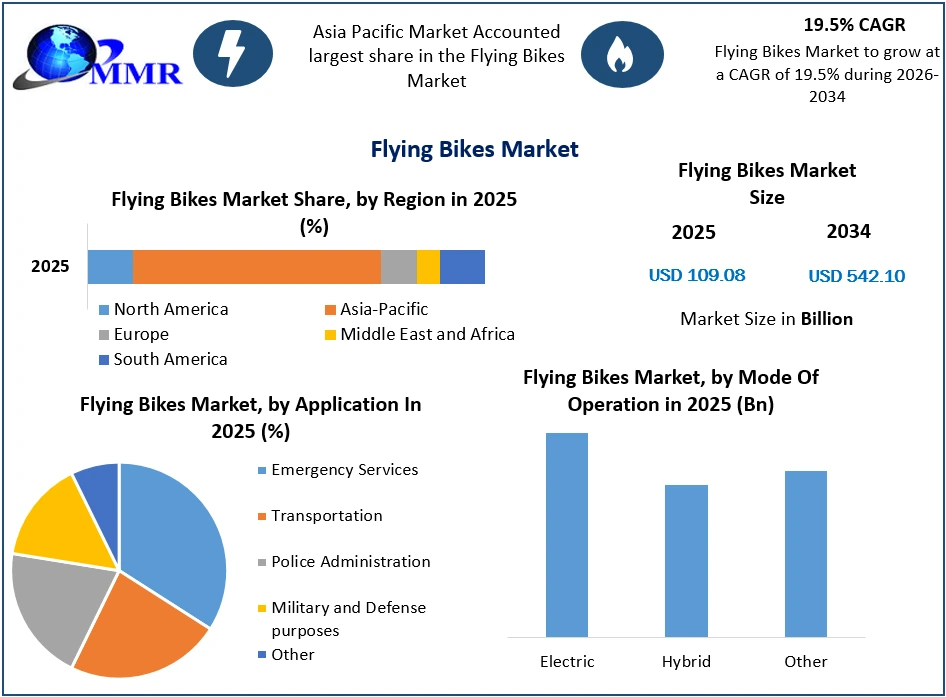
Flying Bikes Market was valued at USD 109.08 Bn. in 2025 Global Flying Bikes Market size is expected to grow at a CAGR of 19.5 % through the forecast period.

Flying Bikes Market Overview:

A flying bike, sometimes known as a hoverbike, is a vehicle that can fly and/or move on the road similarly to a motorcycle. A flying bike usually has two propellers: one in front of the driver and one behind him. Improved flying bike prototypes were created by combining various technologies such as advanced manufacturing processes, autonomous systems, and ultra-efficient batteries. Hoverbike investments have increased, which is forecast to accelerate the advent of futuristic urban commuting, freight and package transportation, as well as military and defense applications. New gadgets have been made available by the latest innovations in an aeroplane and car technology. Hoverbike is one such idea that combines helicopter and bike technology to improve transportation.

Flying Bikes Market Growth and Share Analysis
Flying Bikes Market Growth

To know about the Research Methodology:-Request Free Sample Report

Flying Bikes Market Dynamics:

Market Drivers:

HoverBike is a new, enjoyable, and safe mode of transportation that almost anybody can use. Adventurous motorcyclists may be familiar with the excitement of rising, but the Hoverbike will take the atmosphere to a whole new level. In comparison to a chopper, the HoverBike is faster, rougher, and easier to use–and it offers a completely new flying route. When compared to a helicopter, the HoverBike is faster, cheaper, and easier to use–and it's a whole new way of flying. This less expensive and safer option isn't just for individuals who can't afford a traditional helicopter.

The growth of this market is stimulated by improving infrastructure in countries such as China, Germany, the United States, and Japan, as well as increasing traffic jams and crowdedness in cities for employees, businesses, government, and environmental protection bodies, rapidly increasing demand for individual transportation without traffic problems and increased concerns about driver and vehicle safety.

In recent years, urban mobility has moved toward digital high-end technology, as well as a growth in the adoption of green mobility solutions, to construct the next-generation sustainable and resilient transportation system. Moreover, the rapid trend toward urbanization necessitates the development of alternative transportation solutions to address current urban transportation concerns such as traffic jams and increased air pollution, among others. Companies in the mobility sector have responded by developing innovative solutions, such as flying bikes.

In the hoverbike market, a lot of money has been invested in developing future-ready solutions. To create a practical and reliable product, continuous R&D, testing, improvements, and technological developments are essential. Flying bikes are one of the most reducing technologies to come to market recently. The prices of flying bike products on the market are fairly high. For example, A.L.I Technologies launched its Xturismo product in October 2022 at a cost of around $680,000. Its price is far more than that of many premium cars on the market today. Lazareth Auto Moto's flying bike launched at $560,000 per unit, with the company planning to produce five more shortly.

Market Trend:

Smart helmets with GPS and multi-angle sensors are available for hoverbike riders. With a stunning appearance, this helmet will provide distance and track imaging. This advanced helmet will provide a three-dimensional representation of the path taken by Hoverbike riders. If you need to turn, this useful device will alert you. This is similar to Google Maps' functionality. The Hoverbike's body is fitted with an emergency parachute. The Hoverbike is also equipped with three times the redundancy of a helicopter in terms of safety components.

Traffic problems produced by road vehicles are one of the most serious issues for most modern cities. Roads created decades earlier simply cannot handle the massive number of cars, trucks, and other vehicles fighting for space today. Even when stationary, the majority of these land-based vehicles consume fossil fuels, emitting a variety of hazardous chemicals. This includes compounds that are directly hazardous to human health, such as carbon monoxide (an odorless, colorless, but poisonous gas); other hydrocarbons, such as benzene, which was known to cause cancer; sulfur dioxide, which causes respiratory issues; and tiny solid particles floating in the air (soot).

Because these compounds are released at all times, changing to electric vehicles that do not produce them, whether land-based electric vehicles or VTOLs, has the potential to be beneficial. Because traffic is less of a problem, fuel may be used more efficiently and is not wasted while stuck in a traffic jam. As flying bikes become more common, vehicles on the ground will ideally have to compete with less traffic.

Market Opportunity:

On top of the gases that are directly hazardous to human health, greenhouse gases such as carbon dioxide (CO2) and nitrogen oxides (N2O) enter the atmosphere, trapping heat and causing climate change. flying vehicles significantly decreased pollutants in certain scenarios. A fully charged VTOL with four persons on board has 52 % lower greenhouse gas emissions than the average gasoline-powered vehicle on a 100-kilometer journey.

Because flying bikes must be piloted, they are more likely to be fully occupied, with people sharing lifts, rather than being occupied by a single person, as is currently the case. Keeping with the theme of lower emissions and improved efficiency. Flying bikes can travel from point A to point B significantly more quickly. As a result, less fuel is required, and journey durations are significantly reduced when compared to land travel. Land journeys frequently include many twists and turns, traffic signals, and junctions, all of which reduce route efficiency and increase fuel consumption.

Most cities are still structured and constructed around vehicles and other ground-based vehicles today. More highways are constructed as they extend out into the country. However, city-to-city highways may be among the most dangerous. Large highways and bypasses are constructed to allow vehicles to go from one location to another. These roadways are being extended as the number of cars on the road increases, with more lanes being added every year. These highways frequently have negative ecological impacts since they cross farms and pass through woodlands, harming vital wildlife habitats.

Market Challenge:

Emission over short distances could be higher: Although VTOLs are very efficient once in the air, they require a lot of energy to take off and climb. This means that the benefits in terms of energy use and emissions are much lower for short journeys. Many people (and companies) regard electric flying cars as a feasible choice for city transportation, particularly for trips of around 17 kilometers. Although VTOLs can reduce emissions over longer distances due to their efficiency in the cruise phase, short trips may result in even higher emissions than existing transport options.

They can not carry many passengers compared to other vehicles: These flying bikes are only suited for small groups of people due to the requirement that they are lightweight to order to get off of the ground without using too much energy. One could argue that this is valid for vehicles as well, but when you consider that we could replace many cars in major cities with electric buses or light trains, the efficiency of electric flying vehicles is called into question once more. If VTOLs are to be used most effectively and with the biggest environmental benefits, they should only be used for longer trips, and investment in other forms of electrified transport should be increased at the same time.

Cost: This mode of transport will be too expensive. They'll need a qualified pilot to carry a small group of people, similar to borrowing a tiny private jet. Operators may be able to reduce expenses if technology improves and ride-sharing is used to its full potential. However, if it remains cost expensive, it cannot be considered an environmentally beneficial technology. Sustainability must be accessible to all individuals not just an expensive luxury for the few.

Flying Bikes Market Segment Analysis:

Based on Mode of Operation, the Flying Bikes Market is classified into Electric, Hybrid, and other. In 2025, the electric segment dominated the market, contributing to more than two-thirds of all flying bikes purchased, and it is likely to continue to do so throughout the forecast period. Moreover, during the forecast period, this segment is expected to have the highest CAGR of 24.3 %.


Based on the Application, the Flying Bikes Market is classified into Emergency services, Transportation, Police Administration, Military and Defense purpose, and others. In 2025, the emergency services segment had the highest market share, accounting for almost one-third of the total market, and is expected to maintain this position throughout the forecast period. Furthermore, with a CAGR of 25.2% , this segment is expected to grow the fastest.

Military - Used for border surveillance and to quickly transport weapons from one location to another. Because hoverbikes are so maneuverable, they can more efficiently attack enemy targets.

Transportation - Like conventional bikes, hoverbikes are used for transportation, but in a unique way that allows them to move over rough terrain by hovering above obstacles. Racing - Hoverbikes are also used in races, which drives companies to develop new products quickly.

Police Administration- The police may find flying bikes beneficial in capturing their targets. They can fly over congested highways and in tight spaces, allowing cops to travel quickly and easily over any hurdles. Dubai Police tested a hoverbike in 2025 to benefit from the benefits of flying bikes, and the manufacturer Hoversurf has begun training cops to fly the Hoversurf S3 2025. The Dubai Police Department is considering deploying hoverbikes to help officers better control crimes. Efforts to use flying bikes for police administration are expected to drive the flying bikes market ahead throughout the forecast period.

Flying Bikes Market Regional Insights:

The Asia Pacific region dominated the market with a 35 % share in 2025. The North America region is expected to witness significant growth at a CAGR of 8% through the forecast period.

The Asia Pacific region is expected to have the fastest growth in the flying bike market. The Chinese racing motorbike sector is the largest in the Asia Pacific, with significant revenue growth and demand for high-tech vehicles. China is one of the key sectors for high-tech cars, owing to the country's growing disposable income. Almost all auto manufacturers have invested in China, which is known for its small and inexpensive passenger cars. When compared to developed countries, the present car adoption is forecast to increase in demand. Increasing auto manufacturing standards in China have helped the increased growth of the automotive.

The objective of the report is to present a comprehensive analysis of the global Flying Bikes Market to the stakeholders in the industry. The past and current status of the industry with the forecasted market size and trends are presented in the report with the analysis of complicated data in simple language. The report covers all the aspects of the industry with a dedicated study of key players that include market leaders, followers, and new entrants.

PORTER, PESTEL analysis with the potential impact of micro-economic factors of the market have been presented in the report. External as well as internal factors that are supposed to affect the business positively or negatively have been analyzed, which will give a clear futuristic view of the industry to the decision-makers.

The reports also help in understanding the Flying Bikes Market dynamic, structure by analyzing the market segments and projecting the Flying Bikes Market size. Clear representation of competitive analysis of key players by Vehicle type, price, financial position, product portfolio, growth strategies, and regional presence in the Flying Bikes Market make the report investor’s guide.

Flying Bikes Market Recent Development

Date Company Development Impact
15 January 2025 Jetson Jetson successfully completed the first-ever global delivery of the Jetson ONE personal electric aerial vehicle to tech visionary Palmer Luckey in Carlsbad, California. Accelerates the commercial rollout of personal eVTOL flying bikes and expands high-profile consumer adoption in North America.
10 March 2025 Jetson Jetson partnered with Poland's GOPR to conduct world-first mountain rescue trials in the Tatra Mountains, demonstrating rapid emergency response. Proves the operational viability of flying bikes in emergency services, reaching remote rescue peaks in under four minutes.
18 June 2025 Jetson Jetson secured Europe's first official eVTOL ultralight identification for the Jetson ONE, coinciding with its first delivery to an Italian customer. Establishes a critical regulatory milestone for personal electric flight under Italy's VDS framework across Europe.
15 July 2025 Volonaut Volonaut unveiled its advanced Airbike prototype designed by Tomasz Patan, capable of reaching speeds up to 200 km/h using versatile multi-fuel options. Expands propulsion innovation and high-speed personal aerial mobility alternatives within the global flying motorcycle market.
22 September 2025 Jetson Jetson introduced the innovative Jetson Airframe Parachute System to enhance rider safety and security during personal flight operations. Improves structural safety redundancy, addressing key consumer risk concerns for next-generation urban air mobility.

Flying Bikes Market Scope: Inquire before buying

Global Flying Bikes Market
Report Coverage Details
Base Year: 2025 Forecast Period: 2026-2034
Historical Data: 2020 to 2025 Market Size in 2025: USD 109.08 Bn.
Forecast Period 2026 to 2034 CAGR: 19.5% Market Size in 2034: USD 542.10 Bn
Segments Covered: by Mode Of Operation Electric
Hybrid
Other
by Application Emergency Services
Transportation
Police Administration
Military and Defense purposes
Other

Flying Bikes Market, by Region

North America (United States, Canada and Mexico)
Europe (UK, France, Germany, Italy, Spain, Sweden, Austria, Turkey, Russia and Rest of Europe)
Asia Pacific (China, India, Japan, South Korea, Australia, ASEAN and Rest of APAC)
Middle East and Africa (South Africa, GCC, Egypt, Nigeria and Rest of ME&A)
South America (Brazil, Argentina, Columbia and Rest of South America)

Flying Bikes Market, Key Players are

1. A.L.I Technologies
2. Aerofex Corporation
3. BMF Motorrad
4. Duratec S.R.O
5. HOVER
6. Jetpack Aviation
7. Kalashnikov Concern JSC
8. Lazareth Auto-Moto
9. Malloy Aeronautics
10. Raytheon
11. Safran
12. Honeywell
13. Thales
14. Northrop Grumman

Frequently Asked Questions:

1] What segments are covered in the Global Flying Bikes Market report?
Ans. The segments covered in the Flying Bikes Market report are based on Mode of Operation and Application.

2] Which region is expected to hold the highest share in the Global Flying Bikes Market?
Ans. The Asia Pacific region is expected to hold the highest share in the Flying Bikes Market.

3] What is the market size of the Global Flying Bikes Market by 2034?
Ans. The market size of the Flying Bikes Market by 2034 is expected to reach USD 542.10 Bn.

4] What is the forecast period for the Global Flying Bikes Market?
Ans. The forecast period for the Flying Bikes Market is 2026-2034.

5] What was the market size of the Global Flying Bikes Market in 2025?
Ans. The market size of the Flying Bikes Market in 2025 was valued at USD 109.08 Bn.

Table of Contents

1. Flying Bikes Market Introduction 1.1. Study Assumption and Market Definition 1.2. Scope of the Study 1.3. Executive Summary 2. Global Flying Bikes Market: Competitive Landscape 2.1. MMR Competition Matrix 2.2. Competitive Landscape 2.3. Key Players Benchmarking 2.3.1. Company Name 2.3.2. Business Segment 2.3.3. End-user Segment 2.3.4. Revenue (2025) 2.3.5. Company Locations 2.4. Leading Flying Bikes Market Companies, by market capitalization 2.5. Market Structure 2.5.1. Market Leaders 2.5.2. Market Followers 2.5.3. Emerging Players 2.6. Mergers and Acquisitions Details 3. Flying Bikes Market: Dynamics 3.1. Flying Bikes Market Trends by Region 3.1.1. North America Flying Bikes Market Trends 3.1.2. Europe Flying Bikes Market Trends 3.1.3. Asia Pacific Flying Bikes Market Trends 3.1.4. Middle East and Africa Flying Bikes Market Trends 3.1.5. South America Flying Bikes Market Trends 3.2. Flying Bikes Market Dynamics by Region 3.2.1. North America 3.2.1.1. North America Flying Bikes Market Drivers 3.2.1.2. North America Flying Bikes Market Restraints 3.2.1.3. North America Flying Bikes Market Opportunities 3.2.1.4. North America Flying Bikes Market Challenges 3.2.2. Europe 3.2.2.1. Europe Flying Bikes Market Drivers 3.2.2.2. Europe Flying Bikes Market Restraints 3.2.2.3. Europe Flying Bikes Market Opportunities 3.2.2.4. Europe Flying Bikes Market Challenges 3.2.3. Asia Pacific 3.2.3.1. Asia Pacific Flying Bikes Market Drivers 3.2.3.2. Asia Pacific Flying Bikes Market Restraints 3.2.3.3. Asia Pacific Flying Bikes Market Opportunities 3.2.3.4. Asia Pacific Flying Bikes Market Challenges 3.2.4. Middle East and Africa 3.2.4.1. Middle East and Africa Flying Bikes Market Drivers 3.2.4.2. Middle East and Africa Flying Bikes Market Restraints 3.2.4.3. Middle East and Africa Flying Bikes Market Opportunities 3.2.4.4. Middle East and Africa Flying Bikes Market Challenges 3.2.5. South America 3.2.5.1. South America Flying Bikes Market Drivers 3.2.5.2. South America Flying Bikes Market Restraints 3.2.5.3. South America Flying Bikes Market Opportunities 3.2.5.4. South America Flying Bikes Market Challenges 3.3. PORTER's Five Forces Analysis 3.4. PESTLE Analysis 3.5. Technology Roadmap 3.6. Regulatory Landscape by Region 3.6.1. North America 3.6.2. Europe 3.6.3. Asia Pacific 3.6.4. Middle East and Africa 3.6.5. South America 3.7. Key Opinion Leader Analysis in the Flying Bikes Market 3.8. Analysis of Government Schemes and Initiatives For Global Industry 3.9. Flying Bikes Market Trade Analysis 3.10. The Global Pandemic Impact on Flying Bikes Market 4. Flying Bikes Market: Global Market Size and Forecast by Segmentation (in USD Billion) 2025-2034 4.1. Flying Bikes Market Size and Forecast, by Mode Of Operation (2025-2034) 4.1.1. Electric 4.1.2. Hybrid 4.1.3. Other 4.2. Flying Bikes Market Size and Forecast, by Application (2025-2034) 4.2.1. Emergency Services 4.2.2. Transportation 4.2.3. Police Administration 4.2.4. Military and Defense purposes 4.2.5. Other 4.3. Flying Bikes Market Size and Forecast, by Region (2025-2034) 4.3.1. North America 4.3.2. Europe 4.3.3. Asia Pacific 4.3.4. Middle East and Africa 4.3.5. South America 5. North America Flying Bikes Market Size and Forecast by Segmentation (in USD Billion) 2025-2034 5.1. North America Flying Bikes Market Size and Forecast, by Mode Of Operation (2025-2034) 5.1.1. Electric 5.1.2. Hybrid 5.1.3. Other 5.2. North America Flying Bikes Market Size and Forecast, by Application (2025-2034) 5.2.1. Emergency Services 5.2.2. Transportation 5.2.3. Police Administration 5.2.4. Military and Defense purposes 5.2.5. Other 5.3. North America Flying Bikes Market Size and Forecast, by Country (2025-2034) 5.3.1. United States 5.3.1.1. United States Flying Bikes Market Size and Forecast, by Mode Of Operation (2025-2034) 5.3.1.1.1. Electric 5.3.1.1.2. Hybrid 5.3.1.1.3. Other 5.3.1.2. United States Flying Bikes Market Size and Forecast, by Application (2025-2034) 5.3.1.2.1. Emergency Services 5.3.1.2.2. Transportation 5.3.1.2.3. Police Administration 5.3.1.2.4. Military and Defense purposes 5.3.1.2.5. Other 5.3.2. Canada 5.3.2.1. Canada Flying Bikes Market Size and Forecast, by Mode Of Operation (2025-2034) 5.3.2.1.1. Electric 5.3.2.1.2. Hybrid 5.3.2.1.3. Other 5.3.2.2. Canada Flying Bikes Market Size and Forecast, by Application (2025-2034) 5.3.2.2.1. Emergency Services 5.3.2.2.2. Transportation 5.3.2.2.3. Police Administration 5.3.2.2.4. Military and Defense purposes 5.3.2.2.5. Other 5.3.3. Mexico 5.3.3.1. Mexico Flying Bikes Market Size and Forecast, by Mode Of Operation (2025-2034) 5.3.3.1.1. Electric 5.3.3.1.2. Hybrid 5.3.3.1.3. Other 5.3.3.2. Mexico Flying Bikes Market Size and Forecast, by Application (2025-2034) 5.3.3.2.1. Emergency Services 5.3.3.2.2. Transportation 5.3.3.2.3. Police Administration 5.3.3.2.4. Military and Defense purposes 5.3.3.2.5. Other 6. Europe Flying Bikes Market Size and Forecast by Segmentation (in USD Billion) 2025-2034 6.1. Europe Flying Bikes Market Size and Forecast, by Mode Of Operation (2025-2034) 6.1.1. Electric 6.1.2. Hybrid 6.1.3. Other 6.2. Europe Flying Bikes Market Size and Forecast, by Application (2025-2034) 6.2.1. Emergency Services 6.2.2. Transportation 6.2.3. Police Administration 6.2.4. Military and Defense purposes 6.2.5. Other 6.3. Europe Flying Bikes Market Size and Forecast, by Country (2025-2034) 6.3.1. United Kingdom 6.3.1.1. United Kingdom Flying Bikes Market Size and Forecast, by Mode Of Operation (2025-2034) 6.3.1.1.1. Electric 6.3.1.1.2. Hybrid 6.3.1.1.3. Other 6.3.1.2. United Kingdom Flying Bikes Market Size and Forecast, by Application (2025-2034) 6.3.1.2.1. Emergency Services 6.3.1.2.2. Transportation 6.3.1.2.3. Police Administration 6.3.1.2.4. Military and Defense purposes 6.3.1.2.5. Other 6.3.2. France 6.3.2.1. France Flying Bikes Market Size and Forecast, by Mode Of Operation (2025-2034) 6.3.2.1.1. Electric 6.3.2.1.2. Hybrid 6.3.2.1.3. Other 6.3.2.2. France Flying Bikes Market Size and Forecast, by Application (2025-2034) 6.3.2.2.1. Emergency Services 6.3.2.2.2. Transportation 6.3.2.2.3. Police Administration 6.3.2.2.4. Military and Defense purposes 6.3.2.2.5. Other 6.3.3. Germany 6.3.3.1. Germany Flying Bikes Market Size and Forecast, by Mode Of Operation (2025-2034) 6.3.3.1.1. Electric 6.3.3.1.2. Hybrid 6.3.3.1.3. Other 6.3.3.2. Germany Flying Bikes Market Size and Forecast, by Application (2025-2034) 6.3.3.2.1. Emergency Services 6.3.3.2.2. Transportation 6.3.3.2.3. Police Administration 6.3.3.2.4. Military and Defense purposes 6.3.3.2.5. Other 6.3.4. Italy 6.3.4.1. Italy Flying Bikes Market Size and Forecast, by Mode Of Operation (2025-2034) 6.3.4.1.1. Electric 6.3.4.1.2. Hybrid 6.3.4.1.3. Other 6.3.4.2. Italy Flying Bikes Market Size and Forecast, by Application (2025-2034) 6.3.4.2.1. Emergency Services 6.3.4.2.2. Transportation 6.3.4.2.3. Police Administration 6.3.4.2.4. Military and Defense purposes 6.3.4.2.5. Other 6.3.5. Spain 6.3.5.1. Spain Flying Bikes Market Size and Forecast, by Mode Of Operation (2025-2034) 6.3.5.1.1. Electric 6.3.5.1.2. Hybrid 6.3.5.1.3. Other 6.3.5.2. Spain Flying Bikes Market Size and Forecast, by Application (2025-2034) 6.3.5.2.1. Emergency Services 6.3.5.2.2. Transportation 6.3.5.2.3. Police Administration 6.3.5.2.4. Military and Defense purposes 6.3.5.2.5. Other 6.3.6. Sweden 6.3.6.1. Sweden Flying Bikes Market Size and Forecast, by Mode Of Operation (2025-2034) 6.3.6.1.1. Electric 6.3.6.1.2. Hybrid 6.3.6.1.3. Other 6.3.6.2. Sweden Flying Bikes Market Size and Forecast, by Application (2025-2034) 6.3.6.2.1. Emergency Services 6.3.6.2.2. Transportation 6.3.6.2.3. Police Administration 6.3.6.2.4. Military and Defense purposes 6.3.6.2.5. Other 6.3.7. Austria 6.3.7.1. Austria Flying Bikes Market Size and Forecast, by Mode Of Operation (2025-2034) 6.3.7.1.1. Electric 6.3.7.1.2. Hybrid 6.3.7.1.3. Other 6.3.7.2. Austria Flying Bikes Market Size and Forecast, by Application (2025-2034) 6.3.7.2.1. Emergency Services 6.3.7.2.2. Transportation 6.3.7.2.3. Police Administration 6.3.7.2.4. Military and Defense purposes 6.3.7.2.5. Other 6.3.8. Rest of Europe 6.3.8.1. Rest of Europe Flying Bikes Market Size and Forecast, by Mode Of Operation (2025-2034) 6.3.8.1.1. Electric 6.3.8.1.2. Hybrid 6.3.8.1.3. Other 6.3.8.2. Rest of Europe Flying Bikes Market Size and Forecast, by Application (2025-2034) 6.3.8.2.1. Emergency Services 6.3.8.2.2. Transportation 6.3.8.2.3. Police Administration 6.3.8.2.4. Military and Defense purposes 6.3.8.2.5. Other 7. Asia Pacific Flying Bikes Market Size and Forecast by Segmentation (in USD Billion) 2025-2034 7.1. Asia Pacific Flying Bikes Market Size and Forecast, by Mode Of Operation (2025-2034) 7.1.1. Electric 7.1.2. Hybrid 7.1.3. Other 7.2. Asia Pacific Flying Bikes Market Size and Forecast, by Application (2025-2034) 7.2.1. Emergency Services 7.2.2. Transportation 7.2.3. Police Administration 7.2.4. Military and Defense purposes 7.2.5. Other 7.3. Asia Pacific Flying Bikes Market Size and Forecast, by Country (2025-2034) 7.3.1. China 7.3.1.1. China Flying Bikes Market Size and Forecast, by Mode Of Operation (2025-2034) 7.3.1.1.1. Electric 7.3.1.1.2. Hybrid 7.3.1.1.3. Other 7.3.1.2. China Flying Bikes Market Size and Forecast, by Application (2025-2034) 7.3.1.2.1. Emergency Services 7.3.1.2.2. Transportation 7.3.1.2.3. Police Administration 7.3.1.2.4. Military and Defense purposes 7.3.1.2.5. Other 7.3.2. S Korea 7.3.2.1. S Korea Flying Bikes Market Size and Forecast, by Mode Of Operation (2025-2034) 7.3.2.1.1. Electric 7.3.2.1.2. Hybrid 7.3.2.1.3. Other 7.3.2.2. S Korea Flying Bikes Market Size and Forecast, by Application (2025-2034) 7.3.2.2.1. Emergency Services 7.3.2.2.2. Transportation 7.3.2.2.3. Police Administration 7.3.2.2.4. Military and Defense purposes 7.3.2.2.5. Other 7.3.3. Japan 7.3.3.1. Japan Flying Bikes Market Size and Forecast, by Mode Of Operation (2025-2034) 7.3.3.1.1. Electric 7.3.3.1.2. Hybrid 7.3.3.1.3. Other 7.3.3.2. Japan Flying Bikes Market Size and Forecast, by Application (2025-2034) 7.3.3.2.1. Emergency Services 7.3.3.2.2. Transportation 7.3.3.2.3. Police Administration 7.3.3.2.4. Military and Defense purposes 7.3.3.2.5. Other 7.3.4. India 7.3.4.1. India Flying Bikes Market Size and Forecast, by Mode Of Operation (2025-2034) 7.3.4.1.1. Electric 7.3.4.1.2. Hybrid 7.3.4.1.3. Other 7.3.4.2. India Flying Bikes Market Size and Forecast, by Application (2025-2034) 7.3.4.2.1. Emergency Services 7.3.4.2.2. Transportation 7.3.4.2.3. Police Administration 7.3.4.2.4. Military and Defense purposes 7.3.4.2.5. Other 7.3.5. Australia 7.3.5.1. Australia Flying Bikes Market Size and Forecast, by Mode Of Operation (2025-2034) 7.3.5.1.1. Electric 7.3.5.1.2. Hybrid 7.3.5.1.3. Other 7.3.5.2. Australia Flying Bikes Market Size and Forecast, by Application (2025-2034) 7.3.5.2.1. Emergency Services 7.3.5.2.2. Transportation 7.3.5.2.3. Police Administration 7.3.5.2.4. Military and Defense purposes 7.3.5.2.5. Other 7.3.6. Indonesia 7.3.6.1. Indonesia Flying Bikes Market Size and Forecast, by Mode Of Operation (2025-2034) 7.3.6.1.1. Electric 7.3.6.1.2. Hybrid 7.3.6.1.3. Other 7.3.6.2. Indonesia Flying Bikes Market Size and Forecast, by Application (2025-2034) 7.3.6.2.1. Emergency Services 7.3.6.2.2. Transportation 7.3.6.2.3. Police Administration 7.3.6.2.4. Military and Defense purposes 7.3.6.2.5. Other 7.3.7. Malaysia 7.3.7.1. Malaysia Flying Bikes Market Size and Forecast, by Mode Of Operation (2025-2034) 7.3.7.1.1. Electric 7.3.7.1.2. Hybrid 7.3.7.1.3. Other 7.3.7.2. Malaysia Flying Bikes Market Size and Forecast, by Application (2025-2034) 7.3.7.2.1. Emergency Services 7.3.7.2.2. Transportation 7.3.7.2.3. Police Administration 7.3.7.2.4. Military and Defense purposes 7.3.7.2.5. Other 7.3.8. Vietnam 7.3.8.1. Vietnam Flying Bikes Market Size and Forecast, by Mode Of Operation (2025-2034) 7.3.8.1.1. Electric 7.3.8.1.2. Hybrid 7.3.8.1.3. Other 7.3.8.2. Vietnam Flying Bikes Market Size and Forecast, by Application (2025-2034) 7.3.8.2.1. Emergency Services 7.3.8.2.2. Transportation 7.3.8.2.3. Police Administration 7.3.8.2.4. Military and Defense purposes 7.3.8.2.5. Other 7.3.9. Taiwan 7.3.9.1. Taiwan Flying Bikes Market Size and Forecast, by Mode Of Operation (2025-2034) 7.3.9.1.1. Electric 7.3.9.1.2. Hybrid 7.3.9.1.3. Other 7.3.9.2. Taiwan Flying Bikes Market Size and Forecast, by Application (2025-2034) 7.3.9.2.1. Emergency Services 7.3.9.2.2. Transportation 7.3.9.2.3. Police Administration 7.3.9.2.4. Military and Defense purposes 7.3.9.2.5. Other 7.3.10. Rest of Asia Pacific 7.3.10.1. Rest of Asia Pacific Flying Bikes Market Size and Forecast, by Mode Of Operation (2025-2034) 7.3.10.1.1. Electric 7.3.10.1.2. Hybrid 7.3.10.1.3. Other 7.3.10.2. Rest of Asia Pacific Flying Bikes Market Size and Forecast, by Application (2025-2034) 7.3.10.2.1. Emergency Services 7.3.10.2.2. Transportation 7.3.10.2.3. Police Administration 7.3.10.2.4. Military and Defense purposes 7.3.10.2.5. Other 8. Middle East and Africa Flying Bikes Market Size and Forecast by Segmentation (in USD Billion) 2025-2034 8.1. Middle East and Africa Flying Bikes Market Size and Forecast, by Mode Of Operation (2025-2034) 8.1.1. Electric 8.1.2. Hybrid 8.1.3. Other 8.2. Middle East and Africa Flying Bikes Market Size and Forecast, by Application (2025-2034) 8.2.1. Emergency Services 8.2.2. Transportation 8.2.3. Police Administration 8.2.4. Military and Defense purposes 8.2.5. Other 8.3. Middle East and Africa Flying Bikes Market Size and Forecast, by Country (2025-2034) 8.3.1. South Africa 8.3.1.1. South Africa Flying Bikes Market Size and Forecast, by Mode Of Operation (2025-2034) 8.3.1.1.1. Electric 8.3.1.1.2. Hybrid 8.3.1.1.3. Other 8.3.1.2. South Africa Flying Bikes Market Size and Forecast, by Application (2025-2034) 8.3.1.2.1. Emergency Services 8.3.1.2.2. Transportation 8.3.1.2.3. Police Administration 8.3.1.2.4. Military and Defense purposes 8.3.1.2.5. Other 8.3.2. GCC 8.3.2.1. GCC Flying Bikes Market Size and Forecast, by Mode Of Operation (2025-2034) 8.3.2.1.1. Electric 8.3.2.1.2. Hybrid 8.3.2.1.3. Other 8.3.2.2. GCC Flying Bikes Market Size and Forecast, by Application (2025-2034) 8.3.2.2.1. Emergency Services 8.3.2.2.2. Transportation 8.3.2.2.3. Police Administration 8.3.2.2.4. Military and Defense purposes 8.3.2.2.5. Other 8.3.3. Nigeria 8.3.3.1. Nigeria Flying Bikes Market Size and Forecast, by Mode Of Operation (2025-2034) 8.3.3.1.1. Electric 8.3.3.1.2. Hybrid 8.3.3.1.3. Other 8.3.3.2. Nigeria Flying Bikes Market Size and Forecast, by Application (2025-2034) 8.3.3.2.1. Emergency Services 8.3.3.2.2. Transportation 8.3.3.2.3. Police Administration 8.3.3.2.4. Military and Defense purposes 8.3.3.2.5. Other 8.3.4. Rest of ME&A 8.3.4.1. Rest of ME&A Flying Bikes Market Size and Forecast, by Mode Of Operation (2025-2034) 8.3.4.1.1. Electric 8.3.4.1.2. Hybrid 8.3.4.1.3. Other 8.3.4.2. Rest of ME&A Flying Bikes Market Size and Forecast, by Application (2025-2034) 8.3.4.2.1. Emergency Services 8.3.4.2.2. Transportation 8.3.4.2.3. Police Administration 8.3.4.2.4. Military and Defense purposes 8.3.4.2.5. Other 9. South America Flying Bikes Market Size and Forecast by Segmentation (in USD Billion) 2025-2034 9.1. South America Flying Bikes Market Size and Forecast, by Mode Of Operation (2025-2034) 9.1.1. Electric 9.1.2. Hybrid 9.1.3. Other 9.2. South America Flying Bikes Market Size and Forecast, by Application (2025-2034) 9.2.1. Emergency Services 9.2.2. Transportation 9.2.3. Police Administration 9.2.4. Military and Defense purposes 9.2.5. Other 9.3. South America Flying Bikes Market Size and Forecast, by Country (2025-2034) 9.3.1. Brazil 9.3.1.1. Brazil Flying Bikes Market Size and Forecast, by Mode Of Operation (2025-2034) 9.3.1.1.1. Electric 9.3.1.1.2. Hybrid 9.3.1.1.3. Other 9.3.1.2. Brazil Flying Bikes Market Size and Forecast, by Application (2025-2034) 9.3.1.2.1. Emergency Services 9.3.1.2.2. Transportation 9.3.1.2.3. Police Administration 9.3.1.2.4. Military and Defense purposes 9.3.1.2.5. Other 9.3.2. Argentina 9.3.2.1. Argentina Flying Bikes Market Size and Forecast, by Mode Of Operation (2025-2034) 9.3.2.1.1. Electric 9.3.2.1.2. Hybrid 9.3.2.1.3. Other 9.3.2.2. Argentina Flying Bikes Market Size and Forecast, by Application (2025-2034) 9.3.2.2.1. Emergency Services 9.3.2.2.2. Transportation 9.3.2.2.3. Police Administration 9.3.2.2.4. Military and Defense purposes 9.3.2.2.5. Other 9.3.3. Rest Of South America 9.3.3.1. Rest Of South America Flying Bikes Market Size and Forecast, by Mode Of Operation (2025-2034) 9.3.3.1.1. Electric 9.3.3.1.2. Hybrid 9.3.3.1.3. Other 9.3.3.2. Rest Of South America Flying Bikes Market Size and Forecast, by Application (2025-2034) 9.3.3.2.1. Emergency Services 9.3.3.2.2. Transportation 9.3.3.2.3. Police Administration 9.3.3.2.4. Military and Defense purposes 9.3.3.2.5. Other 10. Company Profile: Key Players 10.1. A.L.I Technologies 10.1.1. Company Overview 10.1.2. Business Portfolio 10.1.3. Financial Overview 10.1.4. SWOT Analysis 10.1.5. Strategic Analysis 10.1.6. Scale of Operation (small, medium, and large) 10.1.7. Details on Partnership 10.1.8. Regulatory Accreditations and Certifications Received by Them 10.1.9. Awards Received by the Firm 10.1.10. Recent Developments 10.2. Aerofex Corporation 10.3. BMF Motorrad 10.4. Duratec S.R.O 10.5. HOVER 10.6. Jetpack Aviation 10.7. Kalashnikov Concern JSC 10.8. Lazareth Auto-Moto 10.9. Malloy Aeronautics 10.10. Raytheon 10.11. Safran 10.12. Honeywell 10.13. Thales 10.14. Northrop Grumman 11. Key Findings 12. Industry Recommendations 13. Flying Bikes Market: Research Methodology 14. Terms and Glossary

Custom Market Research Services

We Will Customise The Research For You, In Case The Report Listed Above Does Not Meet With Your Requirements