
Firefighting Drone Market- Industry Structure Evaluation, Demand Drivers Analysis, Regional Growth Analysis and Identification, Competitive Positioning Review & Global Market Size Forecast to 2032
Overview
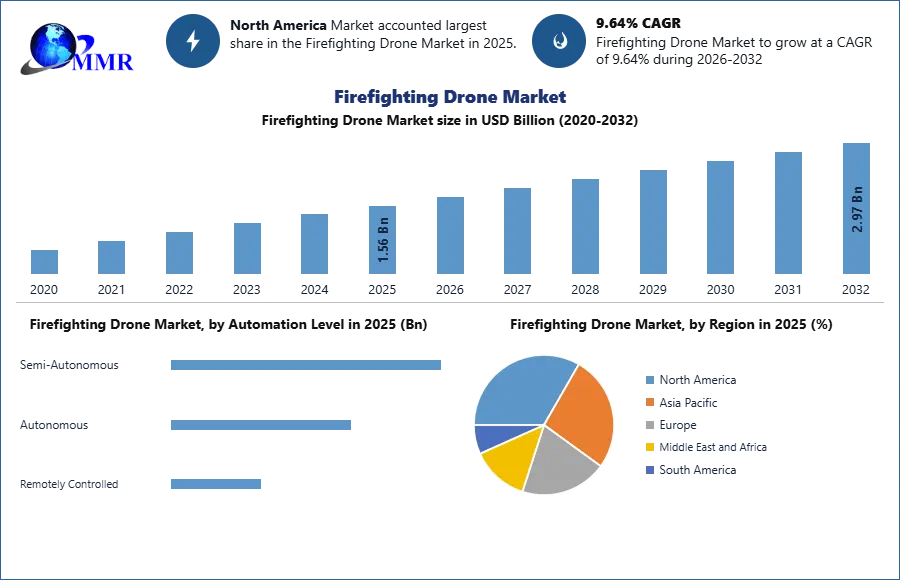
The Firefighting Drone Market size was valued at USD 1.56 Billion in 2025 and the total Firefighting Drone revenue is expected to grow at a CAGR of 9.64% from 2026 to 2032, reaching nearly USD 2.97 Billion.
Fire drones are unmanned aircraft that may be remotely piloted into a target. The high-risk tasks are done by drone where a trained pilot can direct them to carry out procedures for fire safety and emergency response remotely. They are specially made to control fires in places that are inaccessible to people, such as high-rise buildings without stair access or any places where humans can not reach and they carry firefighting equipment, such as water cannons or foam dispensers.
Thanks to the ongoing development of cutting-edge technologies, companies are using electromechanical sensor technology for firefighting drones. Drones used by firefighters are helpful at the scenes of wildfires, car accidents, hazardous situations, and even rescue missions. Accidents involving fires result in deadly injuries to firefighters as well as fatalities and property damage. As a result, governments across the world are promoting the use of new technology and pushing the adoption of firefighting drones. Leading drone manufacturers are also inventing and developing sophisticated firefighting solutions with a greater level of functionality and safety features.
To know about the Research Methodology :- Request Free Sample Report
Firefighting Drone Market Report Scope
The Firefighting Drone market report defines and outlines the products, applications, and specifications to the investor. In addition to highlighting the important change procedures that businesses have adopted to maintain their competitive advantages, the report lists the top companies currently active in the market. The SWOT analysis used in the report evaluates the strengths, weaknesses, opportunities, threats, and combinations of prominent companies. Details about the product type, business overview, sales, manufacturing base, participants, applications, and specifications are provided for each of the leading players in this global market. In addition, the comprehensive analysis provides a full assessment of the market, which includes market trends, current growth factors, new opportunities, industry recommendations, facts, historical information, statistical backed-up, and valid market information.
Firefighting Drone Market Trends
The invention of a drone that can transport a weight of approximately 100 lbs is another continuous breakthrough in the industry. Another new product on the market is the Firefly heavy-lift drone, created by Parallel Flight Technologies in collaboration with NASA. It is a high-duty drone for delivering industrial products, firefighting equipment, and other hefty items. Other human aircraft may not be able to operate in low visibility conditions, thus this autonomous drone can be a suitable replacement. The drone can constantly fly from a distance of two while supporting a burden of over 100 lbs. The beta-level aircraft will be available on the market this year, the business claims. These commercial advances appear to have the potential to change the firefighting drone market.
Firefighting Drone Market Dynamics:
Advancement of New Technology in Firefighting Drone
Infrared drones are exceptionally beneficial for firefighters. The firefighters on the location can be better directed to extinguish the fire with more information from the air incident command. FLIR thermal-equipped drones enable incident command to use smoke-seeking technology to guide firefighters to hotspots or guide and supervise rescue companies during entry. Companies also helped fire departments to launch their drone programs by collaborating with them. These factors are boosting the Firefighting Drone Market growth across the world.
Growing Number of Casualties
Increased building density and the advent of megacities as a result of population growth and urbanization have caused high-rise construction to proliferate in cities all over the world. In such vertical cities, it has proven challenging to ensure the protection of people and other assets, particularly during natural or man-made calamities. There are many obstacles for firefighters to overcome when putting effective mitigation measures into place as a result of the increasing frequency of fire outbreaks in urban settings. As a result, the demand for firefighting drones is expected to boost the firefighting drones market growth through the forecast period.
Airborne Inspection
An oil and gas company needs to conduct its required monthly pipeline inspection. According to MMR estimation, in the US, the company usually hires a USD 2,500-an-hour helicopter crew for the job. But using a drone has reduced costs. In addition to inspection, they are also useful for fire casualties, which causes because of oil and gas sensitivity. These factors are expected to boost product demand and the Firefighting Drone Market growth in the US.
However, firefighter drones are becoming more complex as cutting-edge technology is used more frequently. They also come with cutting-edge GPS systems and sensors. The market's growth is expected to be hampered by variables such as limited Integration complexity, environmental circumstances, and data accuracy.
Firefighting Drone Market Segment Analysis:
Based on Type, Fixed-wing drones have gained significant traction in firefighting, particularly for large-scale operations and monitoring vast fire zones. These drones are equipped with wings that allow them to glide for long distances, making them more efficient for extended flight times compared to multi-rotor drones. They are ideal for aerial surveys, especially when fires are spread over vast, difficult-to-reach landscapes, such as forests or mountains. Their ability to cover large areas in a single flight makes them invaluable for assessing fire boundaries, detecting hotspots, and tracking the spread of the fire over time. Fixed-wing drones can also carry heavier payloads, allowing for the transportation of fire retardants or other firefighting materials to critical areas. Their endurance allows them to stay in the air longer, providing continuous data for decision-making. However, they require a larger takeoff and landing area, which can be a challenge in urban environments. Despite these limitations, fixed-wing drones remain a dominant choice for wildfire management and long-range aerial reconnaissance, where long endurance and extensive coverage are critical.
Based on Automation Level, Autonomous firefighting drones dominated Firefighting Drone Market in 2025 due to their ability to perform tasks with minimal human intervention, offering substantial advantages in both efficiency and safety. These drones are equipped with advanced AI and machine learning algorithms, which allow them to make real-time decisions based on the data they collect, such as monitoring fire behavior or identifying hot spots. Autonomous drones can operate independently for extended periods, reducing the need for manual control and allowing human operators to focus on strategic planning and other critical tasks. In firefighting operations, these drones are often used for tasks such as wildfire monitoring, damage assessment, and tracking fire progression across large areas. Autonomous capabilities also allow these drones to navigate through challenging environments, such as smoke-filled areas or dense forests, where human pilots may struggle to operate effectively. Furthermore, autonomous drones are capable of automatic charging and returning to base without requiring constant supervision. Their integration into firefighting operations can significantly enhance the overall response time, improve situational awareness, and help firefighters make data-driven decisions more quickly and accurately.
Firefighting Drone Market Regional Insights:
North America held the largest market share of the global Firefighting Drone Market in 2025. The North American firefighting drone market is a leading segment globally, driven by high adoption rates in the United States and Canada. This market is primarily fueled by the increasing frequency of wildfires, industrial fire risks, and the need for rapid, data-driven responses. Drones equipped with thermal imaging cameras, infrared sensors, and AI-assisted analytics are becoming integral tools for fire departments, providing critical insights into fire behavior and helping optimize firefighting strategies. Their ability to conduct real-time surveillance, detect hotspots, and map fire progression has revolutionized fire management, enhancing firefighter safety and operational efficiency. Government support, through grants and funding programs, has also accelerated the integration of drones into firefighting operations, further boosting market growth. The region is expected to maintain its dominance in the global market, supported by ongoing investments in autonomous and semi-autonomous drone technologies, making North America a hub for innovation in firefighting drone solutions. The commercial drone market is driven by growing reliance on aerial surveillance and advanced drone capabilities in emergency response operations.
Firefighting Drone Market Competitive Landscape
In Firefighting Drone Market, asset alliances are now being adopted by market participants as one of their main strategies for achieving their objectives. This enables the companies to combine their knowledge and capitalize on one another's advantages to serve a broad customer base. Collaboration frees up time and resources for innovations, helping businesses adjust to shifting market trends. Aquiline Drones Corporation (AD), an American maker of drones and cloud solutions, collaborates with AWARE, a secure cloud-based suite of technologies created especially for first responders. This partnership will increase AD's ability to respond to emergency occurrences fully with effective on-field decision-making capabilities and real-time control. AD's drones are AI-enabled, autonomous, US-made devices. Companies are looking for product development with advanced technology like AI and IoT as their key development strategies to gain a competitive edge. The collaborations and acquisitions are assisting leading players to enhance their product portfolios and develop into different regions across the world. The key players operating in the firefighting drone market include Lockheed Martin, L3Harris Technologies, Ehang, AeroVironment, Inc, DSLRPros, Dronefly, Drone Amplified, and BSS Holland B.V., among others.
Firefighting Drone Market Scope: Inquiry Before Buying
| Firefighting Drone Market | |||
|---|---|---|---|
| Report Coverage | Details | ||
| Base Year: | 2025 | Forecast Period: | 2026-2032 |
| Historical Data: | 2020 to 2025 | Market Size in 2025: | 1.56 USD Billion |
| Forecast Period 2026-2032 CAGR: | 9.64% | Market Size in 2032: | 2.97 USD Billion |
| Segments Covered: | by Type | Fixed Wing Multi-rotor |
|
| by Automation Level | Semi-Autonomous Autonomous Remotely Controlled |
||
| by Propulsion | Electric Motor Piston Engine Solar Powered Others |
||
| by Payload Capacity | Small (Up to 25 Liter) Medium (25 Liter to 50 Liter) Heavy (50 Liter and Above) |
||
| by Component | Avionics Telemetry Receiver Power Distribution Board Motors Others Airframes Landing Gear Propellers Payload IR Cameras Thermal Cameras Tank Centrifugal Novel Pipes Others |
||
Firefighting Drone Market, by Region
North America (United States, Canada, Mexico)
Europe (United Kingdom, France, Germany, Italy, Spain, Sweden, Russia, Poland, Belgium, Netherlands, Rest of Europe)
Asia Pacific (China, South Korea, India, Japan, Australia, Indonesia, Malaysia, Philippines, Thailand, Vietnam, Rest of Asia Pacific)
Middle East & Africa (South Africa, GCC, Egypt, Nigeria, Rest of MEA)
South America (Brazil, Argentina, Colombia, Chile, Rest of South America)
Key players/Competitors profiles covered in the Firefighting Drone Market report in strategic perspective
- DJI
- Parrot
- Quantum Systems
- Delair
- Aeryon Labs
- Altavian
- Skydio
- Aeroscout
- Teledyne FLIR
- Zipline
- EHang
- Northrup Grumman
- Insitu
- Vantage Robotics
- HEMAV
- XAG
- Yuneec International
- Autel Robotics
- Drone Aviation Holding Corp.
- Flyability
- Firehawk Helicopters
- Black Swift Technologies
- Griff Aviation
- Ascent AeroSystems
- Unmanned Systems Technology
- L3Harris Technologies
- DroneVolt
- AVS (Aerial Video Systems)
- Micron UAV
- SkyFire Consulting