
Feed Mycotoxin Detoxifiers Market Size, Share, Growth, Trends & Forecast by Product Type, Form, Animal Type, Mycotoxin Type and Distribution Channel
Overview
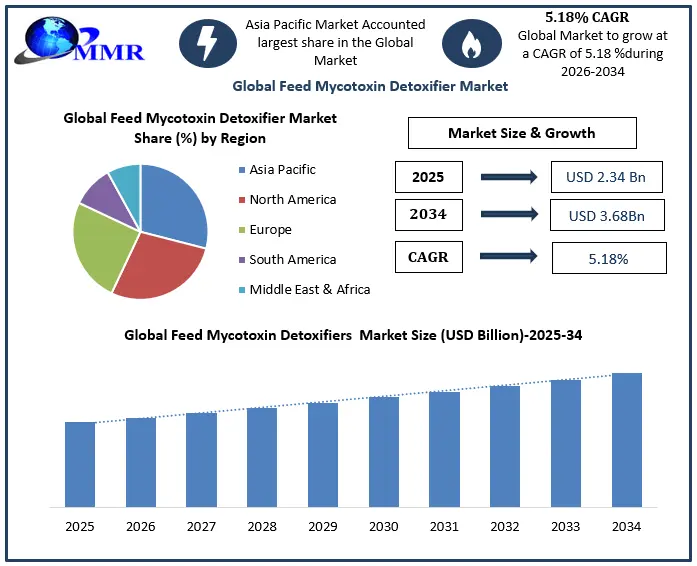
The Global Feed Mycotoxin Detoxifiers Market was valued at USD 2.34 billion in 2025 and is estimated to reach USD 3.68 billion by 2034, growing at a 5.18% CAGR during the forecast period 2026-2034.
Global Feed Mycotoxin Detoxifiers Market Overview
The Feed Mycotoxin Detoxifiers Market comprises feed additives designed to reduce the harmful effects of mycotoxins in animal feed and feed ingredients. These solutions include binders, adsorbents, toxin modifiers, enzymes, and biological detoxification products that limit toxin absorption or convert mycotoxins into less harmful compounds. Key contaminants include aflatoxins, deoxynivalenol, fumonisins, ochratoxin A, and zearalenone, which can negatively affect animal health, feed efficiency, productivity, and livestock performance. EFSA identifies mycotoxins as naturally occurring toxins that can enter the food and feed chain through crop contamination before or after harvest.
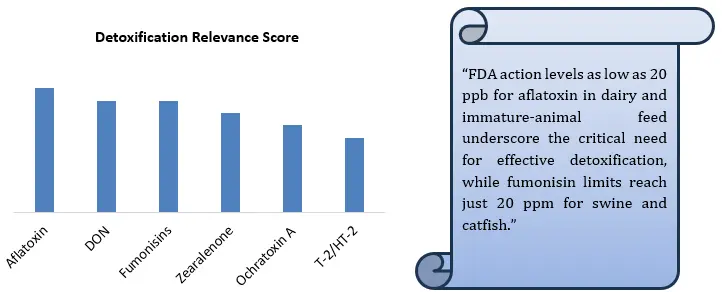
The global market is projected to reach USD 3.68 billion by 2034, expanding at a 5.18% CAGR, driven by persistent feed-contamination risks, expanding commercial livestock production, and increasing emphasis on preventive feed safety. Regulatory requirements also support adoption. The U.S. FDA, for instance, establishes aflatoxin action levels ranging from 20 ppb for feed intended for immature and dairy animals to 300 ppb for certain finishing cattle and cottonseed-meal applications, highlighting the importance of effective mycotoxin management.
Growing demand for meat, dairy, and eggs further strengthens the market opportunity. USDA research indicates that rising population and incomes in India are expected to increase domestic demand for animal protein, placing additional pressure on feed supply and quality. This supports demand for detoxifiers across poultry, livestock, dairy, and aquaculture applications.Going forward, market growth increasingly centers on multi-toxin protection, biological detoxification, enzymatic solutions, and scientifically validated additives. Regulatory scrutiny is likely to favor products with consistent efficacy, broad toxin coverage, and compatibility with commercial feed formulations.
The report evaluates market size and forecast, product and animal types, mycotoxin categories, forms, distribution channels, regional dynamics, competitive strategies, emerging trends, and recent developments to identify growth opportunities and support investment, product-development, market-entry, and expansion decisions.
Global Feed Mycotoxin Detoxifiers Market Growth Outlook
To know about the Research Methodology :- Request Free Sample Report
Global Feed Mycotoxin Detoxifier Market Key Highlights
|
Global Feed Mycotoxin Detoxifiers Market Dynamics
Stricter Feed-Safety Controls Strengthen Detoxifier Demand is to Drive the Market
Increasing regulatory attention toward mycotoxin contamination strengthens the need for preventive feed-safety solutions. The U.S. FDA establishes species- and application-specific action levels for aflatoxin in animal feed, ranging from 20 ppb for feed intended for immature and dairy animals to 300 ppb for certain finishing cattle and other applications. Such differentiated limits require feed manufacturers and livestock producers to actively monitor and manage contamination risks, supporting demand for mycotoxin binders, adsorbents, and other feed detoxification solutions.
Variable Detoxification Efficacy Restrains Product Adoption
The effectiveness of detoxification solutions varies according to the mycotoxin type, concentration, feed composition, and detoxification mechanism. Conventional binding technologies may not provide uniform protection against every toxin, while biological and enzymatic solutions require more specialized formulation and validation. This variability makes producers more cautious about adopting premium products and increases the importance of demonstrated efficacy under practical feeding conditions. FAO notes that mycotoxin contamination can occur at multiple stages, including cultivation, processing, and storage, making consistent toxin management difficult.
Multi-Mycotoxin Solutions Expand the Addressable Market and Creates Opportunities
The increasing recognition of multiple mycotoxin exposure creates opportunities for broad-spectrum detoxification products. Feed ingredients can encounter different fungal contaminants depending on crop, geography, climate, storage conditions, and processing practices. FAO identifies several important fungal sources, including Aspergillus, Fusarium, and Penicillium, and notes that mycotoxins can affect animal growth, reproduction, and immune function. This supports the development of multi-toxin binders, mycotoxin modifiers, enzymatic detoxifiers, and combination formulations that provide broader protection than single-toxin solutions.
Climate-Linked Contamination Increases Risk Uncertainty Challenges the Market
Changing environmental conditions create uncertainty around the occurrence and concentration of mycotoxins in feed ingredients. FAO reports that mycotoxin-producing fungi thrive particularly in warm and humid conditions, while contamination can occur in the field, during harvesting, transportation, and storage. This makes contamination patterns less predictable and complicates consistent formulation, testing, inventory planning, and risk management for feed manufacturers. The challenge is particularly relevant for regions dependent on vulnerable grain crops, where variations in temperature and moisture can alter contamination risks between production cycles.
The strongest market dynamic is the transition toward preventive and continuous mycotoxin management. Regulatory controls create the baseline demand, while multi-toxin exposure and changing contamination conditions increasingly shift purchasing decisions toward broad-spectrum, scientifically validated, and application-specific Feed Mycotoxin Detoxifiers.
Which mycotoxins create the strongest demand for detoxification solutions?
Global Feed Mycotoxin Detoxifiers Market Trends
• From Binding to Biological Breakdown - The market is shifting beyond conventional mycotoxin binders toward enzymatic and microbial biotransformation solutions that directly degrade or modify toxins. This approach is gaining attention because different mycotoxins respond differently to adsorption, while targeted enzymes can be designed around specific toxins. FAO/Codex materials recognize both adsorption and biotransformation as mechanisms used by mycotoxin detoxifying agents.
• Multi-Toxin Protection Becomes the New Standard - Feed producers increasingly seek solutions capable of addressing multiple mycotoxins simultaneously, rather than products focused on a single contaminant. Aflatoxins, deoxynivalenol, fumonisins, ochratoxin A, and zearalenone can occur across different feed ingredients and production conditions. This supports the development of broad-spectrum binders, combination formulations, and multi-mechanism detoxifiers.
• Climate Risk Pushes Preventive Mycotoxin Management - Increasing climate variability is making mycotoxin risk management more important because temperature and humidity influence fungal growth and toxin formation. EFSA notes that climate change is expected to affect mycotoxin occurrence. The risks are associated with changing temperature, rainfall, drought, and humidity patterns. This encourages feed manufacturers and livestock producers to adopt detoxifiers as part of preventive feed-safety programs, rather than relying only on contamination testing after feed production.
Global Feed Mycotoxin Detoxifiers Market – Segment Analysis
| “Binders anchor the market, while next-generation enzymatic and microbial modifiers create the strongest pathway for premiumization and technology-led growth.”
“Poultry remains the key demand engine, while aquaculture and livestock applications offer attractive expansion opportunities as commercial feed adoption rises.” |
By Product Type: Mycotoxin Binders Lead in 2025
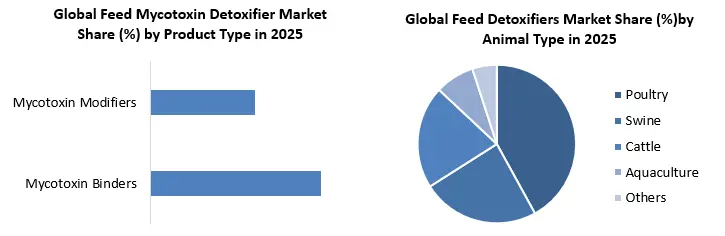
Mycotoxin Binders account for the largest market share in 2025, supported by their established use in commercial feed formulations, ease of incorporation, and practical ability to reduce toxin bioavailability. Mineral-based binders, particularly clay-based adsorbents, form the core of this segment due to their proven application and cost-effective positioning. Organic and biological binders are gaining traction as producers seek broader toxin coverage and improved functional performance.
Mycotoxin Modifiers represent the higher-growth technology segment, driven by increasing adoption of enzymatic, microbial, and biotransformation approaches. Unlike conventional adsorption, these solutions can actively transform specific mycotoxins into less harmful compounds. Enzymatic detoxifiers offer strong long-term potential, while microbial/biotransformation solutions and combination products gain attention for targeted and multi-mycotoxin protection. Regulatory requirements for demonstrated safety and efficacy further support scientifically validated products.
Binders retain the largest revenue base, while modifiers are expected to expand faster as the market shifts toward targeted degradation, multi-mycotoxin protection, and biologically driven detoxification.
By Animal Type: Poultry Dominated the Global Feed Mycotoxin Detoxifier Market in 2025
Poultry represents the largest application segment in 2025, driven by the scale of commercial poultry production, high dependence on formulated feed, and strong sensitivity of production economics to feed efficiency and animal performance. Broilers form a major demand center because rapid growth cycles require consistent feed quality, while layers and breeders require sustained protection to support productivity and reproductive performance.
Swine remains a significant demand segment as producers increasingly focus on feed conversion, growth performance, and preventive feed-safety management. Cattle, particularly dairy cattle, also maintain strong demand because mycotoxin exposure can affect animal performance and create concerns around toxin transfer into milk. Species-specific feed-safety requirements further reinforce the need for targeted detoxification strategies. Aquaculture remains a smaller segment but offers an attractive high-growth opportunity. Growing use of formulated and plant-based feeds increases exposure to contamination risks, creating demand for detoxifiers designed specifically for fish and shrimp diets.
During 2026-34, poultry is expected to remain the largest demand base, while aquaculture and specialized swine/cattle solutions provide attractive incremental growth. Demand increasingly shifts toward broad-spectrum, species-specific, and combination detoxifiers.
Feed Mycotoxin Detoxifiers Market – Regional Analysis
North America: Mature Demand Supported by Strict Feed-Safety Management
North America represents a mature and high-value market, supported by large-scale poultry, swine, and dairy production, extensive use of formulated feed, and strong emphasis on feed-quality monitoring. In the U.S., FDA establishes species- and use-specific action levels for aflatoxins, including 20 ppb for feed intended for immature animals and dairy animals, creating a clear compliance-driven need for mycotoxin management. Alltech is a key regional player, particularly relevant because of its established mycotoxin testing, risk-assessment, and feed-management programs across U.S. and Canadian producers. Growth remains steady, with demand shifting toward multi-mycotoxin solutions, rapid testing, and integrated detoxification programs rather than basic binders alone.
Europe: Regulation-Driven Demand Favors Advanced Detoxifiers
Europe remains one of the most regulation-intensive markets, where stringent feed-safety requirements and scientific evaluation of feed additives encourage adoption of products with demonstrated safety and efficacy. The regulatory environment particularly favors validated enzymatic, microbial, and combination detoxifiers, creating stronger opportunities for higher-value mycotoxin modifiers alongside conventional binders. The region's developed livestock and compound-feed industries further support consistent demand, while increasing focus on multi-mycotoxin contamination encourages broader-spectrum solutions. Europe is expected to remain an important innovation center, with growth concentrated in biotransformation, enzymatic detoxification, and scientifically validated combination products.
Asia Pacific: Fastest-Growing Demand Base
Asia Pacific offers the strongest growth opportunity as expanding poultry, swine, dairy, and aquaculture production increases reliance on commercial feed, while climatic conditions and imported grain exposure create recurring mycotoxin risks. Alltech highlights the importance of mycotoxin risks in imported corn, wheat, and barley used by Asian livestock producers, while Kemin identifies mycotoxin management as an important feed-safety requirement across poultry, swine, and ruminants. Regulatory frameworks remain more fragmented than in Europe, but increasing feed-safety controls and modernization of commercial livestock production are supporting adoption. Kemin is a key regional player, particularly through its established TOXFIN toxin-binder portfolio and mycotoxin-management activities across South Asia and Asia Pacific. Asia Pacific is positioned for the fastest growth, led by poultry and swine, with increasing demand for broad-spectrum and combination detoxifiers.
South America: Growing Demand Linked to Feed and Export-Oriented Livestock Production
South America presents an attractive growth market because of its large poultry, swine, cattle, and feed industries and extensive production of crops such as corn and soybeans that enter animal-feed supply chains. Mycotoxin risk management is particularly relevant where variable climatic conditions and large-scale grain production create contamination risks. Brazil's MAPA regulates animal-feed additives through registration, approved-ingredient lists, and conditions governing their manufacture, import, commercialization, and use, providing a formal regulatory framework for detoxification products. Demand should expand alongside poultry and swine production, with opportunities increasingly moving toward multi-mycotoxin protection and higher-performance formulations.
Middle East & Africa: Emerging Market with Significant Untapped Potential
Middle East & Africa remains a comparatively smaller but strategically attractive market, where rising commercial poultry production, feed manufacturing, climatic stress, and variable grain-storage conditions create increasing mycotoxin-management requirements. Regulatory coverage remains less harmonized than in North America and Europe; a review of African feed regulations found that only a limited number of countries had established specific mycotoxin limits, although the East African Community has defined limits for aflatoxins in poultry feed. This regulatory gap creates both a challenge and an opportunity as feed-safety standards become more formalized. Growth is likely to come primarily from poultry and dairy, with adoption accelerating as commercial feed production, testing infrastructure, and regulatory enforcement improve.
Global Feed Mycotoxin Detoxifiers Market Recent Developments
| Year | Company / Development | Development | Market Significance |
| 2026 | dsm-firmenich | Published its January–June 2026 World Mycotoxin Survey, covering 10,410 samples, 59,180 analyses across 78 countries and highlighting co-contamination and emerging mycotoxin risks. | Strengthens the shift toward data-driven mycotoxin risk assessment and supports demand for targeted, multi-toxin solutions. |
| 2026 | dsm-firmenich | Expanded focus on aquaculture mycotoxin risk, publishing a dedicated analysis in August 2026 as aquaculture becomes an increasingly important feed application. | Supports growth of species-specific detoxifiers, particularly for fish and shrimp feeds. |
| 2026 | Kemin | Advanced TOXFIN™ 360°, based on patented synthetic tectosilicate technology, with broad-spectrum binding of multiple mycotoxins and selected pesticides. | Demonstrates continued innovation within the binder segment, moving beyond conventional clay-based products toward higher-selectivity materials. |
| 2025–26 | dsm-firmenich | Continued development of the Mycofix® portfolio, combining adsorption, biotransformation and bioprotection; its FUMzyme® technology targets irreversible enzymatic degradation of fumonisins. | Reinforces the industry's movement from simple adsorption toward enzymatic and combination-based detoxification. |
| 2025–26 | ADM & Alltech | ADM and Alltech established a North American animal-feed joint venture involving 11 ADM feed mills and Alltech's U.S./Canadian feed-mill operations, with launch planned for 2026. | Signals increasing consolidation and vertical integration in the feed industry, potentially strengthening distribution channels for specialty feed additives and mycotoxin solutions. |
Feed Mycotoxin Detoxifiers Market – Competitive Analysis
The Feed Mycotoxin Detoxifiers Market has a moderately consolidated, technology-driven competitive structure, with leading global feed-additive companies competing through product efficacy, breadth of toxin coverage, regulatory approvals, technical services, and farmer/feed-mill relationships rather than price alone. Competition is gradually shifting from conventional mineral adsorption toward differentiated solutions combining adsorption, enzymatic degradation, microbial biotransformation, and broader toxin-risk management. dsm-firmenich has one of the strongest technology positions through its Mycofix® portfolio, which combines adsorption with enzymatic deactivation and is supported by seven EU authorizations for mycotoxin-deactivating substances. Kemin competes strongly in the binder segment through its TOXFIN™ range, emphasizing broad-spectrum adsorption, activated clays, and in-vitro/in-vivo validation. EW Nutrition differentiates through its Mastersorb portfolio, covering mycotoxin and endotoxin mitigation across poultry, swine, and ruminants.
Global Feed Mycotoxin Detoxifier Market Competitive Positioning of Key Players
| Company | Key positioning | Main competitive strategy | Regional strength |
| dsm-firmenich | Advanced deactivation + risk management | Enzymatic technology, testing, prediction & premium solutions | Global / Europe / Asia |
| Kemin | Broad-spectrum toxin binders | Activated-clay technology, efficacy validation & technical support | North America / Asia / South America |
| EW Nutrition | Integrated toxin mitigation | Multi-product portfolio and species-specific solutions | Europe / Global |
| Biomin | Science-led mycotoxin management | Biological/enzymatic solutions, research & technical services | Europe / Asia |
| Alltech | Feed safety + nutritional management | Diagnostics, technical advisory and integrated nutrition | North America / Global |
Pricing & Go-to-Market Strategy
Pricing is generally value-based rather than commodity-based, with manufacturers differentiating products according to toxin coverage, inclusion rate, mechanism of action, efficacy evidence, and regulatory status. Conventional mineral binders face greater price sensitivity and competition from lower-cost local suppliers, whereas enzyme-based, biological, and multi-functional products command stronger premium positioning because suppliers can link efficacy to reduced production losses and improved animal performance. Consequently, major companies increasingly sell a solution rather than only a feed additive—combining testing, contamination monitoring, risk assessment, formulation advice, and mitigation products. For example, dsm-firmenich provides mycotoxin analysis and prediction services alongside its mitigation portfolio, strengthening customer retention and creating a data-driven entry point for product sales.
Regional Competitive Dynamics
Competition also varies considerably by region. Europe favors scientifically validated and regulatory-compliant technologies, strengthening the position of advanced biological and enzymatic products. North America has a strong presence of established feed-additive and nutrition companies, with technical service and large feed-mill relationships becoming important competitive advantages. Asia Pacific is emerging as a major battleground because of rapid feed-industry expansion; dsm-firmenich, for example, opened a new animal-nutrition plant in India in 2025 with manufacturing capabilities for Mycofix
solutions, strengthening local supply and regional positioning. South America favors suppliers with strong poultry and swine networks and locally adapted products, while emerging markets in Africa and the Middle East remain more price-sensitive and provide opportunities for established binder technologies.
Key Competitive Trend
The most important competitive shift is from “binding the toxin” toward “managing the entire mycotoxin risk.”
Feed Mycotoxin Detoxifier Market Scope: Inquire before buying
| Feed Mycotoxin Detoxifier Market | |||
|---|---|---|---|
| Report Coverage | Details | ||
| Base Year: | 2025 | Forecast Period: | 2026-2034 |
| Historical Data: | 2020 to 2025 | Market Size in 2025: | USD 2.34 Bn. |
| Forecast Period 2026 to 2034 CAGR: | 5.18% | Market Size in 2034: | USD 3.68 Bn. |
| Segments Covered: | by Product Type | Mycotoxin Binders Mineral-based binders Organic/biological binders Mycotoxin Modifiers Enzymatic detoxifiers Microbial/biotransformation agents Combination detoxifiers |
|
| by Form | Liquid Powder |
||
| by Animal Type | Poultry Broilers Layers Breeders Swine Cattle Dairy cattle Beef cattle Aquaculture Fish Shrimp Others |
||
| by Mycotoxin Type | Aflatoxin Deoxynivalenol (DON) Fumonisins Zearalenone (ZEN) Ochratoxin A (OTA) T-2 / HT-2 toxins Others |
||
| by Distribution Channel | Direct Sales Distributors & Dealers Online Channels Other Commercial Channels |
||
Global Feed Mycotoxin Detoxifiers Market, by Region
North America (United States, Canada, and Mexico)
Europe (UK, France, Germany, Italy, Spain, Sweden, Austria, and the Rest of Europe)
Asia Pacific (China, South Korea, Japan, India, Australia, Indonesia, Malaysia, Vietnam, Taiwan, Bangladesh, Pakistan, and the Rest of APAC)
Middle East and Africa (South Africa, GCC, Egypt, Nigeria, and the Rest of ME&A)
South America (Brazil, Argentina, Rest of South America)
Global Feed Mycotoxin Detoxifiers Market Key Players
North America
1. Kemin Industries, Inc.
2. Alltech, Inc.
3. Cargill, Incorporated
4. Archer Daniels Midland Company (ADM)
5. Amlan International
6. Novus International, Inc.
7. Bentoli, Inc.
8. Special Nutrients, Inc.
9. Phibro Animal Health Corporation
10. Prince Agri Products, Inc.
11. Cenzone Tech Inc.
12. Zoetis Inc.
Europe
13. dsm-firmenich / BIOMIN
14. BASF SE
15. EW Nutrition GmbH
16. Adisseo
17. Nutreco / Trouw Nutrition / Selko
18. Perstorp Holding AB
19. Impextraco N.V.
20. Olmix Group
21. Anpario plc
22. Norel S.A.
23. Orffa International
24. Dr. Eckel Animal Nutrition GmbH & Co. KG
25. Novonesis
26. Virbac S.A.
27. Clariant AG
28. VisscherHolland B.V.
Asia Pacific
29. Kemin Industries
30. dsm-firmenich / BIOMIN
31. Alltech
32. Cargill
33. ADM
34. BASF
35. Adisseo
36. Amlan International
37. Novus International
38. EW Nutrition
39. Olmix Group
40. Impextraco
41. Nutreco / Trouw Nutrition / Selko
42. Phibro Animal Health
43. Global Nutritech
44. Anfotel Nutritions
45. Avitech Nutrition
46. Simfa Labs
South America
47. Kemin Industries
48. dsm-firmenich / BIOMIN
49. Alltech
50. Cargill
51. ADM
52. BASF
53. Adisseo
54. Nutreco / Trouw Nutrition / Selko
55. EW Nutrition
56. Impextraco
57. Olmix Group
58. Perstorp
59. Amlan International
60. Phibro Animal Health
61. Novus International
Middle East & Africa
62. Kemin Industries
63. Alltech
64. dsm-firmenich / BIOMIN
65. BASF
66. Cargill
67. ADM
68. EW Nutrition
69. Adisseo
70. Olmix Group
71. Impextraco
72. Amlan International
73. Nutreco / Trouw Nutrition / Selko
74. Perstorp
75. Anpario
76. Global Nutritech
77. Phibro Animal Health
Global Feed Mycotoxin Detoxifiers Market Frequently Asked Questions
1. What is the Feed Mycotoxin Detoxifiers Market?
Ans: The Feed Mycotoxin Detoxifiers Market covers products used in animal feed to reduce the harmful effects of mycotoxins through mechanisms such as adsorption, binding, enzymatic degradation, and biological transformation.
2. What is driving the growth of the Feed Mycotoxin Detoxifiers Market?
Ans. Growth is driven by increasing concerns about mycotoxin contamination in animal feed, greater emphasis on feed safety, expansion of commercial livestock production, and rising adoption of mycotoxin binders and modifiers to protect animal health and productivity.
3. Which product type dominates the Feed Mycotoxin Detoxifiers Market?
Ans. Mycotoxin binders represent the leading product category because of their established use, relatively simple incorporation into feed, and broad availability. However, mycotoxin modifiers and biological detoxification solutions are gaining importance as producers seek more targeted and multi-toxin protection.
4. Which animal type holds the largest share of the Feed Mycotoxin Detoxifiers Market?
Ans. Poultry represents a major demand segment because commercial poultry production relies heavily on formulated feed and is highly sensitive to changes in feed quality and efficiency. Swine, cattle, and aquaculture also provide significant application opportunities.
5. What are the major mycotoxins targeted by Feed Mycotoxin Detoxifiers?
Ans. Key target toxins include aflatoxins, deoxynivalenol (DON), fumonisins, zearalenone (ZEN), ochratoxin A (OTA), and T-2/HT-2 toxins. Product efficacy varies by toxin and detoxification mechanism.
6. What are the major trends in the Feed Mycotoxin Detoxifiers Market?
Ans. Key trends include the shift toward multi-mycotoxin protection, increasing development of enzymatic and microbial detoxification technologies, and growing integration of mycotoxin management into preventive feed-safety programs.
7. What is the future outlook for the Feed Mycotoxin Detoxifiers Market?
Ans. The market is expected to maintain steady growth as feed manufacturers increasingly prioritize contamination control, animal productivity, and regulatory compliance. Asia Pacific, advanced biological detoxification technologies, and broad-spectrum products are expected to provide important opportunities through the forecast period.