
Electrically Conductive Adhesives Market by Chemistry, Filler Material, Application, Morphology, and Region - Global Market Size Estimation, Industry-Wide Analysis, Competitive Landscape Assessment & Long-Term Forecast to 2034
Overview
Electrically Conductive Adhesives Market was valued at US$ 3.02 Bn in 2025 and is expected to reach US$ 6.13 Bn by 2034, at a CAGR of 8.2% during the forecast period.
The report has covered the current short-term and long-term impact on the market, and it would help the decision-makers to prepare the outline and strategies for companies by region.
Electrically Conductive Adhesives Market Dynamics:
The objective of the report is to present a comprehensive assessment of the market and contains thoughtful insights, facts, historical data, industry-validated market data, and projections with a suitable set of assumptions and methodology. The report also helps in understanding electrically conductive adhesives market dynamics, structure by identifying and analyzing the market segments and project the global market size.
Further, the report also focuses on competitive analysis of key players by product, price, financial position, product portfolio, growth strategies, and regional presence. The report also provides PEST analysis, PORTER’s analysis, SWOT analysis to address questions of shareholders to prioritizing the efforts and investment in near future to emerging segment in electrically conductive adhesives market.
The major use of electrically conductive adhesives is to join electrical or electronic components. These adhesives help to complete the circuit as well as maintain the conductivity of the circuit. Electrically conductive adhesives play an extensive role in manufacturing across a wide range of industries such as electronic, solar cell, medical instrument, aerospace, and automotive components.
Electrically conductive adhesive applications include electrical and mechanical attachments for stress-sensitive devices, bonding electronic components to lead frames and circuit materials to heat sinks, and solder replacement. Our electrically conductive adhesives are extremely resilient, featuring excellent conductivity, and are less sensitive to thermal cycling.
Electrically conductive adhesives have qualities such as low shrinkage, moisture resistance, and strong bonds primarily due to the presence of filler materials. Fillers used in electrically conductive adhesives are graphite, nickel, copper, and silver.
Electrically Conductive Adhesives Market Size, Share and Growth Analysis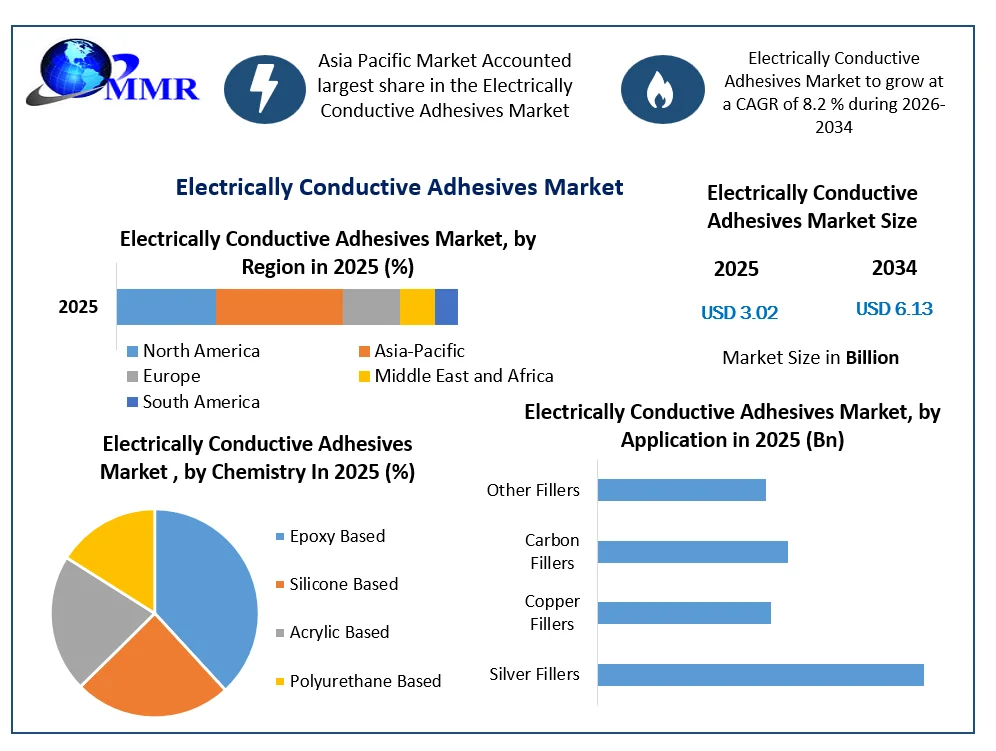
To know about the Research Methodology:-Request Free Sample Report
Segment Analysis:
Based on the chemistry, the epoxy-based adhesives segment has been witnessing significant demand in recent years because of the several advantages that these adhesives offer. Epoxy-based adhesives required short processing time and less handling of assemblies required as a result it provides quicker production.
Based on the filler material, copper is the most lucrative filler segment in the global electrically conductive adhesives followed by silver filler. The silver filler is commonly used due to its high conductivity and stability. However, the cost of conductive adhesives with silver fillers is much higher than usual lead-free solders, so the copper can be a promising candidate for conductive filler metal due to its low resistivity and low cost.
Based on the application, Automotive is the most profitable application segment in the global market followed by Consumer Electronics & others. Electrically conductive adhesives are widely used in automotive for anti-lock braking systems, engine control units, and transmission control units. Although, in the consumer electronics segment, they are used for flexible connections in various electronic devices.
Electrically conductive adhesives have superior properties due to which they can be used extensively in PV solar panels, touch panel screens, LED/OLEDs, and various other electronic devices. Electrically conductive adhesives are also accomplished by blocking the electromagnetic radiations emitted by electronic devices. Thus, these adhesives are used for electromagnetic shielding.
Based on Morphology, Isotropic conductive adhesives dominate the market. Isotropic conductive adhesives (ICA) are used in applications such as chip contacting and bonding electrically conductive SMDs. Further, Anisotropic conductive adhesives (ACA) contain special conductive particles in the µm range, which conduct electricity only in one direction. These adhesives are used in many sensitive structures on circuit boards, such as LCD connections or contacting flexible PCBs, or for bonding antenna structures on RFIDs.
The market is driven by the increase in the use of electronic components in automotive, aerospace, and various other industries accompanied by the growing trend in the miniaturization of electronic gadgets.
Electrically Conductive Adhesives Market Recent Developement
| Date | Company | Development | Impact |
|---|---|---|---|
| 15 January 2025 | Henkel AG & Co. KGaA | Henkel launched a next-generation UV-curable electrically conductive adhesive designed for fast processing in delicate electronic assemblies. | The innovation significantly reduces curing time and thermal stress on sensitive microelectronic components, enhancing yield rates for consumer electronics manufacturers. |
| 06 September 2025 | Creative Materials Inc. | Creative Materials introduced 130-11, a thermal shock-resistant electrically conductive adhesive formulated for high-reliability environments. | The product offers superior mechanical flexibility and electrical performance under extreme temperature fluctuations, targeting demanding automotive and aerospace electronics. |
| 20 January 2026 | DELO Industrial Adhesives | DELO expanded its specialty adhesive portfolio with new high-frequency conductive bonding solutions tailored for advanced RADAR technology and sensor modules. | The formulation delivers optimized signal integrity and structural durability, directly supporting the growing integration of ADAS in next-generation electric vehicles. |
| 27 August 2026 | Master Bond Inc. | Master Bond introduced EP55TCFL, a high-performance conductive bonding system featuring low-outgassing properties and high thermal conductivity. | The development meets strict NASA low-outgassing standards, providing critical electrical pathways and thermal management for ultra-thin bondlines in optical and space applications. |
Electrically Conductive Adhesives Market Regional Insights:
Geographically, The Asia-Pacific region is a large market for electrically conductive adhesives owing to the presence of a large number of electronics companies in countries such as Japan, China, South Korea, and Taiwan. The North American electrically conductive adhesives market is projected to expand significantly in the near future, led by the rising demand for these adhesives in the electronics and automotive industries.
Global Electrically Conductive Adhesives Market, Key Highlights:
The Global Market analysis and forecast, in terms of value.
Comprehensive study and analysis of market drivers, restraints and opportunities influencing the growth of the Global Market
Global Market segmentation on the basis of type, source, end-user, and region (country-wise) has been provided.
The Global Market strategic analysis with respect to individual growth trends, future prospects along with the contribution of various sub-market stakeholders have been considered under the scope of study.
Global Market analysis and forecast for five major regions namely North America, Europe, Asia Pacific, the Middle East & Africa (MEA) and Latin America along with country-wise segmentation.
Profiles of key industry players, their strategic perspective, market positioning and analysis of core competencies are further profiled.
Competitive developments, investments, strategic expansion and competitive landscape of the key players operating in the Global Market are also profiled.
Electrically Conductive Adhesives Market Scope: Inquire before buying
| Electrically Conductive Adhesives Market | |||
|---|---|---|---|
| Report Coverage | Details | ||
| Base Year: | 2025 | Forecast Period: | 2026-2034 |
| Historical Data: | 2020 to 2025 | Market Size in 2025: | US $3.02 Bn. |
| Forecast Period 2026 to 2034 CAGR: | 8.2% | Market Size in 2034: | US $ 6.13Bn. |
| Segments Covered: | by Chemistry | Epoxy Based Silicone Based Acrylic Based Polyurethane Based Others |
|
| by Filler Material | Silver Fillers Copper Fillers Carbon Fillers Other Fillers |
||
| by Application | Automotive Consumer Electronics Aerospace Biosciences Others |
||
| by Morphology | Isotropic Conductive Anisotropic Conductive |
||
Electrically Conductive Adhesives Market, by Region
Asia Pacific (China, South Korea, Japan, India, Australia, Indonesia, Malaysia, Vietnam, Taiwan, Bangladesh, Pakistan and Rest of APAC)
Europe (UK, France, Germany, Italy, Spain, Sweden, Austria and Rest of Europe)
North America (United States, Canada and Mexico)
Middle East and Africa (South Africa, GCC, Egypt, Nigeria and Rest of ME&A)
South America (Brazil, Argentina Rest of South America)
Key Players
1. Henkel AG & Co. KGaA
2. H.B. Fuller Company
3. Master Bond Inc.
4. Panacol-Elosol GmbH,
5. Aremco Products, Inc.
6. Dow Corning
7. 3M Company
8. Coatex Industries
9. Bacon Adhesives
10. Permatex and Kemtron Ltd.
11. MG Chemicals
12. Ellsworth Adhesives
13. United Resin Corp.
14. Applied Technologies Inc
15. Stockwell Elastomerics
Frequently Asked Questions:
1. Which region has the largest share in Global Electrically Conductive Adhesives Market?
Ans: Asia-Pacific region held the highest share in 2025.
2. What is the growth rate of Global Electrically Conductive Adhesives Market?
Ans: The Global Market is growing at a CAGR of 8.2% during forecasting period 2026-2034.
3. What is scope of the Global Electrically Conductive Adhesives market report?
Ans: Global Market report helps with the PESTEL, PORTER, Recommendations for Investors & Leaders, and market estimation of the forecast period.
5. What is the study period of this market?
Ans: The Global Market is studied from 2020 to 2034.