
Dry Mix Mortar Market by Application, End User and Region - Global Market Size Estimation, Industry-Wide Analysis, Competitive Landscape Assessment & Long-Term Forecast to 2032
Overview
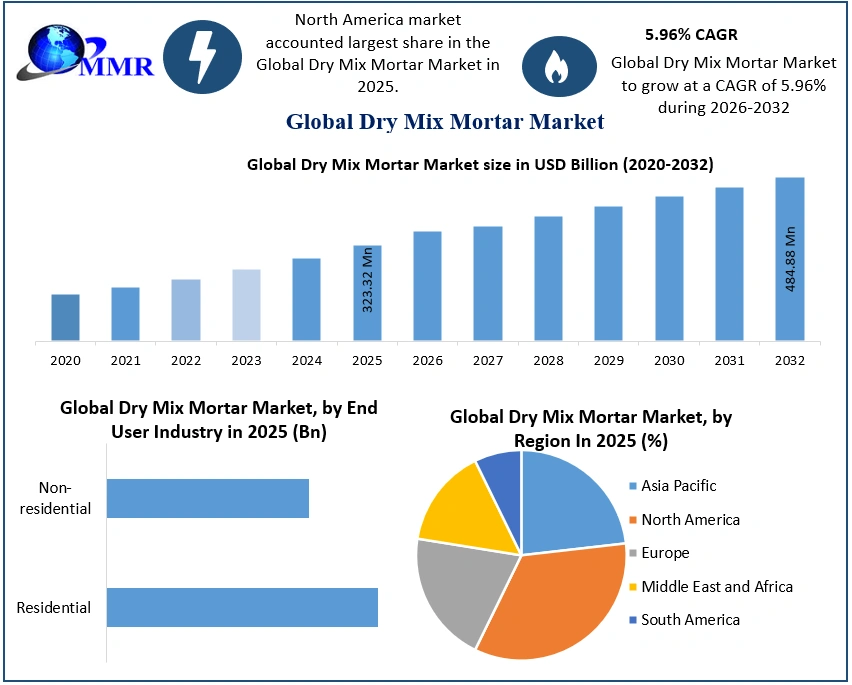
The Dry Mix Mortar Market size was valued at USD 323.32 Million in 2025 and the total Dry Mix Mortar revenue is expected to grow at a CAGR of 5.96% from 2026 to 2032, reaching nearly USD 484.88 Million by 2032.
Dry mix mortar, sometimes known as dry mortar, is a pre-mixed combination of cement, sand, and additives that is used as a building material with the addition of water. This ready-to-use combination has multiple benefits, including improved workability, higher durability, and increased productivity, making it a popular choice in various construction applications.
To know about the Research Methodology :- Request Free Sample Report
The dry mix mortar market has grown significantly in recent years, owing to increased demand for efficient and cost-effective building solutions. The market's expansion may be ascribed to increased urbanisation, infrastructural development, and the growing demand for environmentally friendly and sustainable construction practices. Furthermore, the rising tendency to rebuild and redesign existing structures has increased demand for dry mix mortar. One significant advantage of dry mix mortar is its capacity to maintain uniform quality and remove on-site variability, increasing construction efficiency and lowering personnel costs. Furthermore, its quick setting time and muscular bond strength lead to shorter building cycles, allowing projects to be completed on schedule. These considerations have accelerated dry-mix mortar use in the residential, commercial, and industrial sectors.
As a result of the substantial expansion of the construction sector in countries such as China and India, Asia Pacific has emerged as a significant market for dry mix mortar. The Middle East and Africa area has also seen significant market growth due to large-scale infrastructure projects and urban development efforts. Furthermore, the growing use of dry mix mortar in Europe and North America, notably for energy-efficient building practices, has boosted market development. This report includes market analysis, forecasts, industry segmentation and competitive analysis of top dry mix mortar manufacturers. This report also emphasises sustainability, innovation and consumer preferences, offering a global outlook with trends, drivers, challenges and opportunities. It will help industry stakeholders (manufacturers, distributors, retailers, investors) make informed decisions and capitalise on dry mix mortar market opportunities.
Dry Mix Mortar Market Dynamics:
Market Drivers:
Increasing Construction Activities: The global construction industry has been witnessing steady growth, fueled by population growth, urbanization, and government initiatives to develop infrastructure. Dry mix mortars are extensively used in construction projects for their advantages such as improved workability, reduced construction time, and consistent quality. For instance, in , the Indian government announced the "Housing for All" initiative, which aims to construct affordable houses for all citizens by . This initiative is expected to drive the demand for dry-mix mortars in the country.
Advantages over Traditional Wet Mortar Mixes: Dry mix mortars offer several advantages over wet mortar mixes, such as better workability, improved strength, reduced wastage, and enhanced durability. These benefits have led to an increased adoption of dry-mix mortars in various construction applications. For example, according to a report by Global Market Insights, the global dry mix mortar market size was valued at over USD 40 Million in . In the upcoming years, these dry-mix mortars are anticipated to fuel market growth.
Market Restraints:
Lack of Awareness and Skilled Workforce: The adoption of dry mix mortars requires adequate knowledge and training among construction professionals. However, in some regions, there is a lack of awareness regarding the benefits and application techniques of dry mix mortars. Additionally, a shortage of skilled labor for handling and applying dry mix mortars can pose a challenge to the market growth. Initiatives by governments and companies to provide training and education programs can help overcome these challenges. For instance, in , the Construction Industry Development Board (CIDB) in Malaysia initiated a training program to enhance the skills of construction workers in handling dry mix mortars.
Price Volatility of Raw Materials: The prices of raw materials used in the production of dry mix mortars, such as cement and sand, are subject to market fluctuations. This volatility can impact the profitability of dry mix mortar manufacturers and influence the overall market growth. To mitigate this challenge, companies are focusing on developing alternative materials or exploring innovative sourcing strategies. For instance, in , a major dry mix mortar manufacturer announced the use of recycled materials as a substitute for traditional raw materials, reducing costs and promoting sustainability. These factors are anticipated to hamper the dry mix mortar market growth.
Market Opportunities:
Growing Demand for Sustainable Construction: With increasing environmental concerns, there is a growing demand for sustainable construction practices. Dry mix mortars offer opportunities for sustainable construction due to reduced waste generation and the potential for incorporating eco-friendly additives. For example, the European Union's Horizon program supports research and development activities in the construction industry, including the development of sustainable building materials such as dry-mix mortars.
Technological Advancements: Continuous research and development efforts have led to technological advancements in the dry mix mortar industry. Companies are investing in innovative additives, binders, and production processes to improve the performance and quality of dry-mix mortar products. For instance, a major dry mix mortar manufacturer introduced a self-leveling dry mix mortar with enhanced flow properties and self-compacting characteristics, enabling easier and more efficient application. These factors are predicted to boost the dry mix mortar market opportunity.
Market Challenges:
Lack of Standardization: The dry mix mortar market lacks standardized testing methods and quality control measures, which can lead to variations in product performance and quality. The absence of a unified standard can pose challenges for manufacturers, contractors, and end-users. Initiatives by industry associations and regulatory bodies to establish standardized guidelines and testing protocols can address this challenge. For example, the ASTM International committee is actively developing standards for dry mix mortars to ensure consistent quality across the industry.
Intense Market Competition: The dry mix mortar market is highly competitive, with numerous players operating globally and regionally. Intense competition can result in price wars, reducing profit margins for manufacturers. To stay competitive, companies are focusing on product differentiation, technological advancements, and strategic partnerships. For instance, in , a leading dry mix mortar manufacturer announced a strategic collaboration with a technology company to develop smart mortar solutions that offer enhanced performance and monitoring capabilities.
Dry Mix Mortar Market Segmentation:
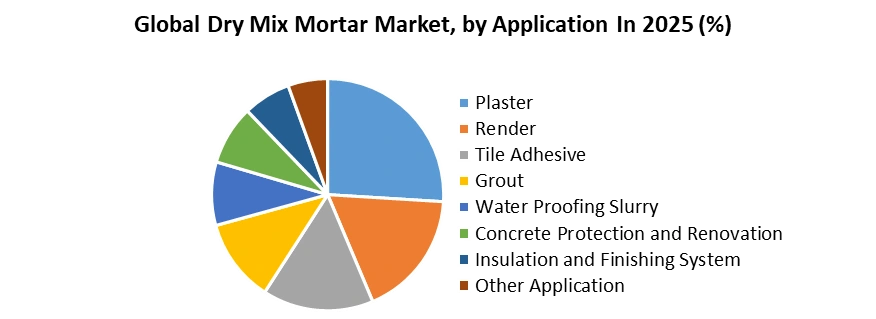
The Dry Mix Mortar Market is characterized by diverse applications that cater to the multifaceted needs of the construction industry. In the realm of applications, formulations for plastering find prominence in both interior and exterior wall finishes, contributing to a seamless and durable surface. Rendering applications, on the other hand, offer protective and decorative coatings for walls and structures, enhancing aesthetic appeal and longevity. The market also witnesses a surge in demand for efficient tile adhesive formulations, facilitating quick and robust tile installations in various settings. Grouting applications focus on filling gaps and ensuring structural stability, finding applications in infrastructure and renovation projects. Waterproofing slurries play a crucial role in surface protection, preventing water penetration and adding to structural resilience. Concrete protection and renovation formulations enhance the durability of concrete structures, particularly relevant in maintenance and industrial settings. Additionally, insulation and finishing systems contribute to energy efficiency and visual appeal in both residential and commercial constructions. The market's adaptability is further evident in emerging applications, reflecting continuous innovation to meet evolving construction needs.
Moving to end-user industries, dry mix mortar plays a pivotal role in non-residential settings, spanning commercial, infrastructure, and industrial/institutional projects. In commercial construction, the formulations cater to various applications like plastering, rendering, and flooring, ensuring efficient project completion. Infrastructure projects leverage dry mix mortar for grouting, concrete protection, and waterproofing, emphasizing the longevity and resilience of critical structures. Industrial and institutional constructions benefit from tailored solutions, incorporating dry mix mortar for insulation, flooring, and concrete protection to meet specific sector requirements. Furthermore, the market embraces emerging non-residential end-user industries, showcasing its adaptability and versatility to cater to unique construction needs. Overall, the Dry Mix Mortar Market thrives on its ability to provide tailored solutions for a myriad of applications, positioning itself as an indispensable component in contemporary construction practices.
Dry Mix Mortar Regional Analysis:
The regional analysis of the dry mix mortar market provides valuable insights into the market's performance and growth potential across different regions. Various factors influence the demand for dry-mixed mortar, including construction activities, infrastructure development, government initiatives, and economic conditions. For instance, North America and Europe have well-established construction industries and stringent building regulations, driving the demand for high-quality dry mix mortar. The Asia Pacific region, with its rapid urbanization and infrastructure investments, offers significant growth opportunities for the market. Latin America, the Middle East & Africa regions are witnessing increasing construction activities, creating a favourable environment for dry mix mortar adoption. Understanding regional variations in market dynamics, preferences, and growth drivers is crucial for market participants to develop targeted strategies and tap into the immense potential of each region.
Dry Mix Mortar Industry, Competitive Landscape
The dry-mix mortar sector is highly competitive, with several regional and worldwide companies. Product quality, innovation, price tactics, distribution networks, and customer relationships drive market rivalry. Key market participants prioritize R&D operations to provide new formulations and meet various client demands. Companies also aggressively pursue partnerships, collaborations, mergers, and acquisitions to increase their market share and obtain core competency. Manufacturers are emphasizing the development of ecologically friendly dry mix mortar products as part of a trend towards sustainability and eco-friendly practices in the industry. Market players aim to differentiate themselves through efficient supply chain management, effective marketing tactics, and excellent customer service to preserve their market position in this highly competitive business.
Dry Mix Mortar Market Scope: Inquire before buying
| Global Dry Mix Mortar Market | |||
|---|---|---|---|
| Report Coverage | Details | ||
| Base Year: | 2025 | Forecast Period: | 2026-2032 |
| Historical Data: | 2020 to 2025 | Market Size in 2025: | USD 323.32 Mn. |
| Forecast Period 2026 to 2032 CAGR: | 5.96% | Market Size in 2032: | USD 484.88 Mn. |
| Segments Covered: | by Application | Plaster Render Tile Adhesive Grout Water Proofing Slurry Concrete Protection and Renovation Insulation and Finishing System Other Application |
|
| by End User Industry | Residential Non-residential Commercial Infrastructure Industrial/Institutional Other Non-residential End-User Industries |
||
Dry Mix Mortar Market, by Region
North America (United States, Canada and Mexico)
Europe (UK, France, Germany, Italy, Spain, Sweden, Austria and Rest of Europe)
Asia Pacific (China, South Korea, Japan, India, Australia, Indonesia, Malaysia, Vietnam, Taiwan, Bangladesh, Pakistan and Rest of APAC)
Middle East and Africa (South Africa, GCC, Egypt, Nigeria and Rest of ME&A)
South America (Brazil, Argetina and Rest of South America)
Dry Mix Mortar Key Players
The following Dry Mix Mortar Companies are the key players in the market and are selected based on criteria for further evaluation. The strategies followed by the companies to sustain and grow in the market are discussed in detail in the report.
1. aint-Gobain Weber
2. Sika AG
3. Ardex Group
4. BASF SE
5. LafargeHolcim Ltd.
6. CEMEX S.A.B. de C.V.
7. Mapei S.p.A.
8. Dow Chemical Company
9. Henkel AG & Co. KGaA
10. Parex Group
11. Bostik SA
12. Rk Drymix Mortar Co., Ltd.
13. Laticrete International, Inc.
14. Quick-mix Gruppe GmbH & Co. KG
15. Dico Fix AD
16. Adhesive Technologies India Pvt. Ltd.
17. Knauf Gips KG
18. Caparol Group
19. HeidelbergCement AG
20. Akzo Nobel N.V.
21. Pidilite Industries Limited
22. Promat International NV/SA
23. Quick-Mix Holding GmbH
24. Sakrete
25. Asian Paints Limited
FAQs
1. What was the Global Dry Mix Mortar Market size in 2025?
Ans: The Global Dry Mix Mortar Market size was USD 323.32 Million in 2025.
2. What is the growth rate of the Dry Mix Mortar Market?
Ans: The CAGR of the Dry Mix Mortar Market is 5.96%.
3. What are the segments of the Dry Mix Mortar Market?
Ans: There are primarily 4 segments – Type, Application, End-user and Geography for the Dry Mix Mortar Market
4. Which region has the highest market share in the Dry Mix Mortar Market sector?
Ans: North America has the highest market share in the Dry Mix Mortar Market sector.
5. Is it profitable to invest in the Dry Mix Mortar Market?
Ans: There is a fair growth rate in this market and there are various factors to be analyzed like the driving forces and opportunities of the market which have been discussed extensively in Maximize’s full report. That would help in understanding the profitability of the market.