
Global Delivery Drones Market Size, Growth, Trends and Forecast (2026–2034): Market Segments, Competitive Landscape, Regional Growth and Industry Dynamics
Overview
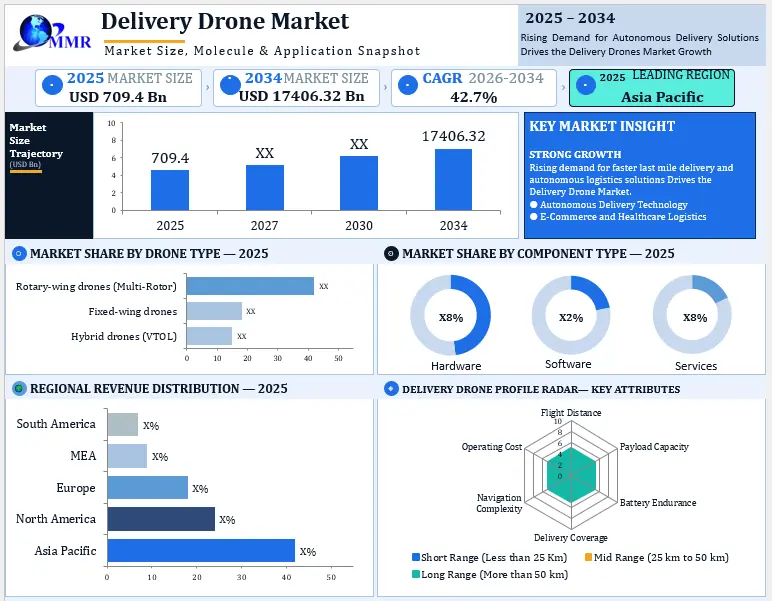
The Global Delivery Drones Market, valued at USD 709.4 Million in 2025, is projected to reach USD 17406.32 Million by 2034, growing at a CAGR of 42.7% during 2026–2034.
Delivery Drones Market Overview
The Delivery Drones Market refers to the industry involved in developing, manufacturing, and deploying unmanned aerial vehicles for transporting parcels, food, medical supplies, groceries, and other goods directly to customers or designated delivery points. Delivery drones use technologies such as GPS navigation, artificial intelligence, obstacle detection, automated flight control, and secure payload systems to support efficient last-mile delivery. The market matters because businesses are seeking faster logistics, reduced delivery costs, improved access to remote locations, and more flexible transportation solutions.
The Delivery Drones Market is gaining momentum as e-commerce companies, food delivery platforms, healthcare providers, retailers, and logistics operators explore autonomous aerial transportation to improve last-mile delivery. Key players such as Amazon Prime Air and Zipline are advancing commercial drone delivery through automated flight systems and dedicated delivery networks. The United States is an important market for commercial drone delivery, supported by regulatory developments and initiatives led by the Federal Aviation Administration (FAA). The FAA's work on beyond visual line of sight operations and drone traffic management highlights how airspace integration and safety technologies are shaping market development. Growing e-commerce demand, faster fulfilment expectations, medical supply transportation, and delivery services for underserved communities are creating opportunities for drone manufacturers, fleet operators, software developers, and logistics providers.
The MMR report on the Delivery Drones Market provides insights into market trends, competitive landscape, technology adoption, customer demand, regional performance, and key growth drivers. It helps businesses evaluate opportunities in autonomous delivery systems, artificial intelligence-based navigation, battery efficiency, payload management, and drone fleet operations. Emerging opportunities include healthcare logistics, rural delivery networks, retail fulfilment, and integration with existing supply chains, while regulatory compliance, flight safety, weather limitations, and infrastructure requirements remain important considerations. The report supports strategic planning by identifying evolving customer needs, competitive positioning, investment opportunities, and potential areas for market development.
Global Delivery Drones Market Size and Growth Outlook
To know about the Research Methodology :- Request Free Sample Report
Delivery Drones Market Strategic Shift: From Pilot Programs to Scalable Logistics Networks
The Delivery Drones Market is transitioning from isolated pilot deployments to structured logistics infrastructure. Early adoption focused on proof-of-concept operations, while current deployments are centered on scalability, cost efficiency, and integration into existing supply chains.
• Logistics providers are increasingly treating drones as network extensions rather than standalone solutions
• High-frequency, low-weight deliveries are shaping fleet design and operational models
• Regulatory approvals are acting as a key accelerator for commercial expansion
This shift indicates that the market is moving beyond experimentation toward long-term commercial viability.
Delivery Drones Market Dynamics
Rising Demand for Faster Last Mile Delivery Drives the Delivery Drones Market
The growing preference for rapid e-commerce fulfilment, contactless delivery, and efficient transportation of lightweight parcels is driving demand in the Delivery Drones Market. Online retailers, grocery delivery companies, healthcare providers, and logistics operators are adopting unmanned aerial vehicles to reduce dependence on road transportation and improve delivery access in congested urban areas. Drone delivery also offers practical benefits for transporting urgent medical supplies, laboratory samples, and essential goods to remote communities. According to the United States Federal Aviation Administration, its Beyond program recorded 70,563 flights, including 48,383 beyond visual line of sight flights during its first phase, demonstrating progress in operational testing and commercial drone integration. These developments support demand for autonomous navigation, automated parcel handling, battery-efficient aircraft, and advanced delivery management systems.
Regulatory Restrictions and High Operational Costs Restrain the Delivery Drones Market
Strict aviation regulations, airspace restrictions, and the cost of obtaining operational approvals remain significant restraints on the Delivery Drones Market. Operators must demonstrate flight safety, reliable communication, secure package handling, and effective collision avoidance before conducting routine delivery operations in many jurisdictions. Requirements for visual observers, specialized infrastructure, trained personnel, insurance, and equipment maintenance can increase the cost per delivery and weaken the financial benefits of drone-based logistics. Battery replacement, charging facilities, weather-related interruptions, and payload restrictions can further limit operational efficiency. The United States Government Accountability Office highlighted in February 2026 that communication between drones and other aircraft, along with reliable detect-and-avoid capabilities, remains an important safety consideration. These requirements can delay commercial deployment and make widespread adoption more difficult for smaller logistics providers.
Healthcare Logistics and Autonomous Navigation Technologies Create Opportunities in the Delivery Drones Market
Healthcare logistics, rural parcel transportation, and automated retail fulfilment present promising opportunities for the Delivery Drones Market. Hospitals, diagnostic laboratories, pharmacies, and emergency response organizations can use aerial delivery systems to transport medical supplies and time-sensitive materials where road access is slow or unreliable. Advances in artificial intelligence, precision navigation, real-time fleet monitoring, improved battery systems, and automated package release can help operators improve delivery reliability and manage multiple aircraft more efficiently. The United States Federal Aviation Administration's second phase of its Beyond program began in 2025 and is scheduled to continue through 2029, supporting further work on routine drone operations and regulatory integration. This creates opportunities for drone manufacturers, navigation software providers, communication technology companies, and logistics service operators to develop scalable delivery networks and specialized commercial applications.
Flight Safety Concerns and Limited Payload Capacity Challenge the Delivery Drones Market
Maintaining safe, reliable, and publicly accepted drone operations is a major challenge for the Delivery Drones Market. Delivery aircraft must navigate changing weather, buildings, power lines, restricted airspace, and unexpected obstacles while protecting people and property on the ground. Noise pollution, privacy concerns, package theft, limited payload capacity, and battery endurance can also influence customer acceptance and service reliability. Coordinating multiple drones in shared airspace requires dependable communication, accurate aircraft tracking, and effective traffic management systems that reduce collision risks. The United States Government Accountability Office reported in February 2026 that existing technologies still present limitations in enabling two-way communication between drones and other aircraft. Addressing these technical gaps while maintaining affordable operations and consistent delivery performance will be essential for building consumer trust and supporting the long-term development of commercial drone delivery services.

Delivery Drone Market Strategic Implications: Who Wins, Who Loses, and Why
The Delivery Drones Market does not reward passive participation. Three distinct competitive outcomes are emerging:
Winners — Platform Integrators: Companies that own the full stack — drone hardware, autonomous software, fleet management, and logistics partnerships — are building moats that pure hardware or pure software players cannot replicate. Wing (Alphabet), Zipline, and Amazon Prime Air exemplify this model. Their advantage is not the drone; it is the data generated across millions of flights that continuously improves route efficiency, failure prediction, and regulatory compliance documentation.
Survivors — Specialist Verticals: Players focused on defensible niches — medical delivery in underserved geographies, agricultural drone logistics, government emergency response — can sustain without platform scale. Their protection is mission-criticality, not volume.
Losers — Hardware Commoditisers: Drone manufacturers competing solely on unit price face an accelerating margin compression cycle, particularly as Chinese OEM supply continues to drive down global hardware costs. Without software differentiation or service revenue, hardware-only positioning is structurally disadvantaged.
The market's 42.7% CAGR masks this internal divergence. The aggregate number looks attractive. The distribution of returns will not be uniform.
Technology-Driven Productivity Improvements
Autonomous delivery drone systems increasingly relied on automation and AI to improve drone logistics efficiency:
• AI route optimization improved delivery efficiency by 20–35%
• Automated landing and charging systems reduced turnaround time by 30–40%
• Hybrid delivery drones increased range by 30–50% compared to multirotor drones
• Drone traffic management (UTM) systems managed 100+ simultaneous drones per urban airspace
Battery technology improvements extended average delivery drone flight endurance to 30–40 minutes, enabling higher drone fleet utilization per asset.
Regulatory Enablement and Network Scaling
Regulatory support remained a critical enabler of delivery drones market growth:
• BVLOS drone approvals enabled continuous operations without visual observers
• Remote ID systems enabled real-time tracking of 100% registered delivery drones
• FAA-certified drone corridors supported thousands of weekly commercial drone delivery flights
• Standardized drone approvals reduced deployment timelines by 6–12 months
As a result, operators transitioned from pilot programs to permanent drone delivery infrastructure, including fixed hubs, charging stations, and designated landing zones.
Cost and Operational Economics
• Per-delivery operating cost reduction vs ground delivery: 40–60%
• Fuel costs eliminated for short-range UAV delivery routes
• Maintenance cost per delivery drone is lower than that of motor vehicles
• Drone fleet utilization rates improved due to automation
Drone-as-a-Service (DaaS) models expanded rapidly, enabling enterprises to access drone delivery services without upfront capital investment.
Operational Capacity & Flight Volumes
• Average delivery drones per operational hub: 20–50 units
• Average flights per drone per day: 10–25
• Monthly delivery volume per drone delivery network: 20,000–50,000 parcels
• Annual deliveries by leading drone delivery operators: hundreds of thousands to millions
• Healthcare drone delivery networks achieved >99% delivery success rates
Centralised drone fleet-control platforms enabled one operator to oversee 10–20 autonomous delivery drones, significantly improving delivery drone scalability.
Delivery Drones Market Demand Analysis
Demand for delivery drone services is being driven by structural shifts in consumer expectations and logistics economics, with several high-impact forces converging to accelerate commercial adoption across urban, suburban, and remote geographies.
• Increasing demand for same-day and sub-1-hour deliveries
• Urban congestion impacting delivery efficiency
• Labour shortages in logistics operations
• Growth in e-commerce and on-demand delivery services
• Expansion of healthcare logistics for critical supplies
Healthcare remains one of the most stable and high-impact segments, where delivery times are reduced from 60–120 minutes (road) to 10–20 minutes via drones, particularly in emergency and remote-area use cases.
Broad-based demand growth projections can obscure where the real conviction lies. Three segments stand out as structurally high-conviction growth pockets through 2032:
Sub-3kg Urban Last-Mile (Food + Pharma): Over 70% of 2025 drone deliveries fell in this weight class. The economics are proven. Consumer acceptance is established. Infrastructure investment is accelerating. This segment alone justifies the market's base case growth trajectory.
Emergency and Critical Healthcare Logistics: Delivery time reduction from 60–120 minutes by road to 10–20 minutes by drone is not a convenience upgrade — it is a clinical outcome differentiator. Governments and healthcare systems are increasingly treating drone delivery as public health infrastructure, not logistics innovation, which means procurement is shifting toward long-term contracts and budget line items rather than pilot funding.
Rural and Remote Market Access: In markets where road infrastructure is inadequate — Sub-Saharan Africa, Southeast Asian archipelagos, rural India — drones are not competing with ground delivery. They are replacing the absence of delivery entirely. This is a structurally uncaptured demand pool with minimal competitive pressure and strong development-finance tailwinds.
Key Operational and Regulatory Constraints Facing the Delivery Drones Market
• Regulation: Drone airspace management, safety standards, and BVLOS certification frameworks continued to evolve
• Privacy Concerns: Use of cameras and sensors in autonomous drone delivery systems raised privacy concerns
• Weather Limitations: Wind, rain, and snow affected delivery drone performance
• Cost of Infrastructure: Drone hubs, charging stations, and UTM integration required a high upfront investment
Regulatory Analysis:
Regulatory developments such as BVLOS approvals, Remote ID implementation, and dedicated drone corridors are directly accelerating market growth by enabling continuous operations and large-scale deployment. These frameworks reduce operational constraints, shorten deployment timelines, and improve commercial viability, making regulation a key driver rather than a barrier.
What the Delivery Drones Market Data Doesn't Say — But Should
Three structural realities about the delivery drones market are systematically underrepresented in mainstream analysis:
1. Regulation is not the bottleneck anymore — operations are. The narrative around drone market constraints has centred on regulatory friction for years. That story is largely outdated. BVLOS approvals are expanding. FAA corridors are operational. The real constraint in 2025–2026 is operational — building drone hubs, integrating UTM systems, and training fleet operators at the speed that regulatory approvals now permit. Companies that invested in operational infrastructure during the "waiting for regulation" phase are now compounding that advantage rapidly.
2. Healthcare is the market's most durable growth engine — not e-commerce. E-commerce drone delivery generates headlines. Healthcare drone delivery generates defensible, recurring, government-contracted revenue. Blood delivery, vaccine distribution, diagnostic sample transport — these use cases operate independently of consumer sentiment cycles, competitive pricing pressure, or last-mile economics debates. Zipline's 2 million delivery milestone was not built on pizza and parcels.
3. The real monetisation shift is from hardware to data. A delivery drone that flies 15 routes per day generates location data, weather performance data, airspace conflict data, and package integrity data — all of which are increasingly valuable to insurers, logistics planners, urban mobility designers, and regulators. The companies that monetise this data layer alongside delivery fees will generate revenue structures that pure logistics operators cannot match.
New Technology Developments in the Delivery Drones Market
The Delivery Drones Market is progressing through advancements in autonomous flight, artificial intelligence, battery technology, and automated parcel handling. These innovations are helping companies improve delivery reliability, flight safety, and last mile logistics efficiency.
| Technology | Recent development and market impact |
| Artificial intelligence based autonomous navigation | Enables drones to plan routes, respond to obstacles, and optimize delivery operations with less manual intervention. |
| Beyond visual line of sight technology | Supports longer delivery routes without requiring the operator to maintain direct visual contact. The Federal Aviation Administration continues work on integrating these operations into national airspace. |
| High energy density battery technology | In May 2026, Amprius Technologies and Matternet announced collaboration on silicon anode battery solutions to improve drone performance and delivery economics. |
| Automated parcel handling systems | In September 2026, DoorDash introduced a purpose built autonomous delivery aircraft and an integrated system designed to coordinate order preparation, aircraft operations, and doorstep delivery. |
| Drone traffic management systems | Digital flight planning, aircraft tracking, and conflict management technologies are being developed to support safer coordination of multiple drones in low altitude airspace. |
| Higher payload delivery drones | Matternet's next generation M3 platform is being developed to support larger payloads, broader service coverage, automated battery handling, and fleet management. Commercial service entry is targeted for late 2027. |
Delivery Drone Market Segment analysis
Delivery Drones Market by Component
The Delivery Drones Market is segmented into hardware, software, and services, with hardware representing the leading component because delivery operations depend on reliable airframes, propulsion systems, batteries, navigation equipment, sensors, and package handling mechanisms. Hardware remains essential for improving flight endurance, payload capacity, and operational safety. Software is emerging as a key technology segment through artificial intelligence-based route planning, autonomous flight control, real-time tracking, and drone fleet management, while services support drone operations, maintenance, logistics integration, and regulatory compliance. Software and services offer attractive growth opportunities as delivery operators move towards automated and scalable delivery networks.
Delivery Drones Market by Range
The Delivery Drones Market is segmented into short range (less than 25 kilometres), mid range (25 to 50 kilometres), and long range (more than 50 kilometres). The short-range segment is currently trending and holds the leading position due to its suitability for last-mile delivery, including food, groceries, pharmaceutical products, and small e-commerce parcels in urban and suburban areas. These drones offer practical advantages through shorter flight times, frequent delivery cycles, and relatively manageable operating requirements. The mid-range segment supports deliveries between distribution centres and surrounding communities, while long-range drones are gaining attention for rural healthcare logistics, remote-area supply networks, and regional transportation. Improvements in battery performance, autonomous navigation, and beyond-visual-line-of-sight operations are creating new opportunities for longer-distance delivery services.
Delivery Drones Market Regional Analysis
Asia-Pacific emerged as the largest and fastest-deploying delivery drones market in 2025, accounting for over 40% of active commercial drone deployments globally. Growth was driven by China, Japan, South Korea, India, and Southeast Asia, supported by dense urban populations, strong e-commerce drone delivery adoption, and government-backed drone corridors.
China dominated delivery drone manufacturing, supplying more than 60% of global commercial delivery drones, while Japan and South Korea led in urban drone automation, medical delivery drones, and aging-population healthcare logistics. India and Southeast Asia witnessed rapid expansion in food delivery drones, last-mile e-commerce drone delivery, and pilot-scale healthcare drone networks, supported by regulatory sandbox programs and rising private investment.
North America represented the most regulatory-mature delivery drones market in 2025, anchored by the United States' FAA-certified operator network and established commercial drone corridors. The region is characterised by high-frequency retail and food delivery drone operations, with Walmart-Wing and Amazon Prime Air scaling rapidly. Canada and Mexico represent emerging growth markets with nascent regulatory frameworks and growing investment in healthcare and rural drone logistics.
Europe demonstrated structured, compliance-led drone market growth in 2025, with the UK, Germany, and France leading BVLOS regulatory pilots and dedicated healthcare drone corridor development. The EU's U-Space framework is progressively enabling large-scale commercial drone operations, with permanent drone delivery infrastructure replacing earlier pilot-phase deployments across major urban centres.
MEA and South America regional narrative writeups are absent — must be added to align with TOC and scope table commitments.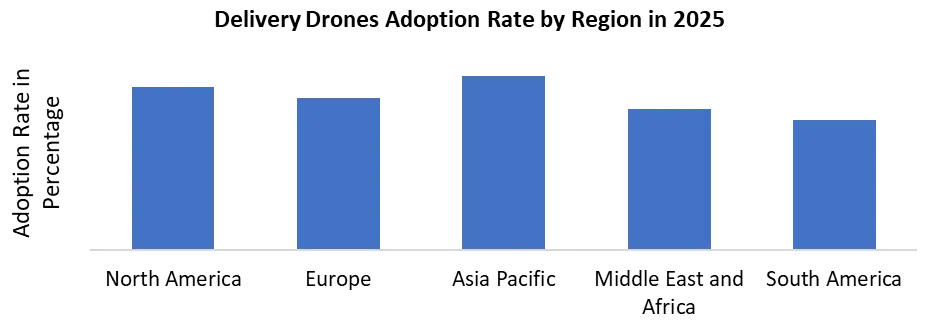
Delivery Drone Market Competitive Landscape
The competitive landscape of the Delivery Drones Market is shaped by technological innovation, autonomous flight capabilities, commercial delivery partnerships, and the development of reliable last mile logistics networks. Major companies such as Zipline, Wing Aviation, Amazon Prime Air, Flytrex, and DroneUp compete by improving delivery speed, payload capacity, flight safety, route optimization, and operational efficiency. Zipline is strengthening its position through autonomous healthcare, food, and retail delivery services, while Wing Aviation focuses on residential deliveries and partnerships with major retailers.
Amazon Prime Air is developing its drone delivery network to serve more customers, and Flytrex is targeting short distance food and retail deliveries. Competitive differentiation increasingly depends on artificial intelligence based navigation, battery performance, regulatory approvals, automated fleet management, and integration with e-commerce platforms. Companies that can combine cost effective drone technology with scalable delivery infrastructure and dependable customer service are well positioned to capture opportunities in the Delivery Drones Market.
Delivery Drone Market Recent Development
| Month in 2026 | Company | Recent development |
| January 2026 | Zipline | Zipline announced more than 600 million US dollars in new funding after surpassing two million commercial deliveries and outlined plans to enter Houston and Phoenix. |
| February 2026 | Zipline and Government of Rwanda | Zipline and Government of Rwanda announced an agreement to extend autonomous delivery coverage nationwide in Rwanda and introduce an urban drone delivery network. |
| July 2026 | Zipline | Announced planned launches in Austin and Cleveland, alongside new executive appointments and increased participation by businesses on its delivery platform. |
| July 2026 | DoorDash | Received commercial air carrier certification for DoorDash Air and announced plans to develop its own delivery drone. |
| June 2026 | Wing and Walmart | Wing and Walmart announced seven additional United States metropolitan areas for planned drone delivery service, advancing their retail delivery network plans. |
| August 2026 | Uber and Zipline | Uber and Zipline announced a strategic partnership to bring drone delivery to Uber Eats customers, with an initial rollout planned for later in the year and a long term goal of one million daily deliveries by 2029. |
| October 2026 | Wing and Walmart | Wing and Walmart announced plans to bring drone delivery to the Denver and Seattle metropolitan areas in 2027, extending their planned residential delivery network. |
Delivery Drones Market Scope: Inquire before buying
| Delivery Drones Market | |||
|---|---|---|---|
| Report Coverage | Details | ||
| Base Year: | 2025 | Forecast Period: | 2026-2034 |
| Historical Data: | 2020 to 2025 | Market Size in 2025: | USD 709.4 Mn. |
| Forecast Period 2026 to 2034 CAGR: | 42.7% | Market Size in 2034: | USD 17406.32 Mn. |
| Segments Covered: | by Drone Type | Rotary-Wing Drones (Multi-Rotor) Fixed-Wing Drones Hybrid Wing Drones |
|
| by Payload Capacity | Below 2 kg 2 kg to 5 kg Above 5 kg / More than 10 kg |
||
| by Range | Short Range (Less than 25 km) Mid Range (25 km – 50 km) Long Range (More than 50 km) |
||
| by Component Type | Hardware Software Services |
||
| by Operation Mode | Remotely Piloted Partially Autonomous Fully Autonomous |
||
| by Duration | Less than 30 Minutes More than 30 Minutes |
||
| by End-User | Retail & E-commerce Companies Healthcare Providers & Hospitals Logistics & Transportation Companies Restaurants & Food Service Chains Government & Public Sector Agricultural Operations |
||
Delivery Drones Market Key Players
1. Wing Aviation LLC
2. Zipline International Inc.
3. Flytrex Inc.
4. United Parcel Service of America Inc. UPS Flight Forward
5. Prime Air Amazon.com Inc.
6. FedEx Corporation
7. Wingcopter GmbH
8. EHang Holdings Limited
9. Drone Delivery Canada Corp.
10. Matternet Inc.
11. Manna Drone Delivery
12. Skyports Drone Services
13. Speedbird Aero
14. Rakuten Group Inc.
15. JD Logistics JD.com
16. DroneUp LLC
17. SkyDrop
18. Swoop Aero
19. Dronamics
20. Garuda Aerospace Pvt Ltd.
21. Asteria Aerospace Limited
22. Terra Drone Corporation
23. Aerodyne Group
24. ANRA Technologies
25. FlyCart DJI
26. Avy B.V.
27. Quantum Systems GmbH
28. Schiebel Corporation
29. Elroy Air Inc.
30. Sabrewing Aircraft Company Inc.
31. MightyFly Inc.
32. Pipistrel Aircraft
33. Vayu Aerospace Corporation
34. Hylio Inc.
35. Draganfly Inc.
36. ParaZero Technologies Ltd.
37. Unifly NV
38. Dedrone Holdings Inc.
39. Iris Automation Inc.
40. ACSL Ltd.
41. Yamaha Motor Co. Ltd.
42. Prodrone Co. Ltd.
43. Autonomous Aerial Systems Inc.
44. Skydio Inc.
45. AeroVironment Inc.
46. Leonardo S.p.A.
47. Thales Group
48. Safran Electronics and Defense
49. F-drones
50. Antwork Technology Co. Ltd.
Delivery Drone Market - Frequently Asked Questions
1. Which region has the largest share in the Delivery Drones Market?
Ans: Asia Pacific is a major region in the Delivery Drones Market, supported by commercial drone operations, technological advancements, and regulatory developments.
2. What is the growth rate of the Delivery Drones Market?
Ans: The Delivery Drones Market is growing at CAGR of 42.7% during forecast period from 2026 to 2034
3. What is the scope of the Delivery Drones Market report?
Ans: The report covers market segmentation, regional analysis, competitive landscape, market drivers, restraints, opportunities, challenges, and future industry trends.
4. Who are the key players in the Delivery Drones Market?
Ans: Key players include Zipline International Inc., Wing Aviation LLC, Amazon Prime Air, Flytrex Inc., Matternet Inc., DroneUp LLC, and Wingcopter GmbH.
5. What is the study period of this market?
Ans: The Delivery Drones Market is studied from 2020 to 2034.