Data Analytics Market Size by Component, Type, Deployment, End User and Region – Segment-Level Market Assessment, Growth Opportunity Analysis, Competitive Mapping & Forecast to 2032

74.28%
CAGR (2026-2032)
471.13 USD Bn.
Market Size
302
Report Pages
137
Market Tables

Overview

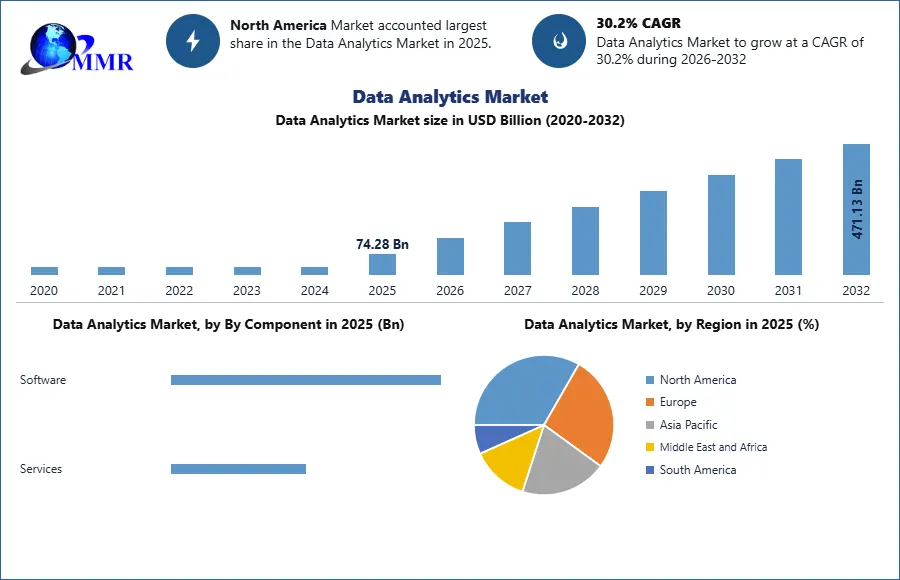
Data Analytics Market size was valued at USD 74.28 Billion in 2025 and the total Data Analytics Market is expected to grow at a CAGR of 30.2 % from 2025 to 2032, reaching nearly USD 471.13 Billion.

Data Analytics Market Overview:

Data analytics is the science of Analysing raw data to make conclusions about the collected information.

The data analytics market includes various components such as software solutions, hardware infrastructure, and services. A number of analytics tools are included in the software part, including predictive analytics, data visualization, data management, and prescriptive analytics. Among the hardware that is required to store and process, data are servers, storage devices, and networking equipment. Analytics solution providers provide consulting, implementation, maintenance, and support. Increasing data proliferation, technological advancements, and the adoption of analytics solutions across industries are all contributing to the growth of the  market in recent years. The importance of data-driven decision-making is recognized by organizations across a variety of sectors, including finance, healthcare, retail, manufacturing, and telecommunications.

Data Analytics Market Scope and Research Methodology

The Data Analytics Market report represents innovation, policy support, increased competition, and environmental concerns by global and local players holding the Market in different countries. The report covered Market structure by comparative analysis of key players, and market followers, which makes this report insightful to the Data Analytics Outlook.

The Data Analytics Market report aims to outlook the market size based on segments, regional distribution and industry competition. The bottom-up approach has been used to estimate and forecast market size and market growth. The report provides a detailed examination of the key players in the Data Analytics industry, including revenue. The report covers the global, regional and local level analysis of the Data Analytics Market with the factors restraining, driving and challenging the market growth during the forecast period.To know about the Research Methodology :- Request Free Sample Report
Data Analytics Market Dynamics:

Data Analytics Market Drivers

Real-Time Insights by Data Analytics Driving the Market Growth

The rapid growth in the data analytics market is driven by factors such as digitalization, IoT devices, social media, and online transactions. For instance, e-commerce company analyses customer data to personalize recommendations and improve customer experience. The storage, processing, and analysis of large volumes of data are made easier by technologies like distributed computing frameworks, in-memory computing, and scalable storage solutions. Scalable and affordable infrastructure for data storage and analysis is provided by cloud computing. For instance, a healthcare organization can analyze patient data to create individualized treatment plans using data analytics. Organizations seek real-time insights from data to make informed decisions. Data analytics enables businesses to respond quickly to market changes, customer demands, and competitive pressures. For example, a retail chain uses real-time analytics to adjust pricing strategies based on market trends and customer behavior.

Data Analytics Market Restraint

Lack Of Skilled Data Analysts Hinders the Market Growth

The shortage of skilled data scientists and professionals with expertise in data analytics is a significant challenge for data analytics market. The complexity of data analytics requires individuals with a deep understanding of statistics, data modeling, machine learning, and programming. For example, Difficulty for a financial institution to find data scientists with expertise in fraud detection to identify and prevent fraudulent activities. The increasing volume and sensitivity of data raise concerns about privacy and security. Organizations must ensure data governance practices, comply with regulations, and protect against cyber threats. Integrating data analytics solutions with existing systems and legacy data sources can be complex and time-consuming. For instance, A manufacturing company faces challenges in integrating analytics solutions with their production systems to optimize processes.

Data Analytics Market Opportunities:

The development of mobile technology, advancements in mobile networks and Wi-Fi, and the exponential growth in data generation and consumption present a significant opportunity in the data analytics market. The rising volume of data created, along with its diverse and fast-paced nature, increased the need for data analytics to improve business operations and minimize data loss. In data analytics, organizations can gain valuable insights from unstructured data, support business ideas, and obtain a competitive advantage.

The data analytics market is fueled by the rising use of the Internet, the availability of high-speed Internet services, globalization, and economic expansion. With the exponential growth in individual and organizational data, every piece of information has become a crucial data point for analysis, leading to the adoption of data scientists and analysts. The revenue-generating potential of data analytics is driving businesses to invest in this field. The market offers diverse opportunities across sectors, enabling businesses to make informed decisions, enhance customer experiences, optimize operations, detect fraud, manage risks, employ predictive analytics, use IoT data, and explore data monetization, ultimately driving growth and gaining a competitive edge.

Data Analytics Market Segment Analysis:

Based on Component ,The Software segment dominated the Global Data Analytics Market owing to the increasing demand for real-time data processing, predictive analytics, artificial intelligence, and business intelligence solutions across industries such as BFSI, healthcare, retail, manufacturing, and telecommunications. Organizations are rapidly investing in advanced analytics software to improve operational efficiency, customer insights, risk management, and strategic decision-making capabilities.

Among software categories, Business Intelligence & Visualization solutions held the largest market share due to growing demand for interactive dashboards, real-time reporting, and data-driven business insights. Data Mining & Machine Learning platforms are also witnessing rapid growth because of increasing adoption of AI-powered automation, predictive modeling, and advanced analytics applications. Predictive & Prescriptive platforms are gaining strong traction in enterprise forecasting and risk analysis, while ETL & Data Preparation solutions remain essential for efficient data integration and management processes.

Meanwhile, the Services segment continues expanding steadily due to rising demand for consulting, deployment, integration, and managed analytics services supporting enterprise digital transformation initiatives and cloud-based analytics implementation.

Data Analytics Market: Regional Insights

North America held a dominant position in the analytics market in 2025 and this is expected to maintain its dominance during the forecast period due to the presence of leading technology companies, the timely adoption of analytics-based solutions, and the development of a mature ecosystem conducive to innovation. The European market is experiencing significant growth, driven by increased investment in data-centric initiatives, digitization initiatives, and compliance with data protection regulations, including the GDPR.

Asia Pacific is rapidly growing in the data analytics market, Countries such as China, India, Japan, and South Korea are experiencing growth in data analytics, attributed to the expanding digital landscape, growing e-commerce sector, and increasing focus on data-driven strategies. Brazil and Mexico are emerging markets in the South America region due to the rising adoption of analytics in sectors like finance, retail, and healthcare. Government initiatives promoting digital transformation and data analytics adoption further contribute to market growth. The MEA  market is witnessing steady growth in this region, primarily driven by the increasing adoption of advanced analytics solutions in industries such as oil and gas, banking, healthcare, and public services.

Data Analytics Market: Competitive Landscape:

The market is highly competitive, with key players engaging in intense competition to gain market share. These players employ strategies such as technology innovation, strategic partnerships, and geographical expansion to strengthen their position in the market. The competitive landscape provides insights into the profiles of key players, including their market strategies, service portfolios, financials, and recent developments.

Data analytics market players such as IBM Corporation, Microsoft, Oracle, and SAP SE are engaged in research and development activities to expand their businesses. Microsoft is known for its software products, whereas IBM is best known for its consulting services. SAP offers a comprehensive portfolio of analytics solutions, and Oracle emphasizes its integrated data platform and machine learning capabilities. SAS specializes in analytics solutions for specific industries, while Tableau and Qlik provide data visualization and business intelligence tools. Teradata offers scalable analytics platforms, Alteryx empowers data analysts, and MicroStrategy provides analytics and mobility platforms.

Data Analytics Market: Recent Developments

  • In May 2026, Palantir Technologies raised its annual revenue forecast driven by strong demand for AI-powered data analytics platforms across government and commercial sectors. The company reported significant growth in defense analytics and enterprise intelligence solutions.
  • In May 2026, Datadog reported strong growth in cloud analytics and observability solutions fueled by rising enterprise adoption of AI-driven monitoring and real-time analytics platforms. The company also secured several large-scale AI analytics contracts.
  • In 2025, Teradata expanded its ClearScape Analytics portfolio with advanced ModelOps, generative AI, and low-code AutoML capabilities designed for enterprise-scale analytics deployment and intelligent data management.
  • In May 2025, Qlik launched new agentic AI-powered analytics capabilities, including automated insight generation, no-code data preparation tools, and enterprise data lakehouse solutions to strengthen real-time analytics and AI-driven business intelligence.
  • In September 2024, Zoho Corporation introduced an upgraded version of Zoho Analytics featuring predictive analytics, machine learning models, AI-powered reporting, and automated dashboard generation for business intelligence applications.
  • In June 2025, Actian partnered with Databricks to integrate enterprise data intelligence and governance solutions supporting self-service analytics, AI-ready data platforms, and advanced analytics workflows.
  • In March 2025, Gartner identified major trends shaping the data analytics market, including generative AI integration, real-time intelligence, democratized analytics platforms, and agentic AI-driven decision-making technologies.

Data Analytics Market Scope: Inquire before buying

Data Analytics Market
Report Coverage Details
Base Year: 2025 Forecast Period: 2026-2032
Historical Data: 2020 to 2025 Market Size in 2025: 74.28 USD Billion
Forecast Period 2026-2032 CAGR: 30.2% Market Size in 2032: 471.13 USD Billion
Segments Covered: By Component Software
    Data management tools
    Data mining & machine learning
    Business intelligence & visualization
    Predictive & prescriptive platforms
    ETL & data preparation solutions
Services
    Consulting & professional services
    Managed services
    Deployment & integration
    Others
by Analytics Type Predictive Analytics
Descriptive Analytics
Prescriptive Analytics
Diagnostic Analytics
Cognitive Analytics
Others
By Organization Size Large Enterprises
Small & Medium-Sized Enterprises (SMEs)
By Deployment Mode On-Premise
Cloud-Based
By Application Enterprise Resource Planning (ERP)
Supply Chain Management
Database Management
Human Resource Management
Others
by End User Banking, Financial Services & Insurance (BFSI)
Retail & E-Commerce
Healthcare & Life Sciences
Manufacturing
Telecom & IT
Government & Public Sector
Energy & Utilities
Others

Data Analytics Market, by Region

North America (United States, Canada, and Mexico)
Europe (UK, France, Germany, Italy, Spain, Sweden, Austria, and the Rest of Europe)
Asia Pacific (China, South Korea, Japan, India, Australia, Indonesia, Malaysia, Vietnam, Taiwan, Bangladesh, Pakistan, and the Rest of APAC)
Middle East and Africa (South Africa, GCC, Egypt, Nigeria, and the Rest of ME&A)
South America (Brazil, Argentina Rest of South America)

Data Analytics Market, Key Players

  1.  IBM Corporation
  2. Microsoft Corporation
  3. Oracle Corporation
  4. SAP SE
  5. Amazon Web Services Inc.
  6. Google LLC (Looker)
  7. Mu Sigma Analytics
  8. Accenture plc
  9. Teradata Corporation
  10. Relevant Software
  11. Snowflake Inc.
  12. Tableau Software
  13. QlikTech International
  14. Strategy Inc
  15. Tableau
  16. Fractal Analytics
  17. Alteryx Inc.
  18. Splunk Inc.
  19. Capgemini SE
  20. Tata Consultancy Services
  21. Infosys Limited
  22. Wipro Limited
  23. Deloitte
  24. KPMG International
  25. Tiger Analytics
  26. EXL
  27. LatentView Analytics
  28. TIBCO Software
  29. PWC
  30. Genpact
  31. Domo, Inc.

Table of Contents

1. Data Analytics Market : Executive Summary 1.1. Study Assumption and Market Definition 1.2. Scope of the Study 1.3. Executive Summary 1.3.1 Market Size (2025) & Forecast (2026-2032), 1.3.2 Data Analytics Market Share By Region And Country (2025) 1.3.3 Market Size (Value USD Mn.) and Market Share (%) - By Segments, Regions and Country 2. Data Analytics Market : Competitive Landscapes 2.1. MMR Competition Matrix 2.2. Key Players Benchmarking 2.2.1 Headquarter 2.2.2 Analytics Type Offered 2.2.3 End User 2.2.4 Application Coverage 2.2.5 Deployment Model 2.2.6 Innovation and R&D Investment 2.2.7 Technology Stack Strength 2.2.8 Market Share (%) 2025 2.2.9 Revenue 2025 (USD Million) 2.2.10 YoY Growth (%) 2.2.11 Global Reach 2.3 Competitive Positioning Of Top Key Players 2.4. Market Structure 2.4.1 Market Leaders 2.4.2 Market Followers 2.4.3 Emerging Players 2.5. Market Share Analysis (2025) 2.6. Comparison Analysis Of Analytics Companies (2025) 2.7. Strategic Developments (2023-2025) 2.7.1 Mergers & Acquisitions 2.7.2 Joint Ventures 2.7.3 Geographic Expansion 2.7.4 Technology Launches By Key Players 3. Data Analytics Market: Dynamics 3.1. Data Analytics Market Trends 3.2. Data Analytics Market Dynamics 3.2.1 Drivers 3.2.2 Restraints 3.2.3 Opportunities 3.2.4 Challenges 3.3. PORTER’s Five Forces Analysis 3.4. PESTLE Analysis 3.5. Key Opinion Leader Analysis For the Global Industry 4. Macro-Economic Impact Analysis 4.1 Global Digital Economy Trends 4.2 IT Spending Outlook 4.3 Global IT spending (USD Bn)(2020-2025) 4.4 Enterprise software spending share (%) of total IT spending (2020-2025) 4.5 Cloud Infrastructure Market Size (2025-2032) 4.6 Enterprise Digital Transformation Spending In USD Million (2020-2032) 4.7 % of enterprises using advanced analytics (2025) 4.8 % of enterprises deploying AI-driven analytics (2025) 5. Technological Innovations & Advancements 5.1 Overview of Advancements in data analytics tools 5.2 Evolution of Business Decision-Making Approaches 5.3 Evolution of Data Analytics Tools 5.4 Early Beginnings 5.5 The Business Intelligence (BI) Boom 5.6 The Big Data Revolution 5.7 Current Landscape: AI, ML, and Real-Time Analytics 5.8 Innovation Evolution in Data Analytics 5.9 AI-Native Analytics Platforms 5.10 Overview of Real-Time & Streaming Analytics Innovations 5.11 Analysis Of Advanced Data Architecture Innovations 6. Supply Chain Analysis 6.1 Structural Overview of the Analytics Ecosystem 6.2 Upstream Layer – Infrastructure & Hardware Providers 6.3 Cloud Infrastructure Providers (IaaS Layer) 6.4 Platform & Middleware Layer 6.5 Data Engineering & Processing Layer 6.6 Analytics & BI Software Layer 6.7 Service Providers & Integrators 6.8 Downstream Layer – Enterprise End Users 6.9 Global Supply Concentration & Geographic Distribution 7. Global Market Data Analytics Adoption Statistics (2025) 7.1 Introduction to Market Adoption Statistics 7.2 Global Data Analytics Adoption Rates By Region in 2025 7.3 Breakdown of adoption across sectors (Banking, Financial Services & Insurance (BFSI), Retail & E-Commerce Healthcare & Life Sciences and Others) 7.4 Growth Trends in Market Data Analytics Adoption 7.5 Historical growth of the Data Analytics market (2020-2024) 7.6 Market Adoption Growth in India vs. Global (2025) 7.7 Comparison of adoption rates in developed regions (North America, Europe) vs developing regions (Asia-Pacific, Africa, Latin America) 8. Pricing & Revenue Analysis 8.1 Overview of Data Analytics Pricing 8.2 Cost Breakdown by Component (2025) 8.3 Price Analysis of Deployment Model By Region in 2025 8.4 Analysis of Regional Price Variability 8.5 Analysis of Key Influencing Factors in Pricing 9. End-Use Sector Analysis 9.1 Data Analytics Revenue Share in % by End User in 2025 9.2 Banking, Financial Services & Insurance (BFSI) 9.3 Data Analytics Role In Banking, Financial Services & Insurance (BFSI) 9.4 Market Size Share in % Global VS India (2025) 9.5 Market Size Share in % Developed VS Developing Countries (2025) 9.6 Retail & E-Commerce 9.7 Data Analytics Role In Retail & E-Commerce 9.8 Market Size Share in % Global VS India (2025) 9.9 Market Size Share in % Developed VS Developing Countries (2025) 9.10 Healthcare & Life Sciences 9.11 Data Analytics Role In Healthcare & Life Sciences 9.12 Market Size Share in % Global VS India (2025) 9.13 Market Size Share in % Developed VS Developing Countries (2025) 9.14 Manufacturing 9.15 Data Analytics Role In Manufacturing 9.16 Market Size Share in % Global VS India (2025) 9.17 Market Size Share in % Developed VS Developing Countries (2025) 9.18 Telecom & IT 9.19 Data Analytics Role In Telecom & IT 9.20 Market Size Share in % Global VS India (2025) 9.21 Market Size Share in % Developed VS Developing Countries (2025) 9.22 Energy & Utilities 9.23 Data Analytics Role In Energy & Utilities 9.24 Market Size Share in % Global VS India (2025) 9.25 Market Size Share in % Developed VS Developing Countries (2025) 9.26 Others 9.27 Data Analytics Role In Others 9.28 Market Size Share in % Global VS India (2025) 9.29 Market Size Share in % Developed VS Developing Countries (2025) 9.30 Government & Public Sector 10. System Configuration and Installation Analysis 10.1 Overview of common hardware and software configurations used in Data Analytics 10.2 Cloud Deployment Penetration by Application, 2025 (%) 10.3 Comparative Analysis of on-premise installations vs cloud-based systems for Data Analytics 11. ESG & Sustainable Data Center Impact 11.1 ESG & Sustainable Data Center Impact 11.2 ESG Regulatory Landscape & Compliance Impact 11.3 Data Center Energy Consumption Trends 11.4 Carbon Emissions & Decarbonization Initiatives 11.5 Renewable Energy Integration in Data Centers 11.6 AI & Analytics for Sustainability Monitoring 11.7 Analysis of Green Cloud & Sustainable Workload Migration 11.8 Regional ESG & Sustainability Comparison 12. Workforce & Talent Gap Analysis 12.1 Global Analytics Workforce Overview 12.2 Overview of Talent Demand Drivers 12.3 Analysis of Skill Gap & Shortage Assessment 12.4 Overview of Education, Certification & Upskilling Trends 12.5 Analysis of SME vs Large Enterprise Talent Gap 12.6 Barriers to Talent Development. 13. Customer Landscape And Buyer Behavior 13.1 Customer Landscape Overview 13.2 Enterprise Size-Based Buyer Behavior 13.3 Analysis of Industry-Wise Buyer Characteristics 13.4 Key Decision-Makers & Influence Structure 13.5 Buying Criteria & Vendor Selection Drivers 13.6 Barriers Influencing Purchase Decisions 13.7 Customer Retention & Switching Behavior 13.8 Global vs Emerging Market Buyer Differences 13.9 Future Buyer Behavior Outlook (2026–2032) 14. Comparative Analysis Global Vs India (2025) 14.1 IT Spending USD Bn Global Vs India (2025-2032) 14.2 Data Analytics Software Share in By Global Vs India 14.3 Data Analytics Analytics Type Market Share In % By Global Vs India 14.4 Data Analytics Organization Market Share In % by Global Vs India 14.5 Data Analytics Deployment Market Share In % by Global Vs India 14.6 Data Analytics Application Market Share In % by Global Vs India 14.7 Data Analytics End User Market Share In % by Global Vs India 15. Investment Landscape & Growth Opportunities 15.1 Overview of venture capital, private equity, and public funding in the sector. 15.2 Investment potential in Asia-Pacific, Africa, and Latin America. 15.3 Opportunities for startups in AI-driven climate analytics and real-time data processing. 15.4 Government Grants and Incentives for Data Analytics Innovation and Research 16. Policy, Regulatory, and Compliance Environment 16.1 Global Data Protection & Privacy Regulations 16.2 Cybersecurity & Operational Resilience Regulations 16.3 AI Governance & Responsible AI Regulations 16.4 Industry-Specific Regulatory Mandates 16.5 ESG & Sustainability Reporting Regulations 16.6 Procurement & Vendor Risk Compliance 16.7 Data Retention & Minimization Policies 16.8 Emerging Markets Regulatory Acceleration (India Focus). 17. Cybersecurity & Risk Landscape 17.1 Cybersecurity Landscape Overview 17.2 Attack Surface Mapping (Where Risks Concentrate) 17.3 Analysis of Threat Landscape (Threat Types & Frequency) 17.4 OT Cyber Incidents: Operational Impact 17.5 Overview of Vulnerability Drivers & Root Causes 17.6 AI/ML Model Security Risks 17.7 Regulatory-Driven Cybersecurity Requirements 17.8 Overview of SME vs Enterprise Cyber Risk Gap 18. Data Analytics Market: Global Market Size and Forecast by Segmentation (by Value in USD Billion) (2025-2032) 18.1. Global Data Analytics Market Size and Forecast, By Component 18.1.1 Software 18.1.2 Data management tools 18.1.3 Data mining & machine learning 18.1.4 Business intelligence & visualization 18.1.5 Predictive & prescriptive platforms 18.1.6 ETL & data preparation solutions 18.1.7 Services 18.1.8 Consulting & professional services 18.1.9 Managed services 18.1.10 Deployment & integration 18.1.11 Others 18.2. Global Data Analytics Market Size and Forecast, by Analytics Type 18.2.1 Predictive Analytics 18.2.2 Descriptive Analytics 18.2.3 Prescriptive Analytics 18.2.4 Diagnostic Analytics 18.2.5 Cognitive Analytics 18.2.6 Others 18.3. Global Data Analytics Market Size and Forecast, By Organization Size 18.3.1 Large Enterprises 18.3.2 Small & Medium-Sized Enterprises (SMEs) 18.4. Global Data Analytics Market Size and Forecast, By Deployment Mode 18.4.1 On-Premise 18.4.2 Cloud-Based 18.5. Global Data Analytics Market Size and Forecast, By Application 18.5.1 Enterprise Resource Planning (ERP) 18.5.2 Supply Chain Management 18.5.3 Database Management 18.5.4 Human Resource Management 18.5.5 Others 18.6. Global Data Analytics Market Size and Forecast, by End User 18.6.1 Banking, Financial Services & Insurance (BFSI) 18.6.2 Retail & E-Commerce 18.6.3 Healthcare & Life Sciences 18.6.4 Manufacturing 18.6.5 Telecom & IT 18.6.6 Government & Public Sector 18.6.7 Energy & Utilities 18.6.8 Others 18.7. Global Data Analytics Market Size and Forecast, by Region 18.7.1 North America 18.7.2 Europe 18.7.3 Asia Pacific Middle East and Africa 18.7.4 South America 19.North America Data Analytics Market Size and Forecast by Segmentation (by Value in USD Billion) (2025-2032) 19.1. North America Market Size and Forecast, By Component 19.2. North America Market Size and Forecast, by Analytics Typ 19.3. North America Market Size and Forecast, By Organization Size 19.4. North America Market Size and Forecast, By Deployment Mode 19.5. North America Market Size and Forecast, By Application 19.6. North America Market Size and Forecast, by End User 19.7. North America Market Size and Forecast, by Country 19.7.1 United States 19.7.2 United States Market Size and Forecast, By Component 19.7.3 United States Market Size and Forecast, by Analytics Type 19.7.4 United States Market Size and Forecast, By Organization Size 19.7.5 United States Market Size and Forecast, By Deployment Mode 19.7.6 United States Market Size and Forecast, By Application 19.7.7 United States Market Size and Forecast, By End User 19.7.8 Canada 19.7.9 Mexico 20. Europe Data Analytics Market Size and Forecast by Segmentation (by Value in USD Billion) (2025-2032) 20.1. Europe Market Size and Forecast, By Component 20.2. Europe Market Size and Forecast, by Analytics Type 20.3. Europe Market Size and Forecast, By Organization Size 20.4. Europe Market Size and Forecast, By Deployment Mode 20.5. Europe Market Size and Forecast, By Application 20.5. Europe Market Size and Forecast, By End User 20.7. Europe Market Size and Forecast, by Country 20.7.1 United Kingdom 20.7.2 France 20.7.3 Germany 20.7.4 Italy 20.7.5 Spain 20.7.6 Netherlands 20.7.7 Belgium 20.7.8 Russia 20.7.9 Turkey 20.7.10 Sweden 20.7.11 Poland 20.7.12 Rest of Europe 21. Asia Pacific Data Analytics Market Size and Forecast by Segmentation (by Value in USD Billion) (2025-2032) 21.1. Asia Pacific Market Size and Forecast, By Component 21.2. Asia Pacific Market Size and Forecast, by Analytics Type 21.3. Asia Pacific Market Size and Forecast, By Organization Size 21.4. Asia Pacific Market Size and Forecast, By Deployment Mode 21.5. Asia Pacific Market Size and Forecast, By Application 21.6. Asia Pacific Market Size and Forecast, by End User 21.7. Asia Pacific Market Size and Forecast, by Country 21.7.1 China 21.7.2 South Korea 21.7.3 Japan 21.7.4 India 21.7.5 Taiwan 21.7.6 Australia 21.7.7 Indonesia 21.7.8 Philippines 21.7.9 Malaysia 21.7.10 Vietnam 21.7.11 Thailand 21.7.12 Rest of Asia Pacific 22.. Middle East and Africa Data Analytics Market Size and Forecast by Segmentation (by Value in USD Billion) (2025-2032) 22..1. Middle East and Africa Market Size and Forecast, By Component 22..2. Middle East and Africa Market Size and Forecast, by Analytics Type 22..3. Middle East and Africa Market Size and Forecast, By Organization Size 22..4. Middle East and Africa Market Size and Forecast, By Deployment Mode 22..5. Middle East and Africa Market Size and Forecast, By Application 22..6. Middle East and Africa Market Size and Forecast, by End User 22..7. Middle East and Africa Market Size and Forecast, by Country 22.1 South Africa 22.2 GCC 22.3 Egypt 22.4 Nigeria 22.5 Rest of ME&A 23. South America Data Analytics Market Size and Forecast by Segmentation (by Value in USD Billion) (2025-2032) 23.1. South America Market Size and Forecast, By Component 23.2. South America Market Size and Forecast, by Analytics Typ 23.3. South America Market Size and Forecast, By Organization Size 23.4. South America Market Size and Forecast, By Deployment Mode 23.5. South America Market Size and Forecast, By Application 23.6. South America Market Size and Forecast, by End-User 23.7. South America Market Size and Forecast, by Country 23.7.1 Brazil 23.7.2 Argentina 23.7.3 Colombia 23.7.4 Chile 23.7.5 Rest Of South America 24. Company Profile: Key Players 24.01. IBM Corporation 24.01.1 Company Overview 24.01.2 Business Portfolio 24.01.3 Financial Overview 24.01.4 SWOT Analysis 24.01.5 Strategic Analysis 24.01. Microsoft Corporation 24.02. Oracle Corporation 24.03. SAP SE 24.04. Amazon Web Services Inc. 24.05. Google LLC (Looker) 24.06. Mu Sigma Analytics 24.07. Accenture plc 24.08. Teradata Corporation 24.09. Relevant Software 24.10. Snowflake Inc. 24.11. Tableau Software 24.12. QlikTech International 24.13. Strategy Inc 24.14. Tableau 24.15. Fractal Analytics 24.16. Alteryx Inc. 24.17. Splunk Inc. 24.18. Capgemini SE 24.19. Tata Consultancy Services 24.20. Infosys Limited 24.21. Wipro Limited 24.22. Deloitte 24.23. KPMG International 24.24. Tiger Analytics 24.25 EXL 24.26. LatentView Analytics 24.27. TIBCO Software 24.28. PWC 24.29. Genpact 24.30. Domo, Inc. 24.30.1 Others 25. Key Findings 26. Strategic Recommendations 27. Data Analytics Market: Research Methodology

Custom Market Research Services

We Will Customise The Research For You, In Case The Report Listed Above Does Not Meet With Your Requirements