Global Cutting Tools Market Size by Product Type, Tool Material, Tool Construction, Coating Type, Sales Channel, and End-Use Industry and Regional Insights 2034

5.41%
CAGR (2026-2034)
28.44 USD Bn.
Forecast Market Size
320
Report Pages
142
Market Tables

Overview

Global Cutting Tools Market size was valued at USD 28.44 Billion in 2025, and the total revenue is expected to grow at a CAGR of 5.41% from 2026 to 2034, reaching 43.35 Billion.

Cutting Tools Market Overview

Cutting Tools are precision instruments used to remove unwanted material from a workpiece through machining operations such as turning, milling, drilling, boring, and grinding. They are widely used in automotive, aerospace, construction, electronics, and industrial machinery manufacturing to produce accurate components with high surface quality and dimensional precision.

The global cutting tools industry is experiencing significant growth, supported by increasing demand for precision machining, industrial automation, and advanced manufacturing technologies across automotive, aerospace, construction, electronics, and heavy engineering sectors. Cutting tools, including turning tools, milling cutters, drilling tools, boring tools, threading tools, carbide inserts, and solid carbide tools, are essential for improving production accuracy, operational efficiency, and machining performance.

The growing adoption of Computer Numerical Control (CNC) machines, particularly 3-axis, 4-axis, and 5-axis systems, is encouraging manufacturers to develop durable and high-performance tooling solutions. Carbide tools are gaining popularity due to their superior hardness, heat resistance, and extended operational life, driving Cutting Tools Market growth. Advanced coatings such as TiN, TiAlN, and AlTiN are improving cutting efficiency and wear resistance. In India, machine tool consumption reached nearly USD 3.7 billion in FY2024–25, increasing 17% year-on-year, while production reached USD 1.7 billion.

Cutting Tools Market Key Market Insights

• Product Leadership: Milling tools dominated the product-type segment in 2025, supported by applications across automotive and aerospace manufacturing. Global vehicle production reached 94.14 million units in 2025, strengthening demand for precision milling operations.

• Material Dominance: Cemented carbide dominated the tool material segment in 2025 because of superior hardness and wear resistance. Global tungsten production reached 82,000 metric tons in 2025, with China contributing nearly 67,000 metric tons.

• Regional Leadership: Asia-Pacific dominated the global cutting tools market in 2025. China recorded USD 30.8 billion in machine tool production, followed by Japan at USD 8.7 billion, reflecting strong regional manufacturing capabilities.
• Technology Advancement: Smart machining and predictive analytics are transforming cutting tool operations. Predictive technologies can reduce unplanned downtime by 20–30% and improve equipment utilisation by 10–20%, supporting productivity and operational efficiency.

Cutting Tools Market Growth and Share Analysis
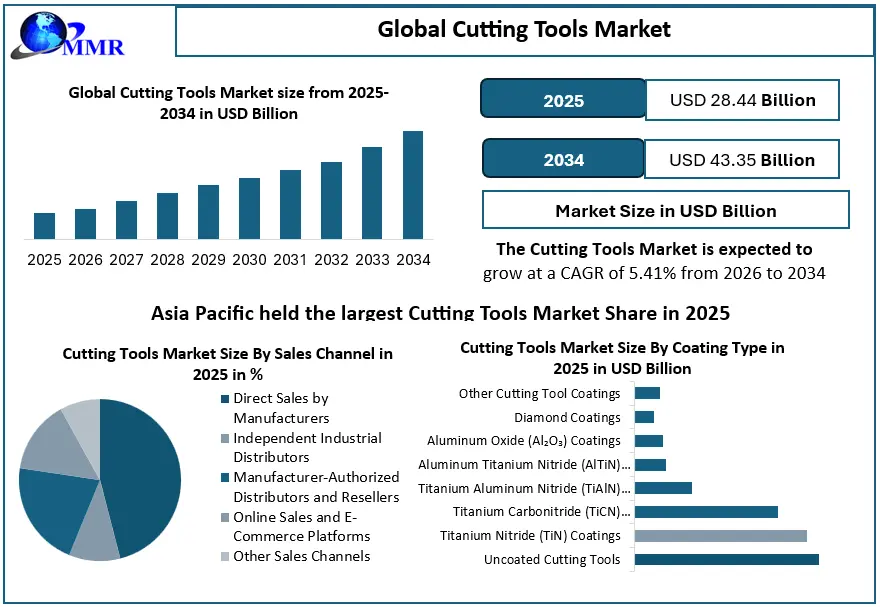
Cutting Tools Market Growth

To know about the Research Methodology :- Request Free Sample Report

Cutting Tools Market Trend: Increasing Adoption of Smart Machining and Digital Twin Technologies

The integration of AI, IIoT, and digital twins is transforming the Cutting Tools Market. Smart sensors can monitor tool wear, cutting temperature, and vibration in real time, while predictive analytics can reduce unplanned downtime by 20–30% and improve equipment utilization by 10–20%, supporting higher machining accuracy and productivity.
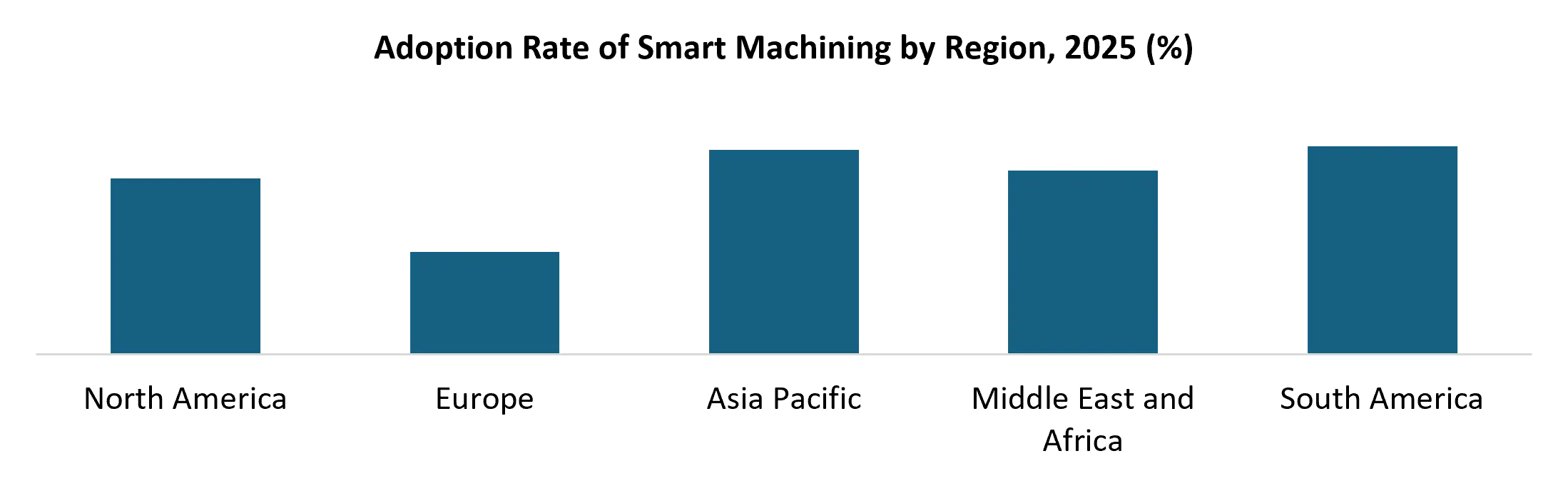
Adoption Rate of Smart Machining by RegionManufacturers are increasingly connecting CNC machines with sensors and digital monitoring systems to track tool wear, cutting temperature, vibration, machining speed and operational performance. These technologies enable predictive maintenance, improve tool-life management and reduce unexpected production interruptions.
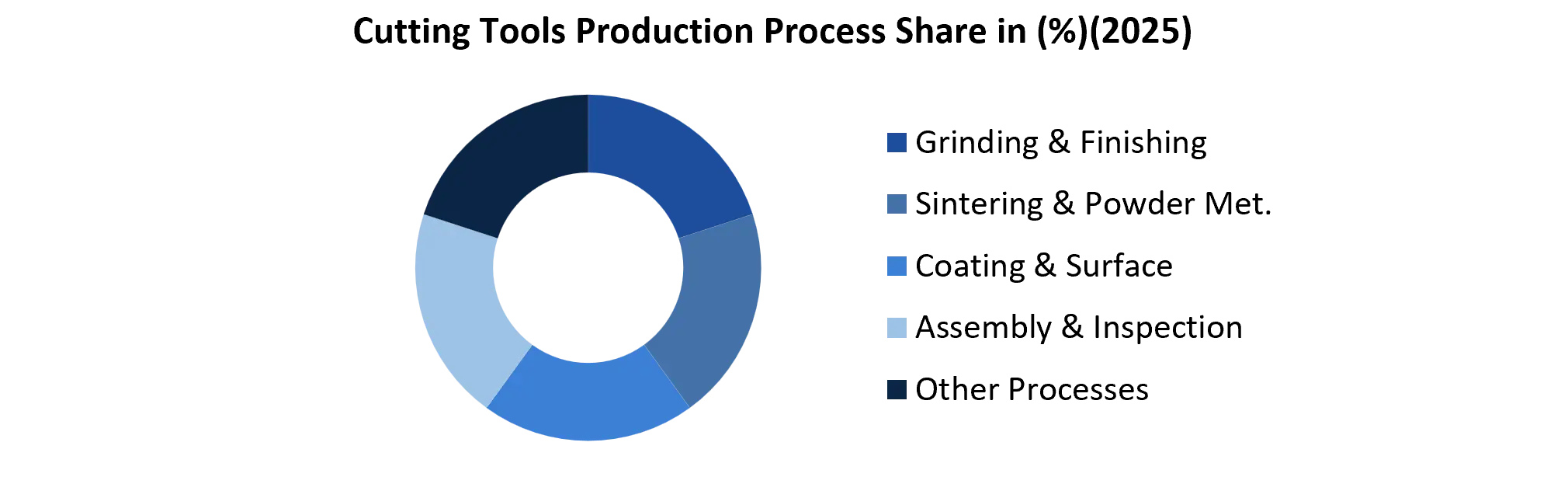
Cutting Tools Production Process ShareCutting-tool manufacturers are responding through the development of smart tooling solutions, digital tool-management platforms and advanced inserts designed for automated machining environments. The integration of cutting tools with computer-aided manufacturing (CAM) systems enables manufacturers to optimize toolpaths, cutting speeds, and feed rates, driving the Cutting Tools Market. Advanced CAM-based machining can reduce programming time by up to 50%, improve machining efficiency, and minimize tool wear through optimized cutting strategies and automated process control.

Cutting Tools Market Dynamics

Expansion of Global Manufacturing and Increasing Demand for Precision Machining to Drive Cutting Tools Market Growth

The expansion of manufacturing activities across automotive, aerospace, industrial machinery, electronics and metal fabrication industries is driving Cutting Tools Market demand. Cutting Tools Manufacturers increasingly require turning, milling, drilling, boring and threading tools to produce precision-engineered components, improve production efficiency and maintain product quality. U.S. food manufacturing recorded nearly USD 1,054.3 billion in shipment value, while chemical manufacturing recorded nearly USD 918.2 billion. These figures demonstrate the considerable scale of industrial production activities that depend on machining, equipment maintenance and component manufacturing.

Manufacturing and Increasing Demand for Precision Machining

Parameter Impact on Cutting Tools Growth Opportunity
Automotive Manufacturing Increases demand for precision machining of engine, transmission and chassis components Growing adoption of carbide tools and CNC machining
Aerospace Manufacturing Drives demand for machining titanium, aluminium and nickel-based alloys High-performance cutting tools with longer tool life
Industrial Machinery Supports demand for milling, drilling and turning tools Advanced tooling for automated production
Precision Engineering Increases demand for high-accuracy tools with tolerances below 10 microns in specialized applications Smart tooling, micro-machining and advanced carbide inserts

The development of electric vehicles, aircraft engines, industrial automation equipment and advanced machinery is increasing requirements for specialised cutting tools capable of machining hardened alloys, stainless steel and other difficult-to-cut materials. Cutting Tools Manufacturers are also investing in advanced CNC machining centres to improve dimensional accuracy and reduce production time. These developments are supporting demand for carbide inserts, high-speed steel tools, ceramic cutting tools and coated tooling solutions, driving Cutting Tools Market Growth.
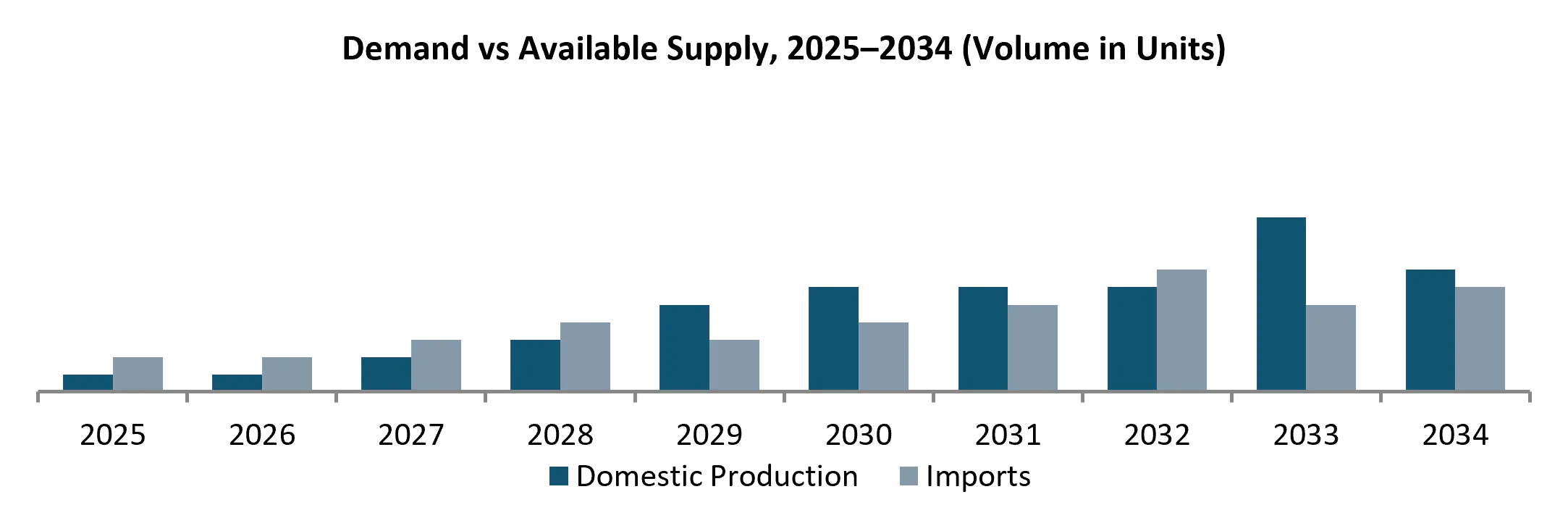
Demand vs Available SupplyRaw Material Supply Concentration and Increasing Tungsten Procurement Costs to hamper Cutting Tools Market growth

The Cutting Tools Market faces challenges from raw material supply concentration, particularly the availability and procurement cost of tungsten, cobalt and other materials used in carbide-based cutting tools. Cemented carbide is widely utilized in milling cutters, turning inserts, drills and other precision machining products because of its hardness, wear resistance and thermal stability. However, dependence on concentrated mining and processing locations creates supply-chain vulnerabilities for manufacturers.

Global tungsten mine production was nearly 81,000 metric tons in 2024, while China produced around 67,000 metric tons. Disruptions in international trade, export restrictions, transportation delays and fluctuations in raw material procurement costs can increase manufacturing expenses. Smaller cutting-tool manufacturers may face additional difficulties in maintaining competitive pricing while securing consistent material supplies, hampering Cutting Tools Market growth.
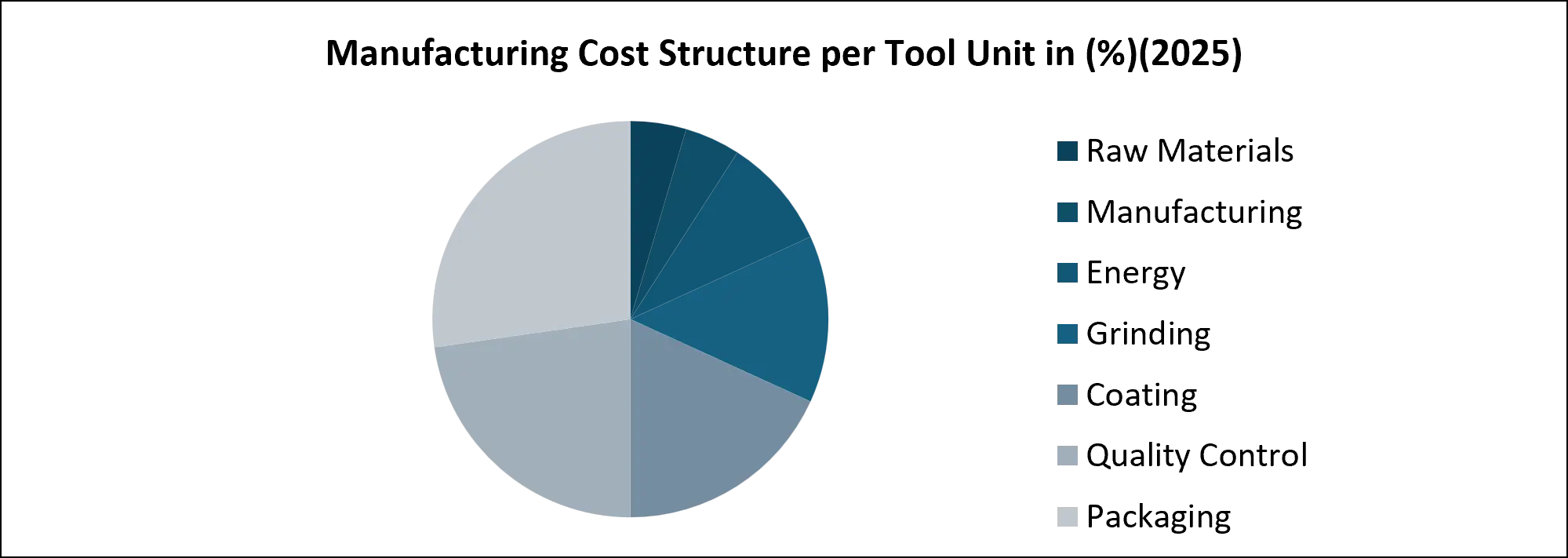
Manufacturing Cost Structure per Tool Unit

Cutting Tools Market Segment Analysis

By Product Type:

Milling tools dominated the product-type segment of the Cutting Tools Market in 2025, supported by their extensive applications across automotive, aerospace, industrial machinery, electronics and general engineering industries. These tools are widely utilized for face milling, end milling, slotting, profiling, contouring and surface-finishing operations. The substantial requirements for machining automotive components such as engine blocks, transmission housings, brake systems and structural parts.

Aerospace manufacturers also require specialized milling solutions for processing titanium alloys, aluminium structures and nickel-based superalloys. Additionally, the increasing adoption of CNC machining centres supports demand for high-performance milling tools capable of delivering precise dimensions and consistent surface finishes. Manufacturers are introducing advanced carbide grades, multilayer coatings and high-feed milling technologies to improve cutting speeds and tool durability.
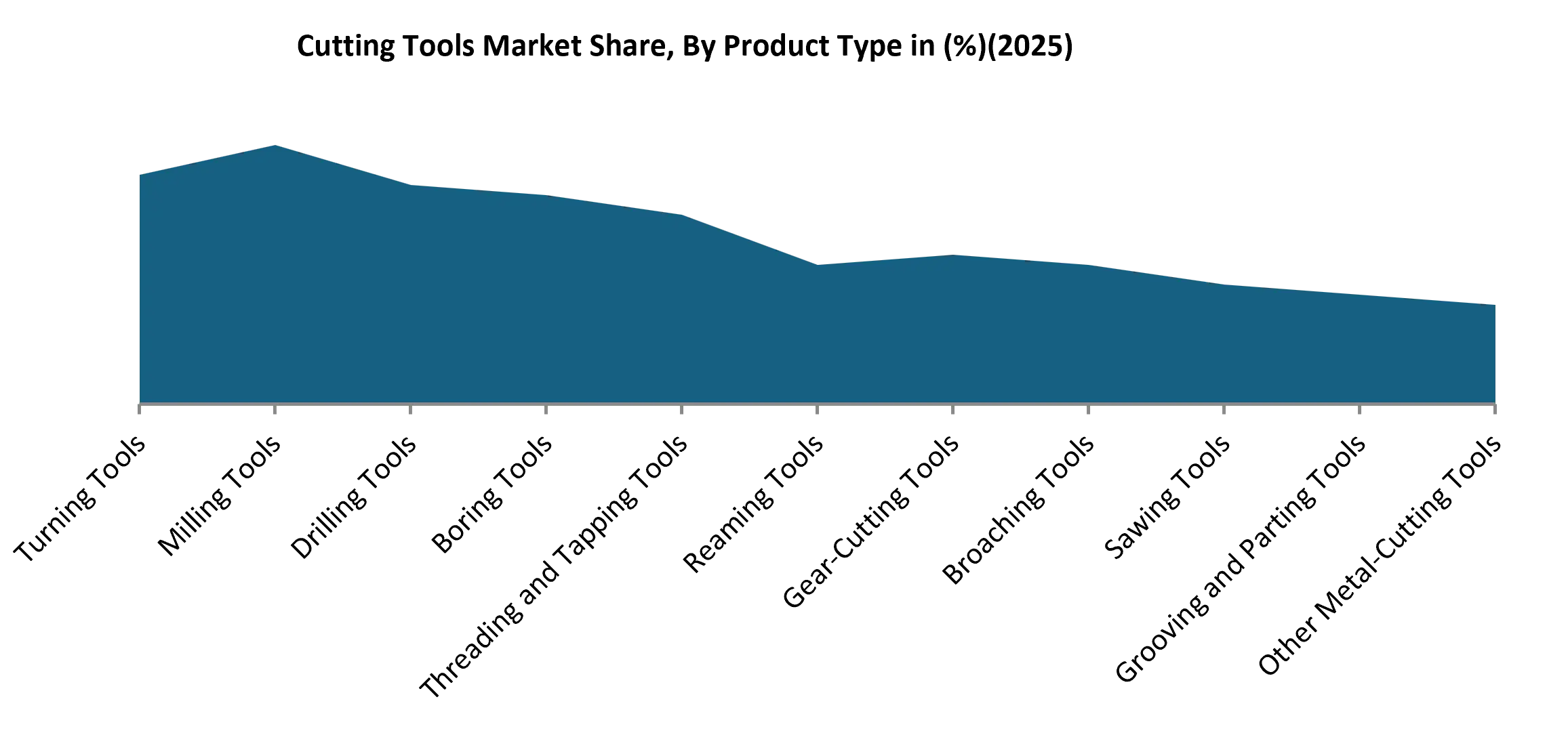
Cutting Tools Market Share, By Product TypeBy Tool Material:

Cemented carbide dominated the tool material segment of the Cutting Tools Market in 2025, due to its superior hardness, wear resistance, thermal stability and suitability for high-speed machining operations. These materials are extensively used in turning inserts, milling cutters, drilling tools, boring tools and other precision-engineered cutting applications. Tungsten carbide accounts for approximately 80–96% of the weight of cemented-carbide cutting tool inserts, while cobalt generally represents 4–20% as a binding material. This composition provides a balance of hardness, toughness, and abrasion resistance, making carbide tools suitable for high-speed turning, milling, and drilling. The transportation industry is also a major tungsten consumer, accounting for nearly one-third of global tungsten consumption, supported by extensive use of carbide cutting inserts and solid carbide tools.
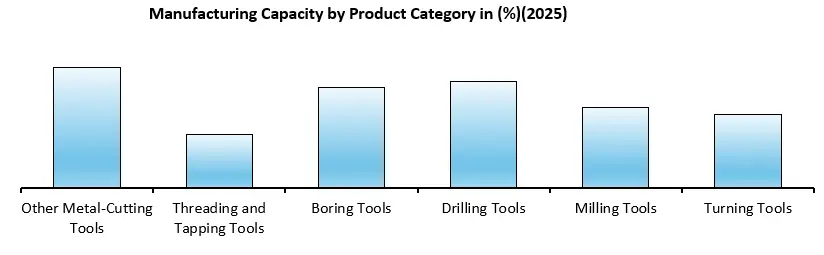
Manufacturing Capacity by Product Category

Nearly 60% of U.S. tungsten consumption was utilized in cemented-carbide parts for cutting and wear-resistant applications. Increasing demand from automotive, aerospace, construction machinery, electronics and industrial equipment manufacturers supports the consumption of carbide-based tooling. The manufacturers are developing coated carbide inserts, micro-grain carbide grades and advanced cutting geometries to improve machining efficiency, tool durability and production accuracy, driving Cutting Tools Market Growth.
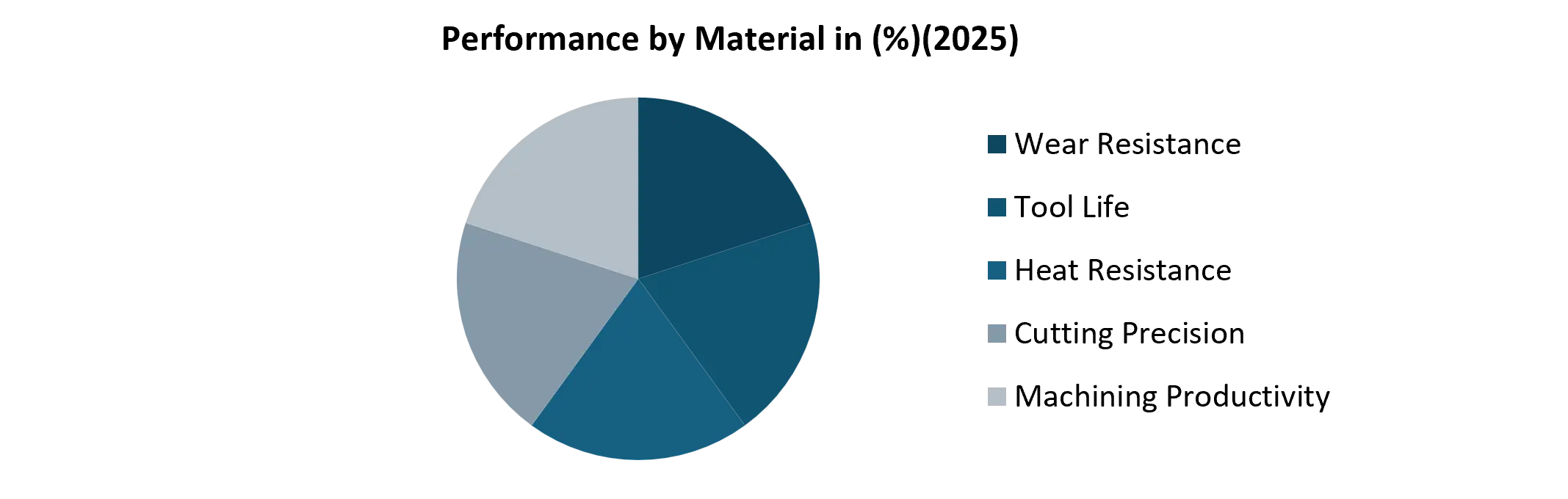
Performance by MaterialCutting Tools Market Regional Insights

• Regional Leadership: Asia Pacific dominated the global Cutting Tools Market in 2025, supported by its extensive manufacturing infrastructure, automotive production, electronics manufacturing and industrial machinery industries.

• China's Manufacturing Strength: China is a major contributor to regional demand. China recorded nearly USD 30.8 billion in machine tool production and USD 26.5 billion in machine tool consumption in 2025.

• Japan's Industrial Base: Japan recorded nearly USD 8.7 billion in machine tool production in 2025, reflecting its established precision engineering, automotive and industrial equipment manufacturing capabilities.

• India's Manufacturing Expansion: India recorded nearly USD 1.8 billion in machine tool production and USD 4.1 billion in machine tool consumption in 2025, indicating demand for imported and domestically manufactured machining equipment.

• South Korea's Contribution: South Korea produced nearly USD 4.4 billion worth of machine tools in 2025, supported by automotive, semiconductor, electronics and industrial manufacturing.

• Key Demand Industries: Automotive components, aerospace equipment, electronics, machinery, defence manufacturing and metal fabrication are major applications supporting cutting-tool consumption.

• Regional Outlook: Increasing investments in CNC machining, industrial automation, electric vehicle production and semiconductor manufacturing are expected to strengthen demand for carbide inserts, milling cutters, drills and precision-engineered cutting tools across China, Japan, India and South Korea.
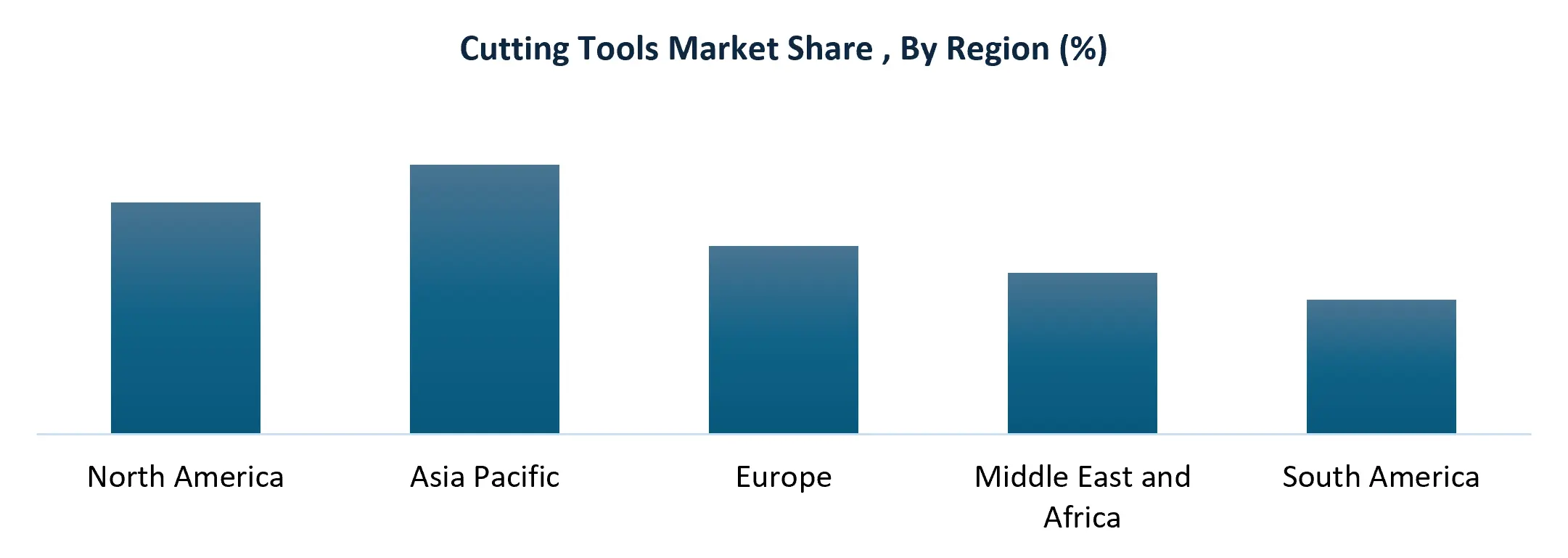
Cutting Tools Market Share , By Region Cutting Tools Market Competitive Landscape

The global Cutting Tools Market is highly competitive, with the presence of multinational manufacturers, specialized tooling companies and regional suppliers. Competition is primarily driven by product quality, cutting performance, tool durability, technological innovation, pricing strategies and distribution networks. Major companies operating in the market include Sandvik AB, Kennametal Inc., ISCAR Ltd., Mitsubishi Materials Corporation, Kyocera Corporation, Sumitomo Electric Industries, OSG Corporation, Walter AG, Ceratizit Group and YG-1 Co., Ltd.. These companies focus on expanding carbide-tool portfolios, developing advanced coatings, improving machining precision and strengthening customer support services. For example, Sandvik expanded its solid-round-tool capabilities through the acquisition of Suzhou Ahno in China in 2024. Additionally, manufacturers are investing in digital machining solutions, customized tooling and application-specific products to strengthen their competitive positioning across automotive, aerospace and industrial manufacturing sectors.
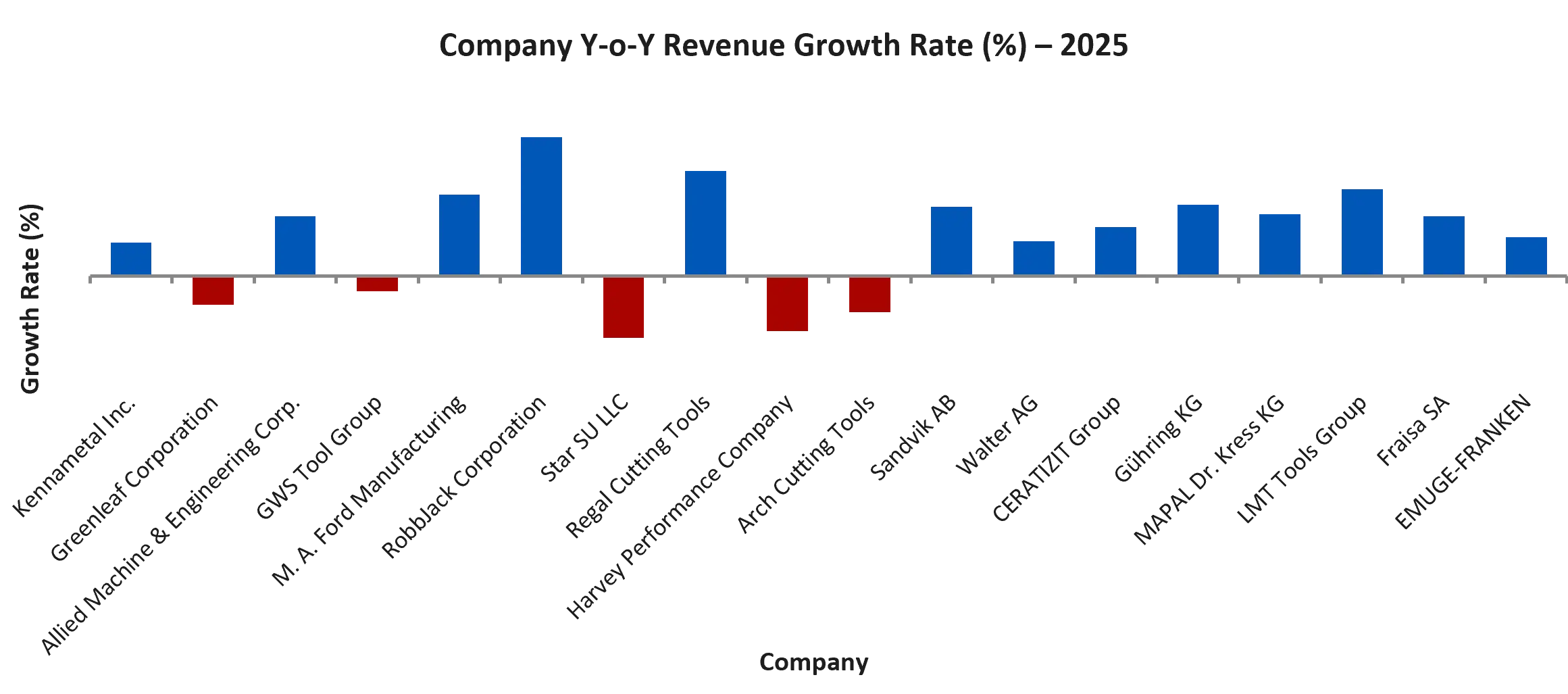
Company Y-o-Y Revenue Growth RateCutting Tools Market Recent Developments

Company Name Date Recent Development Strategic Impact
Kennametal Inc. Sep-26 Introduced an advanced additive tungsten carbide grade for customized carbide hole-finishing tools with optimized cooling channels and complex geometries. Strengthens product innovation and advanced precision machining capabilities.
Greenleaf Corporation Apr-25 Acquired key assets from Haydale Ceramic Technologies to strengthen its whisker-reinforced ceramic cutting tool manufacturing and supply chain. Enhances vertical integration and ceramic tooling production capacity.
Allied Machine & Engineering Corp. Sep-25 Released T-A Pro drill and chamfer holders, enabling drilling and chamfering in a single operation. Reduces machining cycle times and secondary finishing operations.
GWS Tool Group 2026 Expanded manufacturing capabilities through equipment upgrades across five U.S. facilities, including facilities in Arizona and Nashville. Increases production capacity and supports aerospace and medical machining applications.
M. A. Ford Manufacturing Sep-25 Introduced new high-performance solid carbide end mills, including TuffCut X-AL Series 137TWF and 137V5R. Expands its advanced tooling portfolio for high-performance machining applications.

Cutting Tools Market Scope: Inquire before buying

Cutting Tools Market
Report Coverage Details
Base Year: 2025 Forecast Period: 2026-2034
Historical Data: 2020 to 2025 Market Size in 2025: 28.44 USD Billion
Forecast Period 2026-2034 CAGR: 5.41% Market Size in 2034: 43.35 USD Billion
Segments Covered: by Product Type Turning Tools
Milling Tools
Drilling Tools
Boring Tools
Threading and Tapping Tools
Reaming Tools
Gear-Cutting Tools
Broaching Tools
Sawing Tools
Grooving and Parting Tools
Other Metal-Cutting Tools
by Tool Material Cemented Carbide
High-Speed Steel (HSS)
Cermet
Ceramics
Cubic Boron Nitride (CBN)
Polycrystalline Diamond (PCD)
Other Cutting Tool Materials
by Tool Construction Solid-Body Cutting Tools
Indexable-Insert Cutting Tools
Brazed-Edge Cutting Tools
Replaceable-Head Cutting Tools
Modular Cutting Tools
Other Tool Construction Types
by Sales Channel Direct Sales by Manufacturers
Independent Industrial Distributors
Manufacturer-Authorized Distributors and Resellers
Online Sales and E-Commerce Platforms
Other Sales Channels
by Coating Type Uncoated Cutting Tools
Titanium Nitride (TiN) Coatings
Titanium Carbonitride (TiCN) Coatings
Titanium Aluminum Nitride (TiAlN) Coatings
Aluminum Titanium Nitride (AlTiN) Coatings
Aluminum Oxide (Al₂O₃) Coatings
Diamond Coatings
Other Cutting Tool Coatings
by End-User Industry Automotive and Auto Components
Aerospace and Defence
Industrial Machinery and Equipment
General Engineering
Electronics and Electrical Equipment
Medical Devices
Energy and Power
Oil and Gas
Railways and Transportation
Construction and Agricultural Machinery
Die and Mould Manufacturing
Other Industries

Key players/Competitors profiles covered in the Cutting Tools Market report from a strategic perspective

North America

1. Kennametal Inc.
2. Greenleaf Corporation
3. Allied Machine & Engineering Corp.
4. GWS Tool Group
5. M. A. Ford Manufacturing
6. RobbJack Corporation
7. Star SU LLC
8. Regal Cutting Tools
9. Harvey Performance Company
10. Arch Cutting Tools

Europe

11. Sandvik AB
12. Walter AG
13. CERATIZIT Group
14. Gühring KG
15. MAPAL Dr. Kress KG
16. LMT Tools Group
17. Fraisa SA
18. EMUGE-FRANKEN
19. Paul Horn GmbH
20. ZECHA GmbH
21. RUKO GmbH
22. TIVOLY
23. TGS Tools
24. M&V Tools
25. Tech-Diamond

Asia-Pacific

26. Mitsubishi Materials Corporation
27. Kyocera Corporation
28. OSG Corporation
29. Sumitomo Electric Hardmetal
30. Tungaloy Corporation
31. YG-1 Co., Ltd.
32. TaeguTec Ltd.
33. Zhuzhou Cemented Carbide Group (ZCC-CT)
34. NACHI-FUJIKOSHI Corporation
35. Union Tool Co.
36. Korloy Inc.
37. Tiangong International Company Limited
38. Jiangsu Feida Tools Co., Ltd.
39. Shanghai Tool Works Co., Ltd.
40. NTK Cutting Tools
41. Sutton Tools
42. Okazaki Seiko Co., Ltd.

Middle East

43. ISCAR Ltd. (IMC Group)

South America

44. ARNO
45. Mecwide
46. Sul Corte
47. Ferramentas Gedor
48. Metalúrgica Fey
49. Indústrias Togashi
50. Herramientas Uranga S.A.
51. Cutting Tools Chile SpA
52. Trade Tools Cia. S.A.C.

Table of Contents

1. Global Cutting Tools Market Introduction 1.1. Executive Market Landscape and Industry Overview 1.1.1. Global Cutting Tools Market Size and Growth Forecast, 2025–2034 (Value in USD Billion and Volume in Units) 1.1.2. Historical Development and Evolution of the Global Cutting Tools Industry 1.1.3. Industry Overview Covering Turning, Milling, Drilling, Boring, Threading, Carbide Inserts and Solid Cutting Tools 1.1.4. Assessment of Cutting Tool Adoption Across Automotive, Aerospace, Defence, Industrial Machinery, General Engineering, Electronics, Medical Devices, Energy, Oil and Gas, and Railways 1.1.5. Analysis of Cutting Tool Technologies Based on Tool Materials, Carbide Grades, Coatings, Tool Geometry, CNC Machining and High-Speed Machining 1.1.6. Evaluation of Tool Life, Wear Resistance, Machining Accuracy and Productivity Performance 1.1.7. Assessment of Major Market Trends, Advanced Tool Materials, Coating Innovations and Smart Manufacturing Initiatives 1.1.8. Analysis of Regulatory Changes, Investment Activities and Emerging Opportunities Influencing the Global Cutting Tools Market Through 2034 1.1.9. Global Cutting Tools Market Definition, Scope Boundaries, Inclusions and Exclusions 1.1.10. Market Estimation Basis, Manufacturer Sales, Cutting Inserts Revenue Treatment and Double-Counting Prevention Methodology 1.2. Global Cutting Tools Market Segmentation and Share Analysis 1.2.1. Global Cutting Tools Market Segmentation by Product Type, 2025–2034 1.2.2. Global Cutting Tools Market Segmentation by Tool Material, 2025–2034 1.2.3. Global Cutting Tools Market Segmentation by Tool Construction, 2025–2034 1.2.4. Global Cutting Tools Market Segmentation by Coating Type, 2025–2034 1.2.5. Global Cutting Tools Market Segmentation by End-Use Industry, 2025–2034 1.2.6. Global Cutting Tools Market Segmentation by Sales Channel, 2025–2034 1.2.7. Segment-Wise Market Size, Revenue Contribution and Forecast Growth Analysis 1.2.8. Segment-Wise Market Share Analysis and Revenue Contribution Assessment 1.2.9. Identification of High-Growth Segments and Emerging Market Opportunities 1.2.10. Mutually Exclusive Category Definitions and Independent 100% Market Share Reconciliation Across Segmentation Dimensions 1.3. Global Cutting Tools Market Dynamics 1.3.1. Global Cutting Tools Market Trends 1.3.2. Global Cutting Tools Market Drivers 1.3.3. Global Cutting Tools Market Restraints 1.3.4. Global Cutting Tools Market Opportunities 1.3.5. Global Cutting Tools Market Challenges 1.3.6. PORTER’s Five Forces Analysis 1.3.6.1. Bargaining Power of Suppliers 1.3.6.2. Bargaining Power of Buyers 1.3.6.3. Threat of Substitute Products 1.3.6.4. Threat of New Entrants 1.3.6.5. Competitive Rivalry 1.3.7. PESTLE Analysis 1.3.7.1. Political Factors 1.3.7.2. Economic Factors 1.3.7.3. Social Factors 1.3.7.4. Technological Factors 1.3.7.5. Legal Factors 1.3.7.6. Environmental Factors 1.4. Global Cutting Tools Industry Microeconomic and Business Analysis 1.4.1. Industry Demand Elasticity Across Manufacturing Sectors and Production Conditions 1.4.2. Impact of Raw Material Costs on Cutting Tool Manufacturing Profitability 1.4.3. Labour Productivity, Operating Expenses and Manufacturing Cost Competitiveness 1.4.4. Supplier Bargaining Power and Customer Purchasing Behaviour Across Industries 1.4.5. Pricing Sensitivity, Product Substitution Risks and Buyer Negotiation Dynamics 1.4.6. Industry Profitability Drivers, Competitive Pressures and Business Sustainability Factors 1.5. Global Cutting Tools Industry Ecosystem and Value Chain Analysis 1.5.1. Global Cutting Tools Industry Structure and Value Chain Participant Assessment 1.5.2. Leading Manufacturers, Component Suppliers and Technology Provider Relationships 1.5.3. Industrial Customer Requirements and Cutting Tool Supplier Collaboration Models 1.5.4. Value Addition Across Raw Material Processing, Tool Manufacturing and Distribution 1.5.5. Competitive Dependencies, Industry Entry Barriers and Customer Switching Costs 1.5.6. Strategic Partnerships, Joint Ventures and Industry Consolidation Developments 1.6. Global Cutting Tools Geographic Demand and Regional Analysis 1.6.1. Regional Market Size, Revenue Contribution and Cutting Tool Consumption Patterns 1.6.2. Demand Distribution Across North America, Europe, Asia-Pacific, Middle East and Africa, and South America 1.6.3. Regional Manufacturing Concentrations and Industrial Development Influencing Cutting Tool Consumption 1.6.4. Country-Level Demand Drivers Across Automotive, Aerospace and Engineering Industries 1.6.5. Regional Technology Adoption, Product Preferences and Procurement Practice Differences 1.6.6. Emerging Regional Opportunities, Competitive Intensity and Market Accessibility Assessment 1.7. Country-Level and City-Level Cutting Tools Demand Assessment 1.7.1. Country-Level Cutting Tool Consumption Across Major Industrial Manufacturing Economies 1.7.2. City-Level Demand Concentrations Across Manufacturing Hubs and Industrial Clusters 1.7.3. Local Demand Drivers Across Automotive Plants and Engineering Facilities 1.7.4. Country-Level Production Capacity, Import Dependency and Domestic Supply Availability 1.7.5. Industrial Corridor Development and Regional Manufacturing Investment Implications 1.7.6. Local Market Opportunities Across Emerging Manufacturing Cities and Industrial Zones 1.8. Global Cutting Tools Supply Chain and Raw Material Sourcing Analysis 1.8.1. Raw Material Sourcing Networks for Carbide, Steel and Cutting Tool Substrates 1.8.2. Supplier Landscape for Tungsten, Cobalt, Ceramics and Specialty Materials 1.8.3. Raw Material Availability, Price Volatility and Procurement Risk Assessment 1.8.4. Cutting Tool Manufacturing Networks and Component Sourcing Dependencies 1.8.5. Supplier Concentration Risks, Procurement Lead Times and Material Availability 1.8.6. Strategic Sourcing Models, Supplier Partnerships and Procurement Optimization Opportunities 1.8.7. Country-Level Market Size, Growth Rates and Market Share Contribution for Priority Countries 1.9. Cutting Tools Logistics, Distribution and International Trade Analysis 1.9.1. Global Cutting Tool Distribution Networks and Regional Logistics Infrastructure 1.9.2. Direct Sales, Industrial Distributors, Dealers and E-Commerce Channel Assessment 1.9.3. International Trade Flows, Import-Export Dependencies and Tariff Implications 1.9.4. Transportation Costs, Distribution Lead Times and Delivery Performance Evaluation 1.9.5. Channel Partner Coverage, Customer Reach and Distribution Network Optimization 1.9.6. Warehouse Locations, Inventory Availability and Regional Fulfilment Capabilities 1.10. Cutting Tools Manufacturing Capacity and Production Efficiency Analysis 1.10.1. Global Cutting Tool Manufacturing Capacity and Facility Utilization Assessment 1.10.2. Production Output by Product Type, Material and Manufacturing Location 1.10.3. Manufacturing Processes Covering Grinding, Sintering, Coating and Precision Finishing 1.10.4. Manufacturing Machinery Availability, Production Bottlenecks and Capacity Constraints 1.10.5. Automation Adoption, Manufacturing Productivity and Quality Control Performance 1.10.6. Capacity Utilization Trends, Planned Investments and Future Production Availability 1.11. Cutting Tools Pricing, Cost Structure and Margin Analysis 1.11.1. Average Selling Prices Across Cutting Tool Types and Material Categories 1.11.2. Price Differentials by Tool Geometry, Coating, Grade and Performance 1.11.3. Raw Material Costs and Their Impact on Manufacturing Economics 1.11.4. Manufacturing Labour, Energy Consumption and Production Overhead Cost Contributions 1.11.5. Distributor Margins, Procurement Discounts and Regional Price Variation Analysis 1.11.6. Pricing Strategies, Profitability Benchmarks and Total Cost of Ownership Assessment 1.12. Cutting Tools Demand-Supply Balance and Availability Gap Analysis 1.12.1. Global Cutting Tool Demand Compared with Available Manufacturing Supply 1.12.2. Demand-Supply Balance by Product Type, Material and Regional Market 1.12.3. Supply Shortages, Delivery Delays and Industrial Procurement Challenges 1.12.4. Capacity Constraints Affecting Specialized Tools and Advanced Material Availability 1.12.5. Import Dependency, Unmet Customer Requirements and Domestic Production Gaps 1.12.6. Average Selling Price and Price Comparison Methodology by Product Type, Material, Grade and Region 1.12.7. Future Demand-Supply Imbalances and Capacity Expansion Opportunities, 2025–2034 1.13. Cutting Tools Technology, Design and Performance Analysis 1.13.1. Cutting Tool Geometry, Edge Design and Precision Engineering Developments 1.13.2. Tool Coatings, Surface Treatments and Wear Resistance Improvement Technologies 1.13.3. Cutting Performance Across Different Workpiece Materials and Machining Conditions 1.13.4. Tool Life, Cutting Speed, Feed Rate and Productivity Benchmarks 1.13.5. CNC Machining Integration, Tool Compatibility and Precision Manufacturing Applications 1.13.6. Digital Tool Monitoring, Predictive Analytics and Intelligent Machining Integration 1.14. Cutting Tools Maintenance, Repair and Overhaul Services Analysis 1.14.1. Global Cutting Tool Maintenance and Reconditioning Service Market Assessment 1.14.2. Tool Regrinding, Resharpening and Recoating Service Demand Patterns 1.14.3. Maintenance Expenditure Across Manufacturing Plants and Industrial Production Facilities 1.14.4. Reconditioning Economics Compared with Purchasing New Cutting Tools 1.14.5. Service Provider Networks, Turnaround Times and Quality Assurance Standards 1.14.6. MRO Opportunities Across High-Utilization and Precision Machining Applications 1.15. Cutting Tools Aftermarket and Replacement Demand Analysis 1.15.1. Aftermarket Demand for Replacement Tools, Inserts and Cutting Components 1.15.2. Replacement Frequency by Tool Type, Material and Machining Application 1.15.3. Tool Consumption Rates Across High-Volume Manufacturing and Production Operations 1.15.4. Regrinding, Recoating and Refurbishment Effects on Replacement Purchasing 1.15.5. Aftermarket Distribution Channels, Service Contracts and Customer Retention Strategies 1.15.6. Replacement Ratios, Recurring Revenue Opportunities and Aftermarket Growth Outlook 1.16. Cutting Tool Lifecycle and Machine Replacement Impact Analysis 1.16.1. Average Cutting Tool Life Across Materials and Machining Conditions 1.16.2. Replacement Intervals by Tool Type, Workpiece Material and Operating Intensity 1.16.3. Tool Wear, Edge Failure and Performance-Related Replacement Triggers 1.16.4. Manufacturing Machine Utilization and Its Influence on Tool Consumption 1.16.5. CNC Machine Age, Modernization Cycles and Replacement-Driven Tooling Demand 1.16.6. Tool Replacement Ratios, Lifecycle Consumption and Forecast Demand, 2025–2034 1.17. Cutting Tools Procurement, Inventory and Customer Purchasing Analysis 1.17.1. Industrial Procurement Processes Across Manufacturing and Engineering Organizations 1.17.2. Supplier Selection Criteria Covering Quality, Price and Tool Performance 1.17.3. Purchasing Preferences for Inserts, Solid Tools and Specialized Tooling 1.17.4. Inventory Planning, Replenishment Cycles and Cutting Tool Availability Requirements 1.17.5. Procurement Contracts, Bulk Purchasing and Long-Term Supplier Agreements 1.17.6. Customer Purchasing Behaviour, Technical Support and Supplier Relationship Management 1.17.7. Separation of New-Tool Sales, Replacement-Tool Sales and Reconditioning-Service Revenue in Market Estimates 1.18. Cutting Tools Applications and End-Use Industry Demand Analysis 1.18.1. Automotive and Auto Component Manufacturing Cutting Tool Requirements 1.18.2. Aerospace, Defence and Precision Engineering Applications and Performance Needs 1.18.3. Industrial Machinery, General Engineering and Equipment Manufacturing Demand 1.18.4. Electronics, Medical Devices and Electrical Equipment Machining Applications 1.18.5. Energy, Oil and Gas, Railways and Transportation Industry Requirements 1.18.6. Construction Machinery, Agricultural Equipment and Die Manufacturing Tool Demand 1.19. Cutting Tools Investment, Capital Allocation and Expansion Analysis 1.19.1. Capital Investment Across Cutting Tool Manufacturing Facilities and Production Lines 1.19.2. Research and Development Spending on Advanced Materials and Tool Designs 1.19.3. Investment in Precision Grinding, Coating and Automated Manufacturing Equipment 1.19.4. Capacity Expansion Plans, New Facilities and Technology Modernization Projects 1.19.5. Country-Wise Investment Attractiveness, Industrial Growth and Manufacturing Incentives 1.19.6. Future Investment Opportunities Across High-Growth Cutting Tool Applications, 2025–2034 1.20. Cutting Tools Regulatory, Quality and Sustainability Assessment 1.20.1. Industry Quality Standards and Cutting Tool Product Certification Requirements 1.20.2. Occupational Safety Requirements Across Machining and Metalworking Environments 1.20.3. Environmental Regulations Affecting Cutting Tool Manufacturing and Surface Coating 1.20.4. Recycling of Carbide Materials, Tool Scrap and Industrial Metal Waste 1.20.5. Sustainable Manufacturing Practices and Resource Efficiency Improvement Opportunities 1.20.6. Compliance Costs, Environmental Risks and Future Regulatory Developments 1.21. Global Cutting Tools Market Size and Forecast by Segmentation (Value: USD Billion; Volume: Units), 2025–2034 1.21.1. Global Cutting Tools Market Size and Forecast by Product Type 1.21.1.1. Turning Tools 1.21.1.2. Milling Tools 1.21.1.3. Drilling Tools 1.21.1.4. Boring Tools 1.21.1.5. Threading and Tapping Tools 1.21.1.6. Reaming Tools 1.21.1.7. Gear-Cutting Tools 1.21.1.8. Broaching Tools 1.21.1.9. Sawing Tools 1.21.1.10. Grooving and Parting Tools 1.21.1.11. Other Metal-Cutting Tools 1.21.2. Global Cutting Tools Market Size and Forecast by Tool Material 1.21.2.1. Cemented Carbide 1.21.2.2. High-Speed Steel (HSS) 1.21.2.3. Cermet 1.21.2.4. Ceramics 1.21.2.5. Cubic Boron Nitride (CBN) 1.21.2.6. Polycrystalline Diamond (PCD) 1.21.2.7. Other Cutting Tool Materials 1.21.3. Global Cutting Tools Market Size and Forecast by Tool Construction 1.21.3.1. Solid-Body Cutting Tools 1.21.3.2. Indexable-Insert Cutting Tools 1.21.3.3. Brazed-Edge Cutting Tools 1.21.3.4. Replaceable-Head Cutting Tools 1.21.3.5. Modular Cutting Tools 1.21.3.6. Other Tool Construction Types 1.21.4. Global Cutting Tools Market Size and Forecast by Coating Type 1.21.4.1. Uncoated Cutting Tools 1.21.4.2. Titanium Nitride (TiN) Coatings 1.21.4.3. Titanium Carbonitride (TiCN) Coatings 1.21.4.4. Titanium Aluminum Nitride (TiAlN) Coatings 1.21.4.5. Aluminum Titanium Nitride (AlTiN) Coatings 1.21.4.6. Aluminum Oxide (Al₂O₃) Coatings 1.21.4.7. Diamond Coatings 1.21.4.8. Other Cutting Tool Coatings 1.21.5. Global Cutting Tools Market Size and Forecast by Sales Channel 1.21.5.1. Direct Sales by Manufacturers 1.21.5.2. Independent Industrial Distributors 1.21.5.3. Manufacturer-Authorized Distributors and Resellers 1.21.5.4. Online Sales and E-Commerce Platforms 1.21.5.5. Other Sales Channels 1.21.6. Global Cutting Tools Market Size and Forecast by End-Use Industry 1.21.6.1. Automotive and Auto Components 1.21.6.2. Aerospace and Defence 1.21.6.3. Industrial Machinery and Equipment 1.21.6.4. General Engineering 1.21.6.5. Electronics and Electrical Equipment 1.21.6.6. Medical Devices 1.21.6.7. Energy and Power 1.21.6.8. Oil and Gas 1.21.6.9. Railways and Transportation 1.21.6.10. Construction and Agricultural Machinery 1.21.6.11. Die and Mould Manufacturing 1.21.6.12. Other Industries 1.21.7. Global Cutting Tools Market Size and Forecast by Region 1.21.7.1. North America 1.21.7.2. Europe 1.21.7.3. Asia-Pacific 1.21.7.4. Middle East and Africa 1.21.7.5. South America 1.21.8. Global Cutting Tools Market Size and Forecast by Country 1.21.8.1. United States 1.21.8.2. Canada 1.21.8.3. Mexico 1.21.8.4. Germany 1.21.8.5. United Kingdom 1.21.8.6. France 1.21.8.7. Italy 1.21.8.8. Spain 1.21.8.9. China 1.21.8.10. Japan 1.21.8.11. India 1.21.8.12. South Korea 1.21.8.13. Taiwan 1.21.8.14. Australia 1.21.8.15. Brazil 1.21.8.16. Other Key Countries 2. Competitive Intelligence and Industrial Ecosystem 2.1. Global Cutting Tools Market Competitive Landscape 2.1.1. MMR Competition Matrix 2.1.2. Competitive Positioning of Leading Key Players Based on Revenue and Market Share (%) 2.1.3. Key Players Benchmarking 2.1.3.1. Company Name 2.1.3.2. Headquarters 2.1.3.3. Year of Establishment 2.1.3.4. Cutting Tools Market Product Portfolio 2.1.3.5. Cutting Tool Types and Material Specializations 2.1.3.6. Manufacturing Capacity and Production Output 2.1.3.7. Regulatory Approvals, Quality Standards and Product Certifications 2.1.3.8. Total Company Revenue (2025) 2.1.3.9. Cutting Tools Segment Revenue (2025) 2.1.3.10. Cutting Tools Market Share (%) 2.1.3.11. Revenue Growth Rate (Y-o-Y 2025) 2.1.3.12. Operating Profit Margin (2025) 2.1.3.13. Geographic Presence 2.1.3.14. Financial Year, Currency and Reporting Basis 2.1.3.15. Reported Versus Estimated Financial and Market Metrics 2.1.4. Global Cutting Tools Market Structure Analysis 2.1.4.1. Market Leaders 2.1.4.2. Market Followers 2.1.4.3. Emerging Market Players 2.1.5. Mergers, Acquisitions, Joint Ventures and Strategic Collaborations 2.1.6. Recent Key Developments Across Leading Market Participants 2.2. Global Cutting Tools Market Product Portfolio and Technology Capability Benchmarking 2.2.1. Comparative Assessment of Cutting Tool Product Portfolios Across Leading Manufacturers 2.2.2. Comparative Assessment of Turning, Milling, Drilling, Boring and Threading Tools 2.2.3. Cutting Tool Materials, Carbide Grades, Coatings and Advanced Tooling Technologies 2.2.4. Cutting Tool Geometry, Edge Design, Precision Engineering and Product Customization Capabilities 2.2.5. Tool Performance, Wear Resistance, Machining Accuracy and Operational Efficiency 2.2.6. Product Configuration Capabilities for Indexable Inserts, Solid Tools and Specialized Cutting Applications 2.3. Global Cutting Tools Market Manufacturing Infrastructure and Operational Capability Benchmarking 2.3.1. Comparative Assessment of Manufacturing Infrastructure and Operational Capabilities 2.3.2. Availability and Scale of Cutting Tool Manufacturing Plants, Grinding Facilities and Coating Centres 2.3.3. Manufacturing and Engineering Infrastructure Across Major Global Markets 2.3.4. Availability of Carbide, High-Speed Steel, Ceramics, Diamond and Specialized Tool Materials 2.3.5. Production Capacity, Manufacturing Throughput and Quality Control Capabilities 2.3.6. Regional Manufacturing Hubs, Production Networks and Facility Capabilities 2.4. Global Cutting Tools Market Technology Innovation and Advanced Machining Benchmarking 2.4.1. Comparative Assessment of Technology Adoption, Product Innovation and Research Capabilities 2.4.2. Adoption of Advanced Cutting Tool Technologies for Improved Productivity and Precision 2.4.3. Advanced Coatings, Carbide Grades and Material Innovations 2.4.4. Digital Tool Monitoring, Predictive Analytics and Machining Data Integration 2.4.5. CNC Machining, High-Speed Machining and Precision Manufacturing Integration 2.4.6. Innovations in Tool Geometry, Wear Detection and Sustainable Manufacturing 2.5. Global Cutting Tools Market Ecosystem and Strategic Partnership Assessment 2.5.1. Strategic Partnerships Among Cutting Tool Manufacturers, Material Suppliers and Machine Builders 2.5.2. Strategic Relationships Between Cutting Tool Manufacturers and CNC Machine Tool Manufacturers 2.5.3. Partnerships with Carbide Producers, Coating Specialists and Precision Engineering Technology Providers 2.5.4. Collaborations Across Automotive, Aerospace, Medical and Industrial Machinery Applications 2.5.5. Technology Partnerships Supporting Advanced Materials and High-Performance Machining 2.5.6. Partnerships with Industrial Distributors, Reconditioning Providers and Specialized Tooling Service Companies 2.6. Global Cutting Tools Market Competitive Landscape and Strategic Positioning Assessment 2.6.1. Comprehensive Assessment of Competitive Positioning Across Global Cutting Tool Manufacturers 2.6.2. Competitive Positioning Based on Product Portfolios, Manufacturing Capacity, Technology and Geographic Reach 2.6.3. Differentiation Through Tool Materials, Coatings, Geometry and Machining Performance 2.6.4. Competitive Advantage Through Manufacturing Infrastructure, Engineering Capabilities and Technical Expertise 2.6.5. Comparison of Cutting Tool Product Strategies Across Major Manufacturers 2.6.6. Comparison of Carbide Inserts, Solid Tools and Specialized Cutting Tool Market Positioning Strategies 2.7. Global Cutting Tools Market Supply Chain and Strategic Sourcing Benchmarking 2.7.1. Comparative Assessment of Supply-Side Structures Across Raw Material Sourcing, Manufacturing, Distribution and Aftermarket Services 2.7.2. Tungsten, Cobalt, Carbide, High-Speed Steel and Specialty Material Sourcing Models 2.7.3. Raw Material Procurement Practices Adopted by Global Cutting Tool Manufacturers 2.7.4. Supplier Networks for Carbide Substrates, Cutting Inserts, Tool Blanks and Coating Materials 2.7.5. Strategic Sourcing of Advanced Materials, Precision Components and Specialized Manufacturing Inputs 2.7.6. Local Versus Imported Raw Material Sourcing Across Major Cutting Tool Manufacturing Markets 2.8. Company Profiles of 50+ Key Global Cutting Tools Market Players 2.8.1. North America 2.8.1.1. Kennametal Inc. 2.8.1.2. Greenleaf Corporation 2.8.1.3. Allied Machine & Engineering Corp. 2.8.1.4. GWS Tool Group 2.8.1.5. M. A. Ford Manufacturing 2.8.1.6. RobbJack Corporation 2.8.1.7. Star SU LLC 2.8.1.8. Regal Cutting Tools 2.8.1.9. Harvey Performance Company 2.8.1.10. Arch Cutting Tools 2.8.2. Europe 2.8.2.1. Sandvik AB 2.8.2.2. Walter AG 2.8.2.3. CERATIZIT Group 2.8.2.4. Gühring KG 2.8.2.5. MAPAL Dr. Kress KG 2.8.2.6. LMT Tools Group 2.8.2.7. Fraisa SA 2.8.2.8. EMUGE-FRANKEN 2.8.2.9. Paul Horn GmbH 2.8.2.10. ZECHA GmbH 2.8.2.11. RUKO GmbH 2.8.2.12. TIVOLY 2.8.2.13. TGS Tools 2.8.2.14. M&V Tools 2.8.2.15. Tech-Diamond 2.8.3. Asia-Pacific 2.8.3.1. Mitsubishi Materials Corporation 2.8.3.2. Kyocera Corporation 2.8.3.3. OSG Corporation 2.8.3.4. Sumitomo Electric Hardmetal 2.8.3.5. Tungaloy Corporation 2.8.3.6. YG-1 Co., Ltd. 2.8.3.7. TaeguTec Ltd. 2.8.3.8. Zhuzhou Cemented Carbide Group (ZCC-CT) 2.8.3.9. NACHI-FUJIKOSHI Corporation 2.8.3.10. Union Tool Co. 2.8.3.11. Korloy Inc. 2.8.3.12. Tiangong International Company Limited 2.8.3.13. Jiangsu Feida Tools Co., Ltd. 2.8.3.14. Shanghai Tool Works Co., Ltd. 2.8.3.15. NTK Cutting Tools 2.8.3.16. Sutton Tools 2.8.3.17. Okazaki Seiko Co., Ltd. 2.8.4. Middle East 2.8.4.1. ISCAR Ltd. (IMC Group) 2.8.5. South America 2.8.5.1. ARNO 2.8.5.2. Mecwide 2.8.5.3. Sul Corte 2.8.5.4. Ferramentas Gedor 2.8.5.5. Metalúrgica Fey 2.8.5.6. Indústrias Togashi 2.8.5.7. Herramientas Uranga S.A. 2.8.5.8. Cutting Tools Chile SpA 2.8.5.9. Trade Tools Cia. S.A.C. 2.8.6. Company Profile Parameters 2.8.6.1. Company Overview 2.8.6.2. Business Portfolio 2.8.6.3. Cutting Tools Product Portfolio 2.8.6.4. Product Types and Material Specializations 2.8.6.5. Manufacturing Facilities and Production Capabilities 2.8.6.6. Geographic Presence and Distribution Network 2.8.6.7. Financial Overview 2.8.6.8. Cutting Tools Segment Revenue and Market Position 2.8.6.9. SWOT Analysis 2.8.6.10. Strategic Analysis 2.8.6.11. Recent Developments 3. Strategic Recommendations and Research Methodology 3.1. Key Findings 3.1.1. Global Cutting Tools Market Size, Growth and Forecast Outlook 3.1.2. Key Product Type and Tool Material Segment Findings 3.1.3. End-Use Industry Demand and Application-Wise Growth Opportunities 3.1.4. Regional and Country-Level Market Performance 3.1.5. Competitive Landscape and Market Share Assessment 3.1.6. Technology Innovation and Advanced Machining Trends 3.1.7. Demand-Supply Balance and Manufacturing Capacity Findings 3.1.8. Pricing, Profitability and Investment Opportunity Assessment 3.2. Analyst Recommendations 3.2.1. Strategic Recommendations for Global Cutting Tool Manufacturers 3.2.2. Product Portfolio Diversification and Advanced Tool Material Development 3.2.3. Technology Innovation and R&D Investment Strategies 3.2.4. Regional Expansion and Country-Level Market Penetration Strategies 3.2.5. Raw Material Sourcing and Supply Chain Optimization Strategies 3.2.6. Pricing Strategies and Manufacturing Cost Optimization 3.2.7. Aftermarket, Reconditioning and Customer Retention Strategies 3.2.8. Capacity Expansion and Long-Term Investment Recommendations 3.3. Research Methodology 3.3.1. Research Framework and Market Scope Definition 3.3.2. Primary Research and Industry Expert Interviews 3.3.3. Secondary Research and Data Collection Sources 3.3.4. Bottom-Up Market Size Estimation Approach 3.3.5. Top-Down Market Size Estimation Approach 3.3.6. Market Forecasting and CAGR Calculation Methodology 3.3.7. Market Share Estimation and Competitive Benchmarking Methodology 3.3.8. Revenue Validation and Financial Data Assessment 3.3.9. Data Triangulation and Cross-Verification 3.3.10. Research Assumptions, Limitations and Forecast Parameters

Custom Market Research Services

We Will Customise The Research For You, In Case The Report Listed Above Does Not Meet With Your Requirements