Contact Lenses Market – Industry Structure Evaluation, Demand Drivers Analysis, Regional Growth Analysis and Identification, Competitive Positioning Review & Global Market Size Forecast to 2032

6.5%
CAGR (2026-2032)
14.21 USD Bn.
Market Size
313
Report Pages
145
Market Tables

Overview

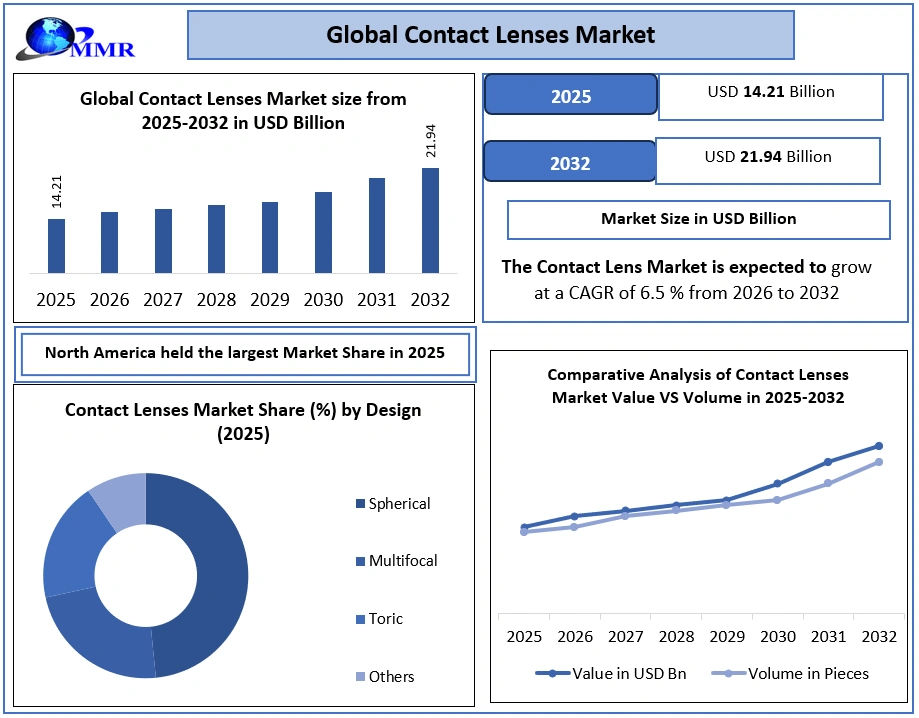
The Global Contact Lenses Market size was valued at USD 14.21 Bn in 2025, and the total Contact Lens revenue is expected to grow at a CAGR of 6.5% from 2026 to 2032, reaching nearly USD 21.94 Bn. The market is driven by the soaring demand for daily disposable contact lenses and silicone hydrogel materials. With the rising prevalence of myopia worldwide, especially in Asia-Pacific and North America, the Contact Lenses Market is forecasted to maintain robust growth through 2032.

Contact Lenses Market Overview

The global Contact Lenses Market has demonstrated structurally resilient growth, driven by rising refractive error prevalence, lifestyle-driven vision correction demand, and rapid product innovation. This long-term expansion reflects a stable demand base supported by silicone hydrogel penetration, accelerating daily disposable adoption, and rising usage in emerging economies.
Contact Lenses Market 2025-2032

To know about the Research Methodology:-Request Free Sample Report

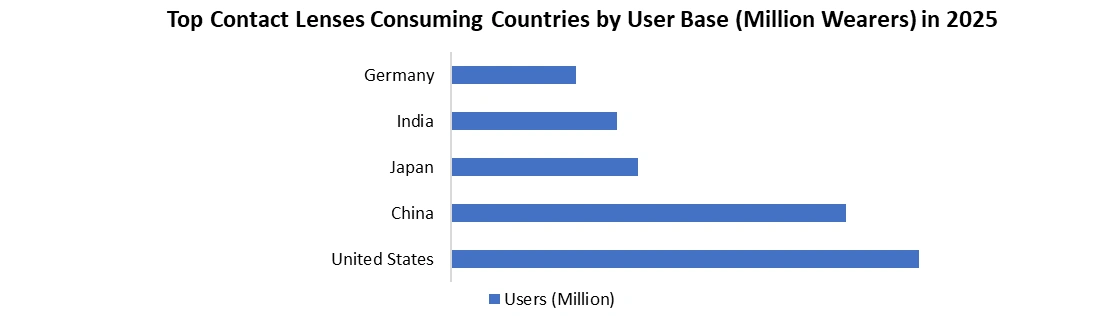
In terms of user base, developed Contact Lenses Markets such as the United States, Canada, Western Europe, Japan, and Australia remain volume leaders, while India, Southeast Asia, and the Middle East are emerging as high-growth regions. India has 60% general awareness of contact lenses in 2024, but only 30% high-awareness penetration, highlighting a large latent demand pool in developing markets.

Key Market Highlights

 • Daily disposable lenses are the fastest-growing segment, contributing up to 10% incremental growth annually in some markets.
• Silicone hydrogel lenses dominated the largest Contact Lenses Market share in 2025, accounting for nearly 65% of total fits, followed by hydrogels and gas-permeable lenses.
• Contact lens wearers comprise ~35% of total eye-care patients in developed practices, generating ~31% of gross practice revenue and ~28% of net profit in 2025.
• Gen Z penetration (35%) lags Millennials (43%) in 2025, representing a clear volume upside opportunity, particularly in daily wear and dual-user conversion.
• Myopia control lenses are rapidly gaining clinical adoption, with 42% of practitioners actively prescribing them as of 2025.

Increasing Demand for Premium Daily Disposable Lenses to boost the Contact Lenses Market

The increasing demand for premium daily disposable lenses is significantly shaping the Contact Lenses Market. With daily disposables accounted 40–55% of global wearers in 2025, this shift is driven by consumers seeking convenience, hygiene, and superior comfort. The advancements in silicone hydrogel technology offer improved eye health boosts Contact Lenses Market growth. This trend is especially prominent in the U.S., supported by the rise in premium daily lenses.

Lifestyle-Driven Vision Correction & Daily Disposable Adoption to Drive the Market Growth

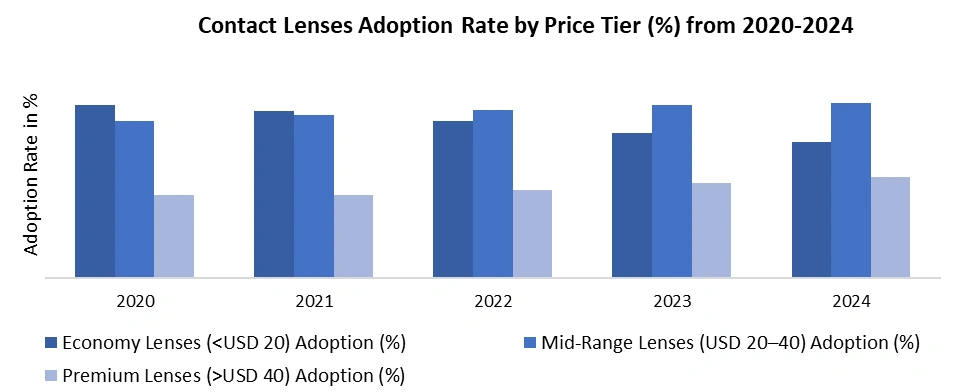
Rising screen exposure, urban lifestyles, and cosmetic preferences are driving demand for convenient, hygienic, and high-performance vision correction and boosting the Contact Lenses Market growth. Daily disposable lenses directly address comfort, infection risk, and compliance, making them the preferred modality across North America, Europe, Japan, and Australia. The daily disposables account for 35–50% of total soft lens usage in 2025, making them the revenue growth engine.
Contact Lenses Adoption Rate by Price Tier (%) from 2020-2024

The myopia prevalence growth, particularly in the Asia-Pacific, is accelerating demand for multifocal and orthokeratology lenses, expanding clinical use cases.

Knowledge Gaps, Hygiene Non-Compliance, and Early Dropouts

The high satisfaction levels (~80% user satisfaction), knowledge gaps remain significant, especially in the emerging Contact Lenses Market. According to MMR research from India, shows 49% unawareness of lens materials, only 43% awareness of side effects, and a 28% dropout rate within six months. Poor hygiene compliance, such as inconsistent solution use (56%), continues to limit sustained adoption, particularly among first-time and younger users.

Gen Z represents the largest untapped growth opportunity for the Contact Lenses Market Growth. An 8-percentage-point adoption gap versus Millennials translates into millions of potential new users globally. Gen Z purchasing behavior emphasizes affordability, convenience, sustainability, personalisation, and brand authenticity, creating opportunities for eco-friendly lenses, subscription models, and digital-first distribution. Myopia management is another structural opportunity, with contact lenses considered the most efficacious solution by 53% of practitioners, supporting premium pricing and long-term patient retention.
Top Contact Lenses Consuming Countries by User Base (Million Wearers) in 2025

Contact Lenses Market Segment Analysis

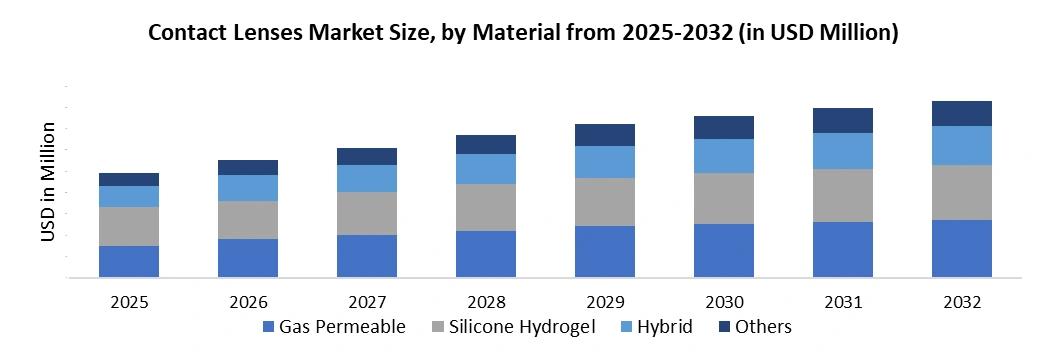
By Material: Silicone hydrogel lenses dominated the Contact Lenses Market, capturing the largest revenue share in 2025, favoured for superior comfort and oxygen permeability. For example, the U.S. saw Hubble Contacts launch SkyHy, its first daily silicone hydrogel lens in 2024-25, catering to active, screen-exposed users. Hybrid lenses, combining RGP and silicone hydrogel, are set to grow 12.5% CAGR (2026–2032), offering sharp vision and durability for astigmatism and keratoconus patients.
Contact Lenses Market Size, by Material from 2025-2032 (in USD Million)

Contact Lenses Market Regional Analysis

North America dominated the global Contact Lenses Market with the largest market share in 2025, primarily driven by the United States, which accounts for nearly USD 3.0 billion. High penetration of daily disposable silicone hydrogel lenses, strong adoption by eye care practitioners, and premium pricing structures sustain an annual growth rate of 5–6%. Continuous product innovations, such as digital eye strain-relief lenses, further strengthen market demand.
Emerging Region: Asia-Pacific

Asia-Pacific, particularly India, China, Southeast Asia, and Australia, represents the highest growth potential. Rising myopia prevalence, young demographics, and increasing cosmetic lens adoption are increasing demand for contact lenses and driving the Contact Lenses Market growth. However, education and hygiene awareness gaps remain key bottlenecks, creating opportunities for industry-led awareness programs and digital eye-care models.
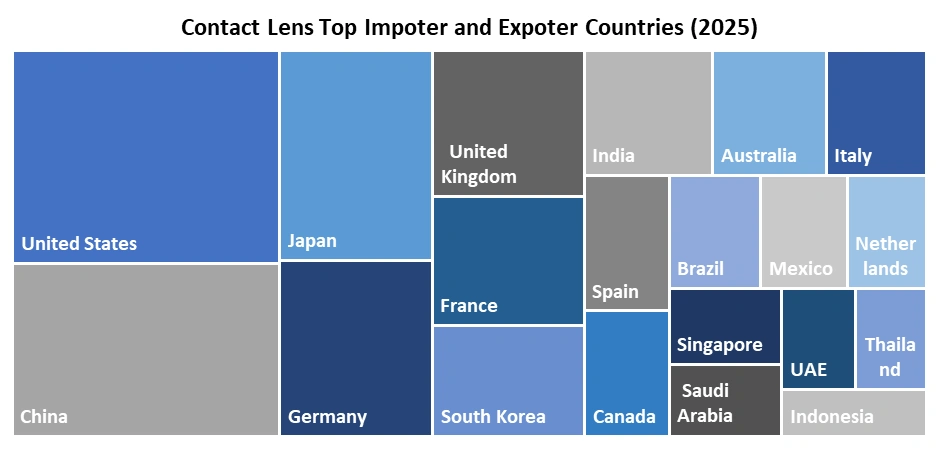
Contact Lens Top Impoter and Expoter Countries (2025)

The global Contact Lenses Market is dominated by the U.S., China, and Japan (nearly 40% share), while India, Southeast Asia, and the Middle East drive high-growth demand fueled by rising myopia and incomes.

Startup Ecosystem: Startups are boosting disruption through smart and sustainable lens technologies, with players such as XPANCEO (AR-enabled lenses) and BVS Insight (biotech-driven solutions) attracting notable funding and reinforcing long-term market confidence.

Competitive Landscape

The global Contact Lenses Market is driven by strategic alliances, mergers and acquisitions, and innovative product launches, particularly in daily disposables and myopia management lenses. Key players are focusing on geographical expansion and digital health integration to enhance their market share. The regional advancements include increased regulatory oversight in the U.S., national myopia programs in Australia & New Zealand, rapid growth in consumer awareness in India, and innovations in ultra-thin lens design in Japan. This value-driven growth supports sustained contact lens Industry attractiveness worldwide.

Market Share, R&D Investments, and Strategic Initiatives of Leading Contact Lens Players (2025)

Company CAGR (%) Market Share 2025 (%) Geographical Strength R&D Investment (USD Million) Recent Key Initiative
Johnson & Johnson Vision Care xx% ~25% North America, Global 150+ Myopia control & premium daily wear expansion
Alcon 4–6% ~20% North America, Europe 130+ Material innovation & digital practitioner tools
CooperVision xx% ~15% Asia-Pacific, Global 90+ Sustainability & speciality lens manufacturing
Bausch + Lomb 4–6% ~18% Emerging markets, Global 110+ Biotrue ecosystem & affordability-driven SKUs
Menicon xx% ~5% Japan, Asia-Pacific 50+ Myopia control & speciality eye care growth

Contact Lenses Market Scope: Inquire before buying

Global Contact Lenses Market
Report Coverage Details
Base Year: 2025 Forecast Period: 2026-2032
Historical Data: 2020 to 2025 Market Size in 2025: USD 14.21 Bn.
Forecast Period 2026 to 2032 CAGR: 6.5% Market Size in 2032: USD 21.94 Bn.
Segments Covered: by Material Gas Permeable
Silicone Hydrogel
Hybrid
Others
by Design Spherical
Multifocal
Toric
Others
by Application Corrective
Prosthetic
Cosmetic
Therapeutic
Lifestyle-oriented
by Distribution Channel E-commerce
Eye Care Practitioners
Retail
by Usage Daily Disposable
Frequently Replacement
Disposable
Traditional

Contact Lenses Market, by Region

Asia Pacific (China, South Korea, Japan, India, Australia, Indonesia, Malaysia, Vietnam, Taiwan, Bangladesh, Pakistan and Rest of APAC)
Europe (UK, France, Germany, Italy, Spain, Sweden, Austria and Rest of Europe)
North America (United States, Canada and Mexico)
Middle East and Africa (South Africa, GCC, Egypt, Nigeria and Rest of ME&A)
South America (Brazil, Argentina Rest of South America)

Contact Lens Key Players

1. Johnson & Johnson Vision
2. Alcon
3. CooperVision
4. Bausch + Lomb
5. HOYA Corporation
6. EssilorLuxottica
7. Menicon
8. Carl Zeiss Meditec
9. SynergEyes
10. X‑Cel Specialty Contacts
11. ClearLab
12. STAAR Surgical
13. Visioneering Technologies
14. Seed Co., Ltd.
15. Contamac
16. BenQ Materials Corporation
17. Oculus
18. Topvue
19. Hydron
20. Kennovy
21. UltraVision CLPL
22. Ginko International
23. Clerio Vision
24. NeoVision
25. CAMAX OPTICAL
26. Others

FAQ

1. What is the global Contact Lenses Market size and forecast?
Ans: The global Contact Lenses Market was valued at USD 14.21 billion in 2025 and is expected to grow at a 6.5% CAGR to USD 21.94 billion by 2032, driven by demand for daily disposable and silicone hydrogel lenses.

2. Which contact lenses are most popular and fastest growing?
Ans: Daily disposable lenses are the fastest growing, with silicone hydrogel lenses holding about 65% market share in 2025, favoured for comfort and oxygen permeability.

3. Which regions are leading and growing in the Contact Lenses Market?
Ans: North America leads in market share, while Asia-Pacific (India, China, Southeast Asia) shows the highest growth due to rising myopia and cosmetic lens use.

4. How is myopia control influencing the Contact Lenses Market?
Ans: Myopia control lenses are rapidly adopted, with 42% of eye care practitioners prescribing them, fueling premium pricing and market growth.

5. Who are the top companies in the Contact Lenses Market?
Ans: Leading companies include Johnson & Johnson Vision, Alcon, CooperVision, Bausch + Lomb, and Menicon, focusing on daily disposables, myopia control, and innovation.

Table of Contents

1. Contact Lenses Market Introduction 1.1. Study Assumption and Market Definition 1.2. Scope of the Study 1.3. Executive Summary 2. Global Contact Lenses Market: Competitive Landscape 2.1. MMR Competition Matrix 2.2. Key Players Benchmarking 2.2.1. Company Name 2.2.2. Headquarter 2.2.3. Product Segment 2.2.4. End-User Segment 2.2.5. Revenue Details in 2025 2.2.6. Market Share (%) 2.2.7. Growth Rate (%) 2.2.8. Return on Investment (%) 2.2.9. Technological Capabilities 2.2.10. Geographical Presence 2.3. Market Structure 2.3.1. Market Leaders 2.3.2. Market Followers 2.3.3. Emerging Players 2.4. Mergers and Acquisitions Details 3. Contact Lenses Market: Dynamics 3.1. Contact Lenses Market Trends 3.2. Contact Lenses Market Dynamics 3.2.1. Drivers 3.2.2. Restraints 3.2.3. Opportunities 3.2.4. Challenges 3.3. PORTER’s Five Forces Analysis 3.4. PESTLE Analysis 3.5. Regulatory Landscape by Region 3.6. Key Opinion Leader Analysis for the Global Industry 3.7. Analysis of Government Schemes and Initiatives for Industry 4. Demand Analysis 4.1. Demand Trends by Lens Type (Soft, Rigid Gas Permeable, Hybrid, Specialty, Smart Lenses) 4.2. End-User Demand Analysis (Vision Correction, Cosmetic, Therapeutic, Orthokeratology, Myopia Control) 4.3. Demographic and Age Group Segmentation Impact on Demand 4.4. Regional Demand Outlook and Market Growth Hotspots (North America, Europe, Asia-Pacific, South America, MEA) 4.5. Demand Drivers: Aging Population, Digital Eye Strain, Lifestyle Changes 4.6. Replacement Cycles and Usage Patterns (Daily, Monthly, Extended Wear) 4.7. Impact of Sustainability and Eco-Friendly Materials on Consumer Preferences 5. Trade & Regulatory Analysis (2026) 5.1. Global Import and Export Volumes of Contact Lenses by Region 5.2. Major Exporting and Importing Countries for Contact Lenses 5.3. Regulatory Landscape: FDA, CE, ISO, MHRA, ANVISA and Other Certification Requirements 5.4. Compliance and Quality Standards in Different Regions 5.5. Supply Chain Dynamics and Value Chain Shifts in Contact Lens Manufacturing 5.6. Impact of Raw Material Availability and Geopolitical Factors on Trade 5.7. Role of Trade Agreements and Localization Strategies 6. Pricing Analysis (2026) 6.1. Pricing Benchmarks by Lens Type and Material 6.2. Cost Comparison: Daily Disposable vs Monthly and Extended Wear Lenses 6.3. Regional Price Variations and Competitiveness (2019–2026) 6.4. Pricing Impact of Smart and AR-Enabled Contact Lenses 6.5. Influence of Raw Material, Production, and Logistics Costs on Final Price 6.6. Consumer Price Sensitivity and Willingness to Pay for Premium Features 7. Supply Chain & Manufacturing Insights 7.1. Key Raw Materials: Silicone Hydrogel, Polymers, Biocompatible Materials 7.2. Supplier Landscape for Lens Materials, Packaging, and Components 7.3. Manufacturing Technologies and Automation in Lens Production 7.4. Quality Standards, Safety Compliance, and Testing Procedures 7.5. Regional Manufacturing Hubs and Localization Trends 7.6. Supply Chain Risks: Material Scarcity, Regulatory Changes, Lead Times 8. End-User & Buyer Insights 8.1. Buyer Segmentation by Channel (Optometrists, Retail Chains, Online, Hospitals) 8.2. Procurement Criteria: Comfort, Vision Quality, Price, Brand Reputation 8.3. Preference Trends: Daily Disposable vs Long-Term Use Lenses 8.4. Impact of Digital Eye Care Platforms on Buyer Behavior 8.5. OEM vs Private Label Purchasing Dynamics 8.6. Customer Loyalty, Subscription Models, and Replacement Cycles 8.7. Consumer Awareness, Education, and Behavior Trends 9. Marketing & Distribution Channels 9.1. Key Distribution Channels: Retail, E-Commerce, Eye Clinics, Pharmacies 9.2. Emerging Digital and Subscription Platforms 9.3. Marketing Strategies and Campaign Effectiveness 9.4. Role of Influencers and Social Media in Consumer Decision-Making 10. Competitive Landscape & Company Profiles 10.1. Market Share Analysis of Top Contact Lens Companies 10.2. Strategic Initiatives: Mergers, Acquisitions, Partnerships 10.3. R&D Focus and Innovation Pipelines 10.4. Regional and Product Portfolio Strategies 11. Technology & Innovation Trends 11.1. Smart Contact Lenses with AR/VR and IoT Capabilities 11.2. Advances in Material Science for Enhanced Comfort and Oxygen Permeability 11.3. Biotech and Drug-Delivery Contact Lenses 11.4. Sustainability Innovations: Biodegradable and Eco-Friendly Lenses 11.5. Digital Eye Care Solutions and Remote Vision Monitoring 11.6. AI and Machine Learning in Lens Design and Fitting 12. Environmental Impact & Sustainability 12.1. Lifecycle Assessment of Contact Lenses and Packaging 12.2. Sustainable Material Adoption and Waste Management 12.3. Corporate Social Responsibility Initiatives 12.4. Consumer Perceptions of Environmental Impact 13. Contact Lenses Market: Global Market Size and Forecast by Segmentation (by Value in USD Billion and Volume in Units) (2025-2032) 13.1. Contact Lenses Market Size and Forecast, By Material (2025-2032) 13.1.1. Gas Permeable 13.1.2. Silicone Hydrogel 13.1.3. Hybrid 13.1.4. Others 13.2. Contact Lenses Market Size and Forecast, By Design (2025-2032) 13.2.1. Spherical 13.2.2. Multifocal 13.2.3. Toric 13.2.4. Others 13.3. Contact Lenses Market Size and Forecast, By Application (2025-2032) 13.3.1. Corrective 13.3.2. Prosthetic 13.3.3. Cosmetic 13.3.4. Therapeutic 13.3.5. Lifestyle-oriented 13.4. Contact Lenses Market Size and Forecast, By Distribution Channel (2025-2032) 13.4.1. E-commerce 13.4.2. Eye Care Practitioners 13.4.3. Retail 13.5. Contact Lenses Market Size and Forecast, By Usage (2025-2032) 13.5.1. Daily Disposable 13.5.2. Frequently Replacement 13.5.3. Disposable 13.5.4. Traditional 13.6. Contact Lenses Market Size and Forecast, By Region (2025-2032) 13.6.1. North America 13.6.2. Europe 13.6.3. Asia Pacific 13.6.4. Middle East and Africa 13.6.5. South America 14. North America Contact Lenses Market Size and Forecast by Segmentation (by Value in USD Billion and Volume in Units) (2025-2032) 14.1. North America Contact Lenses Market Size and Forecast, By Material (2025-2032) 14.2. North America Contact Lenses Market Size and Forecast, By Design (2025-2032) 14.3. North America Contact Lenses Market Size and Forecast, By Application (2025-2032) 14.4. North America Contact Lenses Market Size and Forecast, By Distribution Channel (2025-2032) 14.5. North America Contact Lenses Market Size and Forecast, By Usage (2025-2032) 14.6. North America Contact Lenses Market Size and Forecast, by Country (2025-2032) 14.6.1. United States 14.6.2. Canada 14.6.3. Mexico 15. Europe Contact Lenses Market Size and Forecast by Segmentation (by Value in USD Billion and Volume in Units) (2025-2032) 15.1. Europe Contact Lenses Market Size and Forecast, By Material (2025-2032) 15.2. Europe Contact Lenses Market Size and Forecast, By Design (2025-2032) 15.3. Europe Contact Lenses Market Size and Forecast, By Application (2025-2032) 15.4. Europe Contact Lenses Market Size and Forecast, By Distribution Channel (2025-2032) 15.5. Europe Contact Lenses Market Size and Forecast, By Usage (2025-2032) 15.6. Europe Contact Lenses Market Size and Forecast, by Country (2025-2032) 15.6.1. United Kingdom 15.6.1.1. United Kingdom Contact Lenses Market Size and Forecast, By Material (2025-2032) 15.6.1.2. United Kingdom Contact Lenses Market Size and Forecast, By Design (2025-2032) 15.6.1.3. United Kingdom Contact Lenses Market Size and Forecast, By Application (2025-2032) 15.6.1.4. United Kingdom Contact Lenses Market Size and Forecast, By Distribution Channel (2025-2032) 15.6.1.5. United Kingdom Contact Lenses Market Size and Forecast, By Usage (2025-2032) 15.6.2. France 15.6.3. Germany 15.6.4. Italy 15.6.5. Spain 15.6.6. Sweden 15.6.7. Russia 15.6.8. Rest of Europe 16. Asia Pacific Contact Lenses Market Size and Forecast by Segmentation (by Value in USD Billion and Volume in Units) (2025-2032) 16.1. Asia Pacific Contact Lenses Market Size and Forecast, By Material (2025-2032) 16.2. Asia Pacific Contact Lenses Market Size and Forecast, By Design (2025-2032) 16.3. Asia Pacific Contact Lenses Market Size and Forecast, By Application (2025-2032) 16.4. Asia Pacific Contact Lenses Market Size and Forecast, By Distribution Channel (2025-2032) 16.5. Asia Pacific Contact Lenses Market Size and Forecast, By Usage (2025-2032) 16.6. Asia Pacific Contact Lenses Market Size and Forecast, by Country (2025-2032) 16.6.1. China 16.6.2. S Korea 16.6.3. Japan 16.6.4. India 16.6.5. Australia 16.6.6. Indonesia 16.6.7. Malaysia 16.6.8. Philippines 16.6.9. Thailand 16.6.10. Vietnam 16.6.11. Rest of Asia Pacific 17. Middle East and Africa Contact Lenses Market Size and Forecast (by Value in USD Billion and Volume in Units) (2025-2032) 17.1. Middle East and Africa Contact Lenses Market Size and Forecast, By Material (2025-2032) 17.2. Middle East and Africa Contact Lenses Market Size and Forecast, By Design (2025-2032) 17.3. Middle East and Africa Contact Lenses Market Size and Forecast, By Application (2025-2032) 17.4. Middle East and Africa Contact Lenses Market Size and Forecast, By Distribution Channel (2025-2032) 17.5. Middle East and Africa Contact Lenses Market Size and Forecast, By Usage (2025-2032) 17.6. Middle East and Africa Contact Lenses Market Size and Forecast, by Country (2025-2032) 17.6.1. South Africa 17.6.2. GCC 17.6.3. Egypt 17.6.4. Nigeria 17.6.5. Rest of ME&A 18. South America Contact Lenses Market Size and Forecast by Segmentation (by Value in USD Billion and Volume in Units) (2025-2032) 18.1. South America Contact Lenses Market Size and Forecast, By Material (2025-2032) 18.2. South America Contact Lenses Market Size and Forecast, By Design (2025-2032) 18.3. South America Contact Lenses Market Size and Forecast, By Application (2025-2032) 18.4. South America Contact Lenses Market Size and Forecast, By Distribution Channel (2025-2032) 18.5. South America Contact Lenses Market Size and Forecast, By Usage (2025-2032) 18.6. South America Contact Lenses Market Size and Forecast, by Country (2025-2032) 18.6.1. Brazil 18.6.2. Argentina 18.6.3. Colombia 18.6.4. Chile 18.6.5. Rest Of South America 19. Company Profile: Key Players 19.1. Johnson & Johnson Vision 19.1.1. Company Overview 19.1.2. Business Portfolio 19.1.3. Financial Overview 19.1.4. SWOT Analysis 19.1.5. Strategic Analysis 19.1.6. Recent Developments 19.2. Alcon 19.3. CooperVision 19.4. Bausch + Lomb 19.5. HOYA Corporation 19.6. EssilorLuxottica 19.7. Menicon 19.8. Carl Zeiss Meditec 19.9. SynergEyes 19.10. X‑Cel Specialty Contacts 19.11. ClearLab 19.12. STAAR Surgical 19.13. Visioneering Technologies 19.14. SEED Co., Ltd. 19.15. Contamac 19.16. BenQ Materials Corporation 19.17. Oculus 19.18. Topvue 19.19. Hydron 19.20. Kennovy 19.21. UltraVision CLPL 19.22. Ginko International 19.23. Clerio Vision 19.24. NeoVision 19.25. CAMAX OPTICAL 20. Key Findings 21. Analyst Recommendations 22. Contact Lenses Market: Research Methodology