
Coffee Machine Market by Type, End-User, and Region – Global Market Size Estimation, Industry-Wide Analysis, Competitive Landscape Assessment & Long-Term Forecast to 2032
Overview
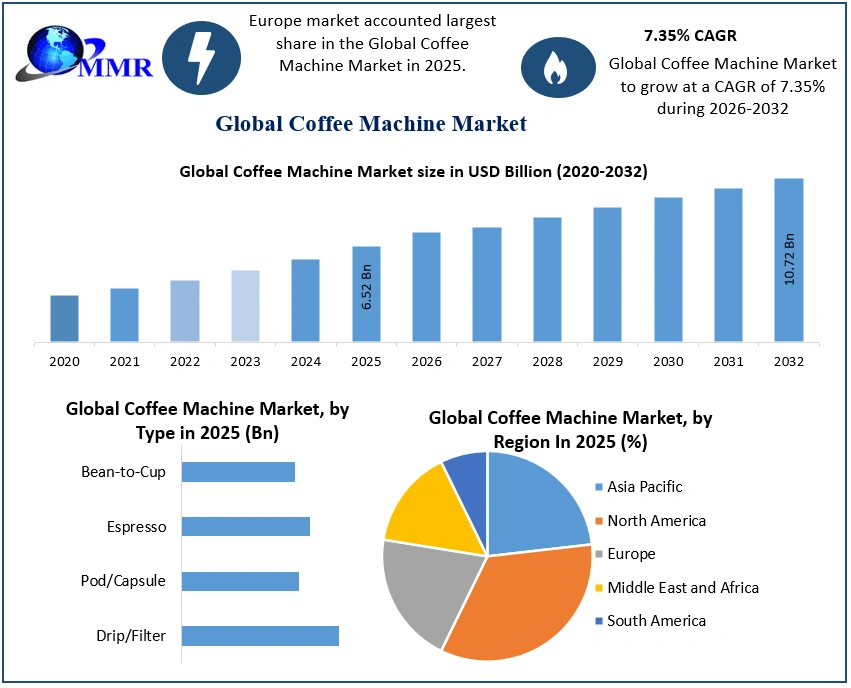
The Coffee Machine Market size was valued at USD 6.52 Billion in 2025 and the total Coffee Machine revenue is expected to grow at a CAGR of 7.35% from 2025 to 2032, reaching nearly USD 10.72 Billion by 2032.
The coffee machine is used in various households for different reasons. Coffee Machines thus have become a common application in brewing coffee. The market offers a wide range of coffee machines catering to different needs and preferences. Some popular types include espresso machines, drip brewers, single-serve machines, French press machines, and bean-to-cup machines. Such varieties have helped the market sustain and grow in this competitive world. The use of technology has been the key to success. Features like programmable settings, smart connectivity, built-in grinders, and milk frothers are increasingly incorporated into coffee machines and have enhanced user experience and coffee quality. The efficiency and feasibility of the machine has been its main USP. Home coffee machines offer a range of brewing options, allowing users to prepare their preferred coffee beverages such as espresso, cappuccino, latte, or a simple cup of drip coffee, while Coffee machines are also found in offices and workplaces to provide employees with a convenient and readily available source of coffee. They boost productivity and also provide a social gathering space. Right from homes to speciality stores all have the access to coffee machines, which makes the market a huge prospect for many brands.
To know about the Research Methodology :- Request Free Sample Report
The coffee machine market is highly competitive, with several prominent players vying for market share. Companies like De'Longhi, Breville, Keurig Dr Pepper, JURA Elektroapparate, and Nestlé (Nespresso) are among the key players in the industry. Europe has been leading the market share as many European countries have their staple drinks as coffee. Also, this high consumption has given rise to higher demand which has caused many more opportunities is coffee machine market.
Coffee Machine Market Driver
- High Global Consumer Demands Help in the Growth of the Coffee Industry
The global demands of consumers continue to govern the coffee industry because of the increasing demands of consumers for high-quality coffee in developed and developing nations. High consumption of coffee, high number of coffee shops and the increasing demands of specialty coffee are some of the elements that are responsible for driving the growth of the coffee industry despite the changes in the supply side.
- On May 2026, as per the report published by the International Coffee Organization (ICO), the projected production of Brazilian coffee for the year 2026-27 will be 66.7 million bags, of which Arabica coffee will account for 45.8 million bags of coffee, a rise of 28% from the previous year.
Coffee Machine Market Restraints
- Declining Coffee Prices Because of Positive Supply Prospects
Rising expectations regarding large amounts of coffee supplies worldwide are leading to falling coffee prices in the international market. Although increased production results in more product supply, low prices cut into profit margins of growers and exporters, especially those from the countries that largely depend on coffee exports. Low prices may have an adverse effect on further investment in production.
- According to the International Coffee Organization (ICO), the I-CIP price was 256.05 US cents/lb, which was 3.8% lower compared to April 2026. At the same time, Brazilian Naturals experienced a 6.4% decrease in prices, Other Milds 4.8%, and Colombian Milds 3.3%. This is a result of the expectations regarding large supply of coffee and the possibility of a surplus
Coffee Machine Market Opportunity
- Increasing Demand for Sustainable and Specialty Coffee
Increasing preference among consumers of sustainably grown premium coffee is generating numerous opportunities for growth for the global coffee industry. Increasingly consumers want to drink ethically grown coffee, whereas retail stores and coffee chains increase the range of their specialty coffees. Moreover, implementation of circular economy principles, use of digital technology, and sustainable agriculture methods help coffee producers to increase efficiency of operations, create additional revenue streams, and boost resilience of their supply chains.
- The International Coffee Organization (ICO), there are more than 60 coffee producing countries which rely on the coffee industry as an essential source of income, and globally around 3 billion cups of coffee are drunk daily. According to ICO, the application of circular economy, transformation of waste coffee into other products and renewable energy sources, and digitalization will help to create additional jobs, lower production costs, and increase sustainability of the coffee supply chain. In addition, according to ICO, collaboration and sustainable development are crucial for prosperity of coffee farmers.
Coffee Machine Market Trends
- Functional and Healthy Coffee Beverages
The customers who value their health are getting inclined towards the consumption of coffee beverages that not only serve as a caffeinated drink but also offer nutrition to the body. Therefore, the coffee companies are launching new beverages that have ingredients like protein, collagen, medicinal mushrooms, adaptogens, probiotics, vitamins, antioxidants, and many more. Apart from this, another trend is developing among the customers, which is their liking for coffee drinks with low sugar content.
Coffee Machine Market Segmentation
By Type: The Coffee Machine Market exhibits a diverse array of types catering to varying consumer preferences. Drip/Filter coffee machines offer a classic and convenient brewing method, suitable for a large volume of coffee, making them popular in households and offices. Pod/Capsule machines provide a quick and hassle-free brewing experience with pre-packaged coffee pods, appealing to those who value convenience and a variety of flavors. Espresso machines, known for their ability to produce strong and concentrated coffee, are favored by coffee enthusiasts seeking a rich and bold flavor profile. Bean-to-cup machines offer the ultimate freshness by grinding coffee beans on demand, providing a customizable and premium brewing experience. This segmentation ensures that the Coffee Machine Market accommodates a wide spectrum of consumer preferences and brewing styles.
By End-Use: The Coffee Machine Market is further segmented based on end-use, primarily distinguishing between Commercial and Residential applications. In the Commercial sector, coffee machines are designed to meet the demands of cafes, restaurants, offices, and other hospitality establishments, focusing on durability, efficiency, and often incorporating advanced features to handle high-volume brewing. The Residential segment, on the other hand, caters to the needs of individual households, emphasizing user-friendly designs, compact sizes, and diverse brewing options to suit personal preferences. This segmentation recognizes the distinct requirements of different settings, ensuring that coffee machines are tailored to deliver optimal performance and convenience in both commercial and residential environments.

Coffee Machine Market, by Region
Europe is the leading market in the coffee machine market. It dominates nearly 35% of the market and is one of the largest coffee-consuming regions. Major coffee markets include Italy, Germany, France, the United Kingdom, Spain, and the Nordic countries. Instant coffee offers convenience and remains a staple in many households and offices across Europe. North America is the 2nd largest market share holder of the coffee machine market. The market is characterized by a preference for convenience, single-serve machines, and specialty coffee.
Technological advancements, smart features, and sustainability have played a huge role in this market. Asia Pacific is the fastest-growing market. The market is influenced by a rising middle class and the adoption of Western coffee culture. The demand for premium espresso machines and single-serve brewers is increasing in this region which has been a huge positive for the industry. Latin America is renowned for its coffee production, and countries like Brazil and Colombia play a significant role in the global coffee industry. The coffee machine market in this region is heavily influenced by its domestic use. The Middle East and Africa region has a unique coffee culture, with a strong preference for traditional Arabic coffee preparations like Turkish coffee and Qahwa. Middle East is an emerging market and has huge potential in the future.
Coffee Machine Market Key Development
- On June 2026, The Nestlé corporation has stated that in 2025, it sourced 53% of Nescafé green coffee from regeneratively farming coffee growers. This has happened due to one of the sustainability plans of the company Nescafé Plan 2030. It has helped more than 100,000 coffee farmers in 15 different countries plant 20.3 million climate-resilient coffee trees and reduce the greenhouse gas emissions of Nescafé green coffee by 18.3% from 2018 and 98.6% of renewable energy in Nescafé plants.
- On Dec 2025, Luckin Coffee significantly expanded its global retail presence, reaching 31,048 stores by the end of 2025, including 30,888 outlets in China, 81 in Singapore, 70 in Malaysia, and 9 in the United States. This rapid network expansion underscores the growing momentum of organized coffee retail and increasing consumer demand across both domestic and international markets.
Competitive Landscape
The coffee machine market is a competitive market with many players providing more or less a similar output. New inventions like Keurig which uses artificial intelligence to personalize the brewing settings for each K-Cup pod and Miele CM 3600, is a high-end coffee machine that features a milk frother that can create microfoam. Thus, such innovations have given companies a competitive edge. Some prominent companies in the market have expanded from coffee-to-coffee machines and one such example is Nestle’s Nespresso which is one of leading player in the market.
Nespresso offers a range of single-serve coffee machines and coffee capsules, known for their convenience and quality. De'Longhi is a well-known Italian manufacturer of coffee machines, including espresso machines, drip brewers, and specialty coffee machines. It holds a huge majority share in Italy and worldwide. WMF Group, a German company, offers a wide range of coffee machines for both commercial and residential use. Their product portfolio includes traditional espresso machines, fully automatic machines, and specialty coffee systems. Breville is an Australian manufacturer known for its high-quality coffee machines and has invested heavily in innovation and user-friendly features. JURA is a Swiss company specializing in premium fully automatic coffee machines. The brand is renowned for its precision, craftsmanship, and advanced brewing technologies.
Coffee Machine Market Scope: Inquire before buying
| Global Coffee Machine Market | |||
|---|---|---|---|
| Report Coverage | Details | ||
| Base Year: | 2025 | Forecast Period: | 2026-2032 |
| Historical Data: | 2020 to 2025 | Market Size in 2025: | USD 6.52 Bn. |
| Forecast Period 2026 to 2032 CAGR: | 7.35% | Market Size in 2032: | USD 10.72 Bn. |
| Segments Covered: | by Type | Drip/Filter Pod/Capsule Espresso Bean-to-Cup |
|
| by End Use | Commercial Residential |
||
Coffee Machine Market, by Region
North America (United States, Canada, and Mexico)
Europe (UK, France, Germany, Italy, Spain, Sweden, Austria, and the Rest of Europe)
Asia Pacific (China, South Korea, Japan, India, Australia, Indonesia, Malaysia, Vietnam, Taiwan, Bangladesh, Pakistan, and the Rest of APAC)
Middle East and Africa (South Africa, GCC, Egypt, Nigeria, and the Rest of ME&A)
South America (Brazil, Argentina Rest of South America)
Coffee Machine Key Players:
1. Automatic, Bean-to-Cup & Capsule Coffee Machine Manufacturers
These companies manufacture fully automatic coffee machines, super-automatic espresso machines, and capsule-based coffee systems for residential and commercial applications.
Europe
1. Nestlé S.A. (Nespresso) – Switzerland
2. De'Longhi Group – Italy
3. JURA Elektroapparate AG – Switzerland
4. WMF Group GmbH – Germany
5. Koninklijke Philips N.V. – Netherlands
6. Melitta Group – Germany
7. Schaerer Ltd. – Switzerland
8. Franke Coffee Systems – Switzerland
Asia-Pacific
9. Breville Group Limited – Australia
North America
10. Keurig Dr Pepper Inc. – United States
2. Professional Espresso Machine Manufacturers
These companies specialize in premium espresso machines for cafés, restaurants, hotels, and specialty coffee businesses.
Europe
1. La Marzocco International LLC – Italy
2. Nuova Simonelli S.p.A. – Italy
3. Elektra S.r.l. – Italy
4. Gaggia Milano – Italy
5. Rocket Espresso Milano – Italy
6. Bezzera S.r.l. – Italy
7. Faema S.p.A. – Italy
8. La Pavoni S.p.A. – Italy
9. Rancilio Group S.p.A. – Italy
3. Filter Coffee, Drip & Specialty Brewing Equipment Manufacturers
These companies manufacture manual, drip, and specialty coffee brewing equipment.
Europe
1. Technivorm B.V. – Netherlands
North America
2. Hamilton Beach Brands Holding Company – United States
3. Wilbur Curtis Company – United States
4. Coffee Grinding & Commercial Coffee Equipment Manufacturers
These companies provide professional coffee grinding equipment and complementary solutions for commercial coffee preparation.
Europe
1. Mazzer Luigi S.r.l. – Italy
FAQ
Q.1) What is the CAGR of Coffee Machine Market?
Ans: The CAGR for Coffee Machine Market is 7.35%.
Q.2) Which are the leading companies in the Coffee Machine Market?
Ans: Nestle and Phillips are some of the leading companies in the Coffee Machine Market.
Q,3) Which is the leading region in the Coffee Machine Market?
Ans: Europe leads the market of Coffee Machine Market significantly.
Q.4) What was the forecast period of this report?
Ans: The forecasted period for the Coffee Machine Market research was 2026– 2032.