
Clinical Mass Spectrometry Market Size by Component, Type, Technology, Sample Type, Instrument Type, Application and End User
Overview
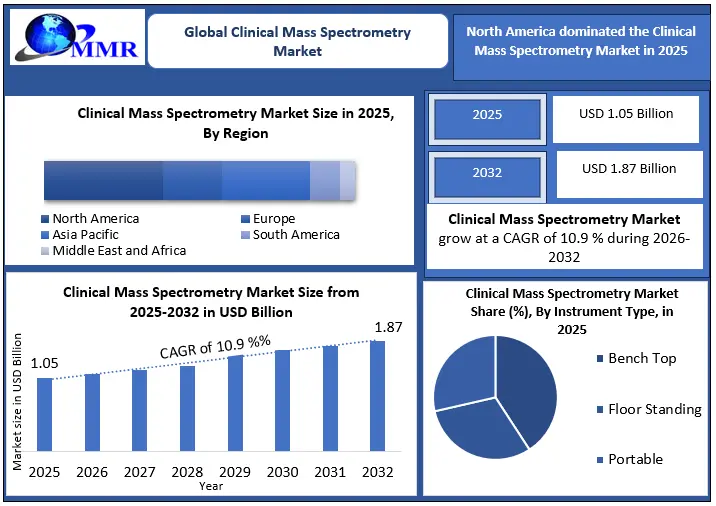
The Global Clinical Mass Spectrometry Market was valued at USD 1.05 billion in 2025 and is projected to reach USD 1.87 billion by 2032, expanding at a CAGR of 10.9% during the forecast period from 2026 to 2032. Advancements In Precision Medicine and Increasing Demand for High-Accuracy Diagnostics.
As healthcare systems increasingly shift toward precision diagnostics and biomarker-driven treatment strategies, clinical laboratories are rapidly adopting highly sensitive analytical technologies capable of detecting diseases at molecular levels. Clinical mass spectrometry has emerged as one of the most critical technologies supporting therapeutic drug monitoring, toxicology testing, endocrinology analysis, and proteomics-based diagnostics due to its exceptional specificity and analytical accuracy.
Clinical Mass Spectrometry Market Key Highlights:
• High Initial Investment: LC-MS/MS systems are priced between USD 200,000 and USD 500,000, but the long-term operational savings offset the initial cost. This makes it a cost-effective solution in the long run for laboratories in the Clinical Mass Spectrometry Market.
• Increased Efficiency: LC-MS/MS reduces test turnaround time, enabling quicker clinical decisions and faster diagnosis, improving efficiency in clinical workflows.
• Precision and Sensitivity: LC-MS/MS systems can detect substances at picogram or nanogram levels, ensuring high accuracy in complex biological samples, making them essential for clinical diagnostics.
• Wide Clinical Adoption: LC-MS/MS is a critical tool in clinical laboratories, supporting millions of tests annually in areas like endocrinology, drug monitoring, and biomarker analysis, demonstrating its widespread adoption in the Clinical Mass Spectrometry Industry.
• Versatility Across Applications: LC-MS/MS is used in a wide variety of clinical applications within the Clinical Mass Spectrometry Market, including toxicology, therapeutic drug monitoring, biomarker discovery, and hormone analysis, making it a versatile tool for comprehensive diagnostics.
• Support for Precision Medicine: LC-MS/MS plays a vital role in precision medicine by enabling the detection of low-abundance biomarkers, which helps in personalised treatment plans tailored to individual patients’ genetic profiles, aligning with the trends in the Clinical Mass Spectrometry Market.
To know about the Research Methodology :- Request Free Sample Report
Global Clinical Mass Spectrometry Market Dynamics:
Increasing regulatory emphasis on laboratory standardization, diagnostic accuracy, and quality assurance under frameworks such as FDA, CLIA, CAP, CE-IVDR, and ISO 15189 is accelerating the adoption of validated clinical mass spectrometry platforms across hospitals and reference laboratories worldwide.
• Technological Advancements: Innovations such as the miniaturization of mass spectrometry systems, microfluidic technologies, and the development of more user-friendly interfaces are driving growth in the Clinical Mass Spectrometry Market. These advancements make mass spectrometry more viable for a broader range of clinical applications, especially in routine clinical labs.
• Rising Incidence of Chronic Diseases: The U.S. public health initiative aiming to help 27 million Americans increase physical activity by 2027 is part of a broader effort to reduce chronic diseases and improve health outcomes. This will lead to more individuals requiring regular health monitoring, which could involve diagnostic tools such as mass spectrometry in the Clinical Mass Spectrometry Market.
• Support from Healthcare Providers and Governments: Governments and healthcare institutions are increasingly recognising the value of advanced diagnostic technologies like mass spectrometry, which is leading to higher adoption of mass spectrometry in clinical settings. The NIH budget for 2024 was about USD 47.7 billion, supporting biomedical and clinical research projects, including diagnostics innovation in the Clinical Mass Spectrometry Market.
• Increasing Demand for Accurate Diagnostic Tools: The healthcare industry’s focus on precision medicine and personalised treatment options is creating strong demand for more accurate diagnostic tests in the Clinical Mass Spectrometry indutry. Mass spectrometry, with its high specificity and sensitivity, is well-suited to meet these evolving clinical needs.
Restraints in the Global Clinical Mass Spectrometry Market:
• High Initial Investment: The cost of acquiring LC-MS/MS systems for clinical laboratories is substantial. Entry-level systems start at around USD 50,000, while mid-range LC-MS systems typically range from USD 150,000 to USD 600,000. High-end systems, including triple quadrupole or Orbitrap setups, exceed USD 1 million. In addition to the purchase price, ongoing operational costs, such as service contracts, consumables, and trained personnel, add significantly to the total cost of ownership in the Clinical Mass Spectrometry Market.
• Need for Specialised Personnel: The Clinical Mass Spectrometry Market faces challenges due to the need for specialised personnel. In the U.S., the Bureau of Labour Statistics projects more than 24,000 job openings per year for clinical laboratory technologists and technicians over the next decade, which could slow adoption in some regions.
Opportunities in the Global Clinical Mass Spectrometry Market:
• Precision Medicine: As the healthcare sector shifts toward precision medicine, the demand for diagnostic tools that can detect biomarkers at low concentrations in patients' blood, urine, or tissues increases. Mass spectrometry is uniquely positioned to meet this need with its high sensitivity and specificity, creating significant opportunities for growth in the Clinical Mass Spectrometry Market.
• Point-of-Care Testing: There is growing interest in the development of portable mass spectrometry systems that could be used in point-of-care settings, such as in operating rooms or emergency departments, for real-time diagnostics. These innovations are boosting the Clinical Mass Spectrometry Market.

Global Clinical Mass Spectrometry Market Segment Analysis:
• Detectors: The detector segment held the largest market share in the Clinical Mass Spectrometry Market in 2025, as detectors are essential for identifying and quantifying ions after separation by mass analyzers. Growing demand for high-resolution and high-sensitivity diagnostics in biomarker analysis, endocrinology, and toxicology testing continues to support segment growth across clinical laboratories.
• Ion Sources: The ion source segment is expected to have fastest-growing segment during the forecast period (2026-2032), driven by advancements in ionisation technologies such as electrospray ionisation (ESI) and atmospheric pressure chemical ionisation (APCI). The demand for ion sources is particularly high in clinical diagnostics, where biomarker discovery and therapeutic drug monitoring require high sensitivity and accuracy in the Clinical Mass Spectrometry Market.

Global Clinical Mass Spectrometry Market Regional Analysis:
North America dominated the Clinical Mass Spectrometry Market in 2025 due to advanced clinical laboratory infrastructure, strong reimbursement frameworks, rising precision medicine adoption, and significant investments in biomarker research and therapeutic drug monitoring. The United States continues to lead regional demand owing to the strong presence of major manufacturers such as Thermo Fisher Scientific, Waters Corporation, Agilent Technologies, and SCIEX, alongside increasing integration of LC-MS/MS systems in hospital laboratories and academic research institutions.
Europe emerged as a significant market for clinical mass spectrometry due to increasing adoption of advanced diagnostic technologies, expanding clinical research activities, and stringent regulatory standards related to laboratory testing quality and patient safety. Countries such as Germany, the United Kingdom, and France are witnessing growing demand for LC-MS/MS platforms in endocrinology, toxicology screening, and pharmaceutical analysis applications. Additionally, the implementation of the European Union’s IVDR framework is encouraging laboratories to adopt highly validated and standardized diagnostic platforms, supporting long-term market expansion across the region.
Asia-Pacific is expected to witness the fastest growth during the forecast period owing to rapidly expanding healthcare infrastructure, increasing investments in precision medicine, and rising awareness regarding advanced molecular diagnostics. Countries such as China, India, Japan, and South Korea are increasingly investing in clinical laboratory modernization and biomedical research capabilities, creating strong demand for high-throughput mass spectrometry systems. Growing pharmaceutical manufacturing activities, rising chronic disease burden, and government-led healthcare digitization initiatives are also accelerating adoption of clinical mass spectrometry technologies across the region.
Middle East & Africa is gradually emerging as a developing market due to increasing healthcare modernization initiatives, growing investments in specialized diagnostic laboratories, and rising focus on improving clinical testing accuracy. Gulf Cooperation Council (GCC) countries are increasingly investing in precision diagnostics and laboratory automation technologies as part of broader healthcare diversification strategies. However, limited availability of skilled professionals and high capital investment requirements continue to restrict widespread adoption across several developing economies in the region.
South America is witnessing moderate growth in the Clinical Mass Spectrometry Market, supported by expanding healthcare access, increasing diagnostic awareness, and rising investments in laboratory infrastructure modernization. Brazil and Argentina are leading regional adoption due to growing utilization of mass spectrometry in toxicology testing, infectious disease diagnostics, and pharmaceutical research applications. The increasing presence of private diagnostic chains and improving healthcare expenditure are expected to create additional growth opportunities during the forecast period.
Global Clinical Mass Spectrometry Market Recent Developments:
• On June 2, 2025, Thermo Fisher unveiled advanced Orbitrap Astral Zoom and Orbitrap Excedion Pro mass spectrometers designed to deliver enhanced speed, sensitivity, and analytical performance for clinical research, proteomics, and precision medicine applications. These instruments help accelerate discovery and deepen insights into complex diseases such as cancer and Alzheimer’s.
• In October 2025, Thermo Fisher Scientific announced plans to acquire Clario for approximately USD 9.4 billion to strengthen its digital clinical trial and diagnostics capabilities, further supporting integration between analytical instrumentation, clinical data management, and precision medicine workflows.
Clinical Mass Spectrometry Market Scope: Inquire before buying
| Clinical Mass Spectrometry Market | |||
|---|---|---|---|
| Report Coverage | Details | ||
| Base Year: | 2025 | Forecast Period: | 2026-2032 |
| Historical Data: | 2020 to 2025 | Market Size in 2025: | USD 1.05 Bn. |
| Forecast Period 2026 to 2032 CAGR: | 10.9% | Market Size in 2032: | USD 1.87 Bn. |
| Segments Covered: | by Component | Detectors Ion Sources Mass Analyzers (Quadrupole Mass Spectrometer, Time-of-Flight Mass Analyzers) |
|
| by Type | Gas chromatography-mass spectrometry (GC-MS) instrument Liquid chromatography-mass spectrometry (LC-MS) instrument Maldi TOF mass spectrometer Capillary electrophoresis-mass spectrometry lon mobility spectrometry-mass spectrometry |
||
| by Technology | Atmospheric Pressure Chemical Ionisation Electrospray Ionization Matrix-Assisted Laser Desorption/Ionization |
||
| by Sample Type | Blood Samples Tissue Samples Urine Samples |
||
| by Instrument Type | Bench Top Floor Standing Portable |
||
| by Application | Biotechnology (Glycomics, Metabolomics) Clinical Diagnostics (Biomarker Discovery, Therapeutic Drug Monitoring) Pharmaceutical Analysis Proteomics |
||
| by End-User | Academic & Research Institutes Biotechnology & Pharmaceutical Companies Contract Research Organizations Hospitals & Laboratories |
||
Global Clinical Mass Spectrometry Market Key Players
1. Thermo Fisher Scientific Inc.
2. Agilent Technologies Inc.
3. Danaher Corporation / SCIEX
4. Waters Corporation
5. Bruker Corporation
6. Shimadzu Corporation
7. PerkinElmer Inc.
8. JEOL Ltd.
9. LECO Corporation
10. Hitachi High-Technologies Corporation
11. KORE Technology Ltd.
12. Ametek, Inc.
13. Teledyne Technologies Incorporated
14. MKS Instruments, Inc.
15. Jasco Analytical Instruments
16. Thermo Electron (Thermo Fisher Scientific subsidiary)
17. PerSeptive Biosystems
18. Mass Spectrometry Instruments (MSI)
19. Bergmann Messgeraete Entwicklung KG
20. Agilent IonMax & API Divisions
21. MS Bioworks LLC
22. Protein Metrics Inc.
23. SCIEX Clinical Solutions Division
24. Bruker Daltonics GmbH & Co. KG
25. Analytik Jena AG
26. Phenomenex (part of Agilent)
27. Sartorius AG
28. Bio-Rad Laboratories, Inc.
29. Chromsystems Instruments & Chemicals GmbH
30. Tecan Group Ltd.
31. Others
FAQ in the Clinical Mass Spectrometry Market
1. What is the size of the Global Clinical Mass Spectrometry Market?
Ans: The global clinical mass spectrometry market size was valued at USD 1.05 billion in 2025 to USD 1.87 billion by 2032, with a CAGR of 10.9%. This growth is driven by increased demand for precision diagnostics and therapeutic drug monitoring.
2. What are the key applications of Global Clinical Mass Spectrometry Market?
Ans: Clinical mass spectrometry is used in therapeutic drug monitoring, toxicology testing, proteomics, biomarker discovery, and clinical diagnostics, offering highly sensitive and accurate results for complex medical conditions.
3. What are the main Global Clinical Mass Spectrometry Market technologies in clinical applications?
Ans: Key technologies include LC-MS/MS, GC-MS, MALDI-TOF, CE-MS, and IMS-MS, each offering unique advantages in sensitivity, speed, and diagnostic capabilities for various medical conditions.
4. What are the benefits of using mass spectrometry in clinical diagnostics?
Ans: Mass spectrometry offers high sensitivity, multiplexing capabilities, and precision medicine, enabling accurate detection of biomarkers, faster results, and personalized treatments.
5. What is driving the growth of the Global Clinical Mass Spectrometry Market?
Ans: The market growth is driven by advancements in technology, rising demand for precision medicine, regulatory support, and the increasing adoption of mass spectrometry for complex diagnostics in clinical settings.