
China Robotic Vacuum Cleaner Market Size by Product Type, Operation Mode, Price, Charging Type, Distribution channel and End User
Overview
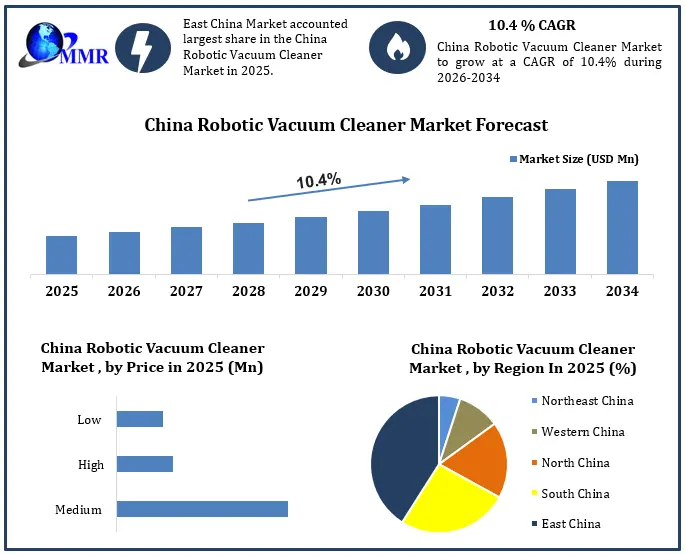
The China Robotic Vacuum Cleaner Market is estimated to be valued at USD 997.75 Million in 2025 and is projected to reach USD 2430.59Million by 2034, registering a CAGR of 10.4. % during the forecast period.
| Parameter | Value |
| Market Size (Base Year 2025) | USD 997.75 Million |
| Forecast Market Size (2034) | USD 2430.59 Million |
| CAGR (2026-2034) | 10.4% |
| Base Year | 2025 |
| Forecast Period | 2026-2034 |
| Historical Period | 2020-2025 |
China Robotic Vacuum Cleaner Market Definition
The China Robotic Vacuum Cleaner Market refers to the commercial market for automated cleaning appliances designed to vacuum, sweep, mop, or perform combined floor-cleaning functions with minimal human intervention. The market includes robotic vacuum cleaners equipped with technologies such as LiDAR, cameras, sensors, artificial intelligence, smart navigation, mapping, obstacle detection, and app-based controls, enabling automated cleaning across residential and commercial spaces. It covers the manufacturing, distribution, and sale of robotic vacuum cleaners through online platforms, appliance retailers, electronics stores, and specialty channels. Market demand is supported by the expanding adoption of smart-home appliances, urbanization, growing consumer preference for convenient household solutions, technological advancements, and the increasing integration of automated cleaning devices into connected-home ecosystems.
China Robotic Vacuum Cleaner Market Overview
The China robotic vacuum cleaner market is a high-growth technology-driven space within the smart home and domestic appliance sectors supported by rising adoption of automation in homecare, growing premiumization of the market, and ongoing innovation in areas such as AI navigation, obstacle avoidance, mopping, self-cleaning, and docking technologies. The market is dominated by technology-centric domestic players, with ECOVACS dominating the largest share of online sales, followed by Roborock. Other notable domestic players include Narwal, Xiaomi and Dreame.
The report provides an analysis of the robotic vacuum cleaner market size and forecast in China, along with growth trends, competitive landscape, product and application insights, distribution landscape, pricing strategies, technological trends, regional demand patterns, and opportunities through 2025. The Eastern China region emerges as a key market for robotic vacuum cleaners, due to the concentration of premium customers, technology-savvy buyers, e-commerce activity, and smart home adoption. At the same time, large first-tier cities represent an opportunity for high-end robotic vacuum cleaners.
The robotic vacuum cleaner market is highly competitive, with a handful of large domestic players, including ECOVACS, Roborock, Dreame, Narwal, and Xiaomi, competing for market share on the back of AI navigation, autonomous mopping technologies, robot vacuums with self-cleaning and self-emptying features, innovative obstacle avoidance solutions, and robot vacuums with enhanced smart home connectivity. The report also details robotic vacuum cleaner market opportunities, including market premiumization, adoption of robot vacuums as a replacement for traditional cleaners, AI-driven cleaning technologies, multifunctional robotic vacuums, and the shift from partial to fully integrated floor care solutions.
China Robotic Vacuum Cleaner Market Growth and Forecast Analysis
To know about the Research Methodology :- Request Free Sample Report
China Robotic Vacuum Cleaner Market Historical Market Size (2020-2025)
| Year | Market Size (USD MN) | Growth Rate (YoY) |
| 2020 | 399.1 | 18.65% |
| 2021 | 478.92 | 20.12% |
| 2022 | 568.72 | 18.75% |
| 2023 | 688.45 | 21.05% |
| 2024 | 827.13 | 20.14% |
| 2025 | 997.75 | 20.63% |
China Robotic Vacuum Cleaner Market Size Forecast (2026-2034)
| Year | Market Size (USD MN) | Growth Rate (YoY) |
| 2026 | 1,101.52 | 10.40% |
| 2027 | 1,216.08 | 10.40% |
| 2028 | 1,342.55 | 10.40% |
| 2029 | 1,482.17 | 10.40% |
| 2030 | 1,636.31 | 10.40% |
| 2031 | 1,806.49 | 10.40% |
| 2032 | 1,994.37 | 10.40% |
| 2033 | 2,201.78 | 10.40% |
| 2034 | 2,430.59 | 10.40% |
China Robotic Vacuum Cleaner Market Key Findings
• Market Growth: Market reaches USD 2.43 Billion by 2034, expanding at a 10.4% CAGR.
• Technology Focus: AI, LiDAR, smart navigation, and automated cleaning drive product development.
• Leading Brand: ECOVACS leads China's online market with a 30.4% sales-volume share in 2025.
• Strong Competition: The top five brands collectively account for 90.3% of online sales volume.
• Product Trend: Demand is shifting toward vacuum-and-mop systems and fully automated cleaning stations.
• Regional Hub: East China remains the leading regional market, supported by urbanization and smart-home adoption.
• Consumer Demand: Convenience, automation, cleaning performance, and smart connectivity remain key purchase factors.
Consumer Insights & Demand Analysis
| Consumer Dimension | Key Insights | Market Implication |
| Smart Home Integration | Chinese consumers deeply embedded in Xiaomi / Alibaba smart home ecosystems, demanding seamless app connectivity | Drives rapid use of Wi-Fi, voice-control, and scheduled cleaning features |
| move toward premium products Wave | Rapid income growth driving upgrade from entry-level to premium LiDAR-based models above RMB 3,000 | Roborock and Ecovacs ARPU rising; brands launching flagship self-emptying base stations |
| E-Commerce Dominance | Over 70% of robotic vacuum sales transacted via Tmall, JD.com, and Douyin live-stream commerce | Live-stream product demonstrations accelerate purchase conversion; KOL marketing critical |
| Hygiene Awareness | Post-COVID heightened consumer focus on indoor air quality and floor cleanliness sustaining demand beyond pandemic period | HEPA-filter and allergen-capture features becoming baseline expectations at mid-tier price points |
China Robotic Vacuum Cleaner Market Dynamics
China Robotic Vacuum Cleaner Market Drivers
Rising Smart-Home Adoption and Demand for Automated Cleaning
The increasing adoption of connected home appliances in China is supporting demand for robotic vacuum cleaners. Consumers are increasingly seeking automated solutions that reduce routine household work, while robotic vacuum cleaners are becoming more closely integrated with mobile applications, voice assistants, smart-home platforms, and automated scheduling. Euromonitor identifies smart and AI-powered product launches as an important growth factor for vacuum cleaners in China, with robotic vacuum cleaners benefiting particularly from continued technological innovation.
Advances in AI, Navigation, and Cleaning Performance
Technological development is strengthening the value proposition of robotic vacuum cleaners beyond basic automated floor cleaning. LiDAR-based mapping, AI-powered obstacle recognition, improved navigation, automated dust collection, and increasingly sophisticated vacuum-and-mop functions are improving cleaning efficiency and convenience. The availability of these features is encouraging consumers to replace conventional cleaning routines with more intelligent automated systems, while Chinese manufacturers continue to introduce advanced functionality at different price points.
China Robotic Vacuum Cleaner Market Restraints
High Initial Cost of Advanced Robotic Vacuum Cleaners
The relatively high upfront cost of technologically advanced robotic vacuum cleaners can limit adoption among price-sensitive households. Models equipped with LiDAR, AI vision, self-emptying stations, automated mop washing, and advanced sensors require higher component and development costs than conventional vacuum cleaners. As a result, consumers who primarily evaluate appliances on purchase price may continue to select traditional or lower-cost cleaning products rather than premium robotic systems.
Privacy and Data-Security Concerns
Connected robotic vacuum cleaners collect and process information such as home layouts, cleaning maps, device activity, and, in camera-equipped models, visual information. These capabilities create concerns regarding how household data is collected, stored, processed, and shared. China's data-security and personal-information requirements therefore create additional compliance and technology-management responsibilities for manufacturers, particularly for products that rely heavily on cloud connectivity and camera-based navigation.
China Robotic Vacuum Cleaner Market Opportunities
Expansion of AI-Powered and Premium Cleaning Solutions
The transition toward AI-enabled household appliances creates opportunities for manufacturers to develop products with more accurate obstacle recognition, intelligent route planning, improved stain detection, automated maintenance, and stronger vacuum-and-pop performance. Consumers are increasingly interested in cleaning effectiveness rather than automation alone, creating room for differentiated products that combine higher cleaning performance with greater autonomy. Euromonitor specifically highlights changing consumer demand and technological advances as opportunities for brands in China's vacuum-cleaner market.
Growth Through E-Commerce and Smart-Home Ecosystems
The continued expansion of online retail provides manufacturers with opportunities to reach consumers through direct digital sales, product demonstrations, livestream commerce, and platform-based promotions. At the same time, integration with broader smart-home ecosystems can encourage cross-selling and increase product engagement through shared applications and voice-control platforms. The growing role of e-commerce and ecosystem integration provides manufacturers with additional routes to build recurring demand for accessories, consumables, and upgraded models.
China Robotic Vacuum Cleaner Market Challenges
Intense Competition and Pricing Pressure
China's robotic vacuum cleaner industry has a highly competitive domestic landscape, with established technology-focused brands continuously introducing new models and competing across multiple price segments. Rapid product launches and aggressive pricing can shorten product life cycles and increase the pressure on manufacturers to maintain differentiation. Companies therefore need to balance product innovation, marketing expenditure, manufacturing costs, and pricing while maintaining acceptable margins.
Maintaining Product Reliability While Increasing Technological Complexity
As robotic vacuum cleaners incorporate more sensors, processors, software, batteries, cameras, and automated docking functions, manufacturers face greater requirements for system reliability and after-sales support. Navigation accuracy, obstacle handling, battery performance, software stability, and automated maintenance functions all influence the consumer experience. Continuous improvements therefore require sustained investment in R&D, software development, testing, component sourcing, and service infrastructure, creating an ongoing operational challenge for market participants.
China Robotic Vacuum Cleaner Market Segment Analysis
China Robotic Vacuum Cleaner Market, by Product Type
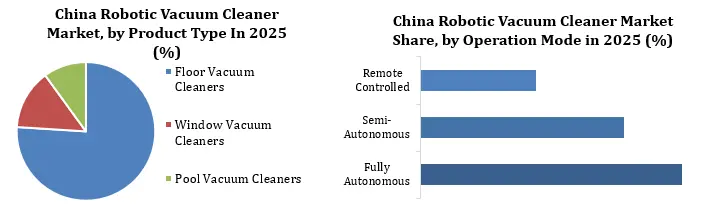
The China Robotic Vacuum Cleaner Market by product type comprises floor vacuum cleaners, pool vacuum cleaners, and window vacuum cleaners, each serving distinct automated cleaning requirements. Floor vacuum cleaners represent the core product category, designed for autonomous cleaning of residential and commercial floor surfaces, including tile, wood, marble, and carpet, with increasing integration of vacuuming, mopping, AI navigation, and self-cleaning functions. Pool vacuum cleaners are specialized systems developed for automated removal of debris and dirt from swimming-pool floors and walls, while window vacuum cleaners use automated movement and suction technologies to clean glass surfaces, particularly in high-rise residences and commercial buildings. The segment structure reflects the expansion of robotic cleaning beyond conventional floor care toward specialized applications, with product differentiation increasingly based on cleaning efficiency, navigation capability, automation, and surface-specific performance.
China Robotic Vacuum Cleaner Market, by Operation Mode
The China Robotic Vacuum Cleaner Market by operation mode is segmented into fully autonomous, semi-autonomous, and remote-controlled systems. Fully autonomous robotic vacuum cleaners perform mapping, navigation, cleaning, automatic charging, and increasingly dust disposal or mop maintenance with minimal user intervention, making them increasingly relevant to smart-home users seeking hands-free cleaning. Semi-autonomous models combine automated navigation and cleaning with user involvement for tasks such as setting cleaning schedules, selecting rooms, adjusting modes, or managing the device manually, offering a balance between convenience and control. Remote-controlled models rely more heavily on user commands through remote controls or smartphone applications and remain relevant among price-sensitive consumers and users who prefer direct control. As AI navigation, mapping, obstacle recognition, and automated docking technologies advance, the market is progressively shifting toward higher levels of autonomy, while semi-autonomous and remote-controlled models continue to serve value-oriented and specific-use applications.
China Robotic Vacuum Cleaner Market Segment Analysis
China Robotic Vacuum Cleaner Market Regional Analysis
The China Robotic Vacuum Cleaner Market is led by East China, which accounts for approximately 41% of the market in 2025, supported by high urbanization, strong purchasing power, advanced e-commerce infrastructure, and rapid adoption of smart-home appliances across Shanghai, Jiangsu, and Zhejiang. South China holds around 26%, driven by Guangdong's large consumer base, strong electronics ecosystem, and high technology adoption, while North China represents approximately 18%, supported by demand from major urban centers such as Beijing and Tianjin. Western China accounts for about 10%, with market expansion supported by improving urban infrastructure, rising smart-home awareness, and increasing online retail penetration, whereas Northeast China contributes around 5%, reflecting an emerging market with gradually increasing adoption of automated household appliances.
Overall, regional demand is concentrated in China's economically developed and highly urbanized eastern and southern provinces, where consumers show stronger acceptance of premium robotic vacuum cleaners featuring AI navigation, automated mopping, obstacle recognition, and self-cleaning functions.

China Robotic Vacuum Cleaner Market Recent Developments
On December 2025-- Multiple news outlets confirmed that Picea Robotics had purchased approximately USD 191 million of iRobot's outstanding debt from Carlyle Group the previous month, making it iRobot's largest creditor. Combined with USD 161.5 million in outstanding manufacturing costs, Picea's total exposure exceeded USD 350 million. The deal effectively marked the end of iRobot as a publicly traded company and cemented Chinese manufacturers' dominance in the global smart vacuum market, with Chinese brands already holding the top five global shipment positions.
On November 2025- Picea Robotics' subsidiary, Santrum Hong Kong, acquired approximately US$191 million (around ¥1.38 billion) worth of iRobot's outstanding debt from the private equity firm Carlyle Group. This debt acquisition positioned Picea as iRobot's secured lender and set the stage for the full acquisition.
China Robotic Vacuum Cleaner Market Competitive Landscape
The China Robotic Vacuum Cleaner Market is highly competitive, with leading domestic brands competing through advanced products, smart-home integration, and rapid product innovation. Key players include ECOVACS Robotics, Roborock, Dreame Technology, Narwal Robotics, Xiaomi, and Midea. ECOVACS maintains a leading position in China’s robotic vacuum segment, while Roborock, Dreame, and Narwal strengthen competition through premium and technology-focused products.
Competitive dynamics center on AI navigation, obstacle recognition, automated mopping, self-cleaning docks, suction performance, and smart connectivity. Leading companies gain advantages through frequent product launches, technology upgrades, e-commerce reach, and smart-home ecosystem integration, while emerging brands compete through competitive pricing and specialized features.
China Robotic Vacuum Cleaner Market Technology & Innovation Trends
| Innovation Area | Current Trend | Market Impact |
| 3D LiDAR + AI Vision Fusion | Combination of LiDAR and visual SLAM enabling millimeter-precision obstacle detection including cables, socks, and pet waste | Drives premium pricing power; Roborock S8 series flagship feature |
| Self-Emptying & Self-Washing Bases | Robotic bases that automatically empty dustbin, refill mop water, and self-clean mop pads after each cycle | Reduces user maintenance to near-zero; Ecovacs DEEBOT X2 OMNI launched at RMB 5,999 |
| Mechanical Arm Integration | Roborock Saros Z70 features 5-axis robotic arm capable of picking up socks and small objects before cleaning | Breakthrough innovation extending autonomy beyond navigation to object handling |
| AI Semantic Room Understanding | Natural language earns via smartphone app: 'Clean under the dining table' recognized with room-level precision | strengthens smart home integration and voice assistant brand ecosystem loyalty |
| Mop-Vacuum Hybrid Optimization | Separate mop lifting mechanism ensuring carpet areas vacuumed without wet mop contact; automatic floor type detection | Overcomes key consumer barrier; over 62% of 2024 Chinese new launches feature combined function |
China Robotic Vacuum Cleaner Market Scope: Inquire before buying
| China Robotic Vacuum Cleaner Market | |||
|---|---|---|---|
| Report Coverage | Details | ||
| Base Year: | 2025 | Forecast Period: | 2026-2034 |
| Historical Data: | 2020 to 2025 | Market Size in 2025: | USD 997.75 Mn. |
| Forecast Period 2026 to 2034 CAGR: | 10.4% | Market Size in 2034: | USD 2430.59 Mn. |
| Segments Covered: | by Product Type | Floor Vacuum Cleaners Window Vacuum Cleaners Pool Vacuum Cleaners |
|
| by Operation Mode | Fully Autonomous Semi-Autonomous Remote Controlled |
||
| by Price | High Medium Low |
||
| by Charging Type | Automatic Docking & Self Charging Manual Charging Battery Swapping System |
||
| by Distribution Channel | Online Company Websites E-Commerce Platforms Offline Department Stores Supermarkets Other |
||
| by End User | Residential Industria Commercial Hospitality Retail & Shopping Centres Healthcare Facilities Airport & Transportation Hubs Office & Corporate Facilities Other |
||
China Robotic Vacuum Cleaner Market Key Players
1. ECOVACS Robotics Co., Ltd.
2. Beijing Roborock Technology Co., Ltd.
3. Dreame Technology Co., Ltd.
4. Narwal Robotics
5. Xiaomi Corporation
6. Midea Group Co., Ltd.
7. Haier Smart Home Co., Ltd.
8. DJI
9. Uwant Technology
10. 3i Robotics
11. Panasonic Corporation
12. Vorwerk Group
13. Green Electric Appliances Inc.
14. ILIFE Robotics
15. OKP Life Technology
Frequently Asked Questions (FAQs)
1. What is the current size of the China Robotic Vacuum Cleaner Market?
The China Robotic Vacuum Cleaner Market is valued at USD 997.75 Million in 2025 and is projected to reach USD 2,430.59 Million by 2034, registering a 10.4% CAGR during 2026–2034.
2. What are the key factors driving the China Robotic Vacuum Cleaner Market?
Key growth factors include increasing smart-home adoption, rising demand for automated household cleaning, advancements in AI and LiDAR navigation, improved obstacle detection, multifunctional vacuum-and-mop systems, and growing adoption of self-emptying and self-cleaning technologies.
3. Which product segment holds the largest share of the China Robotic Vacuum Cleaner Market?
Floor vacuum cleaners hold the largest share of the market, supported by their broad application across residential and commercial spaces. Demand is further strengthened by the integration of vacuuming, mopping, AI navigation, and automated cleaning functions.
4. Which region dominates the China Robotic Vacuum Cleaner Market?
East China dominates the market, accounting for approximately 41% of the market in 2025. Strong urbanization, higher purchasing power, developed e-commerce infrastructure, and high adoption of smart-home technologies support its leading position.
5. Who are the major players operating in the China Robotic Vacuum Cleaner Market?
Major players include ECOVACS Robotics, Beijing Roborock Technology, Dreame Technology, Narwal Robotics, Xiaomi Corporation, Midea Group, Haier Smart Home, and DJI. ECOVACS and Roborock are among the leading brands in China's online robotic vacuum market.