
Catering Service Market - Industry Structure Evaluation, Demand Drivers Analysis, Regional Growth Analysis and Identification, Competitive Positioning / Landscape Review & Global Market Size Forecast to 2034
Overview
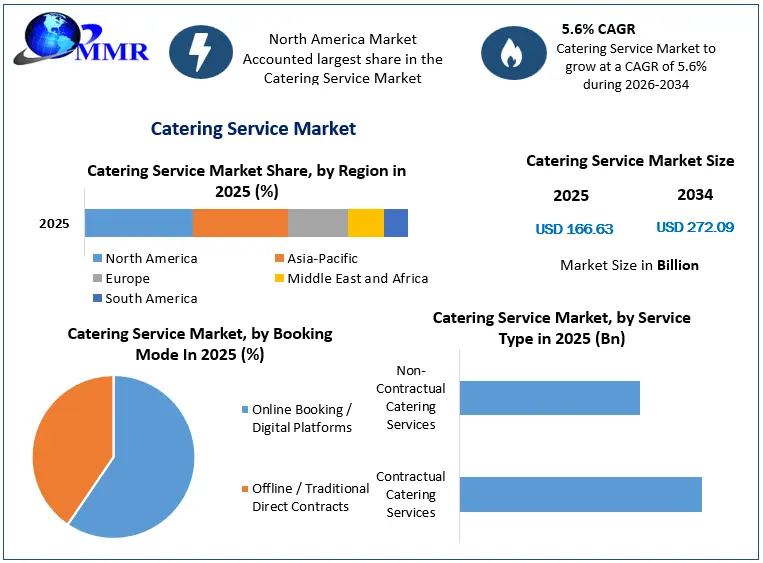
The Catering Service Market size was valued at USD 166.63 Billion in 2025 and the total Catering Service revenue is expected to grow at a CAGR of 5.6% from 2026 to 2034, reaching nearly USD 272.09 Billion.
Catering Service Market Overview:
The Catering Service Market is the market of the food and Beverage industry that provides prepared food and beverages for various events such as gatherings, events, and occasions.
Increasing demand for food and Beverages leads to several opportunities for Catering Services. With the increased emphasis on using technology to improve customer experience and reduce wait times for meals, the market for catering services is expected to grow. Specialized catering services are in greater demand throughout the nation as international firms are increasingly growing in the country. Additionally, catering companies are increasingly providing healthy eating alternatives including organic meals, a balanced vegan diet, and healthy snacks, especially in a vegetarian nation as a result of the global trend of growing health consciousness which triggers the growth of the industry. The need for locally grown fresh farm food, including fruits, vegetables, and meat products, is supporting the market for catering services.
The catering service market is experiencing fast growth in the forecast year. The market is driven by an increase in demand for convenient and professionally prepared meals for events. The market size and its potential growth vary by region, economic condition, and cultural preferences. The increasing outsourcing of food services, growing popularity of social events, rising preference for diverse cuisine options and customized menus, and the increasing disposable income level and changing lifestyles of people represent some of the key factors driving the catering service market.
The careering service market is led by North America and Europe regions due to the high presence of global players and specialized service providers. The industry has met high market maturity in Western European countries, such as the United Kingdom, France, and Hong Kong. However, the industry is expected to have a high potential for growth in the Middle Eastern regions, China, India, Canada, Japan, Mexico, and Australia. The low-maturity regions are the major parts of Asia, Africa, and Latin America, which are expected to witness healthy growth in the Forecast Year.
Catering Service Market Snapshot
 To know about the Research Methodology :- Request Free Sample Report
Catering Service Market Dynamics:
Catering Service Market Drivers:
Expansion of Urbanization and Western Food Culture Drive the Catering Service Market
The expansion of the urban population is inculcating new habits and increasing the preference for international foods. Evolving lifestyles, changing food preferences, rapid urbanization, and the growing number of nuclear families are some factors that are driving the growth of the global fast-food industry. Exposure to international cultures and lifestyles has resulted in consumers across the world experimenting with different cuisines, which is also creating growth opportunities for the global fast-food industry. The popularity of mobile food service providers is increasing in many developed and developing countries as on-the-go foods are widely preferred by the working population of such countries. The rise in consumer purchasing power in APAC and South America is also driving the growth of the mobile food services market. Thus, the growing demand for convenience foods is encouraging vendors to expand their mobile food service offerings in the QSR segment, which is driving the growth of the global catering service market and food contractors market during the forecast period.
Rapid urbanization in India and China has also led to an increase in the number of working populations, leading to the modernization of food consumption patterns. Increased income levels and positive opinions concerning the taste of Western foods have a significant influence on processed food, creating growth opportunities for the catering services market. Many catering services are also mobile food service providers that offer food and beverages at an economical price; consumers prefer such catering mobile food service outlets over FSRs. Also, the increasing demand for fast food is encouraging international vendors to expand their food service offerings in China and South Korea. All these factors will drive the growth of the catering service market during the forecast period.
Catering Services Market Challenges
The Growing Preference for Home-Cooked Foods is a Major Challenge Hampering the Catering Service Market's Growth
Increasing consciousness among consumers about well-being, nutrition, and healthy diets has led to a growing preference for home-cooked food over that offered by restaurants or cafeterias in workplaces and educational institutions. This is because most consumers perceive fast food as unhealthy due to its high contents of added sugar, carbohydrates, and unhealthy fats. With consumers becoming more aware of the increasing occurrences of lifestyle-related diseases such as diabetes and obesity, they try to avoid eating unhealthy foods and prefer home-cooked meals instead.
Home-cooked foods are perceived to have high nutritional value and be fresh and hygienic. Chances of contamination are lower in home-cooked meals compared to food bought elsewhere. Concerns related to the pricing of food bought outside have helped raise demand for home-cooked foods, with the latter being more cost-effective. Thus, benefits such as portion control, hygiene, food safety, better control over allergens, and cost benefits encourage consumers to opt for home-cooked foods. Many people have started preparing foods in-house during personal events such as birthdays and luncheons rather than outsourcing to caterers. Thus, the growing popularity and preference for home-cooked meals are hampering the growth of the catering service Market and food contractors market globally during the forecast period.
Catering Service Market Opportunities:
High-income households and Specialized Catering Services lead to develops demand in Catering Service Market
The Catering Market industry is expected to take a positive turn in the forecast year after recessionary trends and low consumer sentiment temporarily stifled revenue. A rise in demand from high-income households and businesses will boost the growth, with consumers spending more money on parties and other catered functions again and corporate budgets loosened in line with stronger corporate profit. As a result of these trends, the number of businesses within the industry is also estimated to grow.
Due to the increased emphasis on using technology to improve customer experience and reduce wait times for meals, the market for catering service Market is expected to grow. Specialized catering services are in greater demand throughout the nation as international firms are increasingly growing in the world. Additionally, catering companies are increasingly providing healthy eating alternatives including organic meals, a balanced vegan diet, and healthy snacks, especially in a vegetarian nation like India, as a result of the global trend of growing health consciousness which triggers the growth of the industry. The need for locally grown fresh farm food, including fruits, vegetables, and meat products, is supporting the market for catering services. These aspects help to grow opportunities in the catering service market.
Catering Service Market Competitive Landscape:
ISS AS, The revenue of ISS AS is $15.6Bn all over the globe. ISS went global by the 2000s. ISS provides various services including catering delivery services, security services, cleaning services, support services, property services, and facility services. The company serves various industries including public administration, pharmaceuticals, healthcare, business services & IT, energy & resources, and retail & wholesale among others. ISS is present in more than 70 countries in the world across Asia, Latin America, Europe, North America, and Europe. 533,544 people are employed by ISS, making it one of the largest private employers in the world. When it comes to catering services, the ISS provides services to retail shops, Catering Service shops/outlets, pop-ups/high street brands, restaurant/canteen and take-away, events, and fine dining.
Aramark, The revenue of Aramark is $22.4Bn Aramark is a food, uniforms, and Facilities Company that was founded in 1959. It was called ARA, which was short for Automatic Retailers of America, and was founded by William Fishman and Davidson brothers. Initially, it started as providing local catering services and today it has a presence in 19 countries all over the world. It is present in North America, South America, Europe, and Asia. More than 270,000 people work in Aramark. Aramark serves the education industry, sports and entertainment industry, healthcare industry, and business and government industry. Aramark offers corporate dining services & operates concessions at places like sports arenas, stadiums, and other entertainment venues.
Catering Service Market Segments Analysis:
Based on End User, hospitality segment held largest market share in 2025 in the market. The segment is highly competitive and dynamic due to changing customer expectations, cuisine trends, and the demand for customer experience. This segment includes hotels, restaurants, and cafes. Rising per capita disposable income results in increased investments in the food service sector. The hospitality industry is a large service industry that includes several segments, including F&B, travel and tourism, lodging, and recreation. Catering service is essential in hospitality sector because food and beverages are essential to guest satisfaction and customer retention. In-flight segment held the significant market share in 2025. This is due to the introduction of prepared meals and the increased demand for catering on long flights. Airlines are offering meal pre-selection, meal pre-order, and hybrid buy-on-board/complimentary catering choices.
Catering Service Market Regional Insights:
North America, the revenue of the North America Market Dominated the catering service market share and is expected to continue its dominance during the forecast period. The catering market in the U.S. is diverse, ranging from corporate events to weddings and parties. Health-conscious and farm-to-table catering options are gaining popularity. Food trucks and delivery services are also thriving, with an emphasis on convenience and unique culinary experiences. Urban areas like Toronto, Vancouver, and Montreal have a thriving catering scene, with a focus on multicultural cuisine and sustainable practices. Local and seasonal ingredients are emphasized.
Europe, The Europe catering service market is fastly growing in the forecast period and is expected to continue its growth in the forecast period. The UK catering market is evolving to accommodate dietary preferences such as vegan, vegetarian, and gluten-free options. High tea, traditional English fare, and ethnic cuisine catering are popular. In France, catering often includes gourmet offerings, emphasizing quality and presentation. Catering for weddings and formal events is particularly prominent.
Asia, The catering service market in China is expanding rapidly due to urbanization and increasing disposable income. Banquets, corporate events, and weddings are significant segments. Emphasis on traditional Chinese cuisine and unique culinary experiences is prevalent. Catering in India is diverse and rich, reflecting the country's regional and cultural diversity. Traditional cuisine, street food, and fusion options are popular for events ranging from weddings to festivals.
Catering Service Market Recent Industry Developments:
| Date | Company | Development | Impact |
|---|---|---|---|
| 15 June 2026 | Sodexo | Sodexo announced the signing of a definitive share purchase agreement to acquire Antell's restaurant and catering businesses in Finland. | The acquisition significantly strengthens Sodexo's market presence and scale in the Nordic food services and workplace catering market. |
| 11 May 2026 | Foodja | Foodja, a leading workplace restaurant delivery platform, announced a new strategic partnership with P.F. Chang's. | The collaboration enables P.F. Chang's to effectively expand its footprint into the high-value corporate and office catering market. |
| 14 April 2026 | gategroup | Global airline catering provider gategroup reached an agreement with TAP Air Portugal to acquire a majority 51% stake in Cateringpor. | This transaction transitions gategroup to full ownership, consolidating its competitive footprint and supply chain integration in a core European aviation catering hub. |
| 05 February 2026 | Compass Group | Compass Group PLC announced the completed acquisition of Vermaat, a premier food services and retail catering business in the Netherlands, for $1.7 billion. | The buyout adds massive premium capabilities and regional talent, driving targeted expansion across multiple food and hospitality sectors in the Netherlands, France, and Germany. |
| 02 February 2026 | Gulf Hotels Group | Gulf Hotels Group announced the launch of Gulf Catering, a dedicated hospitality, contract catering, and food production brand. | Operating from a newly built, high-volume Central Kitchen and R&D hub, the brand scales structured food service operations across schools, hospitals, and corporate offices. |
| 08 July 2025 | dnata Catering & Retail | Inflight hospitality provider dnata Catering & Retail signed a management contract with PT IAS Hospitality Indonesia (IASH). | The strategic partnership optimizes the operational efficiency and output quality of IASH's inflight catering business, IAS Food Services, at Denpasar International Airport. |
Catering Service Market Scope: Inquire before buying
| Catering Service Market | |||
|---|---|---|---|
| Report Coverage | Details | ||
| Base Year: | 2025 | Forecast Period: | 2026-2034 |
| Historical Data: | 2020 to 2025 | Market Size in 2025: | 166.63 USD Billion |
| Forecast Period 2026-2034 CAGR: | 5.6% | Market Size in 2034: | 272.09 USD Billion |
| Segments Covered: | by Service Type | Contractual Catering Services Non-Contractual Catering Services |
|
| by Booking Mode | Online Booking / Digital Platforms Offline / Traditional Direct Contracts |
||
| by Service Delivery Type | On-Site Catering Services Off-Site Catering Services |
||
| by End-User Industry | In-Flight Catering (Aviation Industry) Educational Institutions (Schools, Colleges, Universities) Hospitality Sector (Hotels, Resorts, Restaurants) Healthcare Sector (Hospitals, Clinics, Care Centers) Special Occasions (Weddings, Events, Conferences) Others (Corporate offices, Government institutions, industrial catering, etc.) |
||
Catering Service Market by Region:
North America (United States, Canada, and Mexico)
Europe (UK, France, Germany, Italy, Spain, Sweden, Austria, and the Rest of Europe)
Asia Pacific (China, South Korea, Japan, India, Australia, Indonesia, Malaysia, Vietnam, Taiwan, Bangladesh, Pakistan, and the Rest of APAC)
Middle East and Africa (South Africa, GCC, Egypt, Nigeria, and the Rest of ME&A)
South America (Brazil, Argentina Rest of South America)
Catering Service Market Key players:
1. Aramark
2. Sodexo
3. Compass Group
4. Gategroup
5. Elior Group
6. Do & Co
7. Newrest
8. Prompt Catering Services
9. Emirates Flight Catering
10. LSG Lufthansa Service Holding AG
11. SATS
12. SkyGourmet Catering Private Limited
13. CaterCow
14. ISS World Services
15. Delaware North
16. Gate Gourmet
17. Centerplate
18. AVI Foodsystems, Inc.
19. Guckenheimer
20. Elior Group
21. Dussmann Group
22. CH&CO Catering
23. Mitie Catering Services
24. Others
Frequently Asked Questions:
1) What is the CAGR for the Catering Service market?
Ans. CAGR for Catering Service Market is 5.6%.
2) How big is the Catering Services market?
Ans. The Catering Services market size is estimated to grow to a catering service market of USD 272.09 billion in 2026-2034.
3) What are the key factors driving the market growth?
Ans. The increasing popularity of online catering and Marketing initiatives helps to drive the catering service Market.
4) Who are the key players in the Catering Services market?
Ans. Aramark, bartlett mitchell Ltd., Caterlink Ltd., CH and Co Catering Group Ltd, Delaware North Companies Inc., Deutsche Lufthansa AG, Dine Contract Catering Ltd., DO and CO Aktiengesellschaft, DoorDash Inc., Elior Group SA, Entier Ltd., Fairfax Meadow Europe Ltd., Fooditude Ltd., gategroup Holding AG, ISS AS, Newrest Group International SAS, Pret A Manger, rhubarb Food Design Ltd., SAVORY Inc, The Emirates Group are a few of the key vendors in the catering services market.
5) Which is the largest regional market for Catering and Food Service contracts?
Ans. North America is the largest regional market for Catering and Food Service contracts.
6) What is the leading application of the Catering and Food Service Contract Market?
Ans. Industrial Sector is the leading application of the Catering and Food Service Contract Market.