
Carbon Credit Market Size by Type, Project Type, End Use, Region – Segment-Level Market Assessment, Growth Opportunity Analysis, Competitive Mapping & Forecast to 2034
Overview
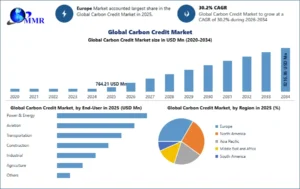
The Carbon Credit Market size was valued at USD 764.2 Million in 2025 and the total Carbon Credit Market size is expected to grow at a CAGR of 30.2% from 2026 to 2034, reaching nearly USD 8216.86 Million by 2034.
Carbon Credit Market Overview:
Carbon credits are a key component of national and international emission trading schemes that are implemented to mitigate global warming. Credits are exchanged between businesses or bought and sold in international markets at the prevailing market price. Credits are used to finance carbon reduction schemes between trading partners and around the world. Carbon Credit is a certificate that allows individuals or small, medium, and large enterprises to emit one ton of carbon dioxide or other greenhouse gases. This happens when the organization reduces its greenhouse gas emissions below a specific level. The carbon credit certification is given by an independent organization.
The growing focus on the use of sustainable energy sources for energy consumption and production is expected to drive the Carbon Credit Market. For example, according to the MMR Study Report, India has positioned itself as a significant gainer in the carbon credit trade, constituting over 25% of the total global transactions. The country distinguishes itself as a significant beneficiary, amassing roughly $5 billion annually. With an annual output exceeding 30 billion tonnes of greenhouse gases (GHGs), there is a growing initiative across the world to confront this environmental challenge.
Approximately 175 nations, collectively accountable for nearly 60% of global emissions, are actively committed to reducing their greenhouse gas discharges. Remarkably, despite ongoing global endeavors to combat climate change, the United States, the largest single emitter contributing 30.3% to global emissions, has not yet ratified the protocol.
To know about the Research Methodology :- Request Free Sample Report
Carbon Credit Market Dynamics
Increasing Emphasis on Sustainability to Boost Carbon Credit Market
The growing corporate social responsibility and rising awareness among companies regarding the reduction in greenhouse gases to achieve zero-emission goals are expected to drive the Carbon Credit Market. Among all industry verticals, the financial industry has recognized the potential of the carbon credit market and is actively engaging in its development. Financial institutions are investing in carbon credit projects, creating specialized funds, and incorporating carbon credits into their investment portfolios. This increased participation of the financial sector adds a revenue stream to the market that enhances transparency, and attracts further investments, and is expected to propel the growth of the Carbon Credit Market.
Increasing awareness of climate change and environmental impact, businesses are under pressure to adopt eco-friendly practices. Carbon credits, a key component of sustainable initiatives, allow companies to offset their carbon emissions by investing in projects that reduce and capture greenhouse gases. This market surge is driven by both regulatory requirements and a genuine commitment to corporate social responsibility by procuring carbon credits, companies not only adhere to environmental regulations but also support initiatives promoting renewable energy, afforestation, and emission reduction.
As sustainability takes center stage in business priorities, the carbon credit market is positioned for substantial growth. It provides a concrete avenue for organizations to address their carbon footprint and actively engage in the worldwide drive toward a more environmentally friendly future.
- On August 29th, 2025, In an article published by UNDP, there is a clear indication that the world’s interest in carbon markets had become more intense because of the increased adoption of climate pledges by countries and companies. According to UNDP, 83% of all countries were expected to use international carbon markets through the Paris Agreement, and the need for carbon credits of good quality was increasing because companies were working hard to attain net-zero emission. UNDP further noted that efficient carbon markets would attract climate finance for renewable energy projects and forests and, thus, develop the Carbon Credit Market.
Price Volatility Expected to Limit the Carbon Credit Market
The carbon credit market faces challenges due to inherent price volatility, which impedes its growth. Prices are influenced by factors such as regulatory changes, market demand, and geopolitical events, making them unpredictable. Investors and businesses may be hesitant to engage in carbon credit transactions due to the uncertainty surrounding returns on investment. Additionally, the lack of standardized pricing mechanisms and the absence of a centralized global market contribute to price fluctuations. This volatility poses a barrier to widespread adoption, as stakeholders may perceive it as a financial risk, hindering the market's ability to attract consistent participation and investment.
A lack of clear and consistent regulations is expected to discourage investments in emission-reduction projects and reduce market participation. Also, Maintaining the quality and integrity of carbon credits is important for the credibility and effectiveness of the market. Concerns about the accuracy and transparency of carbon credit projects undermine confidence among buyers and investors. Issues such as double counting, inadequate verification processes, or the inclusion of questionable projects are expected to lead to reputational risks and Carbon Credit market inefficiencies.
Government policies and Increased Environmentally Aware Customers Create a Lucrative Opportunity for the Carbon Credit Market
Government policies are expected to play an important role in shaping the carbon credit market. Many governments offer incentives and subsidies to encourage emission reduction projects and create favorable regulatory frameworks for the Carbon Credit Market to grow significantly. Additionally, governments often lead by example, offsetting their emissions and signaling the importance of carbon neutrality. Factors such as favorable conditions for carbon credit transactions and encouraging participation and collaborations are expected to boost the Carbon Credit Market.
Government policies mandating carbon reduction, coupled with a growing base of environmentally aware consumers, form a lucrative landscape for the carbon credit market. Stringent emissions regulations push businesses to seek carbon offsets, boosting demand. As consumers prioritize eco-friendly choices, companies embracing carbon credits gain a competitive edge, appealing to a conscientious market segment. This trend stimulates private investment, fostering innovation in carbon reduction projects. Government-backed initiatives, alongside a discerning consumer base, not only drive the carbon credit market's growth but also encourage corporate responsibility, creating a symbiotic relationship between regulatory frameworks, eco-conscious consumers, and the expanding carbon credit market.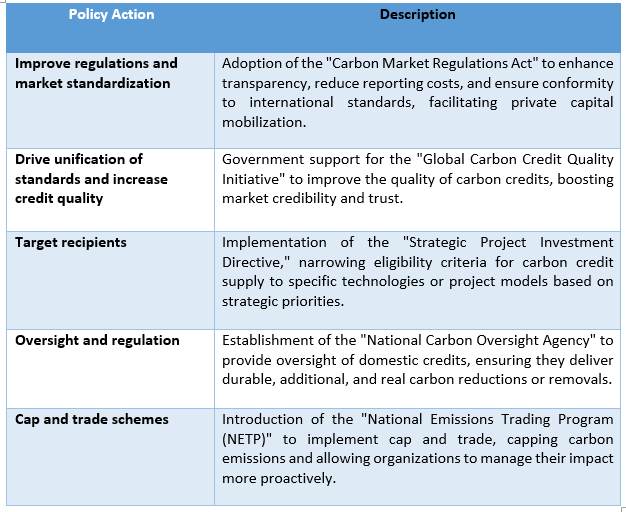
Trends in the Carbon Credit Market:
Increased Digitization and Blockchain Technology: The carbon credit market is leveraging digitalization and blockchain technology to enhance transparency, traceability, and efficiency. Blockchain enables secure and immutable tracking of carbon credits, ensuring their integrity and preventing double counting, which is expected to boost the Carbon Credit Market. It also enables streamlined transactions, automated verification, and easier access for market participants, including smaller buyers and sellers.
Cooperation Between Companies and Measurement and Reporting of Impact: With the growing emphasis on sustainability and ESG (Environmental, Social, and Governance) considerations, there is an increased focus on measuring and reporting the impact of carbon credit projects. Buyers and investors are seeking credible and transparent information on the environmental benefits generated by projects. Standardized methodologies, third-party verification, and reporting frameworks are being developed to provide reliable and comparable data on the emissions reductions achieved. These factors are expected to propel the other end-users to adopt and buy carbon credits, which is simultaneously driving the Carbon Credit Market.
Carbon Credit Market Segment Analysis
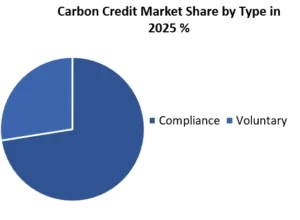
Based on By Type, the carbon credit market segment can be further split into Compliance and Voluntary carbon markets. The compliance type includes government-operated emissions trading schemes (ETS), cap and trade programs, as well as compulsory carbon pricing programs that require regulated industries such as electricity generation, steel, cement, chemical, oil and gas, and aviation sectors to purchase carbon credits and emission permits. Voluntary markets include the purchase of carbon credits by companies, financial institutions, NGOs, and even individuals to achieve zero-net emissions, carbon neutrality, and ESG targets. The Compliance type has the biggest share of the worldwide carbon credits market in 2025 because of stringent emissions regulations, rising carbon pricing policies, and high trading volumes from compliance markets such as the EU ETS and China ETS.
Based on Project Type, The segment of Avoidance/Reduction Projects held the leading share of the global carbon credit market in 2025. Such a segment includes the segments of Avoidance/Reduction Projects, Removal/Sequestration Projects, Nature-Based Solutions, and Technology-Based Solutions. The segment of Avoidance/Reduction Projects consists of renewable energy projects, energy efficiency projects, methane capture projects, landfill gas projects, waste-to-energy projects, fuel switching, and industrial emission reduction projects. Removal/Sequestration Projects are comprised of afforestation projects, reforestation projects, soil carbon sequestration projects, carbon capture and storage (CCS) projects, and direct air capture (DAC) projects. The Nature-Based Solutions include forest conservation, agroforestry, mangrove restoration, peatland restoration, and sustainable agriculture. Technology-Based Solutions consist of CCUS, BECCS, enhanced rock weathering, mineral carbonation, and other engineered carbon removal solutions.
Nature-based solutions alone accounted for nearly 40% of issued credits in the voluntary carbon market in 2025, reflecting strong buyer preference for co-benefits like biodiversity conservation and community development. While technology-based solutions remain limited by high costs and scalability issues, investment is accelerating. As corporate buyers and governments prioritize long-term net-zero strategies, the market is witnessing a gradual shift from avoidance to high-integrity removal credits, underscoring the evolving dynamics of carbon offsetting.
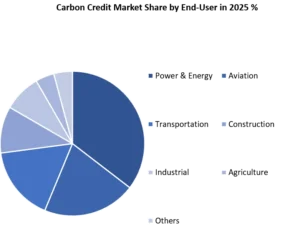
Based on End -User, In 2025, the largest contributor to the worldwide carbon credit market was the Power & Energy segment. The segments under consideration include Power & Energy, Aviation, Transportation, Construction, Industrial, Agriculture, and Others. The Power & Energy segment encompasses coal-based and gas-powered power stations, renewable energy developers, utility firms, IPPs, and grid operators. The aviation segment is made up of passenger and cargo airlines, whereas transportation includes road freight, rail, maritime transport, logistics companies, and fleet operators. The construction segment is made up of commercial and residential building constructors, EPC firms, and steel and cement manufacturers. Industrial includes steel production, cement manufacturing, chemical production, mining industry, oil and gas, and other heavy industries. Agriculture is comprised of crop production, livestock, forestry, agroforestry, and soil carbon projects, while others include commercial buildings, healthcare, data centers, retail, banking, and waste management sectors.
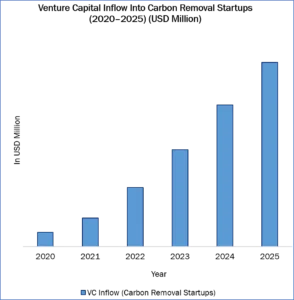
Venture Capital Inflow
Carbon Credit Market Regional Insights
In 2025, Europe was the dominating region in the carbon credit market owing to the presence of an established EU Emission Trading System (EU ETS), strict climate policies, expansion of carbon pricing systems, and active participation of power generation, industry, and aviation sectors. Further, increasing investments in renewables and carbon removal technology aided the growth of regional market.
North America had a considerable market share owing to the presence of regional cap and trade programs, growing commitments from companies towards reaching net zero status, and investments in CCUS, DAC, and renewable energy projects. Asia-Pacific is anticipated to have the fastest growth rate during the forecast period, owing to the expansion of emissions trading system, fast industrial growth, and decarbonization initiatives of the governments of China, Japan, and South Korea.
Middle East & Africa and South America are emerging regions, backed by rising investments in clean energy and carbon reduction initiatives. While Middle East has growing voluntary carbon trading platform and green hydrogen projects, South America has large scale of forestry, REDD+, afforestation and sustainable agriculture projects, thus becoming a key source of nature-based carbon credits.
Recent Industry Developments (2025–2026)
| Date | Company | Development | Impact |
|---|---|---|---|
| 18 March 2026 | Carbon Pulse | Two nature-based climate solutions firms merged to form a new Southeast Asia carbon project developer to scale regional credit supply. | The merger consolidates regional expertise to meet the rising demand for high-quality nature-based offsets in Asian markets. |
| 07 April 2025 | EKI Energy Services Ltd | EKI announced a strategic investment in Tvasta Manufacturing Solutions to integrate sustainable 3D printing technology into its carbon offset portfolio. | This diversification expands technological carbon removal options beyond traditional nature-based sequestration projects. |
| 15 January 2025 | Intercontinental Exchange (ICE) | ICE launched ICE GreenTrace™, a digital environmental registry technology to track the lifecycle of carbon credits using blockchain. | The platform improves market transparency and reduces the risk of double-counting in global carbon credit transactions. |
| 10 January 2025 | Carbonmark | Carbonmark launched Carbonmark Direct, a blockchain-enabled platform designed for the instant issuance and purchase of carbon credits. | This development lowers transaction costs and increases liquidity by allowing direct interaction between project developers and corporate buyers. |
Carbon Credit Market Competitive Landscape
The Carbon Credit Market at the Global Level is quite competitive, and some of the leading players include Verra, Gold Standard Foundation, South Pole, Shell, and EKI Energy Services Ltd., who create their dominance in the market through an extensive portfolio of carbon credits, global projects, and international standards of verification. The likes of Climate Impact Partners, 3Degrees, EcoAct, ClimatePartner, ClimeCo, and Natural Capital Partners have created their competition by providing carbon offsetting options, ESG consulting, and climate financing.
More competition exists through quality carbon credits, nature-based solutions, carbon removals, digital trading platforms, and strategic partnerships. With the growth of net-zero targets globally and the development of carbon pricing mechanisms, the organizations are making innovative moves in terms of climate solutions and diversifying their projects.
Carbon Credit Market Scope: Inquire before buying
| Carbon Credit Market | |||
|---|---|---|---|
| Report Coverage | Details | ||
| Base Year: | 2025 | Forecast Period: | 2026-2032 |
| Historical Data: | 2020 to 2025 | Market Size in 2025: | 764.2 USD Mn. |
| Forecast Period 2026-2034 CAGR: | 30.2% | Market Size in 2034: | 8216.86 USD Mn. |
| Segments Covered: | by Type | Compliance Voluntary |
|
| by Project Type | Avoidance / Reduction projects Removal / Sequestration projects Nature Based Solutions Technology based Solutions Others |
||
| by End Use | Power & Energy Aviation Transportation Construction Industrial Agriculture Others |
||
Carbon Credit Market, by Region
North America (United States, Canada and Mexico)
Europe (UK, France, Germany, Italy, Spain, Sweden, Austria and Rest of Europe)
Asia Pacific (China, South Korea, Japan, India, Australia, Indonesia, Malaysia, Vietnam, Taiwan and Rest of APAC)
Middle East and Africa (South Africa, GCC, Egypt, Nigeria and Rest of ME&A)
South America (Brazil, Argentina Rest of South America)
Key Players / Competitors Profiles Covered in Brief in Global Carbon Credit Market Report in Strategic Perspective:
- Shell
- South Pole
- Verra
- Climate Impact Partners
- 3Degrees
- Terrapass
- NativeEnergy
- Cool Effect, Inc.
- Sustainable Travel International
- Sterling Planet, Inc.
- Enking International
- ClimeCo LLC
- EcoAct
- ClimatePartner
- myclimate
- First Climate
- Forliance
- Natural Capital Partners
- EKI Energy Services Ltd
- Ambipar Group
- Gold Standard Foundation
- Plan Vivo Foundation
- Green Mountain Energy
- WGL Holdings, Inc.
- Allcot
- Atmosfair
- Carbon Clear
- Carbon Credit Capital
- Ecosecurities
- Others