Factory Automation Market– Industry Structure Evaluation, Demand Drivers Analysis, Regional Growth Analysis and Identification, Competitive Positioning Review & Global Market Size Forecast to 2034

8.9%
CAGR (2026-2034)
377.55 USD Bn.
Forecast Market Size
330
Report Pages
159
Market Tables

Overview

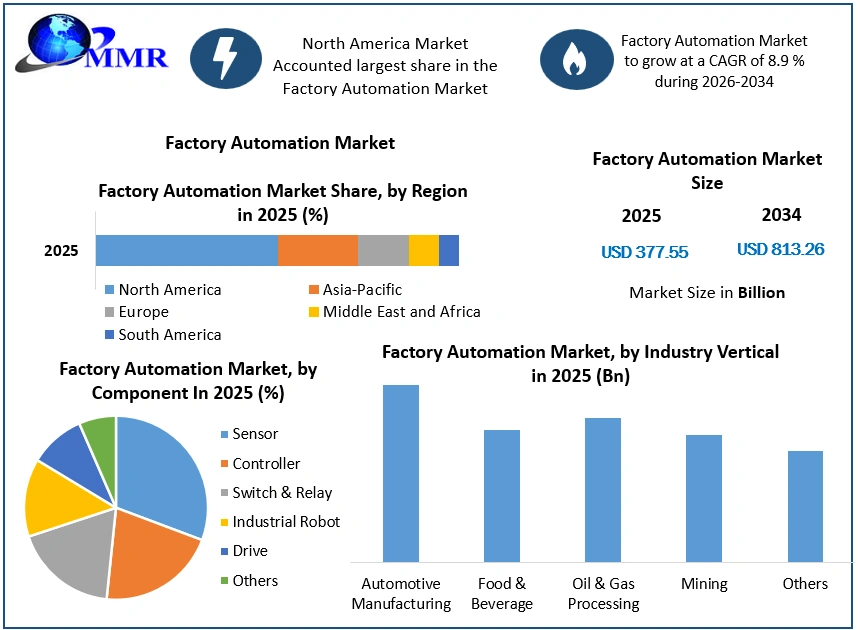
The Factory Automation Market size was valued at USD 377.55 Billion in 2025 and the total Factory Automation revenue is expected to grow at a CAGR of 8.9% from 2026 to 2034, reaching nearly USD 813.26 Billion.

Factory automation is a set of technologies and automatic control devices that improve the production rate and quality of products, as well it controls industrial processes with least intervention of human and achieves superior performance than manual control. The factory automation market report analyses various types of factory automation systems and their applications in end-user industries.

In addition, it covers various types of control and safety systems, which include distributed control system (DCS), supervisory control & data acquisition system (SCADA), manufacturing execution system (MES), safety instrumented system (SIS), programmable logic controller (PLC), and human machine interface (HMI). Based on component, it is segmented into sensor, controller, switch & relay, industrial robot, drive, and other (wireless component, remote terminal unit (RTU), I/O device, actuator, valve, and enclosure).

The industry verticals are segmented into automotive manufacturing, food & beverage, oil & gas processing, mining, and others (pharmaceutical, machinery, chemical, fiber & textile, infrastructure, plastic, water treatment, marine, and metal). Based on region, the factory automation market is analyzed across North America, Asia-Pacific, Europe, South America and Middle East and Africa.

The report provides information about the strategies adopted by the key players to sustain the competition and increase their market shares. ABB Ltd., Mitsubishi Electric Factory Automation, Siemens AG, Honeywell International Incorporation, Emerson Electric Corporation, and Schneider Electric SA are some of the major companies covered in the factory automation industry report.

Factory Automation Market Growth and Share Analysis
Factory Automation Market Growth

To know about the Research Methodology :- Request Free Sample Report

Factory Automation Market Dynamics

Increase in demand for automation for qualitative and reliable manufacturing to drive the growth of factory automation market

The demand for industrial automation is on an increase in various industries as it combines information technology with machine and systems to create smart manufacturing infrastructure. It standardizes the manufacturing process and provides repeatable & consistent results with improved product quality. Moreover, the use of factory automation has reduced human intervention in industrial process, which minimized the human errors and related problems.

Growth in need for mass production with reduced operation cost to drive the growth of factory automation market

The industry players are focusing on increasing the efficiency of manufacturing process to achieve low cost and high-quality production results, which majorly drive the Factory Automation market. Furthermore, increase in demand for mass production in manufacturing industries also increases the demand for factory automation, as it resolves the quality control issue associated with mass production. In addition, it reduces production cost by producing large number of products in optimized time with high accuracy. Moreover, less human intervention reduces the labor cost, this in turn minimizes overall operational cost in the manufacturing process, which also drives the demand for factory automation.

Surge in adoption of industry 4.0 and enabling technologies industries to drive the growth of factory automation market

Increase in shift toward digital transformation fuels the demand for IoT-based smart solutions and automation in various industries to adopt & enable new and autonomous capabilities. Most of automation and smart solutions are used in industries to improve product quality, plant efficiency, and facilitate uniform production. Thus, increase in demand for IoT-based smart solutions is expected to drive the factory automation market growth during the forecast period. In addition, various manufacturing industries focus to obtain safe, fast, and efficient production results, which boost the need for factory automation. Moreover, increase in adoption of industry 4.0 resolutions is expected to shape the future of manufacturing industries by standardizing the processes. It is a digital transformation of manufacturing industries into smart industries. Thus, government is providing funds to industries for adoption of automation systems and enabling technologies in various emerging economies, which can improve industrial processes.

Factory Automation Market Opportunity

Increase in demand for automation in Asian countries such as China and Japan

The automotive and manufacturing industries in Asia-Pacific are growing rapidly. Moreover, low manufacturing cost, supportive policies of the regional governments and increase in cognizance of the assistances of automation influence the growth of the end-user industries in Asia Pacific. In addition, reduction in prices and adoption of enabling technologies provide lucrative opportunity to expand the factory automation market in Asian countries such as China and Japan during the forecast period.
Factory Automation MarketFactory Automation Market Restraint

Limited availability of professionals and awareness regarding security to restraint the growth of factory automation market

Various automotive, food, chemical, oil & gas, mining, packaging, and other industries are investing in adoption of automation systems to operate industrial processes efficiently, reliably, and safely. These industries require highly skilled professionals to manage, implement, and monitor the work flow of automation processes, where these organizations need to provide in-depth training on system security awareness and procedures. In addition, these automation systems require secure authentication procedures and solutions for protection against interference of adversaries. All these factors are expected to hamper the factory automation market growth.

High implementation expenses for factory automation systems to restraint the growth of factory automation market

Factory automation systems are set technologies and mechanical systems that help automate the industrial process; thus, the cost of installation and the ensuing maintenance are high for these systems. However, many of the industry users are not aware about the quality of finished product manufactured using automation, where continuous monitoring & control systems are installed to ensure the flow of process, as well as industry professional are needed to check the quality of products. Accordingly, subsequent equipment and associated maintenance may lead to high cost of investment for the manufacturers. These factors are expected to restrain growth of the factory automation market.

Factory Automation Market Segment Analysis

Based on Control & Safety System, Supervisory control & data acquisition (SCADA) dominated the factory automation market in 2025 and is expected to grow at a CAGR of 9.1% during the forecast period. Supervisory control & data acquisition (SCADA) is an industrial process automation system, which is used to collect data from instruments and equipment located at plants & remote sites. This system acquires & transmits data, and provides monitoring and control for process inputs and outputs.

Moreover, it increases productivity and profitability, as it reduces the operating cost and maintenance cost. As a result, the demand for SCADA systems is increasing in manufacturing, pipeline monitoring & control, water treatment centers & distribution, electrical power transmission & distribution, and other industries, which is expected to drive the growth of the SCADA systems market during the forecast period.

Based on Component, Industrial Robots dominated the factory automation market in 2025 and is expected to grow at a CAGR of 6.4% during the forecast period. The demand for industrial robot is majorly observed in automobiles and heavy engineering industries. Moreover, increased need for smart production in non-conventional areas, such as microelectronics, has increased the demand for industrial robots. The heavy engineering sector is also responsible for the increased demand of industrial robot, to perform critical task in optimized time and maintaining safety at workplace.

In addition, increased demand for mass production in the manufacturing industry, reduction in custom duties, and evolving robotics & artificial intelligence (AI) industry has increased the demand for robots. Furthermore, the high product and implementation cost can hamper the growth of industrial robots in the market.

Based on Industry Vertical, Automotive Manufacturing dominated the factory automation market in 2025 and is expected to grow at a CAGR of 9.5% during the forecast period. The demand for automation is on an increase in the automotive industry to perform repetitive and complex tasks. These tasks can be accomplished with the help of automation, obtaining cost-effective, reliable, and efficient results. Moreover, there is an increase in the demand for mass production to cater to the growth in population. Furthermore, various manufacturing and automotive industries focus on adoption of smart manufacturing systems and logistics systems to deal with growth in competition and to obtain safe, fast, and efficient production results.

Factory Automation Market Regional Insights

North America accounts for the highest revenue in the global factory automation market, thanks to heavy investments in power and oil & gas sectors. Moreover, rise in need for automation is a major factor that fuels the factory automation industry growth in this region. In addition, upsurge in demand for energy-efficient solutions and rise in need to minimize wastage of resources in various process industries are expected to provide lucrative growth opportunities to factory automation market players to grow their business in the region. Furthermore, most of the network security organizations have strong presence in this region, which is expected to drive the growth of the factory automation industry during the forecast period.

Europe witnessed significant growth in the factory automation market in 2025, owing to increase in demand for control systems in the oil & gas industry. The need for modernization of oil & gas, water & wastewater, and power infrastructure has been increasing rapidly in Europe, where automation used to analyse the drilling ground and maintain the drill speed. This factor significantly drives the growth of the European factory automation market. However, increase in cyber-attack threats in critical infrastructure hampers the factory automation market growth.

Various manufactures have been heavily investing in power transmission and distribution in the Asia-Pacific region, because the demand for mass production has been increasing to cater to the need of the growing population. Moreover, increase in need for software in industrial automation, rise in infrastructure investments in the emerging economies, such as China, India, and Japan, and upsurge in demand for cloud-based solutions act as the major factors that boost the factory automation market growth in the region. Furthermore, increase in adoption of smart grid solutions to protect critical infrastructure from threat of cyber-attacks is anticipated to provide new growth opportunities for various players in the factory automation industry.

South America and Middle East & Africa witnessed significant growth in the factory automation market in 2025, owing to increased demand for control systems from the utility industry. Moreover, rapid increase in industrialization and population in the Middle East have led to rise in adoption of smart solutions and automation. Furthermore, the development of the oil refineries and power industries is expected to boost the need for factory automation, thereby driving the factory automation industry growth in South America and Middle East & Africa region.

Factory Automation Market Recent Development

Date Company Development Impact
22 December 2025 Mitsubishi Electric Corporation Invested in and signed a strategic alliance agreement with Tulip Interfaces to integrate no-code platforms for manufacturing digitalization. Accelerates IT/OT convergence by combining edge automation hardware with composable frontline operations software.
07 July 2025 Omron Corporation Entered a strategic partnership with Japan Activation Capital to execute structural reforms targeting its Industrial Automation Business. Revitalizes global competitiveness and rebuilds profitability foundations to capture rising demand for labor efficiency.
22 July 2026 Mitsubishi Electric Corporation Agreed to establish a joint venture with Sony Semiconductor Solutions to build AI vision sensor solutions. Enhances manufacturing applications through advanced perception-driven automation and real-time defect detection.
24 April 2026 Mitsubishi Electric Corporation Signed a memorandum of understanding with Hon Hai Precision Industry (Foxconn) to explore a joint alliance in automotive equipment. Drives synergies in electrification and software-defined vehicle technologies to scale industrial automation infrastructure.

Factory Automation Market Scope: Inquiry Before Buying

Factory Automation Market
Report Coverage Details
Base Year: 2025 Forecast Period: 2026-2034
Historical Data: 2020 to 2025 Market Size in 2025: USD 377.55 Bn.
Forecast Period 2026 to 2034 CAGR: 8.9% Market Size in 2034: USD 813.26Bn.
Segments Covered: by Control & Safety System Distributed Control System (DCS)
Supervisory Control and Data Acquisition System (SCADA)
Manufacturing Execution System (MES)
Safety Instrumented System (SIS)
Programmable Logic Controller (PLC)
Human Machine Interface (HMI)
by Component Sensor
Controller
Switch & Relay
Industrial Robot
Drive
Others
by Industry Vertical Automotive Manufacturing
Food & Beverage
Oil & Gas Processing
Mining
Others

Factory Automation Market, by Region

North America (United States, Canada and Mexico)
Europe (UK, France, Germany, Italy, Spain, Sweden, Austria and Rest of Europe)
Asia Pacific (China, South Korea, Japan, India, Australia, Indonesia, Malaysia, Vietnam, Taiwan, Bangladesh, Pakistan and Rest of APAC)
Middle East and Africa (South Africa, GCC, Egypt, Nigeria and Rest of ME&A)
South America (Brazil, Argentina Rest of South America)

Key Players are:

1. ABB Ltd
2. Emerson Electric Company
3. GE Company
4. Honeywell International Incorporation
5. Mitsubishi Electric Factory Automation
6. Omron Corporation
7. Rockwell Automation, Inc.
8. Schneider Electric SA
9. Siemens AG
10.Yokogawa Electric corporation
11.Kuka AG
12.Keyence Corporation
13.Fanuc Corporation
14.Bosch Rexroth
15.Fuji Electric Co., Ltd.
16.Endress+Hauser
17.Hitachi Ltd.

Frequently Asked Questions:

1] What is the growth rate of the Global Factory Automation Market?
Ans. The Global Factory Automation Market is growing at a significant rate of 8.9% during the forecast period.

2] Which region is expected to have the highest growth rate in the Global Factory Automation Market?
Ans. The North America region is expected to hold the highest growth rate in the Factory Automation Market during the forecast period.

3] What is the market size of the Global Factory Automation Market by 2034?
Ans. The market size of the Factory Automation Market by 2034 is expected to reach USD 813.26 Bn.

4] What are the major key players of the Global Factory Automation Market?
Ans. The major key players of the Global Factory Automation Market are ABB Ltd, Emerson Electric Company, GE Company, Honeywell International Incorporation, Mitsubishi Electric Factory Automation, and Omron Corporation.

5] What was the Global Factory Automation Market size in 2025?
Ans:
The Global Factory Automation Market size was USD 377.55 Billion in 2025.

Table of Contents

1. Factory Automation Market Introduction 1.1. Study Assumption and Market Definition 1.2. Scope of the Study 1.3. Executive Summary 2. Global Factory Automation Market: Competitive Landscape 2.1. MMR Competition Matrix 2.2. Competitive Landscape 2.3. Key Players Benchmarking 2.3.1. Company Name 2.3.2. Business Segment 2.3.3. End-user Segment 2.3.4. Revenue (2025) 2.3.5. Company Locations 2.4. Leading Factory Automation Market Companies, by market capitalization 2.5. Market Structure 2.5.1. Market Leaders 2.5.2. Market Followers 2.5.3. Emerging Players 2.6. Mergers and Acquisitions Details 3. Factory Automation Market: Dynamics 3.1. Factory Automation Market Trends by Region 3.1.1. North America Factory Automation Market Trends 3.1.2. Europe Factory Automation Market Trends 3.1.3. Asia Pacific Factory Automation Market Trends 3.1.4. Middle East and Africa Factory Automation Market Trends 3.1.5. South America Factory Automation Market Trends 3.2. Factory Automation Market Dynamics by Region 3.2.1. North America 3.2.1.1. North America Factory Automation Market Drivers 3.2.1.2. North America Factory Automation Market Restraints 3.2.1.3. North America Factory Automation Market Opportunities 3.2.1.4. North America Factory Automation Market Challenges 3.2.2. Europe 3.2.2.1. Europe Factory Automation Market Drivers 3.2.2.2. Europe Factory Automation Market Restraints 3.2.2.3. Europe Factory Automation Market Opportunities 3.2.2.4. Europe Factory Automation Market Challenges 3.2.3. Asia Pacific 3.2.3.1. Asia Pacific Factory Automation Market Drivers 3.2.3.2. Asia Pacific Factory Automation Market Restraints 3.2.3.3. Asia Pacific Factory Automation Market Opportunities 3.2.3.4. Asia Pacific Factory Automation Market Challenges 3.2.4. Middle East and Africa 3.2.4.1. Middle East and Africa Factory Automation Market Drivers 3.2.4.2. Middle East and Africa Factory Automation Market Restraints 3.2.4.3. Middle East and Africa Factory Automation Market Opportunities 3.2.4.4. Middle East and Africa Factory Automation Market Challenges 3.2.5. South America 3.2.5.1. South America Factory Automation Market Drivers 3.2.5.2. South America Factory Automation Market Restraints 3.2.5.3. South America Factory Automation Market Opportunities 3.2.5.4. South America Factory Automation Market Challenges 3.3. PORTER's Five Forces Analysis 3.4. PESTLE Analysis 3.5. Technology Roadmap 3.6. Regulatory Landscape by Region 3.6.1. North America 3.6.2. Europe 3.6.3. Asia Pacific 3.6.4. Middle East and Africa 3.6.5. South America 3.7. Key Opinion Leader Analysis For Factory Automation Industry 3.8. Analysis of Government Schemes and Initiatives For Factory Automation Industry 3.9. Factory Automation Market Trade Analysis 3.10. The Global Pandemic Impact on Factory Automation Market 4. Factory Automation Market: Global Market Size and Forecast by Segmentation (in USD Billion) 2025-2034 4.1. Factory Automation Market Size and Forecast, by Control & Safety System (2025-2034) 4.1.1. Distributed Control System (DCS) 4.1.2. Supervisory Control and Data Acquisition System (SCADA) 4.1.3. Manufacturing Execution System (MES) 4.1.4. Safety Instrumented System (SIS) 4.1.5. Programmable Logic Controller (PLC) 4.1.6. Human Machine Interface (HMI) 4.2. Factory Automation Market Size and Forecast, by Component (2025-2034) 4.2.1. Sensor 4.2.2. Controller 4.2.3. Switch & Relay 4.2.4. Industrial Robot 4.2.5. Drive 4.2.6. Others 4.3. Factory Automation Market Size and Forecast, by Industry Vertical (2025-2034) 4.3.1. Automotive Manufacturing 4.3.2. Food & Beverage 4.3.3. Oil & Gas Processing 4.3.4. Mining 4.3.5. Others 4.4. Factory Automation Market Size and Forecast, by Region (2025-2034) 4.4.1. North America 4.4.2. Europe 4.4.3. Asia Pacific 4.4.4. Middle East and Africa 4.4.5. South America 5. North America Factory Automation Market Size and Forecast by Segmentation (in USD Billion) 2025-2034 5.1. North America Factory Automation Market Size and Forecast, by Control & Safety System (2025-2034) 5.1.1. Distributed Control System (DCS) 5.1.2. Supervisory Control and Data Acquisition System (SCADA) 5.1.3. Manufacturing Execution System (MES) 5.1.4. Safety Instrumented System (SIS) 5.1.5. Programmable Logic Controller (PLC) 5.1.6. Human Machine Interface (HMI) 5.2. North America Factory Automation Market Size and Forecast, by Component (2025-2034) 5.2.1. Sensor 5.2.2. Controller 5.2.3. Switch & Relay 5.2.4. Industrial Robot 5.2.5. Drive 5.2.6. Others 5.3. North America Factory Automation Market Size and Forecast, by Industry Vertical (2025-2034) 5.3.1. Automotive Manufacturing 5.3.2. Food & Beverage 5.3.3. Oil & Gas Processing 5.3.4. Mining 5.3.5. Others 5.4. North America Factory Automation Market Size and Forecast, by Country (2025-2034) 5.4.1. United States 5.4.1.1. United States Factory Automation Market Size and Forecast, by Control & Safety System (2025-2034) 5.4.1.1.1. Distributed Control System (DCS) 5.4.1.1.2. Supervisory Control and Data Acquisition System (SCADA) 5.4.1.1.3. Manufacturing Execution System (MES) 5.4.1.1.4. Safety Instrumented System (SIS) 5.4.1.1.5. Programmable Logic Controller (PLC) 5.4.1.1.6. Human Machine Interface (HMI) 5.4.1.2. United States Factory Automation Market Size and Forecast, by Component (2025-2034) 5.4.1.2.1. Sensor 5.4.1.2.2. Controller 5.4.1.2.3. Switch & Relay 5.4.1.2.4. Industrial Robot 5.4.1.2.5. Drive 5.4.1.2.6. Others 5.4.1.3. United States Factory Automation Market Size and Forecast, by Industry Vertical (2025-2034) 5.4.1.3.1. Automotive Manufacturing 5.4.1.3.2. Food & Beverage 5.4.1.3.3. Oil & Gas Processing 5.4.1.3.4. Mining 5.4.1.3.5. Others 5.4.2. Canada 5.4.2.1. Canada Factory Automation Market Size and Forecast, by Control & Safety System (2025-2034) 5.4.2.1.1. Distributed Control System (DCS) 5.4.2.1.2. Supervisory Control and Data Acquisition System (SCADA) 5.4.2.1.3. Manufacturing Execution System (MES) 5.4.2.1.4. Safety Instrumented System (SIS) 5.4.2.1.5. Programmable Logic Controller (PLC) 5.4.2.1.6. Human Machine Interface (HMI) 5.4.2.2. Canada Factory Automation Market Size and Forecast, by Component (2025-2034) 5.4.2.2.1. Sensor 5.4.2.2.2. Controller 5.4.2.2.3. Switch & Relay 5.4.2.2.4. Industrial Robot 5.4.2.2.5. Drive 5.4.2.2.6. Others 5.4.2.3. Canada Factory Automation Market Size and Forecast, by Industry Vertical (2025-2034) 5.4.2.3.1. Automotive Manufacturing 5.4.2.3.2. Food & Beverage 5.4.2.3.3. Oil & Gas Processing 5.4.2.3.4. Mining 5.4.2.3.5. Others 5.4.3. Mexico 5.4.3.1. Mexico Factory Automation Market Size and Forecast, by Control & Safety System (2025-2034) 5.4.3.1.1. Distributed Control System (DCS) 5.4.3.1.2. Supervisory Control and Data Acquisition System (SCADA) 5.4.3.1.3. Manufacturing Execution System (MES) 5.4.3.1.4. Safety Instrumented System (SIS) 5.4.3.1.5. Programmable Logic Controller (PLC) 5.4.3.1.6. Human Machine Interface (HMI) 5.4.3.2. Mexico Factory Automation Market Size and Forecast, by Component (2025-2034) 5.4.3.2.1. Sensor 5.4.3.2.2. Controller 5.4.3.2.3. Switch & Relay 5.4.3.2.4. Industrial Robot 5.4.3.2.5. Drive 5.4.3.2.6. Others 5.4.3.3. Mexico Factory Automation Market Size and Forecast, by Industry Vertical (2025-2034) 5.4.3.3.1. Automotive Manufacturing 5.4.3.3.2. Food & Beverage 5.4.3.3.3. Oil & Gas Processing 5.4.3.3.4. Mining 5.4.3.3.5. Others 6. Europe Factory Automation Market Size and Forecast by Segmentation (in USD Billion) 2025-2034 6.1. Europe Factory Automation Market Size and Forecast, by Control & Safety System (2025-2034) 6.2. Europe Factory Automation Market Size and Forecast, by Component (2025-2034) 6.3. Europe Factory Automation Market Size and Forecast, by Industry Vertical (2025-2034) 6.4. Europe Factory Automation Market Size and Forecast, by Country (2025-2034) 6.4.1. United Kingdom 6.4.1.1. United Kingdom Factory Automation Market Size and Forecast, by Control & Safety System (2025-2034) 6.4.1.2. United Kingdom Factory Automation Market Size and Forecast, by Component (2025-2034) 6.4.1.3. United Kingdom Factory Automation Market Size and Forecast, by Industry Vertical (2025-2034) 6.4.2. France 6.4.2.1. France Factory Automation Market Size and Forecast, by Control & Safety System (2025-2034) 6.4.2.2. France Factory Automation Market Size and Forecast, by Component (2025-2034) 6.4.2.3. France Factory Automation Market Size and Forecast, by Industry Vertical (2025-2034) 6.4.3. Germany 6.4.3.1. Germany Factory Automation Market Size and Forecast, by Control & Safety System (2025-2034) 6.4.3.2. Germany Factory Automation Market Size and Forecast, by Component (2025-2034) 6.4.3.3. Germany Factory Automation Market Size and Forecast, by Industry Vertical (2025-2034) 6.4.4. Italy 6.4.4.1. Italy Factory Automation Market Size and Forecast, by Control & Safety System (2025-2034) 6.4.4.2. Italy Factory Automation Market Size and Forecast, by Component (2025-2034) 6.4.4.3. Italy Factory Automation Market Size and Forecast, by Industry Vertical (2025-2034) 6.4.5. Spain 6.4.5.1. Spain Factory Automation Market Size and Forecast, by Control & Safety System (2025-2034) 6.4.5.2. Spain Factory Automation Market Size and Forecast, by Component (2025-2034) 6.4.5.3. Spain Factory Automation Market Size and Forecast, by Industry Vertical (2025-2034) 6.4.6. Sweden 6.4.6.1. Sweden Factory Automation Market Size and Forecast, by Control & Safety System (2025-2034) 6.4.6.2. Sweden Factory Automation Market Size and Forecast, by Component (2025-2034) 6.4.6.3. Sweden Factory Automation Market Size and Forecast, by Industry Vertical (2025-2034) 6.4.7. Austria 6.4.7.1. Austria Factory Automation Market Size and Forecast, by Control & Safety System (2025-2034) 6.4.7.2. Austria Factory Automation Market Size and Forecast, by Component (2025-2034) 6.4.7.3. Austria Factory Automation Market Size and Forecast, by Industry Vertical (2025-2034) 6.4.8. Rest of Europe 6.4.8.1. Rest of Europe Factory Automation Market Size and Forecast, by Control & Safety System (2025-2034) 6.4.8.2. Rest of Europe Factory Automation Market Size and Forecast, by Component (2025-2034) 6.4.8.3. Rest of Europe Factory Automation Market Size and Forecast, by Industry Vertical (2025-2034) 7. Asia Pacific Factory Automation Market Size and Forecast by Segmentation (in USD Billion) 2025-2034 7.1. Asia Pacific Factory Automation Market Size and Forecast, by Control & Safety System (2025-2034) 7.2. Asia Pacific Factory Automation Market Size and Forecast, by Component (2025-2034) 7.3. Asia Pacific Factory Automation Market Size and Forecast, by Industry Vertical (2025-2034) 7.4. Asia Pacific Factory Automation Market Size and Forecast, by Country (2025-2034) 7.4.1. China 7.4.1.1. China Factory Automation Market Size and Forecast, by Control & Safety System (2025-2034) 7.4.1.2. China Factory Automation Market Size and Forecast, by Component (2025-2034) 7.4.1.3. China Factory Automation Market Size and Forecast, by Industry Vertical (2025-2034) 7.4.2. S Korea 7.4.2.1. S Korea Factory Automation Market Size and Forecast, by Control & Safety System (2025-2034) 7.4.2.2. S Korea Factory Automation Market Size and Forecast, by Component (2025-2034) 7.4.2.3. S Korea Factory Automation Market Size and Forecast, by Industry Vertical (2025-2034) 7.4.3. Japan 7.4.3.1. Japan Factory Automation Market Size and Forecast, by Control & Safety System (2025-2034) 7.4.3.2. Japan Factory Automation Market Size and Forecast, by Component (2025-2034) 7.4.3.3. Japan Factory Automation Market Size and Forecast, by Industry Vertical (2025-2034) 7.4.4. India 7.4.4.1. India Factory Automation Market Size and Forecast, by Control & Safety System (2025-2034) 7.4.4.2. India Factory Automation Market Size and Forecast, by Component (2025-2034) 7.4.4.3. India Factory Automation Market Size and Forecast, by Industry Vertical (2025-2034) 7.4.5. Australia 7.4.5.1. Australia Factory Automation Market Size and Forecast, by Control & Safety System (2025-2034) 7.4.5.2. Australia Factory Automation Market Size and Forecast, by Component (2025-2034) 7.4.5.3. Australia Factory Automation Market Size and Forecast, by Industry Vertical (2025-2034) 7.4.6. Indonesia 7.4.6.1. Indonesia Factory Automation Market Size and Forecast, by Control & Safety System (2025-2034) 7.4.6.2. Indonesia Factory Automation Market Size and Forecast, by Component (2025-2034) 7.4.6.3. Indonesia Factory Automation Market Size and Forecast, by Industry Vertical (2025-2034) 7.4.7. Malaysia 7.4.7.1. Malaysia Factory Automation Market Size and Forecast, by Control & Safety System (2025-2034) 7.4.7.2. Malaysia Factory Automation Market Size and Forecast, by Component (2025-2034) 7.4.7.3. Malaysia Factory Automation Market Size and Forecast, by Industry Vertical (2025-2034) 7.4.8. Vietnam 7.4.8.1. Vietnam Factory Automation Market Size and Forecast, by Control & Safety System (2025-2034) 7.4.8.2. Vietnam Factory Automation Market Size and Forecast, by Component (2025-2034) 7.4.8.3. Vietnam Factory Automation Market Size and Forecast, by Industry Vertical (2025-2034) 7.4.9. Taiwan 7.4.9.1. Taiwan Factory Automation Market Size and Forecast, by Control & Safety System (2025-2034) 7.4.9.2. Taiwan Factory Automation Market Size and Forecast, by Component (2025-2034) 7.4.9.3. Taiwan Factory Automation Market Size and Forecast, by Industry Vertical (2025-2034) 7.4.10. Rest of Asia Pacific 7.4.10.1. Rest of Asia Pacific Factory Automation Market Size and Forecast, by Control & Safety System (2025-2034) 7.4.10.2. Rest of Asia Pacific Factory Automation Market Size and Forecast, by Component (2025-2034) 7.4.10.3. Rest of Asia Pacific Factory Automation Market Size and Forecast, by Industry Vertical (2025-2034) 8. Middle East and Africa Factory Automation Market Size and Forecast by Segmentation (in USD Billion) 2025-2034 8.1. Middle East and Africa Factory Automation Market Size and Forecast, by Control & Safety System (2025-2034) 8.2. Middle East and Africa Factory Automation Market Size and Forecast, by Component (2025-2034) 8.3. Middle East and Africa Factory Automation Market Size and Forecast, by Industry Vertical (2025-2034) 8.4. Middle East and Africa Factory Automation Market Size and Forecast, by Country (2025-2034) 8.4.1. South Africa 8.4.1.1. South Africa Factory Automation Market Size and Forecast, by Control & Safety System (2025-2034) 8.4.1.2. South Africa Factory Automation Market Size and Forecast, by Component (2025-2034) 8.4.1.3. South Africa Factory Automation Market Size and Forecast, by Industry Vertical (2025-2034) 8.4.2. GCC 8.4.2.1. GCC Factory Automation Market Size and Forecast, by Control & Safety System (2025-2034) 8.4.2.2. GCC Factory Automation Market Size and Forecast, by Component (2025-2034) 8.4.2.3. GCC Factory Automation Market Size and Forecast, by Industry Vertical (2025-2034) 8.4.3. Nigeria 8.4.3.1. Nigeria Factory Automation Market Size and Forecast, by Control & Safety System (2025-2034) 8.4.3.2. Nigeria Factory Automation Market Size and Forecast, by Component (2025-2034) 8.4.3.3. Nigeria Factory Automation Market Size and Forecast, by Industry Vertical (2025-2034) 8.4.4. Rest of ME&A 8.4.4.1. Rest of ME&A Factory Automation Market Size and Forecast, by Control & Safety System (2025-2034) 8.4.4.2. Rest of ME&A Factory Automation Market Size and Forecast, by Component (2025-2034) 8.4.4.3. Rest of ME&A Factory Automation Market Size and Forecast, by Industry Vertical (2025-2034) 9. South America Factory Automation Market Size and Forecast by Segmentation (in USD Billion) 2025-2034 9.1. South America Factory Automation Market Size and Forecast, by Control & Safety System (2025-2034) 9.2. South America Factory Automation Market Size and Forecast, by Component (2025-2034) 9.3. South America Factory Automation Market Size and Forecast, by Industry Vertical (2025-2034) 9.4. South America Factory Automation Market Size and Forecast, by Country (2025-2034) 9.4.1. Brazil 9.4.1.1. Brazil Factory Automation Market Size and Forecast, by Control & Safety System (2025-2034) 9.4.1.2. Brazil Factory Automation Market Size and Forecast, by Component (2025-2034) 9.4.1.3. Brazil Factory Automation Market Size and Forecast, by Industry Vertical (2025-2034) 9.4.2. Argentina 9.4.2.1. Argentina Factory Automation Market Size and Forecast, by Control & Safety System (2025-2034) 9.4.2.2. Argentina Factory Automation Market Size and Forecast, by Component (2025-2034) 9.4.2.3. Argentina Factory Automation Market Size and Forecast, by Industry Vertical (2025-2034) 9.4.3. Rest Of South America 9.4.3.1. Rest Of South America Factory Automation Market Size and Forecast, by Control & Safety System (2025-2034) 9.4.3.2. Rest Of South America Factory Automation Market Size and Forecast, by Component (2025-2034) 9.4.3.3. Rest Of South America Factory Automation Market Size and Forecast, by Industry Vertical (2025-2034) 10. Company Profile: Key Players 10.1. ABB Ltd 10.1.1. Company Overview 10.1.2. Business Portfolio 10.1.3. Financial Overview 10.1.4. SWOT Analysis 10.1.5. Strategic Analysis 10.1.6. Scale of Operation (small, medium, and large) 10.1.7. Details on Partnership 10.1.8. Regulatory Accreditations and Certifications Received by Them 10.1.9. Awards Received by the Firm 10.1.10. Recent Developments 10.2. Emerson Electric Company 10.3. GE Company 10.4. Honeywell International Incorporation 10.5. Mitsubishi Electric Factory Automation 10.6. Omron Corporation 10.7. Rockwell Automation 10.8. Inc. 10.9. Schneider Electric SA 10.10. Siemens AG 10.11. Yokogawa Electric corporation 10.12. Kuka AG 10.13. Keyence Corporation 10.14. Fanuc Corporation 10.15. Bosch Rexroth 10.16. Fuji Electric Co. 10.17. Ltd. 10.18. Endress+Hauser 10.19. Hitachi Ltd. 11. Key Findings 12. Industry Recommendations 13. Factory Automation Market: Research Methodology 14. Terms and Glossary

Custom Market Research Services

We Will Customise The Research For You, In Case The Report Listed Above Does Not Meet With Your Requirements