
Business Travel Market- Industry Structure Evaluation, Demand Drivers Analysis, Regional Growth Analysis and Identification, Competitive Positioning Review & Global Market Size Forecast to 2032
Overview
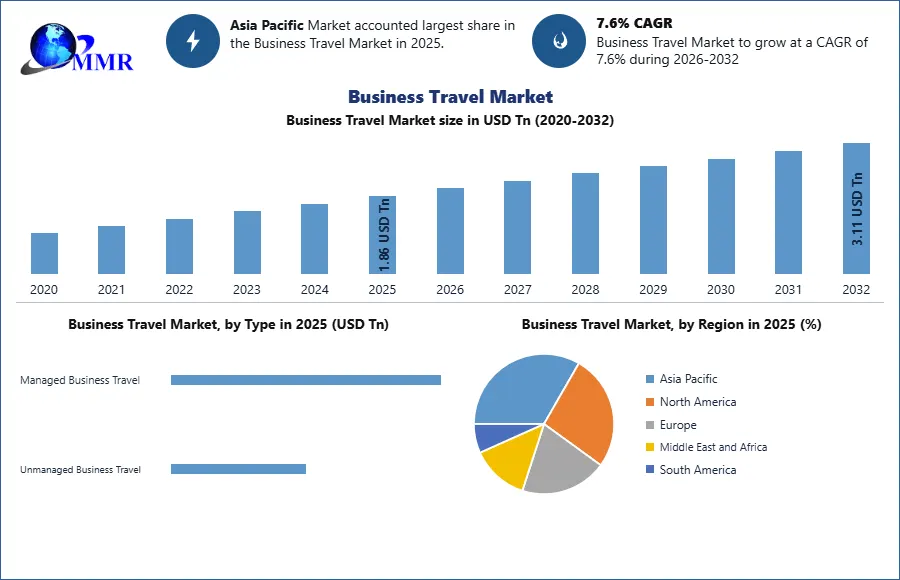
The Business Travel Market size was valued at USD 1.86 Trillion in 2025 and the total Business Travel revenue is expected to grow at a CAGR of 7.6% from 2026 to 2032, reaching nearly USD 3.11 Trillion by 2032.
Business Travel Market Overview
Business Travel is a service that allows individuals or groups of people to travel for work-related purposes such as attending conferences, meeting clients, or visiting company sites. This type of travel can be domestic or international, and may involve different modes of transportation such as air travel, trains, or cars. Business Travel services typically help arrange and book transportation, accommodation, and other necessary arrangements for the trip.
Business Travel requires careful planning and coordination, as it can involve multiple parties, complex itineraries, and different time zones. It is often funded by the employer and can involve various expenses, such as transportation, accommodation, meals, and entertainment.
To know about the Research Methodology :- Request Free Sample Report
Business Travel Market Dynamics
Major Drivers
Market drivers for the Business Travel Market include the increasing globalization of businesses and the rise of the knowledge-based economy, which is creating more demand for business travel as companies seek to establish and maintain relationships with clients, partners, and suppliers across the world. Furthermore, the emergence of new technologies and the digitization of the economy are enabling businesses to operate more efficiently and effectively across borders, further fuelling the growth of the business travel market. In addition, the growth of the global middle class and the increasing number of high-net-worth individuals are also driving demand for business travel, as more individuals seek to engage in international trade, investment, and commerce.
Business Travel Market Opportunities
Opportunities in the Business Travel Market include the increasing adoption of mobile technology, which is enabling travellers to book and manage their travel arrangements more easily and efficiently. This trend is also driving the growth of online travel agencies and mobile apps that provide travellers with real-time access to travel information and tools. Another opportunity is the growing demand for sustainable travel options, as more travellers seek to reduce their carbon footprint and support environmentally responsible travel. In addition, the emergence of new business travel segments, such as leisure travel (business + leisure) and millennial travel, is creating new opportunities for travel providers to offer customized and differentiated products and services that cater to the specific needs and preferences of these segments. Furthermore, the growth of the sharing economy and the rise of alternative accommodations are also driving innovation and competition in the business travel market, as companies seek to offer new and innovative travel options to business travellers.
Major Restraints
One major restraint in the business travel market is the increasing concern for health and safety. In the wake of the COVID-19 pandemic, many businesses have been forced to rethink their travel policies and have restricted or cancelled non-essential travel altogether. Even as travel resumes, there will be a greater emphasis on health and safety measures such as social distancing, enhanced cleaning protocols, and vaccination requirements, which could lead to increased costs and reduced efficiency in business travel. Additionally, there may be a reluctance among employees to travel for work due to health concerns, which could further limit the growth of the business travel market
Challenges
Another challenge in the business travel market is the rise of remote work and virtual meetings. Many businesses have adopted remote work policies in response to the pandemic, and virtual meetings have become the norm. This has led to a reduced need for business travel, as many meetings can now be conducted online. As businesses become more accustomed to remote work and virtual meetings, they may be less willing to invest in business travel, which could limit the growth of the market. Moreover, the increasing popularity of remote work and virtual meetings could lead to a shift in the nature of business relationships and the way business is conducted, which could have long-term implications for the business travel industry.
Business Travel Market Segment Analysis :
In the realm of business travel, the largest sector is transportation, which accounts for more than half of total expenditure. This domain is slated to advance with a 12% CAGR between 2026 and 2032, bolstered by escalated demand for air travel and the proliferation of economical carriers. Food and lodging comprise the second-largest segment, representing over 30% of total spending. This division is predicted to grow at a CAGR of 10% between 2026 and 2032, powered by developing cravings for top-of-the-line sustenance and accommodations. Recreation holds a smaller portion of the market, accounting for less than 20% of total spending. However, it is expected to expand at an 8% CAGR between 2026 and 2032, led by an upswing in the desire for attractions like sightseeing, shopping, and dining.
Business Travel Market Trends
According to the report, the Business Travel Market is witnessing significant trends that are transforming the corporate travel industry. One notable trend is the growing popularity of leisure travel, which combines business and leisure travel, creating opportunities for travel providers to offer bundled packages that cater to both needs. Another trend is the emergence of sharing economy platforms like Airbnb and Uber, which are disrupting the traditional business travel market by offering alternative options for lodging and transportation. The report also highlights that health and wellness are becoming important factors for business travellers, and travel providers are responding by offering healthier food options, fitness facilities, and wellness programs.
Additionally, advancements in technology such as travel management software, mobile apps, and virtual meeting platforms are improving the efficiency of business travel and reducing costs. Lastly, sustainability is becoming an important consideration for both business travellers and companies, with travel providers offering eco-friendly options and companies implementing sustainable travel policies to reduce their carbon footprint.
Business Travel Market Regional Insights:
Asia Pacific:
The Asia Pacific region is expected to witness significant growth in the business travel market, owing to the rising number of business travellers, particularly in countries such as China and India. The region is home to several emerging economies, which are witnessing rapid industrialization and urbanization, leading to an increase in business activities. Additionally, the proliferation of small and medium-sized enterprises (SMEs) in the region is also driving demand for business travel services. The growth of the travel and tourism industry in countries such as Japan, South Korea and Australia is also contributing to the growth of the business travel market in the region.
Europe:
Europe is one of the leading markets for business travel, with a large number of international and domestic business travellers. The region is home to several major business hubs, such as London, Paris, and Frankfurt, which attract a significant number of business travellers from around the world. Additionally, the presence of several multinational corporations and large enterprises in the region is driving demand for business travel services. The growth of the travel and tourism industry in countries such as Spain, Italy, and Germany is also contributing to the growth of the business travel market in the region.
North America:
North America is another major market for business travel, with the United States being the largest contributor to the region's growth. The region has a large number of multinational corporations and large enterprises, which require frequent business travel. Additionally, the growth of the technology industry in the region has led to an increase in demand for business travel services, as companies need to attend conferences, seminars, and trade shows. The growth of the travel and tourism industry in countries such as Mexico and Canada is also contributing to the growth of the business travel market in the region.
LAMEA:
The Latin America, Middle East, and Africa (LAMEA) region is expected to witness significant growth in the business travel market, owing to the rising number of business travelers in the region. The growth of the oil and gas industry in the Middle East is driving demand for business travel services, as companies need to attend conferences and meetings related to the industry. Additionally, the growth of the travel and tourism industry in countries such as Brazil and South Africa is also contributing to the growth of the business travel market in the region. However, political instability, security concerns, and economic volatility in some countries in the region may hinder market growth.
Recent Industry Developments (2025–2026)
| Exact Date | Company | Development | Impact |
|---|---|---|---|
| 12 January 2026 | AMD | Launched the Helios rack-scale platform for data centers, integrating Instinct MI400 GPUs and Zen 5 CPUs to optimize enterprise AI workloads. | Provides a formidable alternative to current AI infrastructure, intensifying competition for high-performance computing market share. |
| 02 October 2025 | Amex GBT & SAP Concur | Announced a strategic partnership to launch "Complete," a natively integrated end-to-end travel and expense (T&E) solution. | Streamlines automated policy compliance and financial workflows, significantly reducing friction in corporate expense management. |
| 18 June 2025 | TravelPerk | Acquired the leading Swiss-based spend management firm Yokoy to integrate AI-driven financial automation into its travel platform. | Expands its value proposition for SMEs by merging travel booking with comprehensive corporate spend control tools. |
| 15 May 2025 | Direct Travel | Completed the acquisition of ATPI, significantly expanding its footprint across the UK, Europe, and Asia-Pacific regions. | Enhances its global service capability and specialized energy-sector travel expertise to compete with tier-one global agencies. |
| 10 March 2025 | Lyft | Successfully acquired TBR Global Chauffeuring and finalized a strategic integration with Freenow for European ground transport. | Strengthens premium business mobility offerings, providing corporate clients with a unified global platform for managed ground travel. |
Business Travel Market Scope: Inquire before buying
| Business Travel Market | |||
|---|---|---|---|
| Report Coverage | Details | ||
| Base Year: | 2025 | Forecast Period: | 2026-2032 |
| Historical Data: | 2020 to 2025 | Market Size in 2025: | 1.86 USD Tn |
| Forecast Period 2026-2032 CAGR: | 7.6% | Market Size in 2032: | 3.11 USD Tn |
| Segments Covered: | by Type | Managed Business Travel Unmanaged Business Travel |
|
| By Traveller | Solo Group |
||
| By Purpose | Marketing Internal Meetings Trade Shows Product Launch Others |
||
| By Booking Type | Online Travel Agencies Direct Bookings Corporate Travel Management Companies |
||
| By Travel Industry | Government Corporate |
||
| By Service Type | Transportation Food and Lodging Recreational Activities Others |
||
Business Travel Market, by Region :
North America (United States, Canada and Mexico)
Europe (UK, France, Germany, Italy, Spain, Sweden, Austria and Rest of Europe)
Asia Pacific (China, South Korea, Japan, India, Australia, Indonesia, Malaysia, Vietnam, Taiwan, Bangladesh, Pakistan and Rest of APAC)
Middle East and Africa (South Africa, GCC, Egypt, Nigeria and Rest of ME&A)
South America (Brazil, Argentina Rest of South America)
Key Players / Competitors Profiles Covered in Brief in Global Business Travel Market Report in Strategic Perspective:
- American Express Global Business Travel
- Carlson Wagonlit Travel
- BCD Travel
- Egencia
- Direct Travel
- Frosch International Travel
- Omega World Travel
- Ovation Travel Group
- TravelPerk S.L.U
- SAP Concur
- Booking Holdings Inc.
- Expedia Group
- Corporate Travel Management Limited
- Navan, Inc.
- Flight Centre Travel Group Limited
- FCM Travel
- Internova Travel Group
- JTB Business Travel
- CWT Global B.V.
- ITILITE
- Amadeus IT Group
- Sabre Corporation
- World Travel, Inc.
- Mainline Travel
- GTM (Global Travel Management)