
Global Bluetooth 5.0 Market Size by Device Type, Bluetooth Technology and Application
Overview
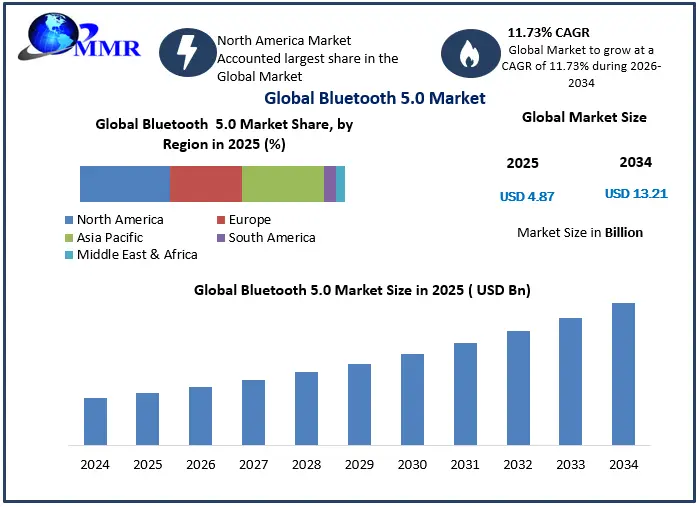
The Global Bluetooth 5.0 Market was valued at US$4.87 Billion in 2025 and is expected to reach US$5.44 Billion in 2026. The market is expected to expand at a CAGR of 11.73% during the forecast period 2026–2034, reaching US$13.21 Billion by 2034.
Global Bluetooth 5.0 Market key Highlights
• Market Growth: Market reaches US$13.21 Billion by 2034 from US$4.87 Billion in 2025, at 11.73% CAGR.
• Technology Leader: Dual-Mode Bluetooth leads with an estimated 48.0% share in 2025.
• Application Leader: Wireless Audio dominates with an estimated 28.0% share in 2025.
• Regional Leader: North America leads with 34.0% share in 2025, followed by Asia Pacific at 31.0%.
• Asia Pacific Ecosystem: APAC has 15,000+ Bluetooth SIG member companies and contributes 56%+ of global product qualifications.
• Emerging Applications: Healthcare, automotive, Industrial IoT, asset tracking, smart buildings, and electronic shelf labels expand Bluetooth adoption.
Bluetooth 5.0 Market Overview:
Bluetooth technology, which dates to 1994, is a radio technology that supports short-distance device communication, often within 10 m. Bluetooth allows wireless information to be exchanged between a variety of devices, such as laptops, mobile phones, wearable gear, and wireless headsets. In recent years, the Bluetooth standard has continuously evolved and expanded to meet the needs of the Internet of Things market with the introduction of Bluetooth 5.0 and Bluetooth mesh networking. Bluetooth 5.0 is the latest umbrella iteration of Bluetooth. It is the wireless, close-range technology we experience in smartphones, smartwatches, tablets, wireless headphones and speakers, laptops, desktop computers and more.
The Global Bluetooth 5.0 Market is driven by the growing adoption of low-power wireless connectivity across consumer electronics, Internet of Things (IoT) devices, smart home systems, wearables, automotive electronics, healthcare devices, and industrial applications. Bluetooth 5.0 introduced major performance improvements over earlier Bluetooth generations, offering up to four times greater range, two times higher speed, and eight times greater broadcast messaging capacity, which proves its suitability for connected-device applications.
Bluetooth 5.0 operates over both Bluetooth Classic and Bluetooth Low Energy (BLE). This enables applications ranging from wireless audio and smartphones to sensors, asset tracking, smart lighting, medical devices, and industrial device networks. As per the Bluetooth Special Interest Group (Bluetooth SIG), global Bluetooth device shipments are projected to approach 8 billion units by 2029. This demonstrates the expanding ecosystem for Bluetooth-enabled connectivity. Single-mode Bluetooth LE devices are particularly strong, with shipments projected to grow at a 22% CAGR, compared with a 2% CAGR for dual-mode devices.
The market is also supported by the wide applications of Bluetooth IoT connectivity, Bluetooth LE, smart wearables, connected healthcare devices, electronic shelf labels, asset tracking, smart buildings, and wireless audio. In 2024, Bluetooth SIG highlighted electronic shelf labels and Ambient IoT among emerging high-volume Bluetooth markets, while newer technologies such as Auracast, Bluetooth Channel Sounding, LE Audio, and direction finding are expanding the broader Bluetooth ecosystem.
North America is a major technology adoption market, while Asia Pacific benefits from large-scale consumer electronics manufacturing and increasing IoT deployments. Thus, the increasing demand for Bluetooth 5.0 devices, Bluetooth 5.0 chips, BLE connectivity, wireless communication, IoT devices, smart wearables, and low-power wireless technologies continues to support market growth.
Bluetooth 5.0 Market Size, Share and Growth Analysis
To know about the Research Methodology :- Request Free Sample Report
Bluetooth 5.0 Market Dynamics:
Rising IoT Device Adoption Drives Bluetooth 5.0 Market Growth
The growing IoT ecosystem, smart devices, wearables, and connected electronics drive demand for Bluetooth 5.0 connectivity. Bluetooth LE is particularly important for low-power applications such as sensors, smart labels, healthcare devices, and industrial IoT. As global Bluetooth device shipments are estimated to approach 8 billion units by 2029, while single-mode Bluetooth LE device shipments are projected to grow at a 22% CAGR is continue to drive market growth significantly.
2.4 GHz Interference Restrains Bluetooth 5.0 Market Growth
Bluetooth 5.0 operates in the 2.4 GHz ISM band, which it shares with Wi-Fi and other wireless technologies. Therefore, High-density environments can create interference, packet loss, and connection-quality issues, particularly where multiple wireless devices operate simultaneously.
Growing Bluetooth IoT Applications Create Market Opportunities
Electronic shelf labels, asset tracking, smart buildings, industrial monitoring, healthcare sensors, and other Bluetooth IoT applications are expanding rapidly, creating opportunities for Bluetooth 5.0 hardware and connectivity solutions. Bluetooth SIG identifies emerging applications such as smart labels and electronic shelf labels as important contributors to the rapid growth of Bluetooth LE devices.
Rapid Bluetooth Version Upgrades Challenge Bluetooth 5.0 Market Expansion
The emergence of newer Bluetooth generations creates a technology-transition challenge for Bluetooth 5.0. Features introduced in later generations, including Bluetooth Channel Sounding and enhanced positioning capabilities, can encourage manufacturers to adopt newer chipsets rather than continue deploying Bluetooth 5.0 hardware. This creates upgrade pressure for Bluetooth 5.0 component manufacturers and device makers.
Bluetooth 5.0 Technology Connects Diverse Devices Across Consumer, IoT, and Industrial Applications
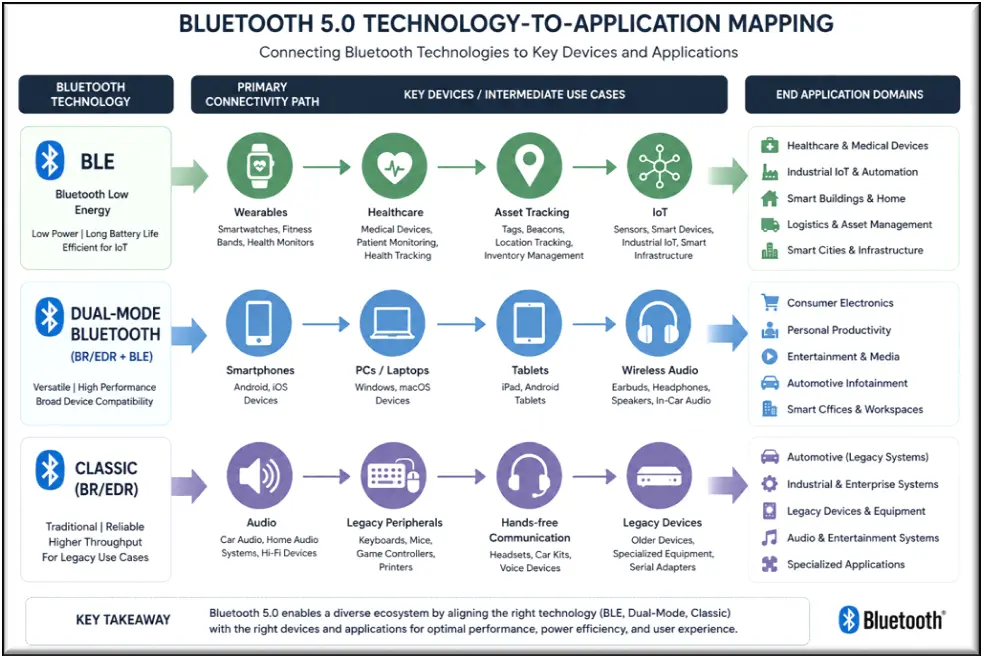
Bluetooth 5.0 connects different application ecosystems through BLE, Dual-Mode Bluetooth, and Bluetooth Classic. BLE supports low-power applications such as wearables, healthcare devices, asset tracking, and Industrial IoT, while Dual-Mode Bluetooth remains important for smartphones, PCs, tablets, and wireless audio. Bluetooth Classic continues to support audio, legacy peripherals, and hands-free connectivity. The increasing use of LE Audio, Auracast, and Channel Sounding broadens Bluetooth applications across smart infrastructure, healthcare, automotive, and connected-device ecosystems.
Key Trends in the Bluetooth 5.0 Market
• Bluetooth LE Adoption Accelerates Across IoT Devices - The market is shifting toward Bluetooth Low Energy (BLE) as manufacturers prioritize low-power, cost-efficient connectivity for IoT sensors, wearables, smart home devices, healthcare equipment, asset tracking, and industrial applications. Bluetooth LE device shipments are to grow at a 22% CAGR, with LE shipments expected to approach dual-mode volumes by 2028. This represents the faster adoption of Bluetooth LE across IoT devices.
• Smart Labels and Electronic Shelf Labels Growth - Bluetooth-enabled smart labels and electronic shelf labels (ESLs) are emerging as high-volume applications because they support automated pricing, inventory visibility, and supply-chain tracking. Bluetooth ESL shipments to reach nearly 176 million units annually by 2030, representing a 40% CAGR. Which is significantly high.
• Bluetooth Channel Sounding Enables Precise Device Tracking - The adoption of Bluetooth Channel Sounding is shifting Bluetooth's role from basic wireless connectivity toward precise distance awareness. Applications include digital car keys, smart locks, item finding, access control, and proximity-based services. Bluetooth SIG expects Bluetooth-enabled device shipments to reach 5.9 billion units in 2026, creating a large installed base for emerging location and ranging applications.
• E Audio and Auracast Expand Wireless Audio Applications - Bluetooth LE Audio and Auracast broadcast audio are increasing Bluetooth applications beyond conventional one-to-one wireless audio. Auracast enables audio broadcasting to multiple compatible receivers and supports applications such as public-venue audio, assistive listening, silent TV, hearing accessibility, and multi-language audio. The real-world Auracast deployments have been increased during 2025, supporting continued growth in next-generation Bluetooth audio applications.
Bluetooth 5.0 Market Segments Analysis:
By Bluetooth Technology segment is divided into Bluetooth Low Energy (BLE), Bluetooth Classic, and Dual-Mode Bluetooth. Dual-Mode Bluetooth accounted for the largest share in 2025. This is because, Dual-Mode Blutooth are widely integrated with both Bluetooth Classic and Bluetooth LE. Bluetooth, reflects its compatibility. Today,100% of key new smartphones, tablets, and laptops support Dual-Mode Bluetooth, reinforcing its broad installed-device base. Bluetooth Low Energy is expected to register the strongest growth as manufacturers increasingly prioritize low-power connectivity for wearables, IoT sensors, healthcare devices, smart-home products, asset tracking, and industrial applications. Bluetooth SIG projects single-mode Bluetooth LE shipments to grow at a 22% CAGR, while single-mode Bluetooth Classic shipments are projected to decline at a 14% CAGR, reflecting the industry's transition toward energy-efficient Bluetooth technologies.
By Application segment comprises Wireless Audio, Data Transfer, Location & Asset Tracking, Smart Home & Building Automation, Healthcare Connectivity, Automotive Connectivity, Industrial IoT, Retail & Electronic Shelf Labels, and Other. Wireless Audio accounted for the largest share of approximately 28.0% in 2025, driven by widespread adoption of earbuds, headphones, speakers, hearing devices, and connected automotive audio. Data Transfer supports smartphones, wearables, computers, and IoT devices, while Location & Asset Tracking expands across logistics, healthcare, retail, and industrial environments. Smart Home & Building Automation and Healthcare Connectivity benefit from growing deployment of connected sensors, lighting, access systems, medical devices, and monitoring equipment.

Automotive Connectivity, Industrial IoT, and Retail & Electronic Shelf Labels are gaining importance through applications such as digital keys, vehicle connectivity, equipment monitoring, asset management, inventory tracking, and smart-store systems. LE Audio, Auracast, Channel Sounding, and Direction Finding further expand Bluetooth applications across specialized connected-device and infrastructure deployments, while Other covers emerging and niche applications.
Global Bluetooth 5.0 Market Regional Analysis:
North America- Advanced Bluetooth Adoption Leads
North America’s Bluetooth 5.0 market is quite mature and innovation-driven. It is supported by widespread adoption of smartphones, PCs, wireless audio, wearables, connected vehicles, healthcare devices, and enterprise IoT among its potential customers. The region is also an important market for emerging Bluetooth applications such as asset tracking, digital keys, smart buildings, and LE Audio. As average American household spends between $760 to $1,200 annually strictly on purchasing hardware like smartphones, laptops, and IoT devices. Thus, purchasing power of the customers supports this emerging market. Companies such as Qualcomm, Texas Instruments, Apple, and Silicon Labs contribute to the regional Bluetooth ecosystem through chipsets, connectivity platforms, and consumer or industrial devices. At the global level, Bluetooth device shipments are going to approach 8 billion by 2029, providing a large addressable ecosystem for North American device manufacturers and technology providers.
Europe – Regulations Shape Bluetooth Adoption
Europe's Bluetooth 5.0 market is generating demand for energy-efficient consumer electronics, automotive connectivity, smart buildings, healthcare devices, retail technologies, and industrial IoT. Regulation is an important market factor: Bluetooth-enabled radio equipment placed on the EU market falls under the Radio Equipment Directive (RED) 2014/53/EU, which establishes requirements covering safety, health, electromagnetic compatibility, and efficient spectrum use. The European Commission has also strengthened requirements concerning cybersecurity, privacy, and protection of personal data for certain categories of connected radio equipment. This regulatory environment encourages manufacturers to integrate secure and compliant wireless connectivity into products such as wearables, smart-home equipment, tracking devices, and connected medical products.
Asia Pacific - Electronics Ecosystem Drives Growth
Asia Pacific is the strongest Bluetooth ecosystem region, with the scale of electronics manufacturing and Bluetooth product development providing a major advantage. As of 2026, APAC has more than 15,000 Bluetooth SIG member companies, and members in the region account for more than 56% of global Bluetooth product qualifications. China is particularly influential: Bluetooth SIG reports that more than 6,500 member companies are based in China, while Chinese member companies develop nearly 50% of Bluetooth chips shipped annually and nearly 50% of smartphones sold annually. This creates an ecosystem for Bluetooth 5.0 chipsets, modules, smartphones, earbuds, wearables, IoT sensors, automotive electronics, and smart-home devices. Qualcomm, MediaTek, Realtek, Huawei, Xiaomi, Samsung, and Sony are among the major technology and device companies contributing to the broader Asian Bluetooth ecosystem.
South America –Connected Devices Expand Adoption
South America is an emerging Bluetooth 5.0 market where adoption is closely linked to the increasing availability of smartphones, wireless earbuds, smartwatches, connected home products, automotive electronics, and IoT devices. Brazil represents an important regional market because of its large consumer-electronics base and increasing digital infrastructure. Argentina, Chile, and Colombia provide additional opportunities for connected-device adoption. Bluetooth-enabled asset tracking, retail technologies, healthcare monitoring, smart lighting, and industrial connectivity can expand demand as businesses digitize operations. Therefore, the region offers greater opportunity for cost-efficient Bluetooth LE devices, modules, and IoT solutions than for highly specialized enterprise deployments.
Middle East & Africa- Smart Infrastructure Drives Demand
The Middle East & Africa market is developing around smart-city infrastructure, connected buildings, healthcare digitalization, retail modernization, industrial automation, and consumer electronics. Gulf countries provide particularly strong opportunities through large-scale smart-city and digital-infrastructure projects, where Bluetooth can support smart lighting, building automation, indoor positioning, asset tracking, and connected sensors. Bluetooth SIG identifies networked lighting, location services, electronic shelf labels, asset tracking, and device networks among the applications. This is expanding the Bluetooth ecosystem, creating opportunities for regional integrators and technology providers.
Bluetooth 5.0 Market Recent Developments:
| Date | Recent Development |
| February 4, 2026 | Texas Instruments announced an agreement to acquire Silicon Labs for approximately US$7.5 billion. The transaction is intended to strengthen TI's wireless connectivity portfolio and expand its position in IoT and embedded connectivity, with TI targeting approximately US$450 million in annual manufacturing and operational synergies within three years after closing, subject to approvals. |
| February 11, 2026 | Bluetooth SIG highlighted the expansion of Bluetooth Channel Sounding, LE Audio, and Auracast in its review of 2025 developments, indicating a broader shift toward precision positioning, accessibility, and advanced low-power audio applications. |
| March 25, 2026 | Bluetooth industry analysis highlighted the increasing deployment of Channel Sounding, Bluetooth LE Audio, and Auracast, with Bluetooth moving beyond basic device connectivity toward precision ranging, richer audio experiences, and low-power IoT applications. |
| May 2026 | Bluetooth Asia 2026 brought together more than 4,200 attendees, 50+ speakers, and 60+ exhibitors, demonstrating the expanding commercial ecosystem around Bluetooth technologies and applications across Asia Pacific. |
| May 16, 2026 | Researchers demonstrated a connectionless Bluetooth LE Channel Sounding architecture using PAwR that reduced active charge by 40–48% compared with a connected baseline in a one-second update cycle, highlighting opportunities for scalable, energy-efficient Bluetooth positioning and tracking systems. |
| May 22, 2026 | Researchers introduced a digital-twin development platform for crystal-free Bluetooth LE sensor motes, demonstrating receiver sensitivity of up to −82 dBm and highlighting efforts to reduce development and validation costs for large-scale low-power sensor networks. |
| July 2026 | Atitan showcased its splitR Auracast transceiver at CES 2026, designed to add Auracast transmission and reception capabilities to devices without native Auracast support, illustrating the emergence of third-party solutions aimed at accelerating Bluetooth broadcast-audio adoption. |
| August 2026 | Victrola introduced an upgraded Wave turntable with integrated Auracast support, allowing wireless audio playback across compatible devices. The product is priced at US$499, demonstrating the incorporation of Auracast into consumer audio products. |
| August 2026 | Brighton railway station began trialing a Bluetooth Auracast-based announcement system that streams station announcements directly to compatible headphones and hearing aids. Brighton station handles approximately 15 million passengers annually, providing a real-world example of Bluetooth broadcast audio in public infrastructure. |
Bluetooth 5.0 Market Competitive Landscape:
The Global Bluetooth 5.0 Market is highly competitive, with semiconductor manufacturers, connectivity specialists, consumer-electronics companies, and regional brands competing across Bluetooth SoCs, RF chips, modules, development platforms, wireless-audio solutions, IoT devices, and connected products. Major international players include Qualcomm Technologies, Nordic Semiconductor, MediaTek, Broadcom, Silicon Labs, Realtek Semiconductor, Texas Instruments, NXP Semiconductors, Microchip Technology, Renesas Electronics, STMicroelectronics, and Telink Semiconductor. Competition depends on power efficiency, connectivity range, processing capabilities, security, multi-protocol support, software ecosystems, product reliability, and application-specific integration rather than Bluetooth 5.0 compatibility alone. Companies with broad semiconductor portfolios target multiple applications, while specialized Bluetooth suppliers differentiate through low-power performance and developer support.
Global Players Strengthen Integrated Connectivity Portfolios
Global semiconductor companies increasingly compete by integrating Bluetooth with Wi-Fi, Thread, Zigbee, Matter, advanced audio, security, and embedded processing. Nordic Semiconductor focuses strongly on low-power Bluetooth LE and IoT applications, and Qualcomm leverages its broader wireless and audio technology portfolio for smartphones, wearables, and premium wireless audio. Texas Instruments, NXP, STMicroelectronics, Microchip, and Renesas emphasize embedded, industrial, automotive, and IoT applications. A notable industry development occurred on February 4, 2026, when Texas Instruments announced its agreement to acquire Silicon Labs for approximately US$7.5 billion. TI highlighted approximately US$450 million in expected annual manufacturing and operational synergies within three years after closing, subject to approvals. The transaction demonstrates the increasing importance of broad wireless-connectivity portfolios in competitive positioning.
Regional Manufacturers Compete Through Scale and Cost
Asia Pacific has a particularly strong competitive position because of its extensive semiconductor, electronics, and device-manufacturing ecosystem. The region has more than 15,000 member companies and accounted for more than 56% of global Bluetooth product qualifications. China alone had more than 6,500 Bluetooth SIG member companies, creating a large base of chip, module, smartphone, earbud, wearable, and IoT manufacturers. Companies such as MediaTek, Realtek, Telink, Goodix, Xiaomi, OPPO, vivo, and Huawei compete through high-volume manufacturing, competitive pricing, rapid product development, and localized supply chains.
Local Brands Differentiate Through Affordability and Product Design
Local and regional brands generally compete downstream by combining competitive pricing, product design, distribution reach, localized features, and brand positioning. India's boAt, for example, has established a strong position in affordable wireless audio through earbuds, headphones, speakers, and other Bluetooth-enabled products. In 2025, boAt partnered with Indian semiconductor startup HrdWyr to develop the Indus 1011 chip, demonstrating increasing efforts to strengthen domestic participation in the connected-device ecosystem. Similar regional strategies are emerging as local brands seek greater control over product development and supply chains.
Pricing and Product Features Drive Market Competition
Pricing remains critical in mass-market Bluetooth products, particularly earbuds, headphones, speakers, adapters, and consumer IoT devices, where manufacturers compete through lower component costs, manufacturing scale, and product bundling. In premium and industrial markets, competition shifts toward battery life, connectivity reliability, range, audio performance, security, multi-device connectivity, software support, and advanced Bluetooth capabilities. Semiconductor suppliers additionally compete through integrated SoCs, reference designs, SDKs, development tools, and certification support that reduce customers' product-development time.
Bluetooth 5.0 Market Scope: Inquire before buying
| Bluetooth 5.0 Market | |||
|---|---|---|---|
| Report Coverage | Details | ||
| Base Year: | 2025 | Forecast Period: | 2026-2034 |
| Historical Data: | 2020 to 2025 | Market Size in 2025: | USD 4.87 Bn. |
| Forecast Period 2026 to 2034 CAGR: | 11.73% | Market Size in 2034: | USD 13.21 Bn. |
| Segments Covered: | by Device Type | Smartphones & Tablets Laptops & PCs Wireless Headsets & Earbuds Smartwatches & Wearables Smart Home Devices Automotive Devices Healthcare Devices Industrial Devices Other Devices |
|
| by Bluetooth Technology | Bluetooth Low Energy (BLE) Bluetooth Classic Dual-Mode Bluetooth |
||
| by Application | Wireless Audio Data Transfer Location & Asset Tracking Smart Home & Building Automation Healthcare Connectivity Automotive Connectivity Industrial IoT Retail & Electronic Shelf Labels Other |
||
Bluetooth 5.0 Market, by region
North America (United States, Canada, and Mexico)
Europe (UK, France, Germany, Italy, Spain, Sweden, Austria, and the Rest of Europe)
Asia Pacific (China, South Korea, Japan, India, Australia, Indonesia, Malaysia, Vietnam, Taiwan, Bangladesh, Pakistan, and the Rest of APAC)
Middle East and Africa (South Africa, GCC, Egypt, Nigeria, and the Rest of ME&A)
South America (Brazil, Argentina Rest of South America)
Global Bluetooth 5.0 Market Key Players:
North America
1. Qualcomm Technologies, Inc. — United States
2. Broadcom Inc. — United States
3. Texas Instruments Incorporated — United States
4. Microchip Technology Inc. — United States
5. Silicon Laboratories Inc. — United States
6. Qorvo, Inc. — United States
7. Synopsys, Inc. — United States
8. Atmosic Technologies — United States
9. Laird Connectivity — United States
10. Inventek Systems — United States
11. Telit Cinterion — United States
12. Marvell Technology, Inc. — United States
Europe
13. Nordic Semiconductor ASA — Norway
14. NXP Semiconductors N.V. — Netherlands
15. STMicroelectronics N.V. — Switzerland/France
16. Infineon Technologies AG — Germany
17. CEVA, Inc. — France
18. Insight SiP — France
19. Virscient — United Kingdom/New Zealand operations
Asia Pacific
20. MediaTek Inc. — Taiwan
21. Realtek Semiconductor Corp. — Taiwan
22. Renesas Electronics Corporation — Japan
23. Taiyo Yuden Co., Ltd. — Japan
24. Goodix Technology Inc. — China
25. Espressif Systems — China
26. Feasycom Technology Co., Ltd. — China
27. Telink Semiconductor Co., Ltd. — China
28. Murata Manufacturing Co., Ltd. — Japan
29. Samsung Electronics Co., Ltd. — South Korea
30. Sony Corporation — Japan
31. Huawei Technologies Co., Ltd. — China
32. Xiaomi Corporation — China
33. ROHM Co., Ltd. — Japan
South America
34. Positivo Tecnologia S.A. — Brazil
35. Multilaser Industrial S.A. — Brazil
36. Intelbras S.A. — Brazil
37. Elgin S.A. — Brazil
Middle East & Africa
38. Mubadala-backed EDGE Group technology ecosystem — UAE
39. STC Solutions — Saudi Arabia
40. Injazat — UAE
41. Mara Corporation — South Africa
Frequently Asked Questions:
1. What is the projected size of the Bluetooth 5.0 Market by 2034?
The Global Bluetooth 5.0 Market is calculated to reach US$13.21 Billion by 2034, based on the 2025 market size of US$ 4.87 Billion and a CAGR of 11.73% throughout the forecast period (2026–2034)
2. Which Bluetooth technology segment dominates the market?
Dual-Mode Bluetooth accounted for the largest share in 2025, supported by its widespread use in smartphones, tablets, PCs, and laptops that require compatibility with both Bluetooth Classic and Bluetooth LE. Bluetooth SIG reports that platform devices such as phones, tablets, PCs, and laptops account for about 60% of all Bluetooth Dual-Mode shipments.
3. Which application dominates the Bluetooth 5.0 Market?
Wireless Audio accounted for the largest application share in 2025, driven by the widespread use of Bluetooth-enabled earbuds, headphones, speakers, automotive audio systems, and hearing devices. Bluetooth SIG projects Bluetooth device shipments overall to surpass 5.3 billion units in 2025, while Bluetooth earbud shipments are expected to reach 712 million units annually by 2028.
4. What factors are driving the Bluetooth 5.0 Market?
The market is driven by increasing adoption of IoT devices, wearables, wireless audio products, smart-home systems, connected healthcare devices, automotive electronics, and industrial sensors. Bluetooth LE is particularly important because its low-power characteristics support battery-operated devices, while single-mode Bluetooth LE shipments are projected to grow at a 22% CAGR.
5. What are the emerging opportunities in the Bluetooth 5.0 Market?
Emerging opportunities include Bluetooth-enabled smart labels, electronic shelf labels, asset tracking, healthcare monitoring, smart buildings, Auracast broadcast audio, and precision location services. Bluetooth SIG identifies technologies such as Channel Sounding, LE Audio, and high-data-throughput enhancements as important developments that are expanding Bluetooth applications beyond conventional short-range device connectivity.