
Biological Seed Treatment Market - Industry Structure Evaluation, Demand Drivers Analysis, Regional Growth Analysis and Identification, Competitive Positioning Review & Global Market Size Forecast to 2034
Overview
Biological Seed Treatment Market size was valued at USD 1.71 Billion in 2025 and the total Biological Seed Treatment Market revenue is expected to grow at a CAGR of 11.6% from 2026 to 2034, reaching nearly USD 4.61 Billion by 2034.
Global Biological Seed Treatment Market Overview
The Biological Seed Treatment Market involves the application of biological agents such as microbes, plant extracts, and organic compounds to seeds to improve germination, protect against pests, and enhance overall crop health. These treatments are used primarily in agriculture and horticulture to promote sustainable farming practices. Key applications include disease control, insect protection, and improved stress tolerance in plants. Market drivers include increasing demand for organic food, regulatory support for sustainable farming, and the need to reduce chemical pesticide use. This market is gaining traction due to its eco-friendly nature and ability to support crop yield improvements in response to global food security concerns
Biological Seed Treatment Market Growth Outlook
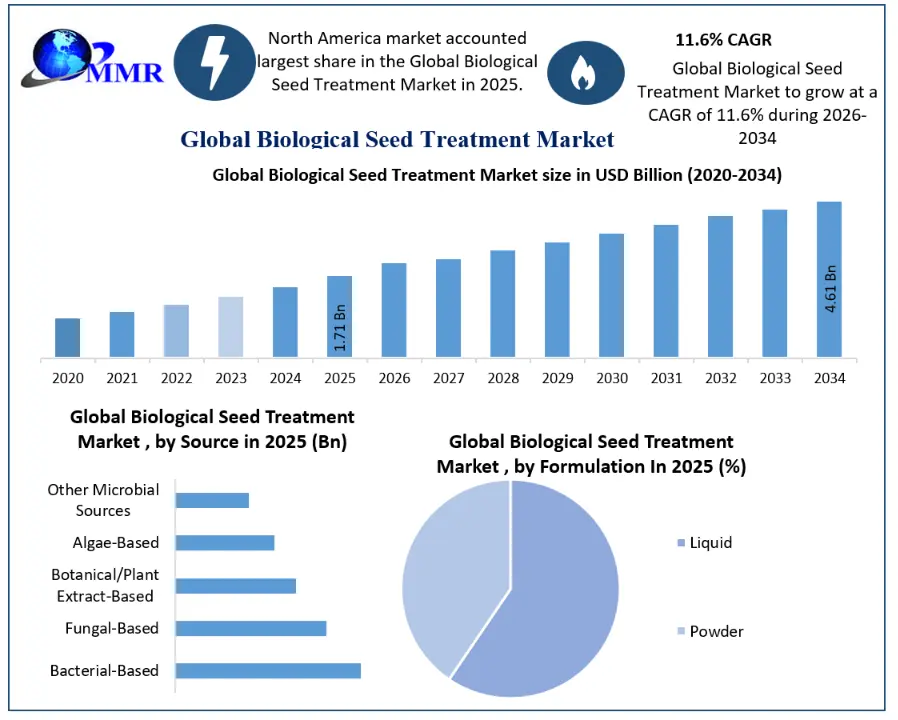 To know about the Research Methodology:- Request Free Sample Report
Global Biological Seed Treatment Market Dynamics
Market Trends
Growing shift from chemical seed treatments to biological and integrated seed treatments driven by sustainability goals, regulatory bans on neonicotinoids and chemical fungicides, and rising demand for organic food is the key trend shaping the market. Increasing adoption of microbial consortia, PGPR, and bio-stimulants combined with precision seed coating technologies is improving efficacy and shelf life. Major seed companies are integrating biologicals into pre-treated seeds, while startups are launching AI-based microbial discovery platforms and microencapsulated formulations for better stability.
Drivers
- Rising demand for sustainable and eco-friendly crop protection and growing regulatory pressure to reduce chemical pesticide residues is driving adoption.
- Increasing seed-borne and soil-borne disease pressure, pest resistance to chemicals, and need for early-stage crop protection is boosting demand.
- Growing adoption of high-yielding hybrid seeds, precision agriculture, and organic farming is accelerating market growth.
- Government subsidies and initiatives promoting bio-fertilizers and bio-pesticides in India, China, EU, and Brazil are supporting expansion.
- Proven benefits in germination, root development, nutrient uptake, nitrogen fixation, and yield improvement are increasing farmer confidence.
Restraints
- Shorter shelf life and lower stability of live microbial products compared to chemical treatments limits adoption.
- High sensitivity to temperature, humidity, UV, and storage conditions affects product performance and distribution.
- Lack of awareness and technical knowledge among smallholder farmers, especially in developing regions, restricts market penetration.
- Higher initial cost and inconsistent field performance across different soil and climatic conditions hamper growth.
- Complex and lengthy registration and regulatory approval processes for biological products delay product launches.
Opportunities
- Rising demand for organic farming, regenerative agriculture, and residue-free exports creates huge opportunity for biological seed treatments.
- Development of next-generation microbial strains, synthetic biology, and multi-strain consortia with broad-spectrum efficacy offers strong growth potential.
- Expansion in emerging markets of Asia Pacific, Latin America, and Africa with large untreated seed volumes presents untapped opportunity.
- Growing partnerships between seed companies, biological companies, and agri-tech startups for integrated seed solutions.
- Increasing adoption of seed treatment services, drone-based seed coating, and digital advisory platforms.
Challenges
- Maintaining microbial viability during seed coating, storage, transportation, and planting remains a major technical challenge.
- Competition from well-established chemical seed treatments with instant and predictable results.
- Lack of standardized testing protocols and quality control for biological products leads to variable efficacy.
- Limited cold-chain infrastructure in developing regions affects product quality.
Global Biological Seed Treatment Market Segment Analysis:-
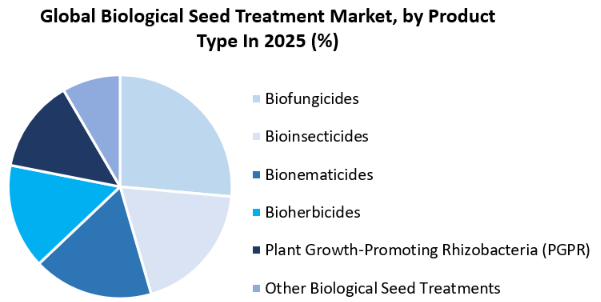
By Product Type, The Biological Seed Treatment Market is segmented by Product Type into Biofungicides, Bioinsecticides, Bionematicides, Bioherbicides, Plant Growth-Promoting Rhizobacteria (PGPR), and Other Biological Seed Treatments. Biofungicides dominate the market due to their high effectiveness in controlling seed-borne and soil-borne fungal diseases such as Fusarium, Rhizoctonia, and Pythium, and their wide adoption in cereals, pulses, and vegetables. Bioinsecticides are witnessing strong growth driven by rising demand for eco-friendly pest control against wireworms, aphids, and root maggots. Bionematicides are gaining traction for nematode management in soybean, cotton, and vegetable crops. Bioherbicides remain a niche segment but are growing with organic farming expansion. PGPR is the fastest-growing segment, driven by its dual role in disease suppression, nitrogen fixation, phosphate solubilization, and plant growth enhancement.
By Source, the market is segmented into Bacterial-Based, Fungal-Based, Botanical / Plant Extract-Based, Algae-Based, and Other Microbial Sources. Bacterial-Based treatments hold the largest share, led by Bacillus, Pseudomonas, and Rhizobium species, due to their proven efficacy, longer shelf life, and ease of formulation. Fungal-Based treatments, including Trichoderma, Beauveria bassiana, and Metarhizium anisopliae, are widely used for fungal disease control and insect management. Botanical / Plant Extract-Based treatments, such as neem, garlic, and essential oils, are gaining popularity in organic and smallholder farming. Algae-Based treatments are emerging as a fast-growing segment for stress tolerance and growth promotion, driven by seaweed extracts and bio-stimulant demand.
By Crop Type, the market is segmented into Corn, Wheat, Soybean, Cotton, Sunflower, Vegetable Crops, and Other Crop Types. Corn holds the largest share due to large-scale commercial cultivation in North America and Latin America and high adoption of treated hybrid seeds. Soybean is the second-largest segment, driven by widespread use of Rhizobium inoculants in Brazil, Argentina, and the US for nitrogen fixation and yield improvement. Wheat is a major segment in Europe and Asia Pacific for disease protection and growth enhancement. Cotton is witnessing strong growth in India, China, and the US for pest and nematode management. Sunflower and Vegetable Crops are growing rapidly due to high-value crop protection and organic vegetable farming demand.
By Function, the market is segmented into Disease Protection, Insect & Pest Control, Nematode Management, Plant Growth Enhancement, and Stress Tolerance Improvement. Disease Protection dominates the market as seed-borne diseases cause major yield losses and biological fungicides provide early-stage protection. Insect & Pest Control is the second-largest function, driven by demand for sustainable alternatives to chemical insecticides. Nematode Management is growing steadily, especially in soybean and cotton. Plant Growth Enhancement is the fastest-growing function, with PGPR and bio-stimulants improving root development, nutrient uptake, and germination. Stress Tolerance Improvement is gaining importance due to climate change, drought, and salinity challenges, driving demand for microbial treatments that enhance abiotic stress resilience.
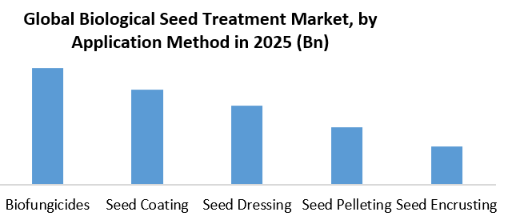
By Application Method, the market is segmented into Seed Coating, Seed Dressing, Seed Pelleting, and Seed Encrusting. Seed Coating dominates the market due to its ability to uniformly apply biological agents, ensure better adhesion, and protect microbes during storage and planting. Seed Dressing is widely used by farmers and small seed companies for on-farm treatment due to its simplicity and low cost. Seed Pelleting is gaining traction in vegetable and high-value crops for precise sowing and improved handling. Seed Encrusting is an emerging method for small and irregular seeds, offering improved flowability and protection without changing seed size significantly.
By Formulation, the market is segmented into Liquid and Powder. Liquid formulations hold the largest share due to ease of application, better seed coverage, compatibility with existing seed treatment equipment, and higher microbial viability. Powder formulations are preferred for on-farm dressing, longer storage, and in regions with limited cold-chain infrastructure, especially in Asia Pacific and Africa. Growing innovation in microencapsulation and stable dry formulations is expected to drive growth in both segments.
By Distribution Channel, the market is segmented into Direct Sales, Agricultural Retailers & Dealers, Cooperatives, and E-commerce. Direct Sales dominate the market as major seed companies and biological manufacturers supply directly to commercial seed companies and large farms. Agricultural Retailers & Dealers hold a significant share, especially in Asia Pacific and Latin America, due to strong local networks and farmer trust. Cooperatives are important in India, Europe, and Brazil for bulk procurement and subsidized distribution. E-commerce is the fastest-growing channel, driven by digital agriculture platforms, easy product comparison, and growing adoption among progressive farmers.
By End User, the market is segmented into Commercial Seed Companies, Farmers, Contract Seed Treatment Providers, Research Institutes & Universities, and Others. Commercial Seed Companies hold the largest share as they integrate biological treatments into certified seeds before sale to ensure quality and performance. Farmers are increasingly adopting on-farm biological treatments, especially in developing regions. Contract Seed Treatment Providers are the fastest-growing segment, offering professional treatment services to seed companies and cooperatives. Research Institutes & Universities play a key role in developing new microbial strains, testing efficacy, and promoting adoption through extension programs.
Global Biological Seed Treatment Market Regional Insights
North America dominates the Biological Seed Treatment Market, driven by large-scale commercial farming, high adoption of precision agriculture, and strong demand for sustainable crop protection solutions in the United States and Canada. The region benefits from the presence of leading players such as Corteva Agriscience, Bayer AG, BASF SE, Syngenta, and Novozymes, along with increasing regulatory pressure to reduce chemical pesticide usage and growing farmer awareness about soil health, yield enhancement, and seed-borne disease control. High adoption in corn, soybean, wheat, and cotton crops further supports market growth.
Europe is the second-largest market, driven by stringent EU regulations on chemical pesticides, the Farm to Fork Strategy targeting 50% reduction in chemical pesticide use by 2030, and strong focus on organic and sustainable farming. Germany, France, UK, Spain, Italy, and Netherlands are key markets, with growing demand for microbial seed treatments based on Bacillus, Trichoderma, Pseudomonas, and Rhizobium for cereals, oilseeds, and vegetables. Presence of major companies such as BASF, Bayer, Syngenta, UPL, and Koppert, along with government subsidies for bio-based inputs, is accelerating market expansion in the region.
Asia Pacific is the fastest-growing market, led by China, India, Japan, Australia, and Southeast Asia, driven by large agricultural base, rising food demand, increasing adoption of high-yielding hybrid seeds, and government initiatives promoting bio-fertilizers and bio-pesticides. India is witnessing rapid growth due to growing awareness of sustainable farming, expansion of organic farming, and presence of local players such as IPL Biologicals, T-Stanes, and Biostadt. China is investing heavily in microbial seed treatment R&D, while Australia is adopting biological treatments for wheat, canola, and pulses to improve drought tolerance and nutrient uptake.
Middle East & Africa is an emerging market, with growing adoption driven by increasing food security initiatives, expansion of commercial farming in South Africa, Egypt, Saudi Arabia, and UAE, and rising demand for drought-tolerant and stress-resistant seed treatments. Growing investments in sustainable agriculture, greenhouse farming, and government support for bio-based crop protection are expected to drive future market growth in the region.
Global Biological Seed Treatment Market, Key Highlights:
• Global market analysis and forecast, in terms of value.
• Comprehensive study and analysis of market drivers, restraints and opportunities influencing the growth of the Global market
• Global market segmentation on the basis of type, source, end-user, and region (country-wise) has been provided.
• Global market strategic analysis with respect to individual growth trends, future prospects along the contribution of various sub-market stakeholders have been considered under the scope of the study.
• Global market analysis and forecast for five major regions namely North America, Europe, Asia Pacific, the Middle East & Africa (MEA) and Latin America along with country-wise segmentation.
• Profiles of key industry players, their strategic perspective, market positioning and analysis of core competencies are further profiled.
• Competitive developments, investments, strategic expansion and competitive landscape of the key players operating in the Global Biological Seed Treatment Market are also profiled.
Global Biological Seed Treatment Market Recent Developments:
| Date | Company | Development | Impact |
|---|---|---|---|
| 11 May 2026 | BASF Agricultural Solutions | BASF commissioned a new commercial fermentation plant in Ludwigshafen backed by a high double-digit million-euro investment to produce biological and biotechnology-based crop protection active ingredients. | The facility expands in-house microbial production capacity and supply chain resilience for biological seed treatments and sustainable crop inputs. |
| 11 June 2026 | Novonesis | Novonesis entered a distribution partnership with Rovensa Next to commercialize its plant health biosolutions portfolio—spanning seed treatment through post-harvest—across the United States. | The alliance broadens grower access to integrated microbial seed treatments and bionutrition solutions across North American row and specialty crops. |
| 29 June 2026 | Agronutrition by DSG & Lidea | Following five years of joint R&D, Agronutrition by DSG and seed producer Lidea unveiled a biological seed treatment biostimulant paired with a novel maize seed coating technology for European rollout. | The co-developed system enhances early seedling vigor and nutrient uptake efficiency while supporting European chemical reduction targets. |
| 09 October 2026 | BioConsortia, Inc. | BioConsortia raised $15 million in financing to accelerate the global commercial rollout of its Zaffre biostimulant and Always N nitrogen-fixing microbial seed treatments. | The capital scales high-stability microbial seed coatings that deliver an average 4.4 bushels per acre corn yield gain and reduce synthetic nitrogen reliance. |
| 11 November 2026 | Syngenta Crop Protection | Syngenta partnered with Aphea.Bio to commercialize ACTIV by Aphea.Bio, a beneficial microorganism-based wheat seed treatment biostimulant, across European markets. | The biological seed treatment improves crop nutrient use efficiency to deliver up to 5% higher wheat yields with reduced synthetic fertilizer inputs. |
Global Biological Seed Treatment Industry Ecosystem
Global Biological Seed Treatment Market Scope: Inquire before buying
| Global Biological Seed Treatment Market | |||
|---|---|---|---|
| Report Coverage | Details | ||
| Base Year: | 2025 | Forecast Period: | 2026-2034 |
| Historical Data: | 2020 to 2025 | Market Size in 2025: | USD 1.71 Bn |
| Forecast Period 2026 to 2034 CAGR: | 11.6% | Market Size in 2034: | USD 4.61 Bn |
| Segments Covered: | by Product Type | Biofungicides Bioinsecticides Bionematicides Bioherbicides Plant Growth-Promoting Rhizobacteria (PGPR) Other Biological Seed Treatments |
|
| by Source | Bacterial-Based Fungal-Based Botanical/Plant Extract-Based Algae-Based Other Microbial Sources |
||
| by Crop Type | Corn Wheat Soybean Cotton Sunflower Vegetable Crops Other Crop Types |
||
| by Function | Disease Protection Insect & Pest Control Nematode Management Plant Growth Enhancement Stress Tolerance Improvement |
||
| by Application Method | Biofungicides Seed Coating Seed Dressing Seed Pelleting Seed Encrusting |
||
| by Formulation | Liquid Powder |
||
| by Distribution Channel | Direct Sales Agricultural Retailers & Dealers Cooperatives E-commerce |
||
| by End User | Commercial Seed Companies Farmers Contract Seed Treatment Providers Research Institutes & Universities Others |
||
Global Biological Seed Treatment Market, by Region
North America (United States, Canada and Mexico)
Europe (UK, France, Germany, Italy, Spain, Sweden, Austria and Rest of Europe)
Asia Pacific (China, South Korea, Japan, India, Australia, Indonesia, Malaysia, Vietnam, Taiwan, Bangladesh, Pakistan and Rest of APAC)
Middle East and Africa (South Africa, GCC, Egypt, Nigeria and Rest of ME&A)
South America (razil, Argentina Rest of South America)
Global Biological Seed Treatment Market Key Players
North America
1. Corteva Agriscience (USA)
2. Valent BioSciences LLC (USA)
3. Certis Biologicals (USA)
4. Indigo Ag Inc. (USA)
5. BioConsortia Inc. (USA)
6. Plant Health Care plc (USA/UK)
7. Locus Agricultural Solutions (USA)
8. NewLeaf Symbiotics (USA)
Europe
9. BASF SE (Germany)
10. Bayer CropScience AG (Germany)
11. Syngenta Group (Switzerland)
12. Koppert Biological Systems (Netherlands)
13. Novonesis A/S (Denmark)
14. Andermatt Biocontrol AG (Switzerland)
15. Biocare AG (Switzerland)
16. Chr. Hansen Holding A/S (Denmark)
17. Lallemand Plant Care (France)
18. De Sangosse Group (France)
Asia-Pacific
19. UPL Ltd. (India)
20. IPL Biologicals Ltd. (India)
21. T. Stanes & Company Ltd. (India)
22. Kan Biosys Pvt. Ltd. (India)
23. Biomax Naturals (India)
24. Gujarat State Fertilizers & Chemicals Ltd. (GSFC) (India)
25. Agri Life (India)
26. International Panaacea Ltd. (India)
27. Som Phytopharma (India)
28. Rizobacter India Pvt. Ltd. (India)
29. Futureco Bioscience Asia (Australia/APAC)
30. BioWorks Australia Pty Ltd. (Australia)
South America
31. Biotrop Soluções Biológicas (Brazil)
32. Vittia S.A. (Brazil)
33. Simbiose Agro (Brazil)
34. Rizobacter S.A. (Argentina)
35. Biagro Group (Brazil)
Middle East & Africa
36. Omnia Holdings Ltd. (South Africa)
37. Madumbi Sustainable Agriculture (South Africa)
38. Agrichem Africa (South Africa)
39. BioWorks Africa (South Africa)
40. Desert Energy Biotech (UAE)
Others
Frequently Asked Questions:
1. Which region has the largest share in Global market?
Ans: North America region holds the highest share in 2025.
2. What is the growth rate of Global market?
Ans: The Global market is growing at a CAGR of 11.6% during forecasting period 2026-2034.
3. What is scope of the Global market report?
Ans: Global market report helps with the PESTEL, PORTER, Recommendations for Investors & Leaders, and market estimation of the forecast period.
4. Who are the key players in Global market?
Ans: The important key players in the Global market are – BASF, Bayer, Syngenta, Monsanto BioAg, Agriscience, Koppert Biological Systems, Corteva Agriscience, DuPont, Italpollina, Koppert, Incotec, Plant Health Care, Precision Laboratories, Verdesian Life Sciences, and Valent Biosciences.
5. What is the study period of this market?
Ans: The Global market is studied from 2020 to 2034.
6. What was the Global Biological Seed Treatment Market size in 2025?
Ans: The Global Biological Seed Treatment Market size was USD 1.71 Billion in 2025.