Automotive Connectors Market – Industry Structure Evaluation, Demand Drivers Analysis, Regional Growth Analysis and Identification, Competitive Positioning Review & Global Market Size Forecast to 2032

8.1%
CAGR (2026-2032)
8.6 USD Bn.
Forecast Market Size
311
Report Pages
160
Market Tables

Overview

The Automotive Connectors Market size was valued at USD 8.6 Billion in 2025 and the total Automotive Connectors revenue is expected to grow at a CAGR of 8.1% from 2026 to 2032, reaching nearly USD 14.84 Billion.
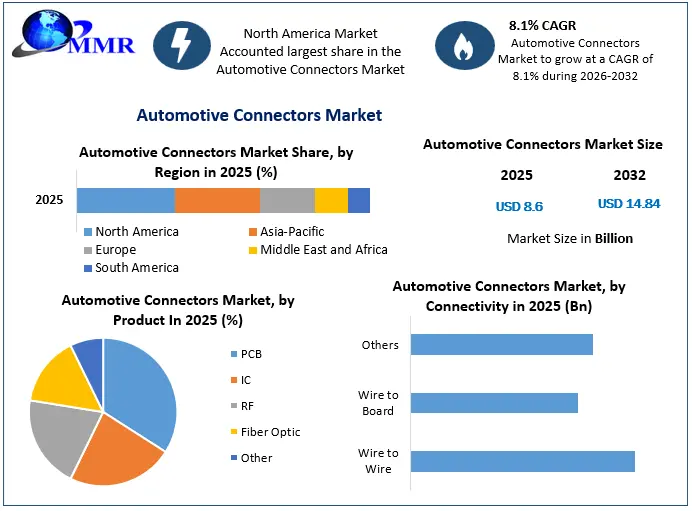
Automotive Connectors Market Overview:

The global automotive connectors market was valued at approximately USD 8.04 billion in 2025 and is expected to witness robust growth during the forecast period, driven by the rapid electrification of vehicles, increasing adoption of advanced driver-assistance systems (ADAS), connected car technologies, and the growing integration of electronic components in modern automobiles. Automotive connectors are critical electromechanical components that enable reliable transmission of power, signals, and data between various vehicle systems, including powertrain, infotainment, lighting, battery management, and safety systems. Their ability to withstand harsh automotive environments such as vibration, moisture, and extreme temperatures makes them indispensable in both conventional and electric vehicles.

The accelerating transition toward electric vehicles (EVs), hybrid vehicles, and software-defined vehicles is significantly increasing the demand for high-performance, lightweight, and high-speed automotive connectors. Automakers are investing in advanced connector technologies capable of supporting high-voltage battery systems, autonomous driving functions, vehicle-to-everything (V2X) communication, and over-the-air (OTA) software updates. Additionally, the growing focus on vehicle safety regulations, premium in-vehicle connectivity, and smart cockpit technologies is creating new opportunities for connector manufacturers. Asia Pacific remains the dominant market owing to its strong automotive manufacturing base, expanding EV production, and the presence of leading connector suppliers, while North America and Europe continue to witness steady growth driven by technological innovation and increasing adoption of connected mobility solutions.

Automotive Connectors Market Snapshot

To know about the Research Methodology :- Request Free Sample Report

Automotive Connectors Market Dynamics:

Increasing Vehicle Electrification is Accelerating Demand for High-Voltage Automotive Connectors

The rapid adoption of electric vehicles (EVs), hybrid electric vehicles (HEVs), and plug-in hybrid electric vehicles (PHEVs) is a major factor driving the automotive connectors market. Modern electric vehicles require a significantly higher number of connectors than conventional vehicles to support high-voltage battery systems, electric powertrains, charging infrastructure, and battery management systems. Manufacturers are increasingly developing lightweight, heat-resistant, and high-current connectors capable of ensuring safe and reliable power transmission. The continued expansion of EV production worldwide and government initiatives promoting zero-emission mobility are further fueling demand for advanced automotive connector solutions.

Rising Integration of ADAS and Connected Vehicle Technologies is Creating New Growth Opportunities

The increasing deployment of advanced driver-assistance systems (ADAS), autonomous driving features, infotainment platforms, and vehicle-to-everything (V2X) communication is creating substantial growth opportunities for automotive connector manufacturers. These technologies require high-speed data transmission, low-latency communication, and highly reliable electrical connections throughout the vehicle. As automakers transition toward software-defined and connected vehicles, demand for miniaturized, high-density, and high-bandwidth connectors is expected to grow rapidly. The adoption of 5G connectivity, over-the-air (OTA) software updates, and smart cockpit systems is further expanding the application scope of next-generation automotive connectors.

High Manufacturing Costs and Complex Reliability Requirements Remain a Key Challenge

Despite strong market growth, the automotive connectors market faces challenges related to stringent quality standards, complex design requirements, and rising manufacturing costs. Automotive connectors must withstand extreme temperatures, vibration, moisture, corrosion, and electromagnetic interference while maintaining long-term reliability. The development of high-voltage and high-speed connectors for electric and autonomous vehicles requires significant investments in research, testing, and specialized materials, increasing production costs. Additionally, fluctuations in raw material prices and supply chain disruptions can impact profitability and product availability for manufacturers.

Automotive Connectors Market Trends:

High-Speed Data Connectors are Becoming Essential for Software-Defined and Connected Vehicles - The automotive industry is rapidly transitioning toward software-defined vehicles, connected mobility, and autonomous driving, driving demand for high-speed data connectors capable of supporting Ethernet, USB-C, FAKRA, and high-bandwidth communication protocols. These advanced connectors enable seamless data exchange between ADAS sensors, cameras, LiDAR, infotainment systems, and central computing platforms. As vehicles become increasingly connected and rely on real-time data processing, manufacturers are focusing on compact, lightweight, and high-performance connector solutions that improve signal integrity while reducing wiring complexity.

Growing Adoption of Miniaturized, Lightweight, and High-Voltage Connectors - Automakers are increasingly adopting miniaturized and lightweight automotive connectors to reduce vehicle weight, improve fuel efficiency, and extend the driving range of electric vehicles. At the same time, the expansion of EV production is accelerating the development of high-voltage connectors designed for battery packs, power electronics, and fast-charging systems. Manufacturers are investing in innovative materials, enhanced sealing technologies, and modular connector designs that improve durability, thermal performance, and ease of assembly. The emergence of standardized connector platforms and smart connector technologies with integrated diagnostics is further shaping the future of the global automotive connectors market.

Automotive Connector Market - Segment Analysis:

The By Product segment is divided into PCB, IC, RF, Fiber Optic, and Other connectors.

PCB Connectors dominated the automotive connectors market in 2025 owing to their extensive use in electronic control units (ECUs), infotainment systems, ADAS modules, body control modules, and power distribution systems. As modern vehicles incorporate an increasing number of electronic components, PCB connectors have become indispensable for ensuring reliable electrical connectivity, compact circuit integration, and high-speed signal transmission. The growing production of electric and connected vehicles has further strengthened demand for PCB connectors due to their durability, miniaturization capabilities, and cost-effectiveness.

IC connectors are expected to register the fastest growth during the forecast period, driven by the increasing adoption of advanced semiconductor chips, vehicle central computing architectures, and AI-enabled automotive electronics. RF connectors continue to gain traction with the expansion of connected vehicles, telematics, V2X communication, GPS, and 5G-enabled systems. Fiber optic connectors are witnessing growing adoption in premium and autonomous vehicles due to their superior bandwidth, electromagnetic interference resistance, and high-speed data transmission capabilities, while other connector types maintain steady demand across specialized automotive electronic applications.

The By Application segment comprises CCE, Powertrain, Safety & Security, Body Wiring & Power Distribution, and Navigation & Instrumentation.

Body Wiring & Power Distribution accounted for the largest market share in 2025 due to the extensive deployment of connectors throughout vehicle electrical architectures. These connectors are essential for distributing electrical power and signals to lighting systems, doors, windows, seats, HVAC systems, battery modules, and numerous electronic control units. The increasing complexity of vehicle electrical systems, particularly in electric vehicles, continues to drive strong demand within this segment.

Automotive Connector Market Share by Application - 2025

Safety & Security is projected to be the fastest-growing application as automakers increasingly integrate ADAS, autonomous driving technologies, airbags, collision avoidance systems, cameras, radar, and LiDAR sensors that require highly reliable electrical connectivity. Powertrain applications continue to expand with the rapid adoption of electric and hybrid vehicles, requiring high-voltage connectors for batteries, inverters, and electric motors. CCE (Comfort, Convenience & Entertainment) maintains significant demand owing to the rising integration of infotainment systems, smart cockpit technologies, and connected vehicle features, while Navigation & Instrumentation benefits from increasing deployment of digital instrument clusters, GPS navigation, head-up displays, and advanced driver information systems.

Automotive Connectors Market Regional Insights:

Asia Pacific dominated the global automotive connectors market in 2025 and is expected to maintain its leading position throughout the forecast period. The region's leadership is driven by its large-scale automotive manufacturing base, rapid production of electric vehicles (EVs), and increasing adoption of advanced automotive electronics in countries such as China, Japan, South Korea, and India. The presence of major automotive OEMs, connector manufacturers, and semiconductor suppliers, coupled with supportive government policies promoting vehicle electrification and smart mobility, continues to fuel market growth. Rising investments in connected vehicles, battery technologies, and autonomous driving systems further strengthen the region's dominance.

Europe accounted for a significant share of the market, supported by stringent vehicle safety regulations, strong penetration of premium automobiles, and accelerating EV adoption. Germany, France, and the United Kingdom are leading the regional market through continuous investments in automotive innovation, advanced driver-assistance systems (ADAS), and high-performance connector technologies. North America is witnessing steady growth owing to increasing production of electric and connected vehicles, technological advancements in autonomous driving, and growing investments by leading automakers and technology companies. Meanwhile, Latin America and the Middle East & Africa are expected to experience gradual growth, driven by expanding automotive manufacturing activities, rising vehicle ownership, and improving investments in transportation infrastructure and automotive electronics.

Automotive Connectors Market Recent Industry Developments:

Month & Year Recent Developments
June 2025 TE Connectivity expanded its automotive connector portfolio with next-generation high-speed data connectors designed for software-defined vehicles, ADAS, and automotive Ethernet applications.
April 2025 Amphenol Corporation introduced new high-voltage automotive connectors for electric vehicle battery management systems and high-power charging applications.
March 2025 Molex LLC launched advanced Mini50 and high-speed connector solutions to support autonomous driving, vehicle networking, and next-generation infotainment systems.
February 2025 Aptiv PLC expanded its smart vehicle electrical architecture solutions with new connector technologies designed for zonal architectures and software-defined vehicles.
October 2024 Yazaki Corporation strengthened its EV component portfolio by introducing lightweight, high-voltage connector systems that improve power efficiency and reduce vehicle weight.
September 2024 Sumitomo Electric Industries announced new automotive wiring harness and connector technologies optimized for electric vehicles and advanced safety systems.

Competitive Landscape - Automotive Connector Market

The global automotive connectors market is highly competitive, with leading manufacturers focusing on product innovation, high-speed data transmission technologies, vehicle electrification, and miniaturized connector solutions. Companies are investing heavily in research and development to develop lightweight, high-voltage, and high-reliability connectors that support electric vehicles (EVs), advanced driver-assistance systems (ADAS), autonomous driving, and connected vehicle platforms. Strategic collaborations with automotive OEMs, capacity expansions, mergers and acquisitions, and the introduction of next-generation connector technologies remain key competitive strategies. The growing adoption of software-defined vehicles and high-speed automotive Ethernet is further intensifying competition among global connector manufacturers.

Key players operating in the market include TE Connectivity, Aptiv PLC, Yazaki Corporation, Sumitomo Electric Industries, Amphenol Corporation, Molex LLC, Rosenberger Group, JAE (Japan Aviation Electronics), Hirose Electric Co., Ltd., Luxshare Precision Industry, Kyocera AVX, Bosch, Foxconn Interconnect Technology (FIT), Phoenix Contact, and HARTING Technology Group.

Automotive Connectors Market: Inquire before buying

Automotive Connectors Market
Report Coverage Details
Base Year: 2025 Forecast Period: 2026-2032
Historical Data: 2020 to 2025 Market Size in 2025: USD 8.6 Bn.
Forecast Period 2026 to 2032 CAGR: 8.1% Market Size in 2032: USD 14.84 Bn.
Segments Covered: By Product PCB
IC
RF
Fiber Optic
Other
By Connectivity Wire to Wire
Wire to Board
Others
By Vehicle Type Passenger Car
Commercial Vehicle
By Application CCE
Powertrain
Safety & Security
Body Wiring & Power Distribution
Navigation & Instrumentation

Automotive Connectors Market by Region:

North America (United States, Canada and Mexico)
Europe (UK, France, Germany, Italy, Spain, Sweden, Austria and Rest of Europe)
Asia Pacific (China, South Korea, Japan, India, Australia, Indonesia, Malaysia, Vietnam, Taiwan, Bangladesh, Pakistan and Rest of APAC)
Middle East and Africa (South Africa, GCC, Egypt, Nigeria and Rest of ME&A)
South America (Brazil, Argentina and Rest of South America)

 Automotive Connectors Market Key Players are:

  1. TE Connectivity
  2. Aptiv PLC
  3. Yazaki Corporation
  4. Sumitomo Electric Industries, Ltd.
  5. Amphenol Corporation
  6. Molex LLC
  7. Japan Aviation Electronics Industry, Ltd. (JAE)
  8. Hirose Electric Co., Ltd.
  9. Rosenberger Group
  10. Luxshare Precision Industry Co., Ltd.
  11. Kyocera AVX Components Corporation
  12. Foxconn Interconnect Technology (FIT)
  13. HARTING Technology Group
  14. Phoenix Contact
  15. JST Manufacturing Co., Ltd.
  16. Korea Electric Terminal (KET) Co., Ltd.
  17. Hu Lane Associate Inc.
  18. Iriso Electronics Co., Ltd.
  19. Rosenberger Hochfrequenztechnik GmbH & Co. KG
  20. BizLink Holding Inc.
  21. FCI (Aptiv Connection Systems)
  22. Weidmüller Interface GmbH & Co. KG
  23. Radiall S.A.
  24. Smiths Interconnect
  25. ITT Inc. (Cannon)
  26. Bosch Mobility
  27. Lear Corporation
  28. Furukawa Electric Co., Ltd.
  29. Shenzhen Deren Electronic Co., Ltd.
  30. Ningbo KBE Electrical Technology Co., Ltd.

Others

Frequently Asked Questions:

1. Which region has the largest share in Global Automotive Connectors Market?
Ans: North America region held the highest share in 2025.

2. What is the growth rate of Global Automotive Connectors Market?
Ans: The Global market is growing at a CAGR of 8.1% during forecasting period 2026-2032.

3. What is scope of the Global Automotive Connectors market report?
Ans: Global market report helps with the PESTEL, PORTER, COVID-19 Impact analysis, Recommendations for Investors & Leaders, and market estimation of the forecast period.

4. Who are the key players in Global Automotive Connectors market?
Ans: The important key players in the Global market are – YAZAKI Corporation, TE Connectivity, Sumitomo Corporation, Delphi Technologies, Amphenol, Hirose Electric Co. Ltd, Japan Aviation Electronics Industry, Ltd, Molex, ERNI International AG, China Auto Electronics Group Limited, Hu Lane Associates Inc., Korea Electric Terminal Co. Ltd., Kyocera Corporation, Lumberg Connect GmbH, Aptiv PLC, Luxshare Precision, JST Manufacturing, AVX Corporation, and Samtec

5. What was the Global Automotive Connectors Market size in 2025?
Ans:
The Global Automotive Connectors Market size was USD 8.6 Billion in 2025.

Table of Contents

Global Automotive Connectors Market

1. Preface 1.1. Report Scope and Market Segmentation 1.2. Research Highlights 1.3. Research Objectives 2. Assumptions and Research Methodology 2.1. Report Assumptions 2.2. Abbreviations 2.3. Research Methodology 2.3.1. Secondary Research 2.3.1.1. Secondary data 2.3.1.2. Secondary Sources 2.3.2. Primary Research 2.3.2.1. Data from Primary Sources 2.3.2.2. Breakdown of Primary Sources 3. Executive Summary: Global Automotive Connectors Market, by Market Value (US$ Bn) 4. Market Overview 4.1. Introduction 4.2. Market Indicator 4.2.1. Drivers 4.2.2. Restraints 4.2.3. Opportunities 4.2.4. Challenges 4.3. Porter’s Analysis 4.4. Value Chain Analysis 4.5. Market Risk Analysis 4.6. SWOT Analysis 4.7. Industry Trends in Global Automotive Connectors Market and Emerging Technologies 4.8. Global Automotive Connectors Market Competitive Landscape 5. Supply Side and Demand Side Indicators 6. Global Automotive Connectors Market Analysis and Forecast 6.1. Global Automotive Connectors Market Size & Y-o-Y Growth Analysis 6.1.1. North America 6.1.2. Europe 6.1.3. Asia Pacific 6.1.4. Middle East & Africa 6.1.5. South America 7. Global Automotive Connectors Market Analysis and Forecast, by Product 7.1. Introduction and Definition 7.2. Key Findings 7.3. Global Automotive Connectors Market Value Share Analysis, by Product 7.4. Global Automotive Connectors Market Size (US$ Bn) Forecast, by Product 7.5. Global Automotive Connectors Market Analysis, by Product 7.6. Global Automotive Connectors Market Attractiveness Analysis, by Product 8. Global Automotive Connectors Market Analysis and Forecast, by Connectivity 8.1. Introduction and Definition 8.2. Key Findings 8.3. Global Automotive Connectors Market Value Share Analysis, by Connectivity 8.4. Global Automotive Connectors Market Size (US$ Bn) Forecast, by Connectivity 8.5. Global Automotive Connectors Market Analysis, by Connectivity 8.6. Global Automotive Connectors Market Attractiveness Analysis, by Connectivity 9. Global Automotive Connectors Market Analysis and Forecast, by Application 9.1. Introduction and Definition 9.2. Key Findings 9.3. Global Automotive Connectors Market Value Share Analysis, by Application 9.4. Global Automotive Connectors Market Size (US$ Bn) Forecast, by Application 9.5. Global Automotive Connectors Market Analysis, by Application 9.6. Global Automotive Connectors Market Attractiveness Analysis, by Application 10. Global Automotive Connectors Market Analysis and Forecast, by Vehicle Type 10.1. Introduction and Definition 10.2. Key Findings 10.3. Global Automotive Connectors Market Value Share Analysis, by Vehicle Type 10.4. Global Automotive Connectors Market Size (US$ Bn) Forecast, by Vehicle Type 10.5. Global Automotive Connectors Market Analysis, by Vehicle Type 10.6. Global Automotive Connectors Market Attractiveness Analysis, by Vehicle Type 11. Global Automotive Connectors Market Analysis, by Region 11.1. Global Automotive Connectors Market Value Share Analysis, by Region 11.2. Global Automotive Connectors Market Size (US$ Bn) Forecast, by Region 11.3. Global Automotive Connectors Market Attractiveness Analysis, by Region 12. North America Automotive Connectors Market Analysis 12.1. Key Findings 12.2. North America Automotive Connectors Market Overview 12.3. North America Automotive Connectors Market Value Share Analysis, by Product 12.4. North America Automotive Connectors Market Forecast, by Product 12.4.1. PCB 12.4.2. IC 12.4.3. RF 12.4.4. Fiber Optic 12.4.5. Other 12.5. North America Automotive Connectors Market Value Share Analysis, by Connectivity 12.6. North America Automotive Connectors Market Forecast, by Connectivity 12.6.1. Wire to Wire 12.6.2. Wire to Board 12.6.3. Others 12.7. North America Automotive Connectors Market Value Share Analysis, by Application 12.8. North America Automotive Connectors Market Forecast, by Application 12.8.1. CCE 12.8.2. Powertrain 12.8.3. Safety & Security 12.8.4. Body Wiring & Power Distribution 12.8.5. Navigation & Instrumentation 12.9. North America Automotive Connectors Market Value Share Analysis, by Vehicle Type 12.10. North America Automotive Connectors Market Forecast, by Vehicle Type 12.10.1. Passenger Car 12.10.2. Commercial Vehicle 12.11. North America Automotive Connectors Market Value Share Analysis, by Country 12.12. North America Automotive Connectors Market Forecast, by Country 12.12.1. U.S. 12.12.2. Canada 12.13. North America Automotive Connectors Market Analysis, by Country 12.14. U.S. Automotive Connectors Market Forecast, by Product 12.14.1. PCB 12.14.2. IC 12.14.3. RF 12.14.4. Fiber Optic 12.14.5. Other 12.15. U.S. Automotive Connectors Market Forecast, by Connectivity 12.15.1. Wire to Wire 12.15.2. Wire to Board 12.15.3. Others 12.16. U.S. Automotive Connectors Market Forecast, by Application 12.16.1. CCE 12.16.2. Powertrain 12.16.3. Safety & Security 12.16.4. Body Wiring & Power Distribution 12.16.5. Navigation & Instrumentation 12.17. U.S. Automotive Connectors Market Forecast, by Vehicle Type 12.17.1. Passenger Car 12.17.2. Commercial Vehicle 12.18. Canada Automotive Connectors Market Forecast, by Product 12.18.1. PCB 12.18.2. IC 12.18.3. RF 12.18.4. Fiber Optic 12.18.5. Other 12.19. Canada Automotive Connectors Market Forecast, by Connectivity 12.19.1. Wire to Wire 12.19.2. Wire to Board 12.19.3. Others 12.20. Canada Automotive Connectors Market Forecast, by Application 12.20.1. CCE 12.20.2. Powertrain 12.20.3. Safety & Security 12.20.4. Body Wiring & Power Distribution 12.20.5. Navigation & Instrumentation 12.21. Canada Automotive Connectors Market Forecast, by Vehicle Type 12.21.1. Passenger Car 12.21.2. Commercial Vehicle 12.22. North America Automotive Connectors Market Attractiveness Analysis 12.22.1. By Product 12.22.2. By Connectivity 12.22.3. By Application 12.22.4. By Vehicle Type 12.23. PEST Analysis 12.24. Key Trends 12.25. Key Development 13. Europe Automotive Connectors Market Analysis 13.1. Key Findings 13.2. Europe Automotive Connectors Market Overview 13.3. Europe Automotive Connectors Market Value Share Analysis, by Product 13.4. Europe Automotive Connectors Market Forecast, by Product 13.4.1. PCB 13.4.2. IC 13.4.3. RF 13.4.4. Fiber Optic 13.4.5. Other 13.5. Europe Automotive Connectors Market Value Share Analysis, by Connectivity 13.6. Europe Automotive Connectors Market Forecast, by Connectivity 13.6.1. Wire to Wire 13.6.2. Wire to Board 13.6.3. Others 13.7. Europe Automotive Connectors Market Value Share Analysis, by Application 13.8. Europe Automotive Connectors Market Forecast, by Application 13.8.1. CCE 13.8.2. Powertrain 13.8.3. Safety & Security 13.8.4. Body Wiring & Power Distribution 13.8.5. Navigation & Instrumentation 13.9. Europe Automotive Connectors Market Value Share Analysis, by Vehicle Type 13.10. Europe Automotive Connectors Market Forecast, by Vehicle Type 13.10.1. Passenger Car 13.10.2. Commercial Vehicle 13.11. Others Europe Automotive Connectors Market Value Share Analysis, by Country 13.12. Europe Automotive Connectors Market Forecast, by Country 13.12.1. Germany 13.12.2. U.K. 13.12.3. France 13.12.4. Italy 13.12.5. Spain 13.12.6. Rest of Europe 13.13. Europe Automotive Connectors Market Analysis, by Country 13.14. Germany Automotive Connectors Market Forecast, by Product 13.14.1. PCB 13.14.2. IC 13.14.3. RF 13.14.4. Fiber Optic 13.14.5. Other 13.15. Germany Automotive Connectors Market Forecast, by Connectivity 13.15.1. Wire to Wire 13.15.2. Wire to Board 13.15.3. Others 13.16. Germany Automotive Connectors Market Forecast, by Application 13.16.1. CCE 13.16.2. Powertrain 13.16.3. Safety & Security 13.16.4. Body Wiring & Power Distribution 13.16.5. Navigation & Instrumentation 13.17. Germany Automotive Connectors Market Forecast, by Vehicle Type 13.17.1. Passenger Car 13.17.2. Commercial Vehicle 13.18. U.K. Automotive Connectors Market Forecast, by Product 13.18.1. PCB 13.18.2. IC 13.18.3. RF 13.18.4. Fiber Optic 13.18.5. Other 13.19. U.K. Automotive Connectors Market Forecast, by Connectivity 13.19.1. Wire to Wire 13.19.2. Wire to Board 13.19.3. Others 13.20. U.K. Automotive Connectors Market Forecast, by Application 13.20.1. CCE 13.20.2. Powertrain 13.20.3. Safety & Security 13.20.4. Body Wiring & Power Distribution 13.20.5. Navigation & Instrumentation 13.21. U.K. Automotive Connectors Market Forecast, by Vehicle Type 13.21.1. Passenger Car 13.21.2. Commercial Vehicle 13.22. France Automotive Connectors Market Forecast, by Product 13.22.1. PCB 13.22.2. IC 13.22.3. RF 13.22.4. Fiber Optic 13.22.5. Other 13.23. France Automotive Connectors Market Forecast, by Connectivity 13.23.1. Wire to Wire 13.23.2. Wire to Board 13.23.3. Others 13.24. France Automotive Connectors Market Forecast, by Application 13.24.1. CCE 13.24.2. Powertrain 13.24.3. Safety & Security 13.24.4. Body Wiring & Power Distribution 13.24.5. Navigation & Instrumentation 13.25. France Automotive Connectors Market Forecast, by Vehicle Type 13.25.1. Passenger Car 13.25.2. Commercial Vehicle 13.26. Italy Automotive Connectors Market Forecast, by Product 13.26.1. PCB 13.26.2. IC 13.26.3. RF 13.26.4. Fiber Optic 13.26.5. Other 13.27. Italy Automotive Connectors Market Forecast, by Connectivity 13.27.1. Wire to Wire 13.27.2. Wire to Board 13.27.3. Others 13.28. Italy Automotive Connectors Market Forecast, by Application 13.28.1. CCE 13.28.2. Powertrain 13.28.3. Safety & Security 13.28.4. Body Wiring & Power Distribution 13.28.5. Navigation & Instrumentation 13.29. Italy Automotive Connectors Market Forecast, by Vehicle Type 13.29.1. Passenger Car 13.29.2. Commercial Vehicle 13.30. Spain Automotive Connectors Market Forecast, by Product 13.30.1. PCB 13.30.2. IC 13.30.3. RF 13.30.4. Fiber Optic 13.30.5. Other 13.31. Spain Automotive Connectors Market Forecast, by Connectivity 13.31.1. Wire to Wire 13.31.2. Wire to Board 13.31.3. Others 13.32. Spain Automotive Connectors Market Forecast, by Application 13.32.1. CCE 13.32.2. Powertrain 13.32.3. Safety & Security 13.32.4. Body Wiring & Power Distribution 13.32.5. Navigation & Instrumentation 13.33. Spain Automotive Connectors Market Forecast, by Vehicle Type 13.33.1. Passenger Car 13.33.2. Commercial Vehicle 13.34. Rest of Europe Automotive Connectors Market Forecast, by Product 13.34.1. PCB 13.34.2. IC 13.34.3. RF 13.34.4. Fiber Optic 13.34.5. Other 13.35. Rest of Europe Automotive Connectors Market Forecast, by Connectivity 13.35.1. Wire to Wire 13.35.2. Wire to Board 13.35.3. Others 13.36. Rest of Europe Automotive Connectors Market Forecast, by Application 13.36.1. CCE 13.36.2. Powertrain 13.36.3. Safety & Security 13.36.4. Body Wiring & Power Distribution 13.36.5. Navigation & Instrumentation 13.37. Rest Of Europe Automotive Connectors Market Forecast, by Vehicle Type 13.37.1. Passenger Car 13.37.2. Commercial Vehicle 13.38. Europe Automotive Connectors Market Attractiveness Analysis 13.38.1. By Product 13.38.2. By Connectivity 13.38.3. By Application 13.38.4. By Vehicle Type 13.39. PEST Analysis 13.40. Key Trends 13.41. Key Development 14. Asia Pacific Automotive Connectors Market Analysis 14.1. Key Findings 14.2. Asia Pacific Automotive Connectors Market Overview 14.3. Asia Pacific Automotive Connectors Market Value Share Analysis, by Product 14.4. Asia Pacific Automotive Connectors Market Forecast, by Product 14.4.1. PCB 14.4.2. IC 14.4.3. RF 14.4.4. Fiber Optic 14.4.5. Other 14.5. Asia Pacific Automotive Connectors Market Value Share Analysis, by Connectivity 14.6. Asia Pacific Automotive Connectors Market Forecast, by Connectivity 14.6.1. Wire to Wire 14.6.2. Wire to Board 14.6.3. Others 14.7. Asia Pacific Automotive Connectors Market Value Share Analysis, by Application 14.8. Asia Pacific Automotive Connectors Market Forecast, by Application 14.8.1. CCE 14.8.2. Powertrain 14.8.3. Safety & Security 14.8.4. Body Wiring & Power Distribution 14.8.5. Navigation & Instrumentation 14.9. Asia Pacific Automotive Connectors Market Value Share Analysis, by Vehicle Type 14.10. Asia Pacific Automotive Connectors Market Forecast, by Vehicle Type 14.10.1. Passenger Car 14.10.2. Commercial Vehicle 14.11. Asia Pacific Automotive Connectors Market Value Share Analysis, by Country 14.12. Asia Pacific Automotive Connectors Market Forecast, by Country 14.12.1. China 14.12.2. India 14.12.3. Japan 14.12.4. ASEAN 14.12.5. Rest of Asia Pacific 14.13. Asia Pacific Automotive Connectors Market Analysis, by Country 14.14. China Automotive Connectors Market Forecast, by Product 14.14.1. PCB 14.14.2. IC 14.14.3. RF 14.14.4. Fiber Optic 14.14.5. Other 14.15. China Automotive Connectors Market Forecast, by Connectivity 14.15.1. Wire to Wire 14.15.2. Wire to Board 14.15.3. Others 14.16. China Automotive Connectors Market Forecast, by Application 14.16.1. CCE 14.16.2. Powertrain 14.16.3. Safety & Security 14.16.4. Body Wiring & Power Distribution 14.16.5. Navigation & Instrumentation 14.17. China Automotive Connectors Market Forecast, by Vehicle Type 14.17.1. Passenger Car 14.17.2. Commercial Vehicle 14.18. India Automotive Connectors Market Forecast, by Product 14.18.1. PCB 14.18.2. IC 14.18.3. RF 14.18.4. Fiber Optic 14.18.5. Other 14.19. India Automotive Connectors Market Forecast, by Connectivity 14.19.1. Wire to Wire 14.19.2. Wire to Board 14.19.3. Others 14.20. India Automotive Connectors Market Forecast, by Application 14.20.1. CCE 14.20.2. Powertrain 14.20.3. Safety & Security 14.20.4. Body Wiring & Power Distribution 14.20.5. Navigation & Instrumentation 14.21. India Automotive Connectors Market Forecast, by Vehicle Type 14.21.1. Passenger Car 14.21.2. Commercial Vehicle 14.22. Japan Automotive Connectors Market Forecast, by Product 14.22.1. PCB 14.22.2. IC 14.22.3. RF 14.22.4. Fiber Optic 14.22.5. Other 14.23. Japan Automotive Connectors Market Forecast, by Connectivity 14.23.1. Wire to Wire 14.23.2. Wire to Board 14.23.3. Others 14.24. Japan Automotive Connectors Market Forecast, by Application 14.24.1. CCE 14.24.2. Powertrain 14.24.3. Safety & Security 14.24.4. Body Wiring & Power Distribution 14.24.5. Navigation & Instrumentation 14.25. Japan Automotive Connectors Market Forecast, by Vehicle Type 14.25.1. Passenger Car 14.25.2. Commercial Vehicle 14.26. ASEAN Automotive Connectors Market Forecast, by Product 14.26.1. PCB 14.26.2. IC 14.26.3. RF 14.26.4. Fiber Optic 14.26.5. Other 14.27. ASEAN Automotive Connectors Market Forecast, by Connectivity 14.27.1. Wire to Wire 14.27.2. Wire to Board 14.27.3. Others 14.28. ASEAN Automotive Connectors Market Forecast, by Application 14.28.1. CCE 14.28.2. Powertrain 14.28.3. Safety & Security 14.28.4. Body Wiring & Power Distribution 14.28.5. Navigation & Instrumentation 14.29. ASEAN Automotive Connectors Market Forecast, by Vehicle Type 14.29.1. Passenger Car 14.29.2. Commercial Vehicle 14.30. Rest of Asia Pacific Automotive Connectors Market Forecast, by Product 14.30.1. PCB 14.30.2. IC 14.30.3. RF 14.30.4. Fiber Optic 14.30.5. Other 14.31. Rest of Asia Pacific Automotive Connectors Market Forecast, by Connectivity 14.31.1. Wire to Wire 14.31.2. Wire to Board 14.31.3. Others 14.32. Rest of Asia Pacific Automotive Connectors Market Forecast, by Application 14.32.1. CCE 14.32.2. Powertrain 14.32.3. Safety & Security 14.32.4. Body Wiring & Power Distribution 14.32.5. Navigation & Instrumentation 14.33. Rest of Asia Pacific Automotive Connectors Market Forecast, by Vehicle Type 14.33.1. Passenger Car 14.33.2. Commercial Vehicle 14.34. Asia Pacific Automotive Connectors Market Attractiveness Analysis 14.34.1. By Product 14.34.2. By Connectivity 14.34.3. By Application 14.34.4. By Vehicle Type 14.35. PEST Analysis 14.36. Key Trends 14.37. Key Development 15. Middle East & Africa Automotive Connectors Market Analysis 15.1. Key Findings 15.2. Middle East & Africa Automotive Connectors Market Overview 15.3. Middle East & Africa Automotive Connectors Market Value Share Analysis, by Product 15.4. Middle East & Africa Automotive Connectors Market Forecast, by Product 15.4.1. PCB 15.4.2. IC 15.4.3. RF 15.4.4. Fiber Optic 15.4.5. Other 15.5. Middle East & Africa Automotive Connectors Market Value Share Analysis, by Connectivity 15.6. Middle East & Africa Automotive Connectors Market Forecast, by Connectivity 15.6.1. Wire to Wire 15.6.2. Wire to Board 15.6.3. Others 15.7. Middle East & Africa Automotive Connectors Market Value Share Analysis, by Application 15.8. Middle East & Africa Automotive Connectors Market Forecast, by Application 15.8.1. CCE 15.8.2. Powertrain 15.8.3. Safety & Security 15.8.4. Body Wiring & Power Distribution 15.8.5. Navigation & Instrumentation 15.9. Middle East & Africa Automotive Connectors Market Value Share Analysis, by Vehicle Type 15.10. Middle East & Africa Automotive Connectors Market Forecast, by Vehicle Type 15.10.1. Passenger Car 15.10.2. Commercial Vehicle 15.11. Middle East & Africa Automotive Connectors Market Value Share Analysis, by Country 15.12. Middle East & Africa Automotive Connectors Market Forecast, by Country 15.12.1. GCC 15.12.2. South Africa 15.12.3. Rest of Middle East & Africa 15.13. Middle East & Africa Automotive Connectors Market Analysis, by Country 15.14. GCC Automotive Connectors Market Forecast, by Product 15.14.1. PCB 15.14.2. IC 15.14.3. RF 15.14.4. Fiber Optic 15.14.5. Other 15.15. GCC Automotive Connectors Market Forecast, by Connectivity 15.15.1. Wire to Wire 15.15.2. Wire to Board 15.15.3. Others 15.16. GCC Automotive Connectors Market Forecast, by Application 15.16.1. CCE 15.16.2. Powertrain 15.16.3. Safety & Security 15.16.4. Body Wiring & Power Distribution 15.16.5. Navigation & Instrumentation 15.17. GCC Automotive Connectors Market Forecast, by Vehicle Type 15.17.1. Passenger Car 15.17.2. Commercial Vehicle 15.18. South Africa Automotive Connectors Market Forecast, by Product 15.18.1. PCB 15.18.2. IC 15.18.3. RF 15.18.4. Fiber Optic 15.18.5. Other 15.19. South Africa Automotive Connectors Market Forecast, by Connectivity 15.19.1. Wire to Wire 15.19.2. Wire to Board 15.19.3. Others 15.20. South Africa Automotive Connectors Market Forecast, by Application 15.20.1. CCE 15.20.2. Powertrain 15.20.3. Safety & Security 15.20.4. Body Wiring & Power Distribution 15.20.5. Navigation & Instrumentation 15.21. South Africa Automotive Connectors Market Forecast, by Vehicle Type 15.21.1. Passenger Car 15.21.2. Commercial Vehicle 15.22. Rest of Middle East & Africa Automotive Connectors Market Forecast, by Product 15.22.1. PCB 15.22.2. IC 15.22.3. RF 15.22.4. Fiber Optic 15.22.5. Other 15.23. Rest of Middle East & Africa Automotive Connectors Market Forecast, by Connectivity 15.23.1. Wire to Wire 15.23.2. Wire to Board 15.23.3. Others 15.24. Rest of Middle East & Africa Automotive Connectors Market Forecast, by Application 15.24.1. CCE 15.24.2. Powertrain 15.24.3. Safety & Security 15.24.4. Body Wiring & Power Distribution 15.24.5. Navigation & Instrumentation 15.25. Rest of Middle East & Africa Automotive Connectors Market Forecast, by Vehicle Type 15.25.1. Passenger Car 15.25.2. Commercial Vehicle 15.26. Middle East & Africa Automotive Connectors Market Attractiveness Analysis 15.26.1. By Product 15.26.2. By Connectivity 15.26.3. By Application 15.26.4. By Vehicle Type 15.27. PEST Analysis 15.28. Key Trends 15.29. Key Development 16. South America Automotive Connectors Market Analysis 16.1. Key Findings 16.2. South America Automotive Connectors Market Overview 16.3. South America Automotive Connectors Market Value Share Analysis, by Product 16.4. South America Automotive Connectors Market Forecast, by Product 16.4.1. PCB 16.4.2. IC 16.4.3. RF 16.4.4. Fiber Optic 16.4.5. Other 16.5. South America Automotive Connectors Market Value Share Analysis, by Connectivity 16.6. South America Automotive Connectors Market Forecast, by Connectivity 16.6.1. Wire to Wire 16.6.2. Wire to Board 16.6.3. Others 16.7. South America Automotive Connectors Market Value Share Analysis, by Application 16.8. South America Automotive Connectors Market Forecast, by Application 16.8.1. CCE 16.8.2. Powertrain 16.8.3. Safety & Security 16.8.4. Body Wiring & Power Distribution 16.8.5. Navigation & Instrumentation 16.9. South America Automotive Connectors Market Value Share Analysis, by Vehicle Type 16.10. South America Automotive Connectors Market Forecast, by Vehicle Type 16.10.1. Passenger Car 16.10.2. Commercial Vehicle 16.11. South America Automotive Connectors Market Value Share Analysis, by Country 16.12. South America Automotive Connectors Market Forecast, by Country 16.12.1. Brazil 16.12.2. Mexico 16.12.3. Rest of South America 16.13. South America Automotive Connectors Market Analysis, by Country 16.14. Brazil Automotive Connectors Market Forecast, by Product 16.14.1. PCB 16.14.2. IC 16.14.3. RF 16.14.4. Fiber Optic 16.14.5. Other 16.15. Brazil Automotive Connectors Market Forecast, by Connectivity 16.15.1. Wire to Wire 16.15.2. Wire to Board 16.15.3. Others 16.16. Brazil Automotive Connectors Market Forecast, by Application 16.16.1. CCE 16.16.2. Powertrain 16.16.3. Safety & Security 16.16.4. Body Wiring & Power Distribution 16.16.5. Navigation & Instrumentation 16.17. Brazil Automotive Connectors Market Forecast, by Vehicle Type 16.17.1. Passenger Car 16.17.2. Commercial Vehicle 16.18. Mexico Automotive Connectors Market Forecast, by Product 16.18.1. PCB 16.18.2. IC 16.18.3. RF 16.18.4. Fiber Optic 16.18.5. Other 16.19. Mexico Automotive Connectors Market Forecast, by Connectivity 16.19.1. Wire to Wire 16.19.2. Wire to Board 16.19.3. Others 16.20. Mexico Automotive Connectors Market Forecast, by Application 16.20.1. CCE 16.20.2. Powertrain 16.20.3. Safety & Security 16.20.4. Body Wiring & Power Distribution 16.20.5. Navigation & Instrumentation 16.21. Mexico Automotive Connectors Market Forecast, by Vehicle Type 16.21.1. Passenger Car 16.21.2. Commercial Vehicle 16.22. Rest of South America Automotive Connectors Market Forecast, by Product 16.22.1. PCB 16.22.2. IC 16.22.3. RF 16.22.4. Fiber Optic 16.22.5. Other 16.23. Rest of South America Automotive Connectors Market Forecast, by Connectivity 16.23.1. Wire to Wire 16.23.2. Wire to Board 16.23.3. Others 16.24. Rest of South America Automotive Connectors Market Forecast, by Application 16.24.1. CCE 16.24.2. Powertrain 16.24.3. Safety & Security 16.24.4. Body Wiring & Power Distribution 16.24.5. Navigation & Instrumentation 16.25. Rest of South America Automotive Connectors Market Forecast, by Vehicle Type 16.25.1. Passenger Car 16.25.2. Commercial Vehicle 16.26. South America Automotive Connectors Market Attractiveness Analysis 16.26.1. By Product 16.26.2. By Connectivity 16.26.3. By Application 16.26.4. By Vehicle Type 16.27. PEST Analysis 16.28. Key Trends 16.29. Key Development 17. Company Profiles 17.1. Market Share Analysis, by Company 17.2. Competition Matrix 17.2.1. Competitive Benchmarking of key players by price, presence, market share, Applications and R&D investment 17.2.2. New Product Launches and Product Enhancements 17.2.3. Market Consolidation 17.2.3.1. M&A by Regions, Investment and Applications 17.2.3.2. M&A Key Players, Forward Integration and Backward Integration 17.3. Company Profiles: Key Players 17.3.1. YAZAKI Corporation 17.3.1.1. Company Overview 17.3.1.2. Financial Overview 17.3.1.3. Product Portfolio 17.3.1.4. Business Strategy 17.3.1.5. Recent Developments 17.3.1.6. Company Footprint 17.3.2. TE Connectivity 17.3.3. Sumitomo Corporation 17.3.4. Delphi Technologies 17.3.5. Amphenol 17.3.6. Hirose Electric Co. Ltd 17.3.7. Japan Aviation Electronics Industry, Ltd 17.3.8. Molex 17.3.9. ERNI International AG 17.3.10. China Auto Electronics Group Limited 17.3.11. Hu Lane Associates Inc. 17.3.12. Korea Electric Terminal Co. Ltd. 17.3.13. Kyocera Corporation 17.3.14. Lumberg Connect GmbH 17.3.15. Aptiv PLC 17.3.16. Luxshare Precision 17.3.17. JST Manufacturing 17.3.18. AVX Corporation 17.3.19. Samtec 18. Primary Key Insights

Custom Market Research Services

We Will Customise The Research For You, In Case The Report Listed Above Does Not Meet With Your Requirements