
Autoimmune Treatment Market – Global Market Size, Strategic Growth Drivers, Risk Assessment Framework, Regulatory Landscape Review, Competitive Intensity Mapping & Long-Term Industry Outlook to 2032
Overview
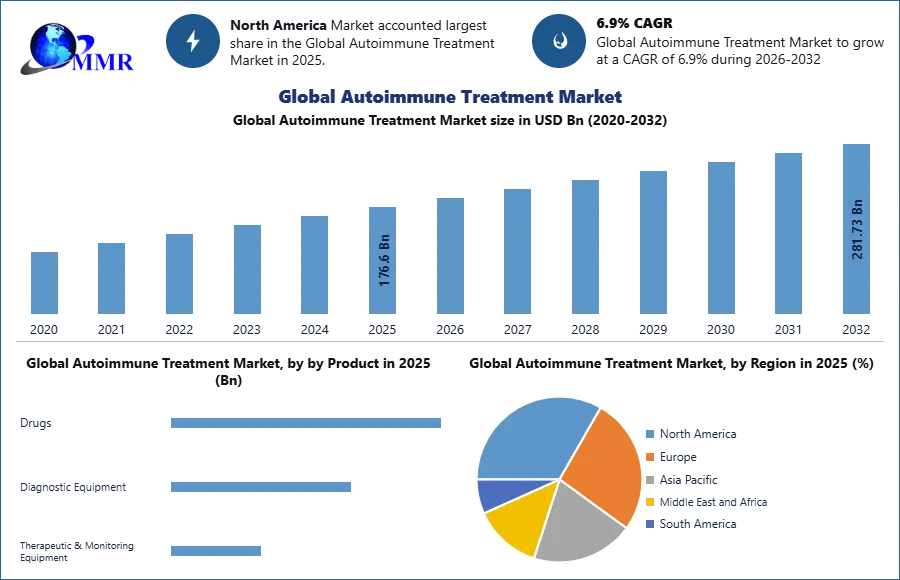
Global Autoimmune Treatment Market was valued at USD 176.6 Bn in 2025 and is expected to reach USD 281.73 Bn by 2032, growing at a CAGR of 6.9% during the forecast period.
Global Autoimmune Treatment Market Overview:
The global Autoimmune Treatment market is experiencing robust growth, driven by the rising prevalence of autoimmune diseases, increasing awareness of early diagnosis, and continuous advancements in targeted therapeutics. Autoimmune disorders such as rheumatoid arthritis, multiple sclerosis, psoriasis, inflammatory bowel disease, systemic lupus erythematosus, and type 1 diabetes are becoming increasingly common due to genetic predisposition, environmental factors, and changing lifestyles. Growing demand for biologics, biosimilars, monoclonal antibodies, Janus kinase (JAK) inhibitors, and other immunomodulatory therapies is transforming disease management by improving treatment efficacy, reducing disease progression, and enhancing patients' quality of life. Furthermore, increasing healthcare expenditure, expanding access to advanced therapies, and favorable reimbursement policies in developed countries continue to support market growth.
Ongoing innovation in precision medicine, cell and gene therapies, and next-generation immunotherapies is creating significant opportunities for the autoimmune treatment market. Pharmaceutical companies are investing heavily in research and development to introduce novel targeted therapies with improved safety profiles and personalized treatment approaches. The integration of artificial intelligence, biomarker-based diagnostics, and companion diagnostics is further enhancing patient stratification and treatment outcomes. Additionally, the expanding pipeline of biosimilars is improving treatment affordability and accessibility across emerging markets. However, the high cost of biologic therapies, potential adverse effects associated with long-term immunosuppression, and stringent regulatory approval processes remain key challenges. Despite these constraints, continued advancements in immunology research, increasing clinical trial activity, and the growing adoption of innovative therapies are expected to drive sustained growth in the global Autoimmune Treatment market throughout the forecast period.
 To know about the Research Methodology :- Request Free Sample Report
Global Autoimmune Treatment Market Dynamics:
Rising prevalence of autoimmune diseases is driving market growth
The increasing incidence of autoimmune diseases worldwide is a major factor driving the growth of the global autoimmune treatment market. Conditions such as rheumatoid arthritis, multiple sclerosis, psoriasis, inflammatory bowel disease, systemic lupus erythematosus, and type 1 diabetes are becoming more prevalent due to genetic susceptibility, environmental triggers, lifestyle changes, and improved disease diagnosis. The growing patient population has led to increased demand for effective treatment options, including biologics, biosimilars, monoclonal antibodies, and targeted immunotherapies. Additionally, expanding healthcare infrastructure, favorable reimbursement policies, and greater awareness of early diagnosis and disease management are further supporting market expansion.
Advancements in precision medicine and biologic therapies are creating significant growth opportunities
Continuous innovation in biologics, biosimilars, cell and gene therapies, and precision medicine is creating new opportunities in the autoimmune treatment market. Pharmaceutical companies are investing heavily in the development of targeted therapies that offer improved efficacy, reduced side effects, and personalized treatment approaches. Advances in biomarker-based diagnostics, artificial intelligence-driven drug discovery, and companion diagnostics are enabling better patient stratification and optimized treatment outcomes. Furthermore, the growing availability of biosimilars is improving access to advanced therapies while reducing treatment costs, particularly in emerging healthcare markets.
High treatment costs and stringent regulatory requirements are restraining market growth
Despite significant therapeutic advancements, the high cost of biologics and advanced immunotherapies remains a major challenge for market growth. Long-term treatment requirements, expensive manufacturing processes, and limited affordability in low- and middle-income countries restrict patient access to innovative therapies. Additionally, stringent regulatory approval processes, extensive clinical trial requirements, and complex manufacturing standards increase development timelines and costs, posing challenges for pharmaceutical companies introducing new autoimmune treatments.
Long-term safety concerns and treatment resistance remain key market challenges
The long-term use of immunosuppressive therapies and biologics may increase the risk of infections, malignancies, and other adverse events, requiring continuous patient monitoring and risk management. In addition, some patients experience reduced therapeutic response or treatment resistance over time, creating a need for alternative therapies and combination treatment strategies. Addressing these challenges through next-generation immunotherapies, personalized medicine, and continuous clinical research remains a key focus for industry participants.
Key Trends in the Global Autoimmune Treatment Market
- Growing adoption of biologics and biosimilars: Biologics continue to dominate autoimmune disease treatment due to their high efficacy, while biosimilars are expanding access to advanced therapies by offering cost-effective alternatives.
- Increasing focus on precision medicine and biomarker-driven therapies: Pharmaceutical companies are developing personalized treatment approaches using genetic profiling, biomarkers, and companion diagnostics to improve therapeutic outcomes and minimize adverse effects.
- Rising investment in cell and gene therapies: Research into CAR-T cell therapies, regulatory T-cell (Treg) therapies, stem cell therapies, and gene-editing technologies is expanding the pipeline for treating complex autoimmune disorders.
- Expansion of oral targeted therapies: The growing adoption of Janus kinase (JAK) inhibitors, S1P receptor modulators, and other oral small-molecule therapies is providing patients with convenient alternatives to injectable biologics.
- Integration of artificial intelligence in drug discovery and clinical development: AI and machine learning are increasingly being used to accelerate target identification, optimize clinical trial design, predict treatment response, and support the development of next-generation autoimmune therapies.
Segment Analysis – Global Autoimmune Treatment Market
Based on Product, the autoimmune treatment market is divided into Drugs, Diagnostic Equipment, and Therapeutic & Monitoring Equipment.
The Drugs segment dominated the global autoimmune treatment market in 2025 and is expected to maintain its leading position throughout the forecast period. The dominance of this segment is attributed to the widespread use of biologics, biosimilars, immunosuppressants, corticosteroids, monoclonal antibodies, and targeted therapies for managing autoimmune diseases such as rheumatoid arthritis, multiple sclerosis, psoriasis, inflammatory bowel disease, and systemic lupus erythematosus. Continuous approvals of novel therapeutics, expanding indications for biologic drugs, and increasing investment in precision medicine are further strengthening the segment's growth. Additionally, the growing availability of advanced immunomodulatory therapies and favorable reimbursement policies in developed countries continue to support market expansion.
The Diagnostic Equipment segment is expected to register the fastest growth during the forecast period, driven by increasing emphasis on early disease detection, precision diagnostics, and biomarker-based testing for autoimmune disorders. Advances in molecular diagnostics, immunoassays, and laboratory automation are improving diagnostic accuracy and enabling personalized treatment decisions. Meanwhile, Therapeutic & Monitoring Equipment continues to witness steady growth due to the increasing use of infusion systems, patient monitoring devices, and digital health technologies that support long-term disease management, treatment adherence, and remote patient monitoring.
Based on Drug Class, the autoimmune treatment market is divided into Anti-Inflammatory, Anti-Hyperglycaemic, NSAIDs, Interferons, and Other Drugs.
The Anti-Inflammatory segment accounted for the largest share of the global autoimmune treatment market in 2025 and is expected to maintain its dominance throughout the forecast period. Anti-inflammatory therapies, including corticosteroids, biologics targeting TNF-α, IL-6, IL-17, and other inflammatory pathways, play a central role in controlling immune-mediated inflammation and preventing disease progression across a wide range of autoimmune disorders. Continuous product innovation, expanding biologic portfolios, and increasing adoption of targeted immunotherapies are driving the growth of this segment.
The Interferons segment is expected to witness the fastest growth during the forecast period, primarily driven by their continued use in the treatment of multiple sclerosis and ongoing research into next-generation immunomodulatory therapies. Meanwhile, NSAIDs remain widely prescribed for symptomatic relief of pain, inflammation, and joint stiffness associated with autoimmune diseases, while Anti-Hyperglycaemic drugs continue to play a vital role in the management of autoimmune type 1 diabetes. The Other Drugs segment, comprising immunosuppressants, disease-modifying antirheumatic drugs (DMARDs), Janus kinase (JAK) inhibitors, calcineurin inhibitors, and emerging biologics, is also expected to experience steady growth due to the expanding treatment landscape and continuous introduction of novel targeted therapies.
Global Autoimmune Treatment Market Regional Insights:
North America dominated the global Autoimmune Treatment market in 2025 and is expected to maintain its leading position throughout the forecast period. The region's leadership is driven by the high prevalence of autoimmune diseases, advanced healthcare infrastructure, favorable reimbursement policies, and strong adoption of biologics and targeted immunotherapies. The United States accounts for the largest share of the regional market owing to significant healthcare expenditure, extensive research and development activities, and the presence of leading pharmaceutical and biotechnology companies. Additionally, increasing investments in precision medicine, growing clinical trial activity, and early adoption of innovative therapies such as monoclonal antibodies, JAK inhibitors, and biosimilars continue to strengthen market growth across North America.
Asia Pacific is expected to register the fastest growth during the forecast period, fueled by improving healthcare infrastructure, rising awareness of autoimmune disorders, increasing healthcare expenditure, and expanding access to advanced therapies across China, Japan, India, South Korea, and Australia. The growing prevalence of autoimmune diseases, supportive government healthcare initiatives, and increasing availability of biosimilars are further accelerating regional market expansion. Meanwhile, Europe continues to witness substantial growth owing to its well-established healthcare systems, favorable reimbursement frameworks, and strong focus on biologic therapies and autoimmune disease research, particularly in Germany, the United Kingdom, France, Italy, and Spain. Latin America is experiencing steady market growth, supported by improving diagnostic capabilities, expanding healthcare access, and increasing adoption of advanced autoimmune therapies in Brazil, Mexico, and Argentina. The Middle East & Africa is also projected to grow steadily, driven by healthcare infrastructure development, rising investments in specialty care, and improving access to innovative biologic treatments across countries such as the UAE, Saudi Arabia, and South Africa, collectively supporting long-term market growth.
Global Autoimmune Treatment Market Recent Developments:
| Date | Recent Development |
| 18 Jun 2025 | Johnson & Johnson received U.S. FDA approval for TREMFYA® (guselkumab) for adults with moderately to severely active Crohn's disease, expanding its autoimmune disease portfolio. |
| 17 Apr 2025 | AbbVie Inc. announced positive Phase III clinical results for Rinvoq® (upadacitinib) in the treatment of giant cell arteritis, supporting the expansion of its autoimmune indications. |
| 14 Mar 2025 | UCB S.A. received European Commission approval for Bimzelx® (bimekizumab) for the treatment of active psoriatic arthritis and axial spondyloarthritis, strengthening its immunology portfolio. |
| 29 Jan 2025 | Amgen Inc. announced expanded global availability of WEZLANA® (ustekinumab-auub), a biosimilar to Stelara®, improving patient access to biologic therapies for multiple autoimmune diseases. |
| 13 Sep 2024 | Eli Lilly and Company received U.S. FDA approval for EBGLYSS™ (lebrikizumab-lbkz) for the treatment of moderate-to-severe atopic dermatitis in adults and adolescents, further expanding its immunology franchise. |
| 07 Aug 2024 | Novartis AG reported positive Phase III results for remibrutinib in chronic spontaneous urticaria, demonstrating significant efficacy and supporting future regulatory submissions in autoimmune and immune-mediated diseases. |
Competitive Landscape – Global Autoimmune Treatment Market
The global Autoimmune Treatment market is highly competitive, with leading pharmaceutical and biotechnology companies focusing on expanding biologic portfolios, developing next-generation immunotherapies, and advancing precision medicine to address the growing burden of autoimmune diseases. Companies are investing significantly in research and development of monoclonal antibodies, Janus kinase (JAK) inhibitors, cell therapies, gene therapies, and novel immunomodulators to improve treatment efficacy, safety, and long-term disease management. Strategic initiatives such as regulatory approvals, pipeline expansion, licensing agreements, mergers and acquisitions, and collaborations with research institutions remain central to strengthening competitive positioning. The growing adoption of biosimilars and personalized medicine is also intensifying competition across major therapeutic segments.
Major players including AbbVie Inc., Johnson & Johnson, F. Hoffmann-La Roche Ltd., Pfizer Inc., Amgen Inc., Bristol Myers Squibb, Eli Lilly and Company, Novartis AG, Sanofi S.A., UCB S.A., AstraZeneca PLC, Biogen Inc., GSK plc, Merck KGaA, and Takeda Pharmaceutical Company Limited continue to strengthen their global presence through product innovation, strategic partnerships, clinical pipeline expansion, and geographic expansion. These companies are actively investing in next-generation biologics, targeted therapies, and AI-enabled drug discovery platforms while expanding indications for existing autoimmune therapies to address unmet clinical needs and sustain long-term market growth.
Autoimmune Treatment Market Scope: Inquire before buying
| Global Autoimmune Treatment Market | |||
|---|---|---|---|
| Report Coverage | Details | ||
| Base Year: | 2025 | Forecast Period: | 2026-2032 |
| Historical Data: | 2020 to 2025 | Market Size in 2025: | 176.6 USD Bn |
| Forecast Period 2026-2032 CAGR: | 6.9% | Market Size in 2032: | 281.73 USD Bn |
| Segments Covered: | By Product | Drugs Diagnostic Equipment Therapeutic & Monitoring Equipment |
|
| By Drug Class | Anti-Inflammatory Anti-Hyperglycaemic NSAIDs Interferons Other Drugs |
||
| By Treatment | Drugs Physical Therapy |
||
| By Indication | Rheumatic Disease Diabetes Multiple Sclerosis Inflammatory Bowel Disease Other Indications |
||
| By Distribution Channel | Hospitals & Clinics Diagnostic Centers Drug Stores Pharmacies Others |
||
Autoimmune Treatment Market, by Region
North America (United States, Canada and Mexico)
Europe (United Kingdom, France, Germany, Italy, Spain, Sweden, Russia, Rest of Europe)
Asia Pacific (China, Japan, South Korea, India, Australia, Malaysia, Thailand, Vietnam, Indonesia, Philippines, Rest of APAC)
Middle East and Africa (South Africa, GCC, Nigeria, Egypt, Turkey, Rest of MEA)
South America (Brazil, Argentina, Colombia, Chile, Peru, Rest of South America)
Autoimmune Treatment Market Key Players are:
Global Autoimmune Treatment Market – Key Players
North America
- AbbVie Inc. (North Chicago, Illinois, USA)
- Pfizer Inc. (New York, New York, USA)
- Amgen Inc. (Thousand Oaks, California, USA)
- Eli Lilly and Company (Indianapolis, Indiana, USA)
- Johnson & Johnson (New Brunswick, New Jersey, USA)
- Bristol Myers Squibb (Princeton, New Jersey, USA)
- Viatris Inc. (Canonsburg, Pennsylvania, USA)
- Gilead Sciences, Inc. (Foster City, California, USA)
- Biogen Inc. (Cambridge, Massachusetts, USA)
Europe
- Novartis AG (Basel, Switzerland)
- F. Hoffmann-La Roche Ltd. (Basel, Switzerland)
- UCB S.A. (Brussels, Belgium)
- AstraZeneca PLC (Cambridge, United Kingdom)
- Sanofi S.A. (Paris, France)
- Merck KGaA (Darmstadt, Germany)
- Galapagos NV (Mechelen, Belgium)
- Sandoz Group AG (Basel, Switzerland)
- Grifols S.A. (Barcelona, Spain)
Asia Pacific
- Takeda Pharmaceutical Company Limited (Tokyo, Japan)
- Chugai Pharmaceutical Co., Ltd. (Tokyo, Japan)
- Astellas Pharma Inc. (Tokyo, Japan)
- Otsuka Pharmaceutical Co., Ltd. (Tokyo, Japan)
- Daiichi Sankyo Company, Limited (Tokyo, Japan)
- Eisai Co., Ltd. (Tokyo, Japan)
- Samsung Bioepis Co., Ltd. (Incheon, South Korea)
- Celltrion Inc. (Incheon, South Korea)
- CSL Limited (Melbourne, Australia)
Emerging & Specialty Immunology Companies (Optional)
- argenx SE (Amsterdam, Netherlands)
- Kyverna Therapeutics, Inc. (Emeryville, California, USA)
- Argenica Therapeutics Limited (Nedlands, Australia)
Others