
ATM Security Market Size – Industry Structure Evaluation, Demand Drivers Analysis, Regional Growth Analysis and Identification, Competitive Positioning Review & Global Market Size Forecast to 2032
Overview
The ATM Security Market size was valued at USD 18.18 Bn. in 2025 and the total ATM Security Market industry revenue is growing by 5.8 % from 2026 to 2032, reaching nearly USD 26.98 Bn.
ATM Security Market Overview
ATM has become one of the most important facilities in our day-to-day life. This facility helps us to withdraw money from the authorized account at any time. Security is the major aspect, as the need for ATMs is increasing day by day. Security systems are the demands of the day, which helps to avoid theft. As technology improves, cybercriminals also improve their techniques and tools. ATM networks are at risk of being hacked, infect with fraud, and targeted by skimming devices that can steal customer information and result in financial harm.
According to Maximize MMR study report In America Consumer reported losing nearly USD $8.8 Billion to Scam in 2025. Increase of more than 30 percent over the previous year. Preventing Scam and Fraudulent activities, modern solutions make it easier to resolve disputes and monitor ATMs, getting photos and videos in real-time. Which helps to boost the growth of the ATM Security Market during the forecast period.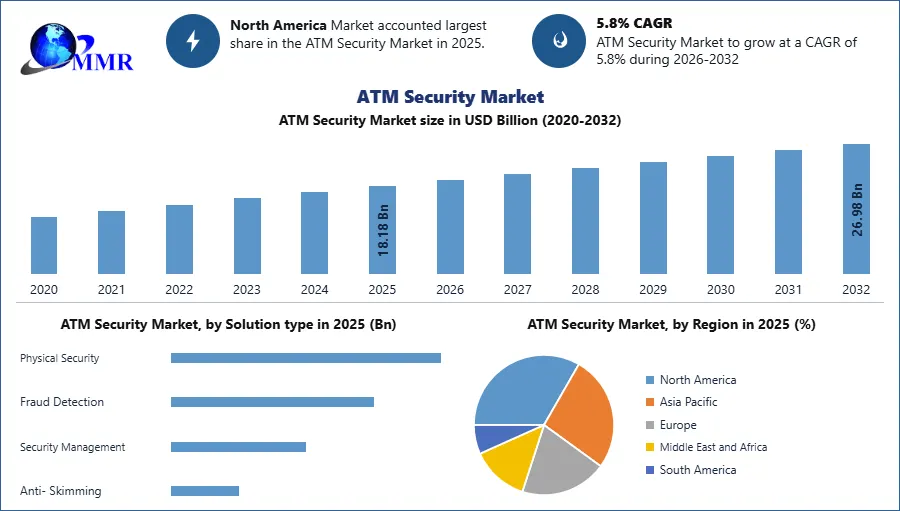 To know about the Research Methodology :- Request Free Sample Report
ATM Security Market Dynamics:
Increasing ATM-related fraud drives the Market Growth
The rise in ATM-related fraud, including card skimming, cash trapping, and malware attacks, is a significant driving factor for the ATM security market. Nowadays, digital payment methods are gaining popularity, so, cash continues to be widely used, and ATMs play a crucial role in cash distribution. The criminals continue to design new techniques to exploit vulnerabilities in ATMs, financial institutions and ATM operators use different stability measures, such as anti–skimming technology, manipulation properties, surveillance systems, user awareness campaigns, and transaction monitoring to identify and prevent these frauds.
According to the MMR Study report in the financial year 2025, the Reserve Bank of India (RBI) reported a total of around 9,103 bank fraud cases across India. This increases as compared to the previous year 2021. This all aspects boost the demand for Excess security for ATMs. So, Increase in the Adoption of ATM Security. This factor significantly drives the growth of the ATM Security Market.
Increasing regulatory compliance requirements boosts the Market growth
Regulatory bodies and industry associations impose strict security standards and guidelines for financial institutions to protect customer data and prevent fraud. For example, the Payment Card Industry Data Security Standard (PCI DSS) mandates specific security measures for ATM operators and card issuers. Compliance with these standards requires financial institutions to invest in robust ATM security solutions to meet the prescribed requirements. Data privacy regulations, such as the General Data Protection Regulation (GDPR) in the European Union, require organizations to implement adequate security measures to protect personal data.
ATM networks handle sensitive customer information, including card data and transaction records. Compliance with data privacy regulations necessitates the implementation of strong security measures to safeguard this information, thereby driving the demand for ATM security solutions. So the increasing regulatory compliance requirements place significant importance on ATM security solutions. Financial institutions and ATM operators must invest in advanced security technologies, access control measures, encryption techniques, surveillance systems, and monitoring capabilities to meet regulatory standards. This drives the growth of the ATM Security Market.
Cost Considerations Restrain the Market Growth
Implementing comprehensive ATM security measures can involve significant costs for financial institutions and ATM operators. This includes the installation of security hardware, software, surveillance systems, and ongoing maintenance and updates. The upfront investment and ongoing expenses associated with ATM security solutions restrain the market growth, particularly for smaller financial institutions or those with limited budgets.
Additionally, the need to regularly upgrade security systems to keep up with evolving threats can further increase the overall cost of ATM security. This cost factor may result in some organizations opting for minimal security measures or delaying investments in advanced security technologies, which can leave them vulnerable to attacks. Therefore, cost is a restraining factor, the potential financial losses from security breaches and fraud incidents can outweigh the initial investment in robust security measures. Organizations need to carefully evaluate the risks and benefits to strike a balance between cost considerations and the need for effective ATM security market.
IoT and Connected Devices create a lucrative growth opportunity
The rise of the Internet of Things (IoT) opens up opportunities for enhanced security in ATMs. Integrating ATMs with interconnected devices and sensors, financial institutions gather real-time information about physical security breaches, such as tampering or unauthorized access attempts. IoT-enabled security solutions can enable proactive responses and remote monitoring, reducing risks and improving incident management.
The Internet of Things (IoT) refers to the network of physical devices, vehicles, appliances, and other objects embedded with sensors, software, and connectivity, which enable them to exchange data and interact with each other over the Internet. They transmit information related to security events, device health status, or other relevant metrics. IoT devices can contribute to enhanced physical security measures for ATMs. For example, IoT-enabled sensors can detect physical tampering, such as attempts to open or dismantle the ATM.
They can trigger alarms or send alerts to security personnel to respond immediately. IoT and connected devices offer opportunities to enhance ATM security by providing real-time monitoring, proactive threat detection, remote management, and data-driven decision-making. By leveraging the capabilities of IoT technology, financial institutions strengthen the security of their ATM networks, mitigate risks, and provide a safer environment for customers' transactions.
ATM Security Market Segment Analysis
Based on Offerings, the Software segment dominates the global ATM Security Market in the year 2025,the segment includes security software solutions specifically designed to protect ATMs from various threats. These solutions include anti-skimming software, encryption software, fraud detection and prevention software, access control software, and remote monitoring and management software.Nowadays,skimming is a common method used by criminals to steal cardholder data from ATMs. So software like Anti-skimming is designed to detect and prevent skimming attacks by monitoring and analyzing the ATM's card reader and detecting any tampering.
The detection and prevention program is used to detect and delete the malignant program of ATMs, as well as provide real-time defense against novel and emerging threats.The software segment is constantly evolving to keep up with emerging Software solutions that can provide robust protection against evolving ATM security risks.
ATM Security Market Regional Insights:
North America Dominates the Global ATM Security Market in the year 2025. North America is one of the leading regions in the ATM security market. The region has a well-developed banking and financial sector, which drives the demand for ATM security solutions. The presence of major ATM security solution providers and continuous technological advancements in the region contribute to market growth.
Additionally, increasing incidents of ATM fraud and the need for secure transactions further propel the demand for ATM security solutions in this region In addition, financial institutions in the United States invest significantly in advanced stability technologies such as biometric authentication, joint devices, and encrypted communication protocols to defend consumer data and ensure safe transactions. Canadian financial institutions are investing in advanced security solutions, including secure card readers, real-time transaction monitoring, and ATM remote management systems.
ATM Security Market Recent Industry Developments
| Date | Company | Development | Impact |
|---|---|---|---|
| 27 February 2026 | Brink's Company | Entered a definitive agreement to acquire NCR Atleos for $6.6 billion to consolidate cash management and ATM security services. | The acquisition creates a global powerhouse in secure logistics and ATM retail hardware security solutions. |
| 15 January 2026 | Diebold Nixdorf | Launched a new AI-driven fraud detection suite integrated into their DN Series ATMs to combat logical and physical attacks. | The software update reduces skimming incidents by 40% through real-time sensor monitoring and behavioral analytics. |
| 12 November 2025 | TMD Security | Announced a strategic partnership with a major European bank to deploy Gas Defence Units and note-staining technology. | This partnership strengthens the bank's resistance against explosive ATM attacks across its 5,000-unit fleet. |
| 08 August 2025 | GRG Banking | Released its latest Biometric Authentication Module featuring multi-modal palm vein and facial recognition for ATM access. | The module aims to eliminate card-based fraud by shifting toward high-assurance passwordless identity verification. |
| 22 May 2025 | Secure Innovation | Commercialized the Remote Management System (RMS) for real-time monitoring of ink-staining security in ATM cassettes. | The cloud-based system provides instant alerts during unauthorized transit or physical tampering of cash containers. |
ATM Security Market Scope: Inquire before buying
| ATM Security Market | |||
|---|---|---|---|
| Report Coverage | Details | ||
| Base Year: | 2025 | Forecast Period: | 2026-2032 |
| Historical Data: | 2020 to 2025 | Market Size in 2025: | 18.18 USD Billion |
| Forecast Period 2026-2032 CAGR: | 5.8% | Market Size in 2032: | 26.98 USD Billion |
| Segments Covered: | by Offerings | Software Services |
|
| by Industry Vertical | Banking Financial Institutions Other |
||
| by ATM Type | Onsite ATM’s Offsite ATM’s |
||
| by Solution type | Physical Security Fraud Detection Security Management Anti- Skimming |
||
ATM Security Market, by Region
North America (United States, Canada and Mexico)
Europe (UK, France, Germany, Italy, Spain, Sweden, Austria and Rest of Europe)
Asia Pacific (China, South Korea, Japan, India, Australia, Indonesia, Malaysia, Vietnam, Taiwan, Bangladesh, Pakistan and Rest of APAC)
Middle East and Africa (South Africa, GCC, Egypt, Nigeria and Rest of ME&A)
South America (Brazil, Argentina Rest of South America)
ATM Security Market Key Players
- NCR Corporation
- Fujitsu Limited
- Diebold Nixdorf
- Euronet Worldwide Inc.
- Hitachi Channel Solutions Corp
- GRG Banking Equipment Co. Ltd.
- Hyosung TNS Inc.
- HESS Cash Systems GmbH & Co. KG
- OKI Electric Industry Co. Ltd.
- LD Systems
- Wincor Nixdorf AG
- Triton Systems of Delaware LLC
- Cennox Group
- Loomis AB
- Giesecke+Devrient
- Brink's Company
- Cardtronics Inc.
- CMS Info Systems Ltd.
- 3SI Security Systems
- Secure Innovation Inc.
- Auriga
- Penki Kontinentai Group
- KAL ATM Software GmbH
- TMD Security
- ScienceSoft USA Corporation