
Asia Pacific Zero Trust Security Market – Analysis by Security Type, Authentication Type, Deployment Model, Industry Vertical and Regional Insights 2034
Overview
The Asia Pacific Zero Trust Security Market was valued at USD 11.50 Billion in 2025 and is projected to reach USD 58.45 Billion by 2034, growing at a CAGR of 19.8% during the forecast period 2026–2034.
| Parameter | Value |
| Market Size (2025) | USD 11.50 Billion |
| Market Size (2034) | USD 58.45 Billion |
| CAGR | 19.8% |
| Historical Period | 2020 to 2025 |
| Forecast Period | 2026 to 2034 |
| Leading Country | China |
| Leading Key Players | Microsoft Corporation, Palo Alto Networks, Inc., Cisco Systems, Inc., Zscaler, Inc., Fortinet, Inc. |
Asia Pacific Zero Trust Security Market Overview
The Asia Pacific Zero Trust Security Market focuses on cybersecurity solutions that continuously verify user identities, devices, applications, and network access before granting permission to enterprise resources. Zero Trust Security operates on the principle of “Never Trust, Always Verify,” helping organizations protect sensitive information and reduce unauthorized access. The market plays a critical role in strengthening enterprise cybersecurity as cloud computing, digital transformation, remote working, and connected infrastructure expand across Asia Pacific. Industries adopt Zero Trust Network Access (ZTNA), identity and access management (IAM), multi-factor authentication (MFA), and cloud security solutions to protect business-critical applications, prevent data breaches, and maintain regulatory compliance.
The Asia Pacific Zero Trust Security Market experiences increasing demand as organizations modernize cybersecurity infrastructure and address sophisticated cyber threats, ransomware attacks, and identity-based security risks. Artificial intelligence, machine learning, micro segmentation, Secure Access Service Edge (SASE), and continuous authentication reshape enterprise security strategies. Major buyers include BFSI, healthcare, government and defense, IT and telecommunications, retail, manufacturing, and energy industries. China, Japan, India, South Korea, and Australia represent important markets for Zero Trust Security adoption, while Southeast Asian economies present opportunities through cloud migration, expanding digital services, and cybersecurity investments. Leading Zero Trust Security companies, including Microsoft, Palo Alto Networks, Cisco Systems, Zscaler, and Cloudflare, provide solutions for secure enterprise access, network protection, identity verification, and cloud workload security.
Maximize Market Research (MMR) examines the Asia Pacific Zero Trust Security Market through market dynamics, technology adoption, competitive positioning, industry-specific demand, and country-level opportunities. The research evaluates Zero Trust Security Market trends, growth drivers, deployment models, authentication technologies, security types, and industry verticals to identify factors influencing enterprise cybersecurity investments. It also assesses how regulatory requirements, digital infrastructure development, cloud-based security adoption, and evolving cyber threats shape regional demand. The analysis provides insights into competitive strategies, emerging cybersecurity technologies, adoption barriers, and opportunities for organizations operating in the Asia Pacific Zero Trust Security industry.
Asia Pacific Zero Trust Security Market Growth and Share Analysis
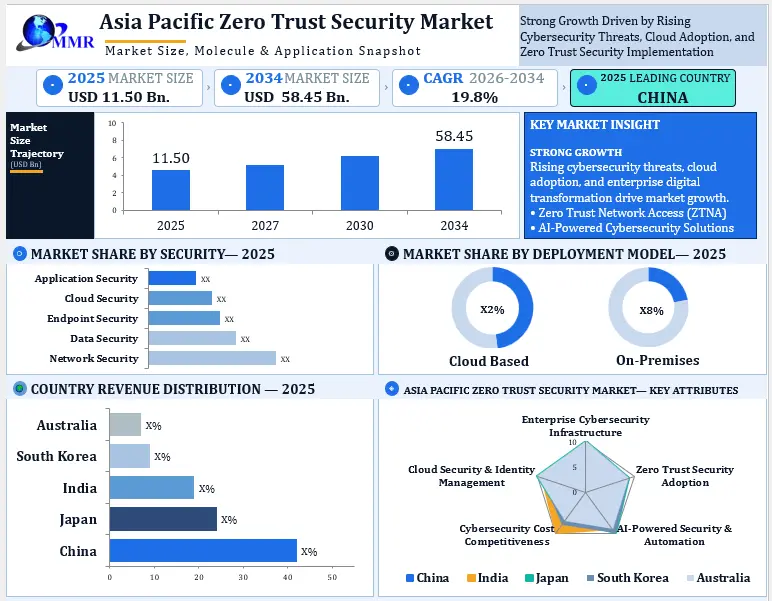
To know about the Research Methodology :- Request Free Sample Report
Asia Pacific Zero Trust Security Market Key Highlights
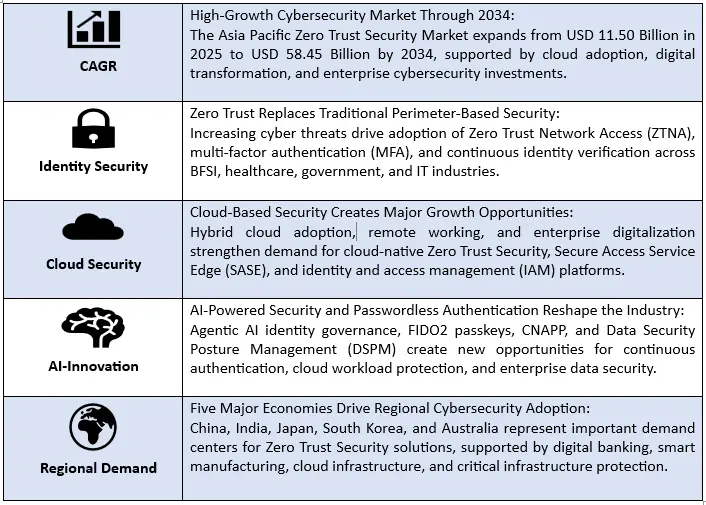
Asia Pacific Zero Trust Security Market Dynamics
Market Drivers
Rising Cybersecurity Threats and Cloud Adoption Drive Zero Trust Security Demand Across Asia Pacific
The Asia Pacific Zero Trust Security Market experiences growing demand as enterprises strengthen protection against ransomware, phishing, unauthorized access, and data breaches. Increasing cloud adoption, remote working, and digital transformation drive investments in Zero Trust Network Access (ZTNA), multi-factor authentication (MFA), and identity and access management (IAM) solutions. Organizations across China, India, Japan, South Korea, and Australia implement continuous identity verification, least-privilege access, and 24/7 security monitoring to protect sensitive enterprise data and critical digital infrastructure.
Government Cybersecurity Initiatives and Enterprise Digitalization Support Market Expansion
Government cybersecurity policies, data protection requirements, and critical infrastructure security initiatives strengthen the adoption of Zero Trust Security solutions across Asia Pacific. BFSI, healthcare, IT and telecommunications, and government organizations prioritize secure network access and regulatory compliance. Enterprises integrate endpoint protection, cloud workload security, and identity-based authentication to safeguard digital transactions and business applications. The growing importance of enterprise cybersecurity, Zero Trust Architecture (ZTA), and secure access management supports demand for comprehensive security platforms.
Market Restraints
High Implementation Costs and Legacy Infrastructure Limit Zero Trust Security Adoption
The Asia Pacific Zero Trust Security Market faces adoption restraints due to the investment requirements associated with enterprise security modernization. Organizations allocate resources toward identity management software, endpoint security, network segmentation, cloud security subscriptions, and system integration. Zero Trust deployment also requires security assessments, employee training, and infrastructure upgrades. Small and medium-sized enterprises face budget limitations, while organizations with legacy IT environments encounter additional costs for integrating Zero Trust Security platforms with existing applications and authentication systems.
Complex Security Integration and Workforce Skill Gaps Restrict Market Penetration
Integrating Zero Trust Network Access, privileged access management, and cloud security solutions across complex enterprise environments creates operational constraints. Organizations manage multiple vendors, authentication systems, security policies, and network architectures, increasing deployment complexity. The shortage of experienced cybersecurity professionals affects implementation, configuration, and continuous monitoring capabilities. Businesses also face difficulties maintaining consistent identity verification across hybrid cloud environments, third-party applications, and remote devices, limiting the scalability of Zero Trust Security solutions in emerging Asia Pacific economies.
Market Opportunities
Cloud-Based Zero Trust Security and SME Digitalization Create Growth Opportunities
The Asia Pacific Zero Trust Security Market presents significant opportunities through expanding cloud adoption and cybersecurity modernization among small and medium-sized enterprises. Cloud-based Zero Trust Security solutions provide subscription-based access to identity verification, device authentication, secure application connectivity, and centralized security management. Managed security service providers offer scalable cybersecurity solutions that reduce the need for extensive on-premises infrastructure. Growing digital business operations across India, Indonesia, Vietnam, Malaysia, and Thailand create opportunities for Zero Trust Network Access and cloud security service providers.
Critical Infrastructure Protection and Advanced Identity Security Expand Market Opportunities
Increasing digital connectivity across healthcare, financial services, manufacturing, and energy infrastructure creates opportunities for Zero Trust Security technology providers. Enterprises integrate micro segmentation, privileged access management, and adaptive authentication to protect critical systems and sensitive information. The adoption of multi-factor authentication requiring two or more verification factors strengthens enterprise access controls. Demand for Secure Access Service Edge (SASE), identity threat detection, and cloud-native Zero Trust Security platforms supports innovation in comprehensive cybersecurity services across Asia Pacific.
Market Challenges
Fragmented Regulatory Requirements and Cross-Border Data Security Complicate Zero Trust Implementation
The Asia Pacific Zero Trust Security Market encounters challenges arising from differing cybersecurity regulations, data privacy requirements, and compliance frameworks across regional economies. Multinational organizations manage security policies across jurisdictions with varying expectations for data handling, access control, and incident reporting. Maintaining consistent Zero Trust Architecture, identity governance, and cloud data protection across geographically distributed business operations requires continuous coordination. Enterprises also balance security verification requirements with operational efficiency and employee access to essential applications.
Increasing Cyberattack Sophistication and Identity Management Complexity Challenge Security Effectiveness
Evolving ransomware techniques, credential theft, malicious insider activities, and AI-assisted cyber threats increase the complexity of Zero Trust Security implementation across Asia Pacific. Organizations manage user identities, machine identities, connected devices, and third-party access across hybrid IT environments. Continuous authentication and security policy enforcement require accurate identity information and reliable device monitoring. Excessive access restrictions also affect employee productivity, creating challenges for enterprises seeking to balance cybersecurity protection, user experience, and operational performance.
Asia Pacific Zero Trust Security Market Trends
| Key Market Trends | Impact on Asia Pacific Zero Trust Security Market |
| Agentic AI Identity Governance | The Asia Pacific Zero Trust Security Market focuses on securing autonomous AI agents through identity verification, automated access controls, and continuous authorization. Enterprises adopt AI identity governance solutions to protect sensitive business applications and prevent unauthorized machine-to-machine access. |
| Passwordless Authentication and Passkey Adoption | Organizations across Asia Pacific implement passwordless Zero Trust Security solutions, including biometric authentication, FIDO2 passkeys, and phishing-resistant identity verification. These technologies strengthen enterprise cybersecurity and reduce credential-based security risks. |
| Cloud-Native Application Protection Platforms (CNAPP) | Increasing adoption of hybrid and multi-cloud environments supports demand for cloud-based Zero Trust Security solutions. Enterprises integrate CNAPP technologies to protect cloud workloads, containers, applications, and sensitive enterprise data through centralized security management. |
| Zero Trust Security for Industrial and OT Networks | Manufacturing, energy, and utility industries adopt Zero Trust Network Access (ZTNA) and micro segmentation technologies to secure operational technology (OT) environments. These solutions strengthen industrial cybersecurity by restricting unauthorized access to connected equipment and critical infrastructure. |
| Data Security Posture Management (DSPM) | The Asia Pacific Zero Trust Security industry increasingly integrates Data Security Posture Management solutions to identify sensitive information, monitor data exposure, and enforce access permissions. DSPM supports continuous data protection and regulatory compliance across enterprise cloud environments. |
Asia Pacific Zero Trust Security Market Segments Analysis
Asia Pacific Zero Trust Security Market Analysis, by Industry Vertical
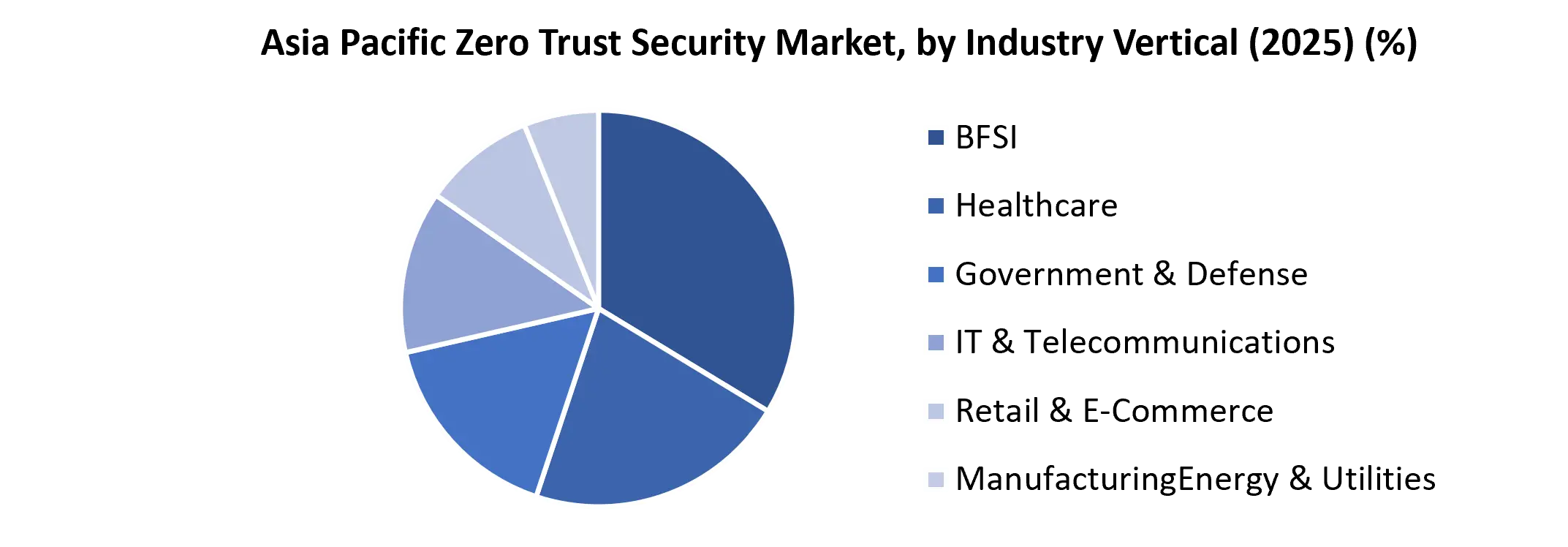
The Asia Pacific Zero Trust Security Market by Industry Vertical covers BFSI, healthcare, government & defense, IT & telecommunications, retail & e-commerce, manufacturing, energy & utilities, and other industries. The BFSI sector adopts Zero Trust Security solutions to protect digital banking transactions, mobile payment platforms, and sensitive financial information, particularly across China, India, Japan, and South Korea. Healthcare organizations prioritize electronic health records, connected medical devices, and patient data security, while government and defense agencies implement Zero Trust Architecture (ZTA) to safeguard critical digital infrastructure and confidential information.
IT and telecommunications companies invest in Zero Trust Network Access (ZTNA) and cloud security solutions to secure distributed networks and enterprise applications. Retail and e-commerce businesses strengthen digital payment security and customer data protection, while manufacturing companies integrate micro segmentation and endpoint security to protect industrial control systems and smart factories. Energy and utilities providers focus on operational technology security and infrastructure resilience. Increasing cloud adoption, digital transformation, and demand for identity and access management (IAM), multi-factor authentication (MFA), and enterprise cybersecurity solutions support Asia Pacific Zero Trust Security Market growth across these industry verticals.
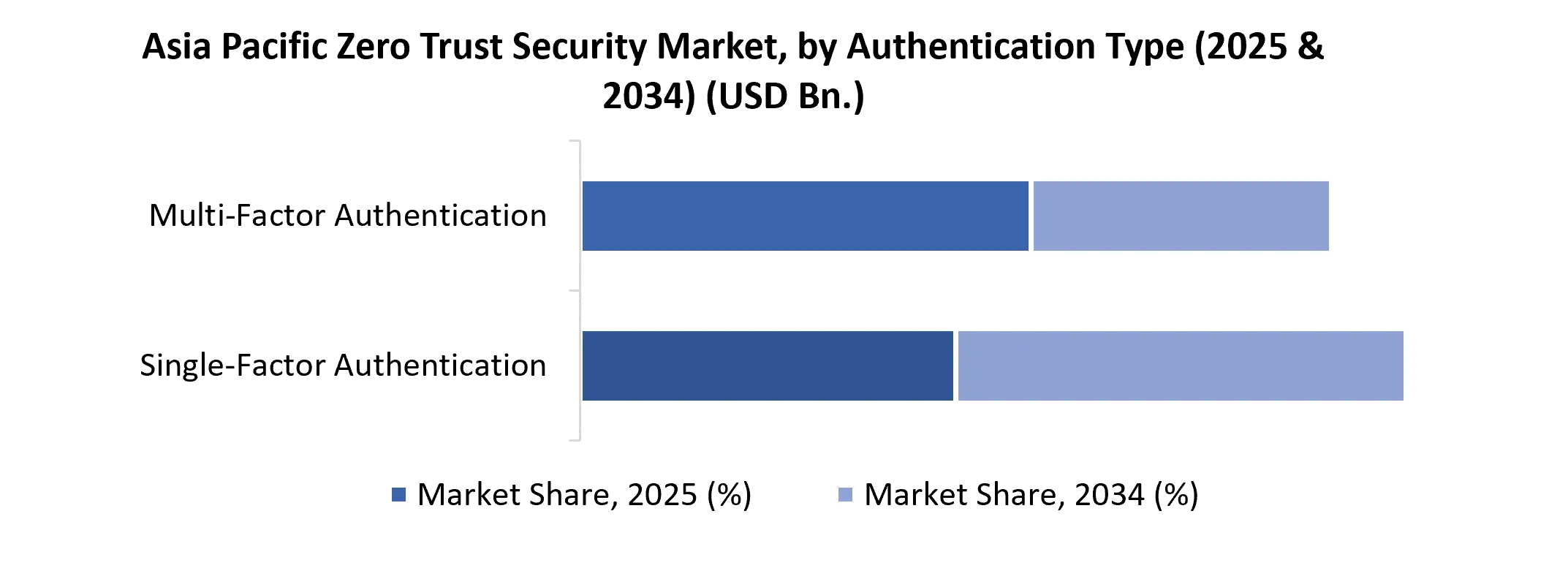
Asia Pacific Zero Trust Security Market Analysis, by Authentication Type
The Asia Pacific Zero Trust Security Market by Authentication Type is segmented into Single-Factor Authentication (SFA) and Multi-Factor Authentication (MFA). Single-Factor Authentication relies on one verification method, such as a password or biometric credential, and remains common in legacy applications and basic enterprise access management systems. However, increasing cybersecurity threats, phishing attacks, and credential theft strengthen demand for Multi-Factor Authentication solutions across China, India, Japan, South Korea, Australia, and Southeast Asia. MFA combines two or more independent verification factors, including passwords, security tokens, and biometric authentication, to improve identity protection.
Enterprises increasingly adopt phishing-resistant MFA, passwordless authentication, and identity and access management (IAM) solutions to secure cloud applications, remote employees, and sensitive business information. BFSI, healthcare, government & defense, and IT & telecommunications organizations prioritize continuous identity verification and risk-based authentication to strengthen Zero Trust Architecture (ZTA) implementation. Growing cloud adoption, digital transformation, and investment in advanced authentication technologies support Asia Pacific Zero Trust Security Market growth, strengthen enterprise access security, and create opportunities for identity security and authentication solution providers.
 Asia Pacific Zero Trust Security Market Regional Insights
China represents a significant market within the Asia Pacific Zero Trust Security Market, supported by extensive digital infrastructure, increasing cloud computing adoption, and enterprise cybersecurity modernization. Banking, telecommunications, manufacturing, and government organizations implement Zero Trust Network Access (ZTNA), identity and access management (IAM), and cloud security solutions to protect sensitive information, enterprise applications, and interconnected networks. The expansion of digital financial services, industrial automation, and smart infrastructure strengthens demand for advanced network protection. Enterprises increasingly integrate micro segmentation, continuous authentication, and AI-powered threat detection to improve cybersecurity resilience. Data security regulations and growing investments in enterprise cloud infrastructure further support demand for comprehensive Zero Trust Security platforms.
Japan demonstrates strong adoption of Zero Trust Security solutions across manufacturing, BFSI, healthcare, and IT industries. Enterprises integrate multi-factor authentication (MFA), endpoint security, and Zero Trust Architecture (ZTA) to protect industrial control systems, hybrid cloud environments, and critical business applications. Increasing digital transformation and connected manufacturing infrastructure strengthen demand for continuous authentication and identity-based access controls. Japanese organizations emphasize privileged access management, secure remote connectivity, and cloud workload protection to manage cybersecurity risks across distributed business environments. The expansion of smart factories, IoT devices, and enterprise automation support investment in advanced Zero Trust network security technologies.
India presents significant opportunities in the Asia Pacific Zero Trust Security industry as digital banking, cloud computing, IT services, and e-commerce expand. Enterprises adopt cloud-based Zero Trust Security platforms, privileged access management, and secure remote access solutions to protect financial transactions, distributed workforces, and sensitive enterprise data. Increasing adoption of digital payment systems, SaaS applications, and hybrid cloud infrastructure strengthens demand for scalable cybersecurity solutions. BFSI institutions, government organizations, healthcare providers, and technology companies prioritize identity verification, multi-factor authentication, and endpoint security to prevent unauthorized access. Growing cybersecurity investments and enterprise cloud migration support opportunities for Zero Trust Security solution providers across India.
South Korea experiences increasing demand for Zero Trust Security technologies across electronics manufacturing, telecommunications, financial services, and digital platforms. Organizations implement AI-powered threat detection, network micro segmentation, multi-factor authentication, and endpoint protection to strengthen enterprise cybersecurity and safeguard interconnected digital infrastructure. The integration of 5G networks, cloud computing, and smart manufacturing technologies increases demand for continuous identity verification and secure application access. Enterprises emphasize Zero Trust Network Access, behavioral analytics, and automated security monitoring to identify suspicious activities and strengthen network protection. Increasing reliance on connected devices and digital services supports demand for advanced identity security and enterprise cybersecurity platforms.
Australia maintains a strong focus on Zero Trust Security implementation, cybersecurity resilience, and enterprise data protection. Financial institutions, healthcare organizations, government agencies, and critical infrastructure operators integrate Zero Trust Network Access, identity governance, and cloud security solutions to strengthen regulatory compliance, continuous access verification, and secure enterprise connectivity. Increasing adoption of hybrid cloud environments and remote working models supports investment in advanced authentication and network security systems. Organizations implement privileged access management, endpoint detection and response, and security automation technologies to protect sensitive business information. Cybersecurity governance requirements and critical infrastructure protection priorities strengthen demand for integrated Zero Trust Security solutions across Australian enterprises.
Asia Pacific Zero Trust Security Market Recent Developments (2026)
| Date | Company | Development Type | Recent Developments | Market Impact |
| October 2026 | Zscaler, Inc. | Strategic Agreement | Zscaler enters a distribution agreement with Link Axia Networks in Malaysia to expand its Zero Trust Exchange platform across public-sector organizations. | Strengthens Zero Trust Network Access (ZTNA), cloud security adoption, and enterprise cybersecurity infrastructure in Malaysia. |
| September 2026 | Palo Alto Networks, Inc. | Product Launch & Collaboration | Palo Alto Networks collaborates with KDDI to introduce SASE Gateway in Japan, integrating Prisma SASE with secure enterprise connectivity. | Supports Zero Trust Architecture (ZTA), Secure Access Service Edge (SASE), and cloud-based network security adoption in Japan. |
| September 2026 | Microsoft Corporation | Cybersecurity Collaboration | Microsoft collaborates with Thailand's National Cyber Security Agency through a Zero Trust cybersecurity workshop for government and enterprise organizations. | Promotes identity and access management (IAM), Zero Trust Security adoption, and AI-powered cybersecurity across Thailand. |
| July 2026 | Fortinet, Inc. | Product Launch | Fortinet introduces FortiGate 1200G and FortiSASE Outpost capabilities in South Korea for enterprise network protection and secure connectivity. | Expands demand for advanced network security, Zero Trust access controls, and cloud security solutions in South Korea. |
| July 2026 | Cisco Systems, Inc. | Strategic Partnership | Cisco partners with Tech Mahindra to deliver AI-driven Security Service Edge solutions for global enterprises. | Strengthens Zero Trust Security implementation, secure remote access, and cloud-native cybersecurity services through an India-based technology partnership. |
Asia Pacific Zero Trust Security Market Competitive Landscape
The Asia Pacific Zero Trust Security Market features a competitive environment with established cybersecurity providers, cloud security companies, and specialized identity protection vendors. Leading players, including Microsoft Corporation, Palo Alto Networks, Cisco Systems, Zscaler, and Fortinet, compete through advanced Zero Trust Security solutions, cloud-based cybersecurity platforms, and enterprise network protection technologies. Microsoft provides integrated identity and access management, endpoint security, and cloud security solutions, while Palo Alto Networks focuses on Zero Trust Architecture, network security, and AI-powered threat prevention. Cisco strengthens enterprise access security through Secure Access Service Edge (SASE) and network protection solutions, whereas Zscaler specializes in cloud-native Zero Trust Network Access (ZTNA). Fortinet offers integrated network security, secure connectivity, and Zero Trust access controls.
Strategic Partnerships, Product Innovation, and Regional Expansion Shape Market Competition
Companies in the Asia Pacific Zero Trust Security industry emphasize strategic partnerships, product launches, technology integration, and regional expansion to strengthen their competitive positioning. Cybersecurity providers collaborate with telecommunications operators, cloud service providers, system integrators, and managed security service companies to expand enterprise adoption. Increasing investments in multi-factor authentication (MFA), identity and access management (IAM), AI-powered cybersecurity, micro segmentation, and cloud security platforms support product differentiation. China, India, Japan, South Korea, Australia, and Southeast Asian countries represent important markets for enterprise cybersecurity solutions. Vendors compete through platform integration, pricing flexibility, regulatory compliance capabilities, technical support, and industry-specific security services.
| Key Player | Core Zero Trust Security Solutions | Competitive Positioning |
| Microsoft Corporation | Microsoft Entra ID, Microsoft Defender, Microsoft Sentinel | Integrated identity security, endpoint protection, and enterprise cloud security |
| Palo Alto Networks, Inc. | Prisma Access, Prisma SASE, Next-Generation Firewalls | Network security, Zero Trust Architecture, and AI-driven threat prevention |
| Cisco Systems, Inc. | Cisco Secure Access, Duo Security, Cisco Security Cloud | Secure enterprise connectivity, identity verification, and SASE integration |
| Zscaler, Inc. | Zscaler Zero Trust Exchange, Zscaler Private Access | Cloud-native Zero Trust Network Access and secure application connectivity |
| Fortinet, Inc. | FortiSASE, FortiGate, FortiClient | Integrated network protection, secure access, and hybrid infrastructure security |
The competitive outlook for the Asia Pacific Zero Trust Security Market centers on unified cybersecurity platforms, continuous authentication, automated threat detection, and secure cloud access. Established technology providers strengthen their portfolios through integrated security architectures, while specialized vendors compete through passwordless authentication, identity governance, application security, and data protection. Increasing demand from BFSI, healthcare, government & defense, IT & telecommunications, and manufacturing industries creates opportunities for cybersecurity providers to expand services and strengthen customer relationships. Maximize Market Research (MMR) evaluates this competitive environment through company benchmarking, product portfolios, technology differentiation, geographic presence, strategic collaborations, and enterprise adoption trends to assess competitive positioning across the Asia Pacific Zero Trust Security Market.
Asia Pacific Zero Trust Security Market Scope: Inquire before buying
| Asia Pacific Zero Trust Security Market | |||
|---|---|---|---|
| Report Coverage | Details | ||
| Base Year: | 2025 | Forecast Period: | 2026-2034 |
| Historical Data: | 2020 to 2025 | Market Size in 2025: | 11.50 USD Billion |
| Forecast Period 2026-2034 CAGR: | 19.8% | Market Size in 2034: | 58.45 USD Billion |
| Segments Covered: | by Security Type | Network Security Data Security Endpoint Security Cloud Security Application Security |
|
| by Authentication Type | Single-Factor Authentication Multi-Factor Authentication |
||
| by Deployment Model | Cloud-Based On-Premises |
||
| by Industry Vertical | BFSI Healthcare Government & Defense IT & Telecommunications Retail & E-Commerce ManufacturingEnergy & Utilities Others |
||
Asia Pacific Zero Trust Security Market, by Country
China (Beijing, Shanghai, Shenzhen, Guangzhou, Hangzhou, Chengdu, and Wuhan)
India (Bengaluru, Hyderabad, Mumbai, Pune, New Delhi, Chennai, and Gurugram)
Japan (Tokyo, Osaka, Yokohama, Nagoya, Fukuoka, and Kyoto)
South Korea (Seoul, Incheon, Busan, Daejeon, Daegu, and Gyeonggi Province)
Australia (Sydney, Melbourne, Brisbane, Canberra, Perth, and Adelaide)
Singapore (Marina Bay, Raffles Place, One-North, Changi, Jurong, and Tampines)
Indonesia (Jakarta, Surabaya, Bandung, Tangerang, Bekasi, and Medan)
Malaysia (Kuala Lumpur, Cyberjaya, Selangor, Penang, Johor Bahru, and Putrajaya)
Thailand (Bangkok, Chiang Mai, Chonburi, Rayong, and Pathum Thani)
Vietnam (Ho Chi Minh City, Hanoi, Da Nang, Hai Phong, and Binh Duong)
Philippines (Metro Manila, Makati, Taguig, Quezon City, Cebu City, and Davao City)
Rest of Asia Pacific (Taiwan, Hong Kong, New Zealand, Bangladesh, Pakistan, Sri Lanka, Cambodia, and Other Asia Pacific Countries)
Asia Pacific Zero Trust Security Market Key Players
1. Microsoft Corporation
2. Palo Alto Networks, Inc.
3. Cisco Systems, Inc.
4. Zscaler, Inc.
5. Fortinet, Inc.
6. Cloudflare, Inc.
7. Check Point Software Technologies Ltd.
8. CrowdStrike Holdings, Inc.
9. Netskope, Inc.
10. Okta, Inc.
11. Trend Micro Incorporated
12. International Business Machines Corporation (IBM)
13. Akamai Technologies, Inc.
14. Broadcom Inc.
15. Google Cloud
16. Amazon Web Services (AWS)
17. CyberArk Software Ltd.
18. Illumio, Inc.
19. Sentinel One, Inc.
20. Sophos Limited
21. F5, Inc.
22. Forcepoint LLC
23. Ping Identity Corporation
24. SailPoint Technologies, Inc.
25. Beyond Trust Corporation
26. One Identity LLC
27. RSA Security LLC
28. Ivanti, Inc.
29. Cato Networks Ltd.
30. Versa Networks, Inc.
31. Sangfor Technologies Inc.
32. Huawei Technologies Co., Ltd.
33. H3C Technologies Co., Ltd.
34. Hillstone Networks Co., Ltd.
35. NSFOCUS Technologies Group Co., Ltd.
36. Qi-Anxin Technology Group Inc.
37. Asia Info Security Technologies Co., Ltd.
38. Ahn Lab, Inc.
39. SK Shieldus Co., Ltd.
40. LG CNS Co., Ltd.
41. NEC Corporation
42. Fujitsu Limited
43. NTT Security Holdings Corporation
44. SCSK Corporation
45. Tata Consultancy Services Limited (TCS)
46. Infosys Limited
47. Wipro Limited
48. HCL Technologies Limited (HCL Tech)
49. Tech Mahindra Limited
50. ManageEngine (Zoho Corporation)
FAQ
1. What is the Asia Pacific Zero Trust Security Market Size?
The Asia Pacific Zero Trust Security Market is valued at USD 11.50 Billion in 2025 and is projected to reach USD 58.45 Billion by 2034, growing at a CAGR of 19.8% (2026–2034).
2. What are the key drivers of the Asia Pacific Zero Trust Security Market?
Increasing cyberattacks, cloud adoption, digital transformation, and demand for Zero Trust Network Access (ZTNA), MFA, and identity security solutions drive market growth.
3. How is the Asia Pacific Zero Trust Security Market segmented?
The market is segmented by Security Type, Authentication Type, Deployment Model, and Industry Vertical, covering network security, MFA, cloud-based solutions, and enterprise cybersecurity applications.
4. Which countries are important in the Asia Pacific Zero Trust Security Market?
China, India, Japan, South Korea, and Australia represent important markets, supported by enterprise cybersecurity investments and expanding digital infrastructure.
5. Who are the leading players in the Asia Pacific Zero Trust Security Market?
Microsoft, Palo Alto Networks, Cisco Systems, Zscaler, and Fortinet are prominent providers of Zero Trust Security and cloud cybersecurity solutions.
6. What are the emerging trends in the Asia Pacific Zero Trust Security Market?
Key trends include AI-powered cybersecurity, passwordless authentication, Zero Trust Architecture (ZTA), CNAPP, and Data Security Posture Management (DSPM).
7. What are the major opportunities and challenges in the Asia Pacific Zero Trust Security Market?
Cloud security, managed Zero Trust services, and identity protection create opportunities, while high implementation costs, legacy infrastructure, and cybersecurity skill shortages present challenges.