Amino Acids Market Size by Form, Source, Grade, Type, End User, Region, Industry-Wide Analysis, Competitive Landscape Assessment & Long-Term Forecast to 2032

7.1%
CAGR (2026-2032)
34.88 USD Bn.
Forecast Market Size
328
Report Pages
141
Market Tables

Overview

The Amino Acids Market size was valued at USD 34.88 Billion in 2025 and the total Amino Acids revenue is expected to grow at a CAGR of 7.1% from 2026 to 2032, reaching nearly USD 56.38 Billion.

Amino Acids Market Overview:

The global amino acids market, a fast-growing industry. Amino acids are vital organic compounds that are essential for proper bodily function and serve as the building blocks of proteins. In the food and beverage industry, amino acids are widely used as additives to enhance flavor and nutrition in processed products, as well as in the production of protein supplements and sports nutrition products. For animal feed, amino acids are added to improve animal health and growth, and they are commonly used in poultry, swine, aquaculture, and pet food. Amino acids are also extensively used in the pharmaceutical industry to produce drugs, including antibiotics, antacids, anti-inflammatory medications, vaccines, and cancer treatments. Furthermore, amino acids are added to cosmetics to enhance skin and hair health.
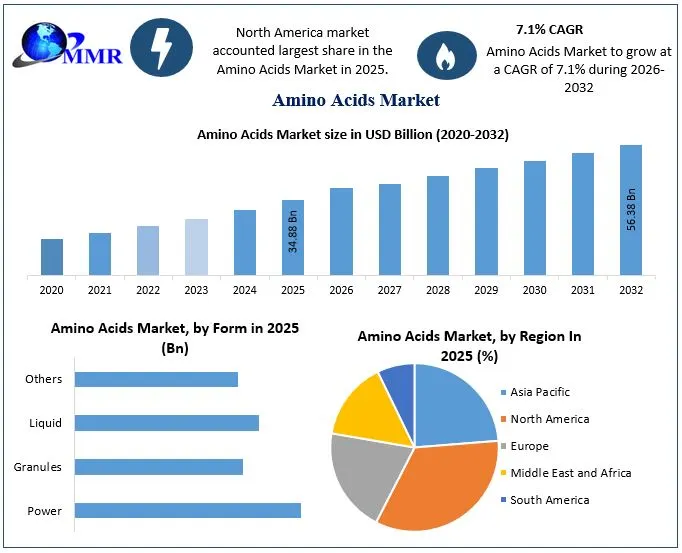
Amino Acids Market GrowthTo know about the Research Methodology :- Request Free Sample Report

Amino Acid Market Dynamics:

Rising demand for animal feed, dietary supplements, and functional foods is driving the market growth

The growing demand for amino acids across animal nutrition, dietary supplements, pharmaceuticals, and functional foods is a major factor driving the global Amino Acid market. Amino acids play a vital role in improving animal growth performance, feed efficiency, and overall health, making them essential ingredients in livestock, poultry, aquaculture, and pet food formulations. Additionally, increasing consumer awareness of preventive healthcare, sports nutrition, and protein-rich diets is boosting the demand for amino acid-based dietary supplements and functional food products. The expanding pharmaceutical industry and rising use of amino acids in drug formulations, clinical nutrition, and biopharmaceutical manufacturing are further supporting market growth.

Fluctuating raw material prices and stringent regulatory requirements are restraining the market growth

The Amino Acid market is influenced by fluctuations in the prices of key raw materials such as corn, sugarcane, molasses, and other fermentation feedstocks, which directly impact production costs and profit margins. In addition, manufacturers must comply with stringent food safety, pharmaceutical quality, and environmental regulations governing amino acid production and commercialization. Regulatory approvals, quality control standards, and increasing operational costs associated with sustainable manufacturing practices may limit market growth, particularly for small and medium-sized producers.

Expanding applications in pharmaceuticals, biotechnology, and personalized nutrition are creating growth opportunities for the market

The increasing application of amino acids in pharmaceuticals, biotechnology, clinical nutrition, cosmetics, and personalized healthcare is creating significant growth opportunities for the market. Rising investments in biopharmaceutical research, cell culture media, regenerative medicine, and precision nutrition are accelerating the demand for high-purity amino acids. Furthermore, advancements in microbial fermentation technologies, bio-based production processes, and synthetic biology are improving manufacturing efficiency while supporting the development of innovative amino acid products for emerging healthcare and industrial applications.

Supply chain disruptions and increasing competition from alternative protein ingredients are challenging the market growth

The global Amino Acid market faces challenges from supply chain disruptions, fluctuating agricultural commodity prices, and geopolitical uncertainties that can affect the availability of raw materials and manufacturing operations. Additionally, increasing competition from alternative protein sources, plant-based ingredients, and novel nutritional formulations is encouraging manufacturers to continuously innovate and differentiate their product portfolios. Maintaining product quality, ensuring cost competitiveness, and meeting evolving consumer preferences for sustainable and clean-label products remain key challenges for market participants throughout the forecast period.

Amino Acid Market Trends:

Growing demand for plant-based nutrition and functional foods is emerging as a key market trend - The increasing consumer preference for plant-based diets, functional foods, and protein-enriched products is driving demand for amino acids across the food and beverage industry. Manufacturers are incorporating essential amino acids into nutritional supplements, fortified foods, meal replacements, and sports nutrition products to meet the growing demand for health and wellness solutions. The rising popularity of vegan and vegetarian lifestyles is further encouraging the development of fermentation-derived and plant-based amino acid ingredients.

Advancements in fermentation technology and bio-based production are transforming amino acid manufacturing - Technological advancements in microbial fermentation, synthetic biology, and metabolic engineering are improving the efficiency, yield, and sustainability of amino acid production. Manufacturers are increasingly adopting bio-based production processes to reduce environmental impact, lower production costs, and meet stringent sustainability requirements. These innovations are enabling the commercialization of high-purity amino acids for applications in food, pharmaceuticals, cosmetics, and animal nutrition.

Rising adoption of amino acids in pharmaceutical and biopharmaceutical applications is expanding market opportunities- - The pharmaceutical and biotechnology industries are increasingly utilizing amino acids in drug formulations, cell culture media, biologics manufacturing, clinical nutrition, and regenerative medicine. Growing investments in precision medicine, biologics, and advanced therapeutics are accelerating the demand for pharmaceutical-grade amino acids. Additionally, the expansion of contract manufacturing and biopharmaceutical research is creating new growth opportunities for amino acid manufacturers worldwide.

Amino Acids Market: Market Segment Analysis:

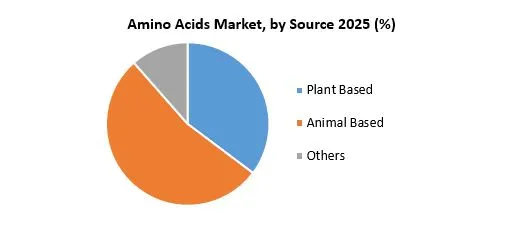
Based on Source: Plant-based natural resources such as soybeans, grains, and corn are gaining popularity due to their growing availability and higher protein concentration. The increasing demand for soybeans has led to their incorporation in the production processes of various commercial products. To ensure a steady supply of raw materials for manufacturing, key market players are implementing integration strategies. These strategies aim to secure high-quality and consistent sources of raw materials. Vertical integration steps not only enhance confidence in the availability of raw materials but also provide opportunities to create new products using existing raw materials. However, it is widely recognized that the processing of soybeans alters the protein ratio, posing a significant challenge in obtaining consistent raw materials.Amino Acids Market by Source
By End User,

The Food and Dietary Supplement segment is expected to dominate the global Amino Acid market during the 2025–2032 forecast period, driven by increasing consumer awareness of health and wellness, rising demand for protein-rich diets, and the growing popularity of functional foods and nutritional supplements. Amino acids are widely used in sports nutrition, clinical nutrition, fortified beverages, infant nutrition, and dietary supplements to support muscle growth, immunity, and overall health. The rising prevalence of lifestyle-related diseases, coupled with the increasing adoption of preventive healthcare and personalized nutrition, is further accelerating demand for amino acid-based food products. Pharmaceutical applications also account for a significant market share, as amino acids are extensively utilized in drug formulations, intravenous nutrition, biologics manufacturing, and regenerative medicine. Continuous investments in biopharmaceutical research and the expanding production of biologics are expected to further strengthen this segment.

Meanwhile, the Agriculture segment is witnessing steady growth owing to the increasing use of amino acids in animal feed, crop nutrition, and biostimulant formulations to improve livestock productivity and agricultural yields. The Personal Care and Cosmetics segment is expected to register healthy growth due to the rising incorporation of amino acids in skincare, haircare, and anti-aging products, where they enhance skin hydration, repair, and overall product performance. Additionally, the Others segment, which includes industrial applications, biotechnology, research laboratories, and chemical manufacturing, continues to expand as amino acids find increasing use in fermentation processes, cell culture media, and specialty chemical production. The broadening application scope across multiple industries is expected to support sustained growth of the global Amino Acid market throughout the forecast period.

Amino Acid Market Regional Insights:

Asia-Pacific dominates the Amino Acid market driven by expanding food processing, animal feed, and pharmaceutical industries

Asia-Pacific holds the largest share of the global Amino Acid market, supported by rapid industrialization, increasing livestock production, and strong demand from the food & beverage, animal nutrition, and pharmaceutical sectors. China, Japan, India, South Korea, and Thailand are major producers and consumers of amino acids, benefiting from well-established fermentation manufacturing capabilities and abundant agricultural feedstocks. The region is also witnessing rising consumption of dietary supplements, functional foods, and sports nutrition products due to increasing health awareness and disposable incomes. Furthermore, expanding pharmaceutical manufacturing and government initiatives promoting biotechnology are contributing to sustained market growth.

North America is witnessing significant growth fueled by rising demand for nutritional supplements and pharmaceutical applications

North America represents a significant market for amino acids due to growing consumer awareness of preventive healthcare, increasing demand for protein supplements, and the expansion of the pharmaceutical and biotechnology industries. The United States and Canada are experiencing strong demand for amino acids in sports nutrition, clinical nutrition, functional foods, and biologics manufacturing. In addition, advancements in fermentation technologies, increasing investments in precision nutrition, and the growing popularity of plant-based protein products are further driving regional market expansion.

Europe maintains a substantial market share supported by clean-label food trends and sustainable production

Europe accounts for a considerable share of the global Amino Acid market owing to increasing demand for clean-label ingredients, functional foods, pharmaceutical products, and sustainable animal nutrition solutions. Countries such as Germany, France, the UK, Italy, and the Netherlands are investing in bio-based production technologies and advanced fermentation processes to improve manufacturing efficiency and reduce environmental impact. Rising consumer preference for natural, non-GMO, and sustainably produced ingredients is also encouraging manufacturers to expand their amino acid product portfolios across food, healthcare, and personal care applications.

Latin America and the Middle East & Africa are emerging markets driven by agricultural development and improving healthcare infrastructure

Latin America and the Middle East & Africa are expected to witness steady growth during the forecast period due to increasing investments in agriculture, livestock production, food processing, and healthcare infrastructure. Countries such as Brazil, Mexico, Saudi Arabia, the UAE, and South Africa are experiencing growing demand for amino acids in animal feed, dietary supplements, pharmaceuticals, and personal care products. The expansion of organized food manufacturing, rising health consciousness, and improving access to nutritional products are expected to create new growth opportunities for amino acid manufacturers across these regions.

Recent Developments In Global Amino Acid Market

Month & Year Recent Developments
May 2025 Ajinomoto Co., Inc. expanded its amino acid production capacity to meet the growing global demand from food, pharmaceutical, and nutrition applications while improving manufacturing efficiency.
March 2025 Evonik Industries AG announced investments in sustainable biotechnology and precision fermentation technologies to strengthen its specialty amino acid portfolio.
January 2025 CJ CheilJedang Corporation expanded its global amino acid manufacturing capabilities and enhanced its fermentation technology to support increasing demand for animal nutrition and food ingredients.
October 2024 ADM introduced new fermentation-based specialty ingredient solutions, strengthening its portfolio for human nutrition, health, and wellness applications.
August 2024 Kyowa Hakko Bio Co., Ltd. expanded its pharmaceutical-grade amino acid portfolio by introducing high-purity ingredients for clinical nutrition and biopharmaceutical applications.

Competitive Landscape - Amino Acid Market

The global Amino Acid market is highly competitive, with leading manufacturers focusing on expanding production capacity, improving fermentation technologies, and developing high-purity amino acids for applications in animal nutrition, food and dietary supplements, pharmaceuticals, personal care, and biotechnology. Companies are investing significantly in research and development to enhance product quality, production efficiency, and sustainability while meeting the growing global demand for functional ingredients. Strategic initiatives such as mergers and acquisitions, capacity expansions, strategic partnerships, and distribution agreements are enabling market participants to strengthen their market presence and expand their global customer base. In addition, manufacturers are increasingly adopting bio-based production methods, precision fermentation, and renewable feedstocks to align with evolving environmental regulations and consumer preferences.

Leading companies are also emphasizing product innovation, regional expansion, and advanced biotechnology to support the growing demand for amino acids across diverse end-use industries. The increasing popularity of personalized nutrition, sports nutrition, pharmaceutical-grade amino acids, and sustainable animal feed additives is encouraging companies to diversify their product portfolios and invest in next-generation manufacturing technologies. Key companies operating in the global Amino Acid market include Ajinomoto Co., Inc., Evonik Industries AG, Kyowa Hakko Bio Co., Ltd., CJ CheilJedang Corporation, ADM, Meihua Holdings Group Co., Ltd., Fufeng Group Limited, Global Bio-chem Technology Group Company Limited, Prinova Group LLC, and Cargill, Incorporated, all of which continue to strengthen their competitive positions through technological innovation, strategic collaborations, and global production expansion.

Amino Acids Market Scope: Inquire before buying

Global Amino Acids Market
Report Coverage Details
Base Year: 2025 Forecast Period: 2026-2032
Historical Data: 2020 to 2025 Market Size in 2025: USD 34.88 Bn.
Forecast Period 2026 to 2032 CAGR: 7.1% Market Size in 2032: USD 56.38 Bn.
Segments Covered: By Form Power
Granules
Liquid
Others
By Source Plant Based
Animal Based
Others
By Grade Pharma
Food
Feed
Others
By Type Lysine
Thymine
Methionine
Glutamic Acid
Alanine
Leucine
Arginine
Glycine
Others
By End User Agriculture
Pharmaceutical
Food and Dietary Supplement
Personal Care and Cosmetics
Others

Amino Acids Market, by Region

North America (United States, Canada and Mexico)
Europe (UK, France, Germany, Italy, Spain, Sweden, Austria and Rest of Europe)
Asia Pacific (China, South Korea, Japan, India, Australia, Indonesia, Malaysia, Vietnam, Taiwan, Bangladesh, Pakistan and Rest of APAC)
Middle East and Africa (South Africa, GCC, Egypt, Nigeria and Rest of ME&A)
South America (Brazil, Argentina Rest of South America)

Amino Acids Market, Key Players

1. Ajinomoto Co., Inc. (Japan)
2. ADM (US)
3. Evonik Industries AG (Germany)
4. CJ CheilJedang Corp. (South Korea)
5. Kyowa Hakko Bio Co., Ltd. (Japan)
6. Sumitomo Chemical Co., Ltd. (Japan)
7. Daesang Corporation (South Korea)
8. Shijiazhuang Donghua Jinlong Chemical Co. Ltd. (China)
9. Yichang Sanxia Pharmaceutical Co., Ltd. (China)
10. Meihua Holdings Group Co., Ltd. (China)
11. Fufeng Group (China)
12. Chengfu Group Co., Ltd. (China)
13. Nippon Rika Co., Ltd. (Japan)
14. Tianjin Tianan Pharmaceuticals Co., Ltd. (China)
15. Amino GmbH (Germany)
16. AminoLogics Co., Ltd. (South Korea)
17. Hiran Orgochem Ltd. (India)
18. Sunrise Nutrachem Group (China)
19. Tai Heng Industry Co., Ltd. (Taiwan)
20. Jinghai Amino Acid Co., Ltd. (China)
21. Chongqing Unisplendour Chemical Co., Ltd. (China)
22. Star Lake Bioscience Co., Ltd. (China)
23. Prinova Group LLC (US)
24. Shandong Fortune Spring Co., Ltd. (China)
25. Archer Daniels Midland Company (US)
26. Wuxi Jinghai Amino Acid Co., Ltd. (China)
27. Sichuan Tongsheng Amino Acid Co., Ltd. (China)

FAQs

1. What is the forecast market size of the Market by 2032?
Ans: The market size of the Amino Acids Market by 2032 is expected to reach USD 56.38 Billion

2. What is the growth rate of Global Amino Acids Market?
Ans: The Global Amino Acids Market is growing at a CAGR of 7.1% during forecasting period 2026-2032.

3. Who are the key players in Global Amino Acids Market?
Ans: Ajinomoto Co., Inc., ADM, Evonik Industries AG, CJ CheilJedang Corp, Kyowa Hakko Bio Co., Ltd., Sumitomo Chemical Co., Ltd., Daesang Corporation, Shijiazhuang Donghua Jinlong Chemical Co. Ltd., Yichang Sanxia Pharmaceutical Co., Ltd, Meihua Holdings Group Co., Ltd.

4. What was the Global Amino Acids Market size in 2025?
Ans: The Global Amino Acids Market size was USD 34.88 Billion in 2025.

Table of Contents

1. Amino Acids Market Introduction 1.1. Study Assumption and Market Definition 1.2. Scope of the Study 1.3. Executive Summary 2. Global Amino Acids Market: Competitive Landscape 2.1. MMR Competition Matrix 2.2. Competitive Landscape 2.3. Key Players Benchmarking 2.3.1. Company Name 2.3.2. Business Segment 2.3.3. End-user Segment 2.3.4. Revenue (2025) 2.3.5. Company Locations 2.4. Leading Amino Acids Market Companies, by market capitalization 2.5. Market Structure 2.5.1. Market Leaders 2.5.2. Market Followers 2.5.3. Emerging Players 2.6. Mergers and Acquisitions Details 3. Amino Acids Market: Dynamics 3.1. Amino Acids Market Trends by Region 3.1.1. North America Amino Acids Market Trends 3.1.2. Europe Amino Acids Market Trends 3.1.3. Asia Pacific Amino Acids Market Trends 3.1.4. Middle East and Africa Amino Acids Market Trends 3.1.5. South America Amino Acids Market Trends 3.2. Amino Acids Market Dynamics by Region 3.2.1. North America 3.2.1.1. North America Amino Acids Market Drivers 3.2.1.2. North America Amino Acids Market Restraints 3.2.1.3. North America Amino Acids Market Opportunities 3.2.1.4. North America Amino Acids Market Challenges 3.2.2. Europe 3.2.2.1. Europe Amino Acids Market Drivers 3.2.2.2. Europe Amino Acids Market Restraints 3.2.2.3. Europe Amino Acids Market Opportunities 3.2.2.4. Europe Amino Acids Market Challenges 3.2.3. Asia Pacific 3.2.3.1. Asia Pacific Amino Acids Market Drivers 3.2.3.2. Asia Pacific Amino Acids Market Restraints 3.2.3.3. Asia Pacific Amino Acids Market Opportunities 3.2.3.4. Asia Pacific Amino Acids Market Challenges 3.2.4. Middle East and Africa 3.2.4.1. Middle East and Africa Amino Acids Market Drivers 3.2.4.2. Middle East and Africa Amino Acids Market Restraints 3.2.4.3. Middle East and Africa Amino Acids Market Opportunities 3.2.4.4. Middle East and Africa Amino Acids Market Challenges 3.2.5. South America 3.2.5.1. South America Amino Acids Market Drivers 3.2.5.2. South America Amino Acids Market Restraints 3.2.5.3. South America Amino Acids Market Opportunities 3.2.5.4. South America Amino Acids Market Challenges 3.3. PORTER's Five Forces Analysis 3.4. PESTLE Analysis 3.5. Technology Roadmap 3.6. Regulatory Landscape by Region 3.6.1. North America 3.6.2. Europe 3.6.3. Asia Pacific 3.6.4. Middle East and Africa 3.6.5. South America 3.7. Key Opinion Leader Analysis For Amino Acids Industry 3.8. Analysis of Government Schemes and Initiatives For Amino Acids Industry 3.9. Amino Acids Market Trade Analysis 3.10. The Global Pandemic Impact on Amino Acids Market 4. Amino Acids Market: Global Market Size and Forecast by Segmentation (in USD Billion) 2025-2032 4.1. Amino Acids Market Size and Forecast, by Form (2025-2032) 4.1.1. Power 4.1.2. Granules 4.1.3. Liquid 4.1.4. Others 4.2. Amino Acids Market Size and Forecast, by Source (2025-2032) 4.2.1. Plant Based 4.2.2. Animal Based 4.2.3. Others 4.3. Amino Acids Market Size and Forecast, by Grade (2025-2032) 4.3.1. Pharma 4.3.2. Food 4.3.3. Feed 4.3.4. Others 4.4. Amino Acids Market Size and Forecast, by Type (2025-2032) 4.4.1. Lysine 4.4.2. Thymine 4.4.3. Methionine 4.4.4. Glutamic Acid 4.4.5. Alanine 4.4.6. Leucine 4.4.7. Arginine 4.4.8. Glycine 4.4.9. Others 4.5. Amino Acids Market Size and Forecast, by End User (2025-2032) 4.5.1. Agriculture 4.5.2. Pharmaceutical 4.5.3. Food and Dietary Supplement 4.5.4. Personal Care and Cosmetics 4.5.5. Others 4.6. Amino Acids Market Size and Forecast, by Region (2025-2032) 4.6.1. North America 4.6.2. Europe 4.6.3. Asia Pacific 4.6.4. Middle East and Africa 4.6.5. South America 5. North America Amino Acids Market Size and Forecast by Segmentation (in USD Billion) 2025-2032 5.1. North America Amino Acids Market Size and Forecast, by Form (2025-2032) 5.1.1. Power 5.1.2. Granules 5.1.3. Liquid 5.1.4. Others 5.2. North America Amino Acids Market Size and Forecast, by Source (2025-2032) 5.2.1. Plant Based 5.2.2. Animal Based 5.2.3. Others 5.3. North America Amino Acids Market Size and Forecast, by Grade (2025-2032) 5.3.1. Pharma 5.3.2. Food 5.3.3. Feed 5.3.4. Others 5.4. North America Amino Acids Market Size and Forecast, by Type (2025-2032) 5.4.1. Lysine 5.4.2. Thymine 5.4.3. Methionine 5.4.4. Glutamic Acid 5.4.5. Alanine 5.4.6. Leucine 5.4.7. Arginine 5.4.8. Glycine 5.4.9. Others 5.5. North America Amino Acids Market Size and Forecast, by End User (2025-2032) 5.5.1. Agriculture 5.5.2. Pharmaceutical 5.5.3. Food and Dietary Supplement 5.5.4. Personal Care and Cosmetics 5.5.5. Others 5.6. North America Amino Acids Market Size and Forecast, by Country (2025-2032) 5.6.1. United States 5.6.1.1. United States Amino Acids Market Size and Forecast, by Form (2025-2032) 5.6.1.1.1. Power 5.6.1.1.2. Granules 5.6.1.1.3. Liquid 5.6.1.1.4. Others 5.6.1.2. United States Amino Acids Market Size and Forecast, by Source (2025-2032) 5.6.1.2.1. Plant Based 5.6.1.2.2. Animal Based 5.6.1.2.3. Others 5.6.1.3. United States Amino Acids Market Size and Forecast, by Grade (2025-2032) 5.6.1.3.1. Pharma 5.6.1.3.2. Food 5.6.1.3.3. Feed 5.6.1.3.4. Others 5.6.1.4. United States Amino Acids Market Size and Forecast, by Type (2025-2032) 5.6.1.4.1. Lysine 5.6.1.4.2. Thymine 5.6.1.4.3. Methionine 5.6.1.4.4. Glutamic Acid 5.6.1.4.5. Alanine 5.6.1.4.6. Leucine 5.6.1.4.7. Arginine 5.6.1.4.8. Glycine 5.6.1.4.9. Others 5.6.1.5. United States Amino Acids Market Size and Forecast, by End User (2025-2032) 5.6.1.5.1. Agriculture 5.6.1.5.2. Pharmaceutical 5.6.1.5.3. Food and Dietary Supplement 5.6.1.5.4. Personal Care and Cosmetics 5.6.1.5.5. Others 5.6.2. Canada 5.6.2.1. Canada Amino Acids Market Size and Forecast, by Form (2025-2032) 5.6.2.1.1. Power 5.6.2.1.2. Granules 5.6.2.1.3. Liquid 5.6.2.1.4. Others 5.6.2.2. Canada Amino Acids Market Size and Forecast, by Source (2025-2032) 5.6.2.2.1. Plant Based 5.6.2.2.2. Animal Based 5.6.2.2.3. Others 5.6.2.3. Canada Amino Acids Market Size and Forecast, by Grade (2025-2032) 5.6.2.3.1. Pharma 5.6.2.3.2. Food 5.6.2.3.3. Feed 5.6.2.3.4. Others 5.6.2.4. Canada Amino Acids Market Size and Forecast, by Type (2025-2032) 5.6.2.4.1. Lysine 5.6.2.4.2. Thymine 5.6.2.4.3. Methionine 5.6.2.4.4. Glutamic Acid 5.6.2.4.5. Alanine 5.6.2.4.6. Leucine 5.6.2.4.7. Arginine 5.6.2.4.8. Glycine 5.6.2.4.9. Others 5.6.2.5. Canada Amino Acids Market Size and Forecast, by End User (2025-2032) 5.6.2.5.1. Agriculture 5.6.2.5.2. Pharmaceutical 5.6.2.5.3. Food and Dietary Supplement 5.6.2.5.4. Personal Care and Cosmetics 5.6.2.5.5. Others 5.6.3. Mexico 5.6.3.1. Mexico Amino Acids Market Size and Forecast, by Form (2025-2032) 5.6.3.1.1. Power 5.6.3.1.2. Granules 5.6.3.1.3. Liquid 5.6.3.1.4. Others 5.6.3.2. Mexico Amino Acids Market Size and Forecast, by Source (2025-2032) 5.6.3.2.1. Plant Based 5.6.3.2.2. Animal Based 5.6.3.2.3. Others 5.6.3.3. Mexico Amino Acids Market Size and Forecast, by Grade (2025-2032) 5.6.3.3.1. Pharma 5.6.3.3.2. Food 5.6.3.3.3. Feed 5.6.3.3.4. Others 5.6.3.4. Mexico Amino Acids Market Size and Forecast, by Type (2025-2032) 5.6.3.4.1. Lysine 5.6.3.4.2. Thymine 5.6.3.4.3. Methionine 5.6.3.4.4. Glutamic Acid 5.6.3.4.5. Alanine 5.6.3.4.6. Leucine 5.6.3.4.7. Arginine 5.6.3.4.8. Glycine 5.6.3.4.9. Others 5.6.3.5. Mexico Amino Acids Market Size and Forecast, by End User (2025-2032) 5.6.3.5.1. Agriculture 5.6.3.5.2. Pharmaceutical 5.6.3.5.3. Food and Dietary Supplement 5.6.3.5.4. Personal Care and Cosmetics 5.6.3.5.5. Others 6. Europe Amino Acids Market Size and Forecast by Segmentation (in USD Billion) 2025-2032 6.1. Europe Amino Acids Market Size and Forecast, by Form (2025-2032) 6.2. Europe Amino Acids Market Size and Forecast, by Source (2025-2032) 6.3. Europe Amino Acids Market Size and Forecast, by Grade (2025-2032) 6.4. Europe Amino Acids Market Size and Forecast, by Type (2025-2032) 6.5. Europe Amino Acids Market Size and Forecast, by End User (2025-2032) 6.6. Europe Amino Acids Market Size and Forecast, by Country (2025-2032) 6.6.1. United Kingdom 6.6.1.1. United Kingdom Amino Acids Market Size and Forecast, by Form (2025-2032) 6.6.1.2. United Kingdom Amino Acids Market Size and Forecast, by Source (2025-2032) 6.6.1.3. United Kingdom Amino Acids Market Size and Forecast, by Grade (2025-2032) 6.6.1.4. United Kingdom Amino Acids Market Size and Forecast, by Type (2025-2032) 6.6.1.5. United Kingdom Amino Acids Market Size and Forecast, by End User (2025-2032) 6.6.2. France 6.6.2.1. France Amino Acids Market Size and Forecast, by Form (2025-2032) 6.6.2.2. France Amino Acids Market Size and Forecast, by Source (2025-2032) 6.6.2.3. France Amino Acids Market Size and Forecast, by Grade (2025-2032) 6.6.2.4. France Amino Acids Market Size and Forecast, by Type (2025-2032) 6.6.2.5. France Amino Acids Market Size and Forecast, by End User (2025-2032) 6.6.3. Germany 6.6.3.1. Germany Amino Acids Market Size and Forecast, by Form (2025-2032) 6.6.3.2. Germany Amino Acids Market Size and Forecast, by Source (2025-2032) 6.6.3.3. Germany Amino Acids Market Size and Forecast, by Grade (2025-2032) 6.6.3.4. Germany Amino Acids Market Size and Forecast, by Type (2025-2032) 6.6.3.5. Germany Amino Acids Market Size and Forecast, by End User (2025-2032) 6.6.4. Italy 6.6.4.1. Italy Amino Acids Market Size and Forecast, by Form (2025-2032) 6.6.4.2. Italy Amino Acids Market Size and Forecast, by Source (2025-2032) 6.6.4.3. Italy Amino Acids Market Size and Forecast, by Grade (2025-2032) 6.6.4.4. Italy Amino Acids Market Size and Forecast, by Type (2025-2032) 6.6.4.5. Italy Amino Acids Market Size and Forecast, by End User (2025-2032) 6.6.5. Spain 6.6.5.1. Spain Amino Acids Market Size and Forecast, by Form (2025-2032) 6.6.5.2. Spain Amino Acids Market Size and Forecast, by Source (2025-2032) 6.6.5.3. Spain Amino Acids Market Size and Forecast, by Grade (2025-2032) 6.6.5.4. Spain Amino Acids Market Size and Forecast, by Type (2025-2032) 6.6.5.5. Spain Amino Acids Market Size and Forecast, by End User (2025-2032) 6.6.6. Sweden 6.6.6.1. Sweden Amino Acids Market Size and Forecast, by Form (2025-2032) 6.6.6.2. Sweden Amino Acids Market Size and Forecast, by Source (2025-2032) 6.6.6.3. Sweden Amino Acids Market Size and Forecast, by Grade (2025-2032) 6.6.6.4. Sweden Amino Acids Market Size and Forecast, by Type (2025-2032) 6.6.6.5. Sweden Amino Acids Market Size and Forecast, by End User (2025-2032) 6.6.7. Austria 6.6.7.1. Austria Amino Acids Market Size and Forecast, by Form (2025-2032) 6.6.7.2. Austria Amino Acids Market Size and Forecast, by Source (2025-2032) 6.6.7.3. Austria Amino Acids Market Size and Forecast, by Grade (2025-2032) 6.6.7.4. Austria Amino Acids Market Size and Forecast, by Type (2025-2032) 6.6.7.5. Austria Amino Acids Market Size and Forecast, by End User (2025-2032) 6.6.8. Rest of Europe 6.6.8.1. Rest of Europe Amino Acids Market Size and Forecast, by Form (2025-2032) 6.6.8.2. Rest of Europe Amino Acids Market Size and Forecast, by Source (2025-2032) 6.6.8.3. Rest of Europe Amino Acids Market Size and Forecast, by Grade (2025-2032) 6.6.8.4. Rest of Europe Amino Acids Market Size and Forecast, by Type (2025-2032) 6.6.8.5. Rest of Europe Amino Acids Market Size and Forecast, by End User (2025-2032) 7. Asia Pacific Amino Acids Market Size and Forecast by Segmentation (in USD Billion) 2025-2032 7.1. Asia Pacific Amino Acids Market Size and Forecast, by Form (2025-2032) 7.2. Asia Pacific Amino Acids Market Size and Forecast, by Source (2025-2032) 7.3. Asia Pacific Amino Acids Market Size and Forecast, by Grade (2025-2032) 7.4. Asia Pacific Amino Acids Market Size and Forecast, by Type (2025-2032) 7.5. Asia Pacific Amino Acids Market Size and Forecast, by End User (2025-2032) 7.6. Asia Pacific Amino Acids Market Size and Forecast, by Country (2025-2032) 7.6.1. China 7.6.1.1. China Amino Acids Market Size and Forecast, by Form (2025-2032) 7.6.1.2. China Amino Acids Market Size and Forecast, by Source (2025-2032) 7.6.1.3. China Amino Acids Market Size and Forecast, by Grade (2025-2032) 7.6.1.4. China Amino Acids Market Size and Forecast, by Type (2025-2032) 7.6.1.5. China Amino Acids Market Size and Forecast, by End User (2025-2032) 7.6.2. S Korea 7.6.2.1. S Korea Amino Acids Market Size and Forecast, by Form (2025-2032) 7.6.2.2. S Korea Amino Acids Market Size and Forecast, by Source (2025-2032) 7.6.2.3. S Korea Amino Acids Market Size and Forecast, by Grade (2025-2032) 7.6.2.4. S Korea Amino Acids Market Size and Forecast, by Type (2025-2032) 7.6.2.5. S Korea Amino Acids Market Size and Forecast, by End User (2025-2032) 7.6.3. Japan 7.6.3.1. Japan Amino Acids Market Size and Forecast, by Form (2025-2032) 7.6.3.2. Japan Amino Acids Market Size and Forecast, by Source (2025-2032) 7.6.3.3. Japan Amino Acids Market Size and Forecast, by Grade (2025-2032) 7.6.3.4. Japan Amino Acids Market Size and Forecast, by Type (2025-2032) 7.6.3.5. Japan Amino Acids Market Size and Forecast, by End User (2025-2032) 7.6.4. India 7.6.4.1. India Amino Acids Market Size and Forecast, by Form (2025-2032) 7.6.4.2. India Amino Acids Market Size and Forecast, by Source (2025-2032) 7.6.4.3. India Amino Acids Market Size and Forecast, by Grade (2025-2032) 7.6.4.4. India Amino Acids Market Size and Forecast, by Type (2025-2032) 7.6.4.5. India Amino Acids Market Size and Forecast, by End User (2025-2032) 7.6.5. Australia 7.6.5.1. Australia Amino Acids Market Size and Forecast, by Form (2025-2032) 7.6.5.2. Australia Amino Acids Market Size and Forecast, by Source (2025-2032) 7.6.5.3. Australia Amino Acids Market Size and Forecast, by Grade (2025-2032) 7.6.5.4. Australia Amino Acids Market Size and Forecast, by Type (2025-2032) 7.6.5.5. Australia Amino Acids Market Size and Forecast, by End User (2025-2032) 7.6.6. Indonesia 7.6.6.1. Indonesia Amino Acids Market Size and Forecast, by Form (2025-2032) 7.6.6.2. Indonesia Amino Acids Market Size and Forecast, by Source (2025-2032) 7.6.6.3. Indonesia Amino Acids Market Size and Forecast, by Grade (2025-2032) 7.6.6.4. Indonesia Amino Acids Market Size and Forecast, by Type (2025-2032) 7.6.6.5. Indonesia Amino Acids Market Size and Forecast, by End User (2025-2032) 7.6.7. Malaysia 7.6.7.1. Malaysia Amino Acids Market Size and Forecast, by Form (2025-2032) 7.6.7.2. Malaysia Amino Acids Market Size and Forecast, by Source (2025-2032) 7.6.7.3. Malaysia Amino Acids Market Size and Forecast, by Grade (2025-2032) 7.6.7.4. Malaysia Amino Acids Market Size and Forecast, by Type (2025-2032) 7.6.7.5. Malaysia Amino Acids Market Size and Forecast, by End User (2025-2032) 7.6.8. Vietnam 7.6.8.1. Vietnam Amino Acids Market Size and Forecast, by Form (2025-2032) 7.6.8.2. Vietnam Amino Acids Market Size and Forecast, by Source (2025-2032) 7.6.8.3. Vietnam Amino Acids Market Size and Forecast, by Grade (2025-2032) 7.6.8.4. Vietnam Amino Acids Market Size and Forecast, by Type (2025-2032) 7.6.8.5. Vietnam Amino Acids Market Size and Forecast, by End User (2025-2032) 7.6.9. Taiwan 7.6.9.1. Taiwan Amino Acids Market Size and Forecast, by Form (2025-2032) 7.6.9.2. Taiwan Amino Acids Market Size and Forecast, by Source (2025-2032) 7.6.9.3. Taiwan Amino Acids Market Size and Forecast, by Grade (2025-2032) 7.6.9.4. Taiwan Amino Acids Market Size and Forecast, by Type (2025-2032) 7.6.9.5. Taiwan Amino Acids Market Size and Forecast, by End User (2025-2032) 7.6.10. Rest of Asia Pacific 7.6.10.1. Rest of Asia Pacific Amino Acids Market Size and Forecast, by Form (2025-2032) 7.6.10.2. Rest of Asia Pacific Amino Acids Market Size and Forecast, by Source (2025-2032) 7.6.10.3. Rest of Asia Pacific Amino Acids Market Size and Forecast, by Grade (2025-2032) 7.6.10.4. Rest of Asia Pacific Amino Acids Market Size and Forecast, by Type (2025-2032) 7.6.10.5. Rest of Asia Pacific Amino Acids Market Size and Forecast, by End User (2025-2032) 8. Middle East and Africa Amino Acids Market Size and Forecast by Segmentation (in USD Billion) 2025-2032 8.1. Middle East and Africa Amino Acids Market Size and Forecast, by Form (2025-2032) 8.2. Middle East and Africa Amino Acids Market Size and Forecast, by Source (2025-2032) 8.3. Middle East and Africa Amino Acids Market Size and Forecast, by Grade (2025-2032) 8.4. Middle East and Africa Amino Acids Market Size and Forecast, by Type (2025-2032) 8.5. Middle East and Africa Amino Acids Market Size and Forecast, by End User (2025-2032) 8.6. Middle East and Africa Amino Acids Market Size and Forecast, by Country (2025-2032) 8.6.1. South Africa 8.6.1.1. South Africa Amino Acids Market Size and Forecast, by Form (2025-2032) 8.6.1.2. South Africa Amino Acids Market Size and Forecast, by Source (2025-2032) 8.6.1.3. South Africa Amino Acids Market Size and Forecast, by Grade (2025-2032) 8.6.1.4. South Africa Amino Acids Market Size and Forecast, by Type (2025-2032) 8.6.1.5. South Africa Amino Acids Market Size and Forecast, by End User (2025-2032) 8.6.2. GCC 8.6.2.1. GCC Amino Acids Market Size and Forecast, by Form (2025-2032) 8.6.2.2. GCC Amino Acids Market Size and Forecast, by Source (2025-2032) 8.6.2.3. GCC Amino Acids Market Size and Forecast, by Grade (2025-2032) 8.6.2.4. GCC Amino Acids Market Size and Forecast, by Type (2025-2032) 8.6.2.5. GCC Amino Acids Market Size and Forecast, by End User (2025-2032) 8.6.3. Nigeria 8.6.3.1. Nigeria Amino Acids Market Size and Forecast, by Form (2025-2032) 8.6.3.2. Nigeria Amino Acids Market Size and Forecast, by Source (2025-2032) 8.6.3.3. Nigeria Amino Acids Market Size and Forecast, by Grade (2025-2032) 8.6.3.4. Nigeria Amino Acids Market Size and Forecast, by Type (2025-2032) 8.6.3.5. Nigeria Amino Acids Market Size and Forecast, by End User (2025-2032) 8.6.4. Rest of ME&A 8.6.4.1. Rest of ME&A Amino Acids Market Size and Forecast, by Form (2025-2032) 8.6.4.2. Rest of ME&A Amino Acids Market Size and Forecast, by Source (2025-2032) 8.6.4.3. Rest of ME&A Amino Acids Market Size and Forecast, by Grade (2025-2032) 8.6.4.4. Rest of ME&A Amino Acids Market Size and Forecast, by Type (2025-2032) 8.6.4.5. Rest of ME&A Amino Acids Market Size and Forecast, by End User (2025-2032) 9. South America Amino Acids Market Size and Forecast by Segmentation (in USD Billion) 2025-2032 9.1. South America Amino Acids Market Size and Forecast, by Form (2025-2032) 9.2. South America Amino Acids Market Size and Forecast, by Source (2025-2032) 9.3. South America Amino Acids Market Size and Forecast, by Grade (2025-2032) 9.4. South America Amino Acids Market Size and Forecast, by Type (2025-2032) 9.5. South America Amino Acids Market Size and Forecast, by End User (2025-2032) 9.6. South America Amino Acids Market Size and Forecast, by Country (2025-2032) 9.6.1. Brazil 9.6.1.1. Brazil Amino Acids Market Size and Forecast, by Form (2025-2032) 9.6.1.2. Brazil Amino Acids Market Size and Forecast, by Source (2025-2032) 9.6.1.3. Brazil Amino Acids Market Size and Forecast, by Grade (2025-2032) 9.6.1.4. Brazil Amino Acids Market Size and Forecast, by Type (2025-2032) 9.6.1.5. Brazil Amino Acids Market Size and Forecast, by End User (2025-2032) 9.6.2. Argentina 9.6.2.1. Argentina Amino Acids Market Size and Forecast, by Form (2025-2032) 9.6.2.2. Argentina Amino Acids Market Size and Forecast, by Source (2025-2032) 9.6.2.3. Argentina Amino Acids Market Size and Forecast, by Grade (2025-2032) 9.6.2.4. Argentina Amino Acids Market Size and Forecast, by Type (2025-2032) 9.6.2.5. Argentina Amino Acids Market Size and Forecast, by End User (2025-2032) 9.6.3. Rest Of South America 9.6.3.1. Rest Of South America Amino Acids Market Size and Forecast, by Form (2025-2032) 9.6.3.2. Rest Of South America Amino Acids Market Size and Forecast, by Source (2025-2032) 9.6.3.3. Rest Of South America Amino Acids Market Size and Forecast, by Grade (2025-2032) 9.6.3.4. Rest Of South America Amino Acids Market Size and Forecast, by Type (2025-2032) 9.6.3.5. Rest Of South America Amino Acids Market Size and Forecast, by End User (2025-2032) 10. Company Profile: Key Players 10.1. Ajinomoto Co. 10.1.1. Company Overview 10.1.2. Business Portfolio 10.1.3. Financial Overview 10.1.4. SWOT Analysis 10.1.5. Strategic Analysis 10.1.6. Scale of Operation (small, medium, and large) 10.1.7. Details on Partnership 10.1.8. Regulatory Accreditations and Certifications Received by Them 10.1.9. Awards Received by the Firm 10.1.10. Recent Developments 10.2. Inc. (Japan) 10.3. ADM (US) 10.4. Evonik Industries AG (Germany) 10.5. CJ CheilJedang Corp. (South Korea) 10.6. Kyowa Hakko Bio Co. 10.7. Ltd. (Japan) 10.8. Sumitomo Chemical Co. 10.9. Daesang Corporation (South Korea) 10.10. Shijiazhuang Donghua Jinlong Chemical Co. Ltd. (China) 10.11. Yichang Sanxia Pharmaceutical Co. 10.12. Ltd. (China) 10.13. Meihua Holdings Group Co. 10.14. Fufeng Group (China) 10.15. Chengfu Group Co. 10.16. Nippon Rika Co. 10.17. Tianjin Tianan Pharmaceuticals Co. 10.18. Amino GmbH (Germany) 10.19. AminoLogics Co. 10.20. Ltd. (South Korea) 10.21. Hiran Orgochem Ltd. (India) 10.22. Sunrise Nutrachem Group (China) 10.23. Tai Heng Industry Co. 10.24. Ltd. (Taiwan) 10.25. Jinghai Amino Acid Co. 10.26. Chongqing Unisplendour Chemical Co. 10.27. Star Lake Bioscience Co. 10.28. Prinova Group LLC (US) 10.29. Shandong Fortune Spring Co. 10.30. Archer Daniels Midland Company (US) 10.31. Wuxi Jinghai Amino Acid Co. 10.32. Sichuan Tongsheng Amino Acid Co. 11. Key Findings 12. Industry Recommendations 13. Amino Acids Market: Research Methodology 14. Terms and Glossary

Custom Market Research Services

We Will Customise The Research For You, In Case The Report Listed Above Does Not Meet With Your Requirements