
Global Air Fryer Market by Product, by End User, by Price Range, by Distribution Channel, by Region and Forecast 2034
Overview
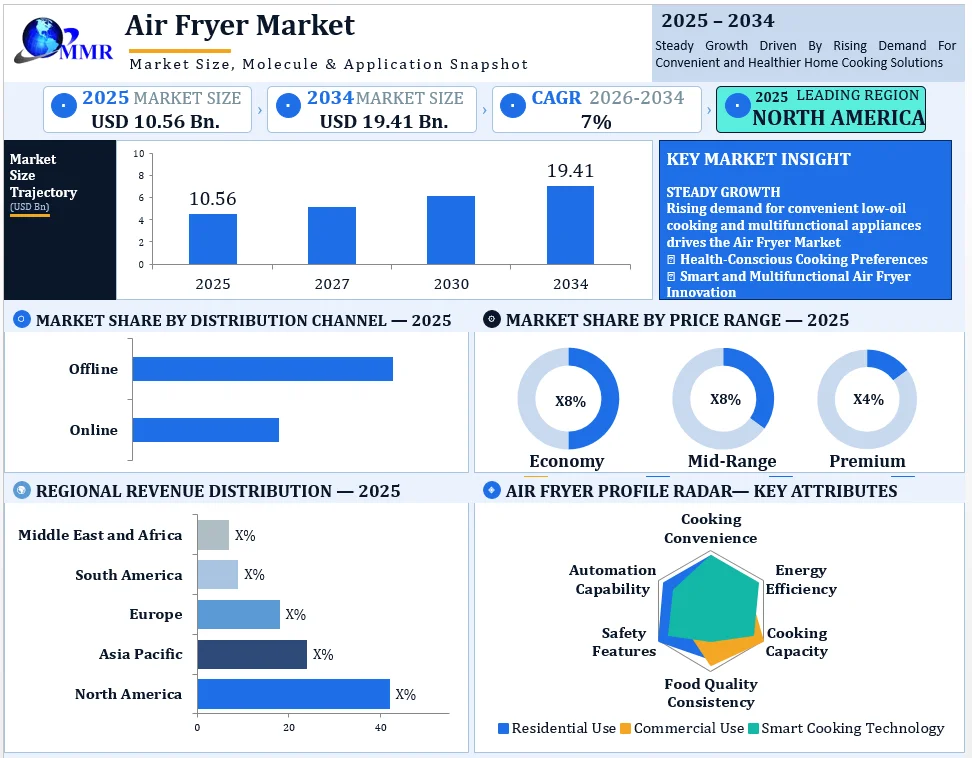
The Global Air Fryer Market size was valued at USD 10.56 Billion in 2025 and the total Air Fryer revenue is expected to grow at a CAGR of 7% from 2026 to 2034, reaching USD 19.41 Billion by 2034.
Global Air Fryer Market Overview:
The Air Fryer Market comprises appliances designed to cook food using rapidly circulating hot air, delivering a crispy texture with minimal oil compared with conventional deep frying. Air fryers are gaining popularity as convenient kitchen appliances that support healthier cooking habits, faster meal preparation, energy-conscious cooking, and versatile food preparation for modern households.
The Air Fryer Market is growing as health-conscious consumers, working professionals, young families, and urban households increasingly prefer convenient cooking appliances that combine speed, versatility, and reduced-oil food preparation. North America represents an established market, while Asia Pacific offers significant growth potential through rising disposable incomes, urbanisation, digital retail expansion, and growing awareness of modern kitchen appliances. Key players such as Philips and SharkNinja are strengthening competition through multifunctional designs, smart cooking features, and improved product performance. In India, government public-health messaging encouraging lower cooking-oil consumption also supports consumer interest in alternative cooking methods, although air fryers alone do not guarantee healthier diets.
The MMR Air Fryer Market Report provides an in-depth assessment of market trends, growth drivers, restraints, emerging technologies, competitive positioning, regional demand, and consumer purchasing behaviour. The research identifies opportunities in multifunctional air fryers, smart kitchen integration, compact designs, energy-conscious cooking, affordable product offerings, premium appliances, and expanding e-commerce distribution. It helps manufacturers, investors, suppliers, and retailers evaluate changing customer preferences, product innovation strategies, market entry opportunities, and competitive developments to support informed business decisions.
Global Air Fryer Market Size, Growth and Share Analysis
To know about the Research Methodology :- Request Free Sample Report
Global Air Fryer Market Key Highlights
| Key Highlight |
Analytical Insights |
|---|---|
| Market Growth Outlook | The Air Fryer Market is valued at USD 10.56 billion in 2025 and is projected to reach USD 19.41 billion by 2034, growing at a CAGR of 7% during the forecast period. |
| Regional Market Leadership |
North America leads the market, supported by established appliance brands, strong retail networks, and consumer demand for convenient cooking solutions. Asia Pacific offers growth opportunities through urbanisation, rising disposable incomes, and increasing adoption of modern kitchen appliances. |
| Product Segment Leadership |
Digital Air Fryers are the leading product segment, benefiting from programmable timers, precise temperature controls, preset cooking functions, and convenient operation. Manual air fryers remain relevant for price-sensitive consumers. |
| End User Demand | Residential consumers represent the primary demand base, driven by everyday meal preparation, reduced-oil cooking preferences, and multifunctional appliance adoption. Commercial users provide additional opportunities in restaurants, cafés, and foodservice kitchens. |
| Competitive Landscape and Innovation |
Philips, SharkNinja, Cosori, Groupe SEB, and Instant Brands compete through product innovation, dual-basket designs, smart controls, improved cooking performance, and differentiated pricing. Multifunctional appliances and space-efficient designs are important areas of product development. |
Global Air Fryer Market Dynamics:
Rising Health Awareness and Demand for Low-Oil Cooking Appliances Drive Air Fryer Market Growth
Increasing consumer awareness of healthy eating and convenient meal preparation is driving demand in the Air Fryer Market as households seek alternatives to conventional deep frying. The World Health Organization recommends limiting total fat intake to 30% or less of total energy intake for adults, supporting broader interest in balanced cooking practices. Air fryers circulate hot air to prepare vegetables, meat, seafood, and frozen foods with little or no added oil, depending on the recipe. Growing demand from working professionals, fitness-conscious consumers, and families is encouraging manufacturers to introduce adjustable temperature settings, digital timers, preset cooking modes, and multifunctional designs. In addition, the availability of compact models and larger-capacity appliances suited to different household sizes is strengthening consumer interest in modern kitchen appliances, supporting air fryer adoption across residential markets.
High Initial Purchase Costs and Limited Basket Capacity Restrict Air Fryer Market Adoption
High upfront costs and practical cooking limitations continue to restrict the adoption of air fryers among price-sensitive consumers. Basic models may be affordable, but premium appliances featuring dual baskets, smart connectivity, digital controls, and multiple cooking functions can carry substantially higher prices. Limited basket capacity can also create difficulties for larger households, as preparing meals in several batches increases cooking time and reduces convenience. Consumers may additionally face cleaning requirements, replacement accessory costs, non-stick coating wear, and inconsistent results when food is overcrowded. These concerns are particularly relevant in markets where conventional frying pans, ovens, and stovetop cooking remain familiar and economical options. Consequently, manufacturers must balance product pricing, durability, cooking capacity, and ease of maintenance to improve affordability and encourage purchases among first-time buyers.
Smart Features and Multifunctional Designs Create New Opportunities in the Air Fryer Market
Technological innovation and changing household cooking preferences offer manufacturers opportunities to differentiate air fryer products and reach new consumer groups. Smart connectivity, programmable cooking cycles, dual-zone temperature controls, automatic shut-off functions, and multifunctional cooking modes can improve convenience and product usability. The United States Department of Energy identifies energy efficiency as an important consideration in household appliance use, creating an opportunity for brands to communicate verified energy performance through comparable cooking tests rather than unsupported savings claims. Compact appliances can appeal to students, single-person households, and apartment residents, while larger models can target families requiring greater cooking capacity. Manufacturers can also develop region-specific cooking presets, accessories, and recipe applications for popular local dishes. Affordable product ranges, online retail channels, and improved after-sales support can further help brands reach underserved consumers and strengthen their competitive position.
Intense Brand Competition and Product Safety Requirements Challenge Air Fryer Market Participants
Intensifying competition among established appliance manufacturers and emerging brands presents a major challenge for the Air Fryer Market, particularly as similar product features make differentiation increasingly difficult. Companies compete on price, basket capacity, heating performance, product design, digital controls, and warranty coverage, creating pressure on profit margins and marketing expenditure. Manufacturers must also meet applicable electrical safety and food-contact material requirements while addressing overheating risks, hot external surfaces, ventilation needs, and the durability of non-stick coatings. Compliance testing and quality assurance can increase product development costs, particularly for companies selling across multiple countries with different regulatory requirements. Customer expectations for reliable cooking results, easy cleaning, and responsive after-sales service add further pressure. Brands that cannot maintain consistent product quality or substantiate claims about cooking performance and energy consumption may experience negative reviews and reduced consumer confidence, making product reliability and transparent communication essential for sustained competitiveness.
Global Air Fryer Market – Key Trends
| Market Trend | Descritpion |
|---|---|
| Multifunctional Air Fryers with Advanced Cooking Modes |
Manufacturers are developing air fryers that combine frying, baking, roasting, grilling, reheating, and dehydrating in a single appliance. INALSA introduced its Aero Smart 30 Air Fryer Oven in September 2026 with 18 preset cooking functions, reflecting demand for versatile kitchen appliances that reduce the need for separate equipment. |
| Dual-Basket Air Fryers for Simultaneous Meal Preparation |
Dual-basket technology is gaining attention among families and time-conscious consumers who want to cook different foods at different temperatures. Bosch introduced double-drawer models with independent cooking zones and synchronised finishing functions in 2026, addressing the need to prepare main dishes and side dishes together. |
| Smart Air Fryers with Connected Cooking Controls | Digital displays, app-based controls, guided recipes, and programmable cooking settings are becoming important product differentiators. These features help users manage cooking time and temperature more precisely, while manufacturers use connected functionality to attract technology-oriented consumers seeking convenient and consistent meal preparation. |
| Glass Cooking Containers and Alternative Interior Materials |
Manufacturers are introducing transparent glass cooking containers and alternative food-contact surfaces to address consumer interest in food visibility, cleaning convenience, and material choices. SharkNinja launched its Ninja CRISPi glass cooking system in India in September 2026, featuring transparent borosilicate glass containers and a reheating function. |
| Compact Designs and Space-Efficient Cooking Capacity |
Space-saving designs are becoming relevant for apartment residents and households with limited countertop space. INALSA's vertically stacked DuoSlim air fryer, launched in India in May 2026, combines two independent cooking baskets within a vertical layout, illustrating how manufacturers are balancing larger cooking capacity with efficient kitchen space utilisation. |
Global Air Fryer Market Segment Analysis:
By Product, Digital Air Fryers are the leading and trending segment of the Air Fryer Market, driven by consumer preference for convenient cooking, precise temperature adjustment, programmable timers, and preset cooking functions. Digital models appeal to busy households seeking consistent cooking results and versatile meal preparation, while touchscreen interfaces and smart features support premium product positioning. Manual Air Fryers continue to attract budget-conscious buyers because of their straightforward controls, ease of use, and generally lower purchase prices. As consumers increasingly value convenience and cooking precision, digital models are well positioned to maintain their market leadership. Industry estimates also identify digital air fryers as the leading segment in 2025.
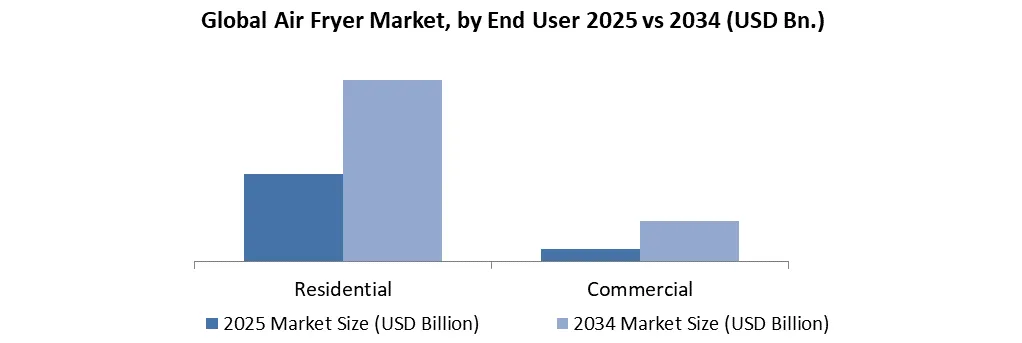
By End User, The Residential segment is the leading end-user segment in the Air Fryer Market, supported by growing household interest in convenient cooking, reduced-oil food preparation, and appliances that simplify everyday meal preparation. Working professionals, small families, and health-conscious consumers are increasingly choosing air fryers for preparing snacks, vegetables, meat, and complete meals with less hands-on cooking. Digital controls, compact designs, and multifunctional cooking programmes further support residential demand. Meanwhile, the Commercial segment serves restaurants, cafés, hotels, and other foodservice businesses seeking consistent food preparation and efficient kitchen workflows. Commercial adoption depends on cooking capacity, durability, service requirements, and the volume of food prepared. Residential use currently represents the stronger demand base, while commercial kitchens offer opportunities where air fryers suit specific menu items and service needs.
Global Air Fryer Market Regional analysis
North America is the leading region in Air Fryer Market, supported by widespread awareness of modern kitchen appliances, established retail networks, and consumer preference for convenient, low-oil cooking. Households in the United States and Canada are showing interest in digital air fryers, dual-basket models, and multifunctional appliances that simplify everyday meal preparation. Strong e-commerce platforms, product reviews, promotional offers, and established appliance brands also influence purchasing decisions. Demand increasingly reflects product upgrades, premium features, and replacement purchases as consumers seek improved cooking performance and greater convenience.
Asia Pacific is emerging as an important growth region for the Air Fryer Market, driven by rising disposable incomes, urban lifestyles, growing interest in convenient cooking, and wider access to online appliance retail. China, India, Japan, and South Korea offer varied opportunities based on consumer spending patterns, household sizes, and preferences for compact or technologically advanced appliances. Manufacturers are targeting price-sensitive buyers with affordable models while introducing digital controls, multiple cooking functions, and space-saving designs for urban households. Local distribution networks and increasing product awareness are also helping air fryers reach a broader range of consumers.
Europe maintains a significant position in the Air Fryer Market, supported by consumer interest in convenient meal preparation, modern kitchen design, and appliances that can prepare food with less added oil. Demand across the United Kingdom, Germany, France, Italy, and other European countries is influenced by product reliability, cooking performance, energy consumption, and ease of cleaning. Digital controls, multifunctional cooking capabilities, and compact countertop designs appeal to households seeking practical alternatives for everyday cooking. Retail availability, established appliance brands, and consumer attention to product quality continue to shape regional purchasing preferences.
South America presents opportunities for the Air Fryer Market as consumers gain greater access to modern kitchen appliances through online marketplaces, organised retailers, and specialist electronics stores. Brazil and Mexico are important markets for products that combine affordability, practical cooking capacity, and ease of use. Demand is influenced by household purchasing power, product availability, promotional pricing, and growing interest in convenient meal preparation. Manufacturers that offer competitively priced digital air fryers, reliable after-sales service, and products suited to local cooking habits can strengthen their presence across the region.
The Middle East and Africa region offers emerging opportunities for the Air Fryer Market through urban household growth, modern retail development, and rising interest in convenient kitchen appliances. Demand in countries such as the United Arab Emirates, Saudi Arabia, and South Africa is supported by consumer interest in premium home appliances, digital cooking functions, and multifunctional designs. In other markets, affordability, electricity access, product availability, and after-sales support remain important purchasing considerations. Wider e-commerce access and a broader selection of entry-level and mid-range products can help manufacturers reach additional consumers across the region.
Global Air Fryer Market Competitive Landscape
The Air Fryer Market is characterised by strong competition among established kitchen appliance manufacturers and emerging brands, with companies focusing on product innovation, digital cooking technology, premium designs, and competitive pricing to strengthen their market positions. SharkNinja competes through its Ninja range of dual-basket and multifunctional air fryers, while Philips leverages its established expertise in hot-air cooking technology and premium kitchen appliances. Cosori differentiates itself through digital controls, connected cooking features, and online retail engagement, whereas Groupe SEB competes through its Tefal and Moulinex brands. Other significant participants include Instant Brands, Breville Group, De’Longhi Group, Midea Group, Xiaomi, Cuisinart, Havells India, and TTK Prestige. Competitive differentiation increasingly depends on cooking performance, basket capacity, smart features, energy efficiency, product durability, distribution reach, and after-sales service. Companies that align product development with consumer demand for convenient, reliable, and versatile cooking appliances are well positioned to strengthen brand recognition and capture new opportunities in the Air Fryer Market.
Global Air Fryer Market Recent Development
| Month | Company | Recent Development |
|---|---|---|
| January 2026 | Cosori | Cosori introduced its Iconic smart air fryer featuring stainless steel construction, ceramic coated cooking surfaces, adjustable fan speeds, and connected cooking guidance through the VeSync application. |
| April 2026 | Crompton | Crompton launched the Ameo Pro 5.5 litre air fryer with even heating technology, preset cooking menus, a viewing window, quieter operation, and dishwasher safe components. |
| April 2026 | Cosori | Cosori introduced the Dual Blaze TwinFry air fryer, featuring dual heating elements designed to improve cooking consistency and reduce the need to turn food during preparation. |
| August 2026 | Crompton | Crompton launched the Ameo Edge air fryer, strengthening its kitchen appliance portfolio with a product focused on convenient cooking and everyday household use. |
| September 2026 | SharkNinja | SharkNinja launched the Ninja CRISPi portable glass cooking system in India, featuring transparent borosilicate glass containers, 360 degree air circulation, and a reheating function. |
| September 2026 | INALSA | INALSA introduced the Aero Smart 30 air fryer oven in India with a 30 litre capacity, stainless steel food contact components, and multiple cooking functions for versatile meal preparation. |
Global Air Fryer Market Scope: Inquire before buying
| Air Fryer Market | |||
|---|---|---|---|
| Report Coverage | Details | ||
| Base Year: | 2025 | Forecast Period: | 2026-2034 |
| Historical Data: | 2020 to 2025 | Market Size in 2025: | 10.56 USD Billion |
| Forecast Period 2026-2034 CAGR: | 7% | Market Size in 2034: | 19.41 USD Billion |
| Segments Covered: | by Product | Digital Air Fryers Manual Air Fryers |
|
| by End User | Residential Commercial |
||
| by Price Range | Economy Mid-Range Premium |
||
| by Distribution Channel | Online Offline |
||
Global Air Fryer Market, by Region
Asia Pacific (China, South Korea, Japan, India, Australia, Indonesia, Malaysia, Vietnam, Taiwan, Bangladesh, Pakistan and Rest of APAC)
Europe (UK, France, Germany, Italy, Spain, Sweden, Austria and Rest of Europe)
North America (United States, Canada and Mexico)
Middle East and Africa (South Africa, GCC, Egypt, Nigeria and Rest of ME&A)
South America (Brazil, Argentina Rest of South America)
Global Air Fryer Market, Key Players
1. Koninklijke Philips N.V.
2. SharkNinja Operating LLC
3. Instant Brands Inc.
4. COSORI (VeSync Co., Ltd.)
5. Groupe SEB (Tefal and Moulinex)
6. Breville Group Ltd.
7. De’Longhi S.p.A.
8. Xiaomi Corporation
9. Newell Brands Inc. (BLACK+DECKER and Oster)
10. Cuisinart
11. Hamilton Beach Brands Holding Company
12. GoWISE USA
13. Arçelik A.Ş. (Beko)
14. Midea Group Co., Ltd.
15. Zhejiang Supor Co., Ltd.
16. Dash
17. Havells India Ltd.
18. TTK Prestige Ltd.
19. Gourmia Inc.
20. NuWave LLC
21. Stanley Black & Decker, Inc. (BLACK+DECKER)
22. Chefman
23. KENT RO Systems Ltd.
24. Bajaj Electricals Ltd.
25. Electrolux Group
26. Tristar Products, Inc. (PowerXL)
27. Wonderchef Home Appliances
28. Haier Smart Home Co., Ltd.
29. Panasonic Corporation
30. Toshiba Corporation
31. Sharp Corporation
32. Russell Hobbs
33. Spectrum Brands Holdings, Inc.
34. Kalorik
35. Taurus Group
36. Faber S.p.A.
37. Gorenje
38. Joyoung Co., Ltd.
39. Bear Electric Appliance Co., Ltd.
40. Shenzhen Typhur Technology Co., Ltd.
41. Aroma Housewares
42. Secura
43. American Micronic Instruments
44. Inalsa Home Appliances
45. Jaipan Industries Ltd.
46. Mayer Marketing Pte. Ltd.
47. Rosewill Inc.
48. Elite Gourmet
49. Ariete
50. Tower Housewares
Global Air Fryer Market - Frequently Asked Questions
1. Which region has the largest share in the Air Fryer Market?
Ans: North America holds a leading position in the Air Fryer Market, supported by strong consumer demand for convenient kitchen appliances.
2. What is the growth rate of the Air Fryer Market?
Ans: The Air Fryer Market is projected to grow at a CAGR of 7% during the forecast period from 2026 to 2034.
3. What is the scope of the Air Fryer Market report?
Ans: The report covers market segmentation, growth drivers, restraints, opportunities, competitive landscape, regional analysis, and strategic recommendations.
4. Who are the key players in the Air Fryer Market?
Ans: Key players include Philips, SharkNinja, Instant Brands, Cosori, Groupe SEB, Breville, De’Longhi, Xiaomi, Midea Group, and Cuisinart.
5. What is the study period of the Air Fryer Market?
Ans: The Air Fryer Market is studied from 2020 to 2034.