
Air Filters Market by Type, End User and Region – Global Market Size Estimation, Industry-Wide Analysis, Competitive Landscape Assessment & Long-Term Forecast to 2032
Overview
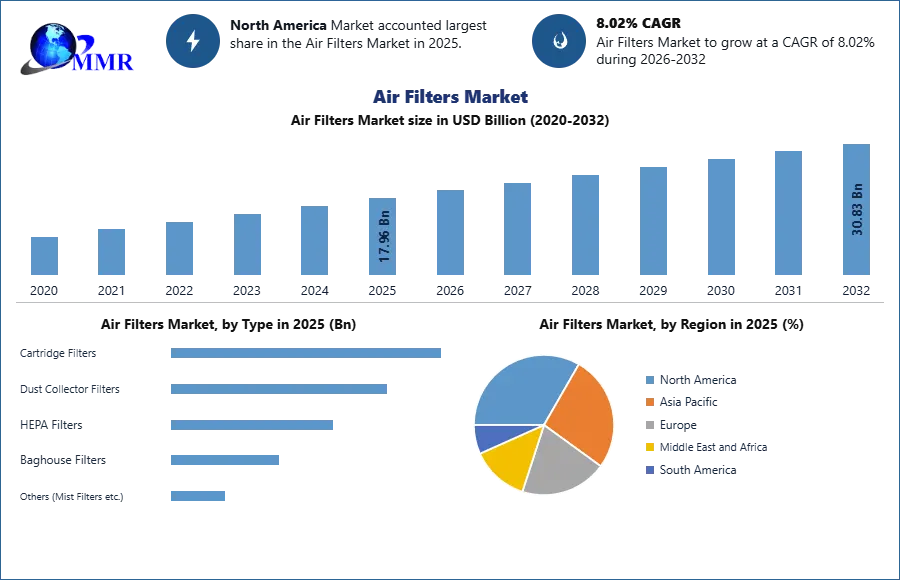
Air Filters Market size was valued at USD 17.96 Billion in 2025 and the total Air Filters Market revenue is expected to grow at a CAGR of 8.02 % from 2026 to 2032, reaching nearly USD 30.83 Billion By 2032
Air Filters Market Overview
Air Filters are devices used to remove airborne particles and pollutants that are hazardous to health and the ecosystem. These devices utilize a filter media, which captures those particles on the upstream side. Pleated air filters have folds on the pleats, which increase their surface area.
The need for air filtration solutions is being driven by factors like increasing industrial activity, urbanization, and growing awareness of the health risks associated with air pollution. There is increased awareness of the value of clean air among people, organizations, and governments as worries about indoor and outdoor air pollution grow. Because of this awareness, air filter producers have more opportunities to create and offer cutting-edge filtration solutions to a range of end users and industries.
To know about the Research Methodology :- Request Free Sample Report
1.In the past decade, the Air Filters market has shown a compound annual growth rate (CAGR) of 8.5%
Air filters and air purification systems are used in the food and beverage, pharmaceutical, and automotive industries, among other industries, to eliminate impurities from the air. Nanofiber Technology, Electrostatic Filtration, Activated Carbon Filters, and HEPA-grade filters are innovations and technologies put forth by the Air Filters Market.
Maximize Market Research found that North America dominated the market for Air Filters based on data gathered over the preceding five years. Asia-Pacific is an emerging region in the Air Filters Market, The Asia-Pacific indoor air purification market is expanding at a compound annual growth rate (CAGR) of more than 4% over the following five years, with China predicted to be the largest market because of rising urbanization and declining outdoor air quality, Air filter demand is being driven by rising car sales in nations like South Korea, China, and India. Daikin Industries, Ltd. (Japan), Camfil (Sweden), MANN+HUMMEL (Germany), Parker Hannifin Corp (U.S.), and Cummins, Inc. (U.S.) are major key players mentioned below in the report.
The Air Filters Market is undergoing a fundamental restructuring as the 2026 Middle East crisis destabilizes the production of high-performance filtration media. With the Hormuz blockade driving crude to $120/bbl, energy-intensive synthetic fiber manufacturing overheads have surged 30%, while 400% maritime freight surcharges disrupt global trade. Market leaders are prioritizing near-shored production and circular bio-based media to bypass volatile corridors. This strategic transition is essential for maintaining the 8.02% CAGR, ensuring industrial resilience amidst the largest global energy-driven supply disruption.
Air Filters Market Dynamics
Health and Safety Considerations
Air filters are designed to eliminate airborne pollutants from both indoor and outdoor air, including dust, pollen, mold spores, bacteria, viruses, and volatile organic compounds (VOCs). Many people have allergies that are brought on by dust mites, pet dander, and pollen in the air.
Allergens are effectively captured and kept from circulating in indoor spaces by high-efficiency air filters, such as HEPA (High-Efficiency Particulate Air) filters. Respiratory disorders like respiratory infections, asthma, and chronic obstructive pulmonary disease (COPD) all be made worse by airborne pollutants.
Air filtration systems are necessary to maintain safe and healthy working environments in commercial and industrial settings. Compliance with Occupational Safety and Health Administration (OSHA) standards and regulations requires employers to provide adequate ventilation
Rapid Urbanization and Industrialization
Rapid urbanisation and industrialization increase air pollution levels, because of increased vehicle emissions, industrial activity, construction, and waste generation. Focus on Indoor Air Quality (IAQ), as more people choose to live and work in cities, the significance of indoor air quality (IAQ) for health and wellbeing is becoming increasingly apparent. The demand for air filtration systems in residential, commercial, and institutional buildings is driven by the need to maintain clean and healthy indoor environments.
Manufacturing sites, power plants, refineries, and other industrial operations are concentrated in urban and peri-urban areas as a result of industrialization. These sectors discharge airborne pollutants into the atmosphere, including particulate matter, nitrogen oxides (NOx), sulfur dioxide (SO2), and volatile organic compounds (VOCs).
Shift towards Sustainable Solutions
Biodegradable and sustainable materials are being used by manufacturers more often in the creation of air filters. Natural fibres, recycled fibres, and biopolymers made from renewable resources are a few examples of these materials. Energy efficiency is a critical consideration in the design and operation of air filtration systems. Advanced filtration technologies that minimize pressure drop, reduce energy consumption, and optimize airflow efficiency help lower operational costs and environmental footprint. Sustainability goals are aided by extending the life of air filters through durability enhancements, maintenance optimization, and reusable filter designs. To increase sustainability and extend product life, manufacturers incorporate washable filter media and replaceable parts into their filter designs.
Air Filters Market Segment Analysis
By Type, the segment is further divided into Cartridge Filters, Dust Collector, HEPA Filters, Baghouse Filters, and Others (Mist Filters and others). Cartridge Filters are made of different materials, sizes, and configurations to meet a range of filtration needs. The filter element collects particles and impurities suspended in the fluid or gas. It is commonly constructed of materials like cellulose, polyester, polypropylene, fiberglass, or activated carbon. Cartridge housings offer the filter element structural support and protection. They are made of materials like plastic, aluminum, or stainless steel.
Dust collectors are essential for maintaining clean and safe working environments, protecting worker health, and complying with environmental regulations. Dust collectors employ various mechanisms to capture dust particles from air or gas streams, including, Cyclonic separation, Filtration, and Electrostatic precipitation. Systems for collecting dust come with control systems to keep an eye on temperature, pressure, airflow, and other operational factors.
HEPA filters are designed to remove airborne particles and contaminants from the air. They are highly efficient in capturing particles as small as 0.3 microns with a high level of efficiency, typically 99.97% or higher. To guarantee adherence to industry standards and specifications, HEPA filters are put through a rigorous testing process. To gauge filtration efficiency, tests like the PSL (Polystyrene Latex) and DOP (Dispersed Oil Particulate) tests are performed. Baghouse Filters consist of a series of fabric filter bags made of woven or felted materials such as polyester, polypropylene, aramid, or fiberglass. The arrangement of the filter bags creates a vertical housing or chamber that lets gas streams pass through while catching particles on the filter media's surface.
Air Filters Market Regional Insights
North America has dominated the Air Filters Market and is expected to continue its dominance in the next 5 years, because of the growing demand for energy-efficient air filters during the forecast period, the growing adoption of IoT-enabled air filters, and the growing awareness of the significance of indoor air quality. The air Filters Market is expected to grow at a CAGR of 9%. Many major players in the Air Filters Market, including Mann + Hummel, K&N Engineering, A.L. Group, Allena Auto Industries Pvt. Ltd., Purolator Filters LLC, and others, have a fragmented presence in the North American automotive air filter market. To provide customers with the newest technology and draw in customers, they are constantly increasing the range of products they offer.
Europe is the second largest region witnessing a notable growth in adoption of the Air Filters Market, One of the main factors propelling the market enlargement for air filters in Europe is the existence of strict air quality regulations. The use of air filtration systems in a variety of commercial and industrial settings is being encouraged by these regulations. Since air filters are necessary parts of HVAC systems, the growing European market for these systems is also driving the growth of the air filter market. Europe's Industrial Air Filtration Market was valued at USD 4.1 billion in 2022 and is expected to reach USD 8.4 billion by 2032, with Germany holding the largest share of the market
Asia-Pacific is an emerging region in the Air Filters Market, The Asia-Pacific indoor air purification market is expanding at a compound annual growth rate (CAGR) of more than 4% over the following five years, with China predicted to be the largest market because of rising urbanization and declining outdoor air quality, Air filter demand is being driven by rising car sales in nations like South Korea, China, and India.
Air Filters Market Competitive Landscape
1. Daikin Industries, Ltd. is a Japanese multinational company and the undisputed global leader in air conditioning and filtration. In 2026, Daikin continues its aggressive expansion strategy to dominate the "clean air" and data center cooling sectors. Following a period of massive investment, Daikin has acquired over 20 companies in the recent forecast period, with total acquisition spending exceeding $6.5 billion. In 2025 and early 2026, Daikin Industries, Ltd. acquired Anh Nguyen (Vietnam) to bolster its Southeast Asian solutions, along with Chilldyne and DDC Solutions to integrate advanced liquid and air cooling for AI infrastructure. The company also absorbed the operations of several regional distributors to streamline its global supply chain.
2. Camfil remains headquartered in Stockholm and has significantly scaled its operations since its 1963 founding in Trosa, Sweden. By 2026, the company has grown to approximately 6,000 workers with net sales surpassing $1.35 billion. Continuing its spree of European consolidation, Camfil signed an agreement to acquire 100 percent of Bioconservación (Bion) in Spain in early 2026 to lead the molecular contamination control market. This follows the 2025 acquisitions of F.C.R. in Italy and the full integration of its previous Australian and British subsidiaries to create a unified global "Life Science" filtration division.
3. Parker Hannifin has emerged as a primary consolidator in the industrial filtration space as of 2026. Established as a diversified motion and control leader, the company executed one of the largest deals in industry history in March 2026 by signing a definitive agreement to acquire Filtration Group for $9.25 billion. This move effectively triples Parker’s air filtration portfolio. Additionally, in late 2025, the company expanded its high-purity filtration capacity in Europe and North America to meet the surging demand from the semiconductor and pharmaceutical manufacturing industries.
4. Donaldson Company, Inc. has intensified its competitive stance in 2026 through strategic high-value acquisitions. In February 2026, Donaldson acquired the Facet Filtration business for $820 million, significantly strengthening its footprint in the aerospace and power generation markets. This follows a 2025 initiative where the company invested over $150 million in new "Life Sciences" manufacturing facilities, positioning itself as a direct competitor to Camfil and Mann+Hummel in the sterile air filtration segment.
Recent Industry Developments
| Exact Date | Company | Development | Impact |
|---|---|---|---|
| 10 March 2026 | Camfil | Launched the CC X-Series, a new generation of intelligent industrial air cleaners for manufacturing and logistics. | Improves energy efficiency and operational performance in high-load industrial environments. |
| 23 February 2026 | Donaldson Company | Introduced ArmorSeal™ air filtration technology for heavy-duty on-road and off-road equipment. | Sets a new standard for structural integrity and contaminant bypass prevention in extreme conditions. |
| 02 February 2026 | Donaldson Company | Entered a definitive agreement to acquire Facet Filtration for approximately $820 million. | Strengthens aftermarket position in aerospace, defense, and power generation filtration segments. |
| 28 January 2026 | Daikin Industries | Unveiled high-performance HVAC filtration innovations at the AHR Expo to support hyperscale data centers. | Addresses the intensifying cooling demands and air quality needs of AI-driven infrastructure. |
| 11 December 2025 | Camfil | Acquired F.C.R., a leading Italian air filtration company, effective January 1, 2026. | Expands regional presence in Italy and strengthens local manufacturing for energy-efficient solutions. |
| 11 November 2025 | Parker Hannifin | Agreed to acquire Filtration Group Corp. in a massive $9.25 billion all-cash transaction. | Creates one of the world's largest industrial filtration businesses with a focus on stable aftermarket revenue. |
Air Filters Market Scope: Inquire before buying
| Air Filters Market | |||
|---|---|---|---|
| Report Coverage | Details | ||
| Base Year: | 2025 | Forecast Period: | 2026-2032 |
| Historical Data: | 2020 to 2025 | Market Size in 2025: | 17.96 USD Billion |
| Forecast Period 2026-2032 CAGR: | 8.02% | Market Size in 2032: | 30.83 USD Billion |
| Segments Covered: | by Type | Cartridge Filters Dust Collector Filters HEPA Filters Baghouse Filters Others (Mist Filters, etc.) |
|
| by End-User | Residential Commercial Industrial |
||
| by Application | HVAC Systems Industrial Processing Cleanrooms Automotive Power Generation |
||
Air Filters Market, by Region
North America (United States, Canada and Mexico)
Europe (UK, France, Germany, Italy, Spain, Sweden, Austria and Rest of Europe)
Asia Pacific (China, South Korea, Japan, India, Australia, Indonesia, Malaysia, Vietnam, Taiwan, Bangladesh, Pakistan and Rest of APAC)
Middle East and Africa (South Africa, GCC, Egypt, Nigeria and Rest of ME&A)
South America (Brazil, Argentina Rest of South America)
Key Players / Competitors Profiles Covered in Brief in Global Air Filters Market Report in Strategic Perspective:
- Camfil
- MANN+HUMMEL
- Donaldson Company
- Daikin Industries
- Parker Hannifin Corp
- Honeywell International
- Cummins
- Freudenberg Performance Materials
- Purafil, Inc
- Trojan Technologies
- 3M Company
- General Filter
- SPX Flow
- Munters Group
- Cleanova
- American Air Filter (AAF)
- Sogefi Group
- Lydall
- FläktGroup
- Sandvik
- Hollingsworth & Vose
- Flanders
- Premium Guard Inc.
- Kimberly-Clark Professional
- U-Air Environmental Technology
Frequently Asked Questions
1. What is the projected size and growth rate of the Air Filters Market?
Ans. The global market reached $17.96 billion in 2025 and is forecasting an 8.02% CAGR, hitting a $30.83 billion Air Filters Market valuation by year 2032.
2. Which region currently leads the Air Filters Market share analysis?
Ans. North America dominates due to energy-efficient filter adoption and strict IAQ regulations, while Asia-Pacific remains the fastest-growing region through rising urbanization and automotive sales.
3. How is the shift towards sustainable air filtration solutions impacting manufacturers?
Ans. Industry growth drivers include a transition to biodegradable fibers and washable media, helping companies meet environmental goals while reducing operational costs through optimized airflow efficiency.
4. What role does AI and IoT play in Air Filters Market Trends 2026?
Ans. Smart filtration innovations, like Camfil’s intelligent CC X-Series, utilize IoT sensors to monitor real-time air quality, significantly enhancing energy efficiency for high-load industrial logistics.
5. Which filtration technologies are currently dominating industrial and commercial applications?
Ans. High-efficiency HEPA-grade filters, Nanofiber technology, and Electrostatic filtration lead the market, specifically targeting hazardous pollutants, VOCs, and pathogens across pharmaceutical and data center environments.
6. How are recent mergers and acquisitions shaping the competitive landscape?
Ans. Strategic consolidation, such as Parker Hannifin’s $9.25 billion acquisition of Filtration Group, strengthens global supply chains and expands aftermarket revenue across aerospace and defense segments.
7. What specific factors are driving demand for air filters in industrial processing?
Ans. Stringent OSHA workplace safety standards and the rise of hyperscale data centers necessitate advanced dust collectors and cartridge filters to maintain critical, contaminant-free operational environments.