
AI Voice Agent Market - Growth Trends, Industry Analysis, Competitive Landscape, Technology, Applications, Regional Insights, and Forecast 2026–2034
Overview
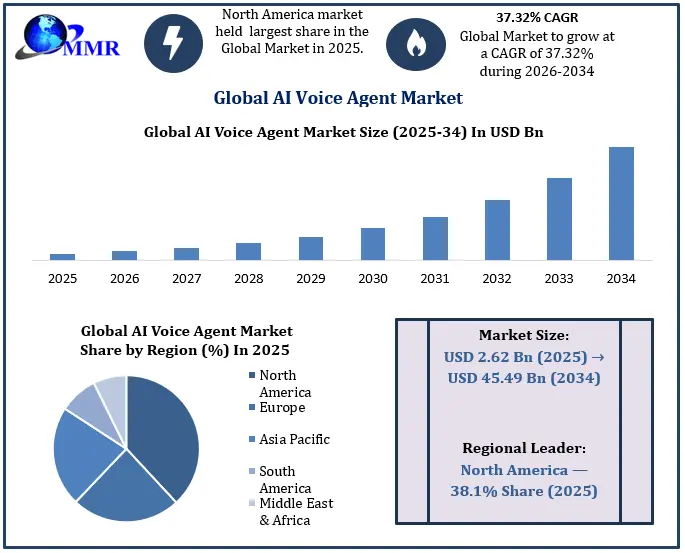
The Global AI Voice Agent Market was valued at USD 2.62 billion in 2025. The market is expected to reach USD 45.49 billion in 2034 at a 37.32% CAGR during 2026–2034.
Key Highlights of the AI Voice Agent Market
|
This report provides an in-depth assessment of the AI Voice Agent Market, combining market dynamics, technology evolution, competitive positioning, regional demand, and application-level analysis to identify where the market is moving and where opportunities are emerging. It evaluates agent types, applications, deployment models, language capabilities, technology trends, regional ecosystems, key players, pricing models, and competitive differentiation, while examining the transition from conventional voice automation toward generative and agentic AI voice systems. The analysis helps technology providers, investors, enterprises, and other stakeholders identify high-growth opportunities, understand competitive intensity, assess regional and application-specific demand, benchmark strategic positioning, and make informed decisions on market entry, product development, partnerships, and investment.
AI Voice Agent Market Overview
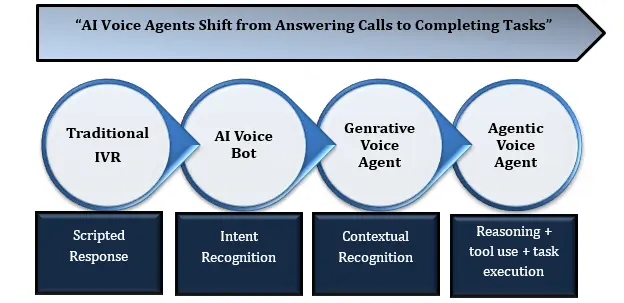
The AI voice agent market comprises intelligent conversational systems that use speech recognition, natural language processing, generative AI, text-to-speech, and workflow orchestration to understand spoken requests, generate contextual responses, and increasingly execute tasks autonomously. The market is moving beyond traditional IVR and scripted voice bots toward agentic voice systems that can maintain conversational context, access enterprise information, and complete multi-step customer and business workflows.
A key market transition is the shift from voice interaction to voice-driven task execution. Modern AI voice agents increasingly connect conversational intelligence with enterprise systems, allowing a single interaction to progress from understanding a request to retrieving information, updating records, scheduling appointments, initiating transactions, or routing complex cases. This expands the role of voice AI from a customer-service automation tool into an operational interface for enterprise workflows, increasing its relevance across customer support, sales, healthcare, financial services, retail, travel, and other high-volume service environments.
Multilingual voice AI also expands the addressable opportunity. As of 2025, BHASHINI supports voice-based services across 22 Indian languages, hosts more than 350 AI models and datasets, and has processed over 4 billion language inferences, demonstrating the expanding infrastructure for localised and voice-first digital interactions. Similar developments in multilingual speech infrastructure across Europe and Africa indicate that language localization is becoming an important capability for scaling voice AI beyond English-dominant markets.
During 2026–2034, the market shifts toward real-time, multilingual, generative, and autonomous voice agents, with customer service automation, enterprise workflow execution, and voice-first digital services emerging as major adoption pathways. Competitive differentiation increasingly depends not only on speech quality but also on latency, contextual accuracy, multilingual performance, system integration, security, and the ability to complete business tasks reliably. This evolution positions AI voice agents as an emerging layer between users and enterprise applications rather than simply an advanced replacement for conventional IVR systems.
Global AI Voice Agent Market Size Forecast and Geography Share Analysis
To know about the Research Methodology :- Request Free Sample Report
AI Voice Agent Market Dynamics
Rising Enterprise Adoption of AI-Powered Voice Automation to Drive the AI Voice Agent Market
Enterprises increasingly deploy AI voice agents to automate high-volume customer interactions, improve service availability, and reduce reliance on repetitive human-led processes. The broader shift toward AI-integrated workflows strengthens demand for voice agents that can understand context and execute tasks rather than only respond to predefined commands. Enterprise AI adoption also increasingly moves into repeatable, multi-step workflows, creating a favorable environment for autonomous voice-based systems.
Data Privacy and Security Concerns Limit Voice AI Deployment
AI voice agents process sensitive conversational, personal, and potentially biometric information, increasing concerns around data protection, unauthorized access, storage, and model misuse. Voice cloning further raises impersonation and fraud risks. The U.S. Federal Trade Commission identifies AI-enabled voice cloning as a technology that can facilitate impersonation scams and misuse of biometric data, increasing the compliance and security requirements associated with enterprise voice deployments.
Multilingual Voice AI Expands Underserved User Segments, Creates Opportunities
The expansion of multilingual AI infrastructure creates significant opportunities for voice agents in markets where users interact primarily through regional languages. India’s Bhashini provides a prime example of it. Its integration across government services demonstrates how voice-first and multilingual AI can expand digital access beyond English-centric interfaces.
Achieving Reliable Real-Time Conversational Intelligence Challenges the Market
AI voice agents must simultaneously achieve low latency, accurate speech recognition, contextual understanding, natural speech generation, and reliable task execution. Performance becomes more difficult across accents, background noise, code-switching, domain-specific terminology, and multilingual conversations. Consequently, vendors need to continuously improve speech models, reasoning capabilities, orchestration, and integration reliability to deliver consistent human-like interactions at enterprise scale.
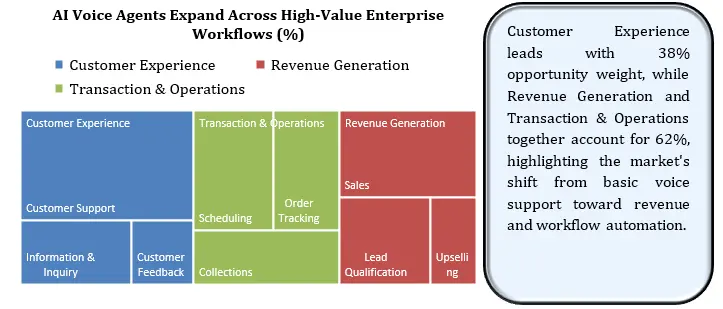
“Where does AI voice-agent adoption create the greatest commercial opportunity?”
AI Voice Agent Market Key Trends
• Agentic AI Drives Autonomous Voice Interactions - AI voice agents increasingly move beyond scripted conversations toward agentic systems that understand intent, maintain context, access enterprise data, and execute multi-step actions. This shift positions voice agents as digital workers rather than basic voice-response tools. Enterprise demand also reflects this transition, with 50% of organizations identifying task/service automation as a leading voice-AI use case.
• Multilingual Voice AI Expands Market Reach - Voice agents increasingly support multiple languages, regional accents, and localized terminology to serve linguistically diverse users. In February 2026, Google Research introduced WAXAL, an open speech dataset covering 21 African languages and more than 11,000 hours of speech data, strengthening the data infrastructure required for multilingual speech recognition and voice-AI applications across Africa.
• Real-Time Conversational Intelligence Becomes a Core Differentiator - The market increasingly prioritizes low-latency speech processing, interruption handling, contextual understanding, and natural turn-taking. Enterprises evaluate voice agents not only on their ability to generate human-like speech but also on their ability to deliver accurate, reliable, and actionable responses during complex interactions. This trend shifts competitive differentiation toward conversational reliability and task completion.
• Voice AI Moves Toward Edge and Offline Deployment - Voice AI increasingly extends beyond cloud-only architectures toward on-device and edge AI, particularly where low latency, connectivity limitations, privacy, and data sovereignty are important. For Example, India's 2026 VYOMA initiative promotes open-source multilingual voice-first AI that operates in offline and low-connectivity environments, indicating growing interest in decentralized voice intelligence.
Global AI Voice Agent Market Segment Analysis
By Agent Type
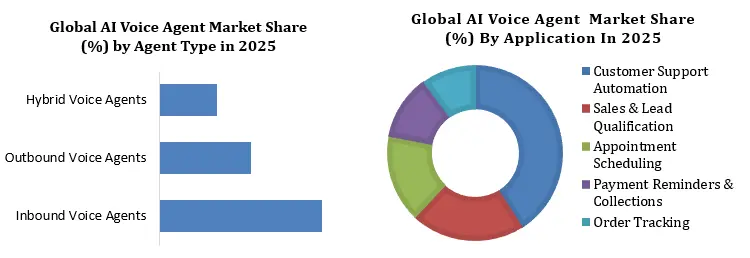
Inbound voice agents dominated the AI Voice Agent Market in 2025, supported by strong enterprise demand for automated customer support, inquiry handling, technical assistance, appointment management, and after-hours service. Customer-initiated interactions generate large and recurring call volumes, making inbound automation one of the most immediate areas for enterprises to improve response times and reduce dependence on human agents for repetitive requests. Salesforce identifies customer service, inquiries, and technical support as primary AI voice-agent use cases, reinforcing the commercial importance of inbound deployments.
During 2026–2034, hybrid voice agents record the strongest growth potential as enterprises increasingly seek a single AI system capable of managing both inbound and outbound conversations. Hybrid agents enable organizations to resolve incoming requests while also initiating follow-ups, reminders, renewals, lead nurturing, and collections within connected workflows. Outbound voice agents also expand steadily, driven by sales prospecting, lead qualification, payment collections, appointment reminders, customer feedback, and proactive engagement. Enterprise platforms increasingly support both inbound and outbound automation at scale, indicating a gradual shift toward unified voice orchestration.
By Application,
Customer support automation dominated the application segment for the AI Voice Agent Market in 2025, as enterprises prioritize voice AI for handling frequently repeated customer inquiries, resolving routine service issues, providing 24/7 assistance, and escalating complex conversations to human representatives. Customer support represents a natural entry point for AI voice agents because organizations already operate established call-center infrastructure and measurable service workflows.
From 2026–2034, sales and lead qualification emerge as one of the fastest-growing applications, supported by growing demand for immediate lead response, automated prospect qualification, CRM updates, and appointment conversion. Appointment scheduling also gains strong momentum, particularly across healthcare, professional services, hospitality, and field-service businesses, as agents increasingly check availability, book appointments, and send confirmations autonomously. Payment reminders and collections expand across BFSI and lending, while order tracking and customer follow-up gain traction across retail and e-commerce. This expansion indicates that AI voice agents increasingly move from reactive support toward revenue-generating and transaction-oriented workflows.
AI Voice Agent Market Regional Analysis
North America dominated the AI Voice Agent Market in 2025, supported by a mature AI ecosystem, high enterprise technology spending, advanced cloud infrastructure, and strong adoption of contact-center automation. The U.S. remains the principal demand center, with enterprises across BFSI, healthcare, retail, and telecommunications deploying AI voice agents for customer support, lead management, order tracking, and other high-volume interactions. The region also benefits from the presence of major AI, cloud, and conversational-technology providers, which accelerates access to foundation models, speech infrastructure, and enterprise APIs. Regulatory requirements around automated communications and consumer consent increase the importance of compliant, auditable voice-agent deployments, particularly for outbound calling. Going forward, demand increasingly shifts from basic call automation toward generative and agentic voice systems integrated with CRM, contact-center, and enterprise workflow platforms, while replacement of legacy IVR infrastructure creates an additional adoption pathway.
In Europe, the regulation-driven AI voice agent market, with demand supported by sophisticated telecommunications infrastructure, established contact-center operations, multilingual customer bases, and strong enterprise interest in responsible AI. The region's distinctive factor is its regulatory environment: the EU AI Act increasingly influences how organizations assess AI systems, manage transparency, governance, risk, and documentation. This encourages enterprises to prioritize voice-agent vendors offering explainability, data governance, security, and controlled deployment. Multilingual capability is particularly important because European enterprises serve customers across multiple national languages and markets. Germany, France, the U.K., and other digitally mature economies provide important demand centers across financial services, healthcare, telecommunications, and customer service. Europe increasingly favors enterprise-grade, compliant, multilingual voice agents, with regulatory readiness becoming a competitive differentiator rather than simply a constraint.
Asia Pacific represents the strongest growth opportunity as rapid AI adoption combines with large multilingual populations, expanding digital services, contact-center outsourcing, and growing enterprise automation. India, China, Japan, Australia, Singapore, and South Korea form important demand centers, although their adoption drivers differ. India benefits from particularly strong enterprise AI adoption and government-backed multilingual infrastructure, while Japan uses AI automation to address labor constraints and maintain service quality. Singapore provides a strong indicator of AI adoption across Asia Pacific.
According to Singapore's Infocomm Media Development Authority (IMDA), AI adoption among non-SMEs increases from 44% in 2023 to 62.5% in 2024, while SME adoption rises from 4.2% to 14.5%. Among AI-using firms, customer service represents one of the leading business functions for AI deployment, with 43% applying AI to customer-service activities, creating a favorable environment for conversational and voice-based automation. India provides a particularly strong example through BHASHINI, which supports inclusive voice technologies and multilingual digital services. Consequently, the region's growth increasingly centers on multilingual voice agents, customer-service automation, financial services, healthcare, telecommunications, and voice-first public services.
South America is developing as an emerging AI Voice Agent Market, with adoption supported by expanding cloud infrastructure, digital banking, e-commerce, telecommunications, and contact-center modernization. Brazil represents the principal regional technology and demand center, while Spanish-speaking markets create additional opportunities for scalable multilingual voice solutions. Voice agents provide particular value where businesses manage high customer-service volumes and seek to extend service availability without proportionally increasing human-agent capacity. Regional demand also benefits from the increasing use of AI in financial services, retail, telecommunications, and public-facing digital services. However, deployment remains more sensitive to affordability, infrastructure maturity, data governance, and availability of high-quality Portuguese and Spanish speech models than in North America or Western Europe. Through 2034, localized language performance, lower-cost cloud deployment, and contact-center automation increasingly determine adoption across the region.
Middle East & Africa presents an emerging but increasingly diverse AI Voice Agent Market opportunity, driven by digital-government programs, smart-city development, telecommunications modernization, financial inclusion, and enterprise digitization. Gulf countries such as the UAE and Saudi Arabia provide the region's strongest technology investment environments, with national AI strategies supporting the adoption of intelligent digital services. Arabic-language capability represents an important differentiator because enterprises and government organizations require voice systems that handle Arabic alongside English and regional linguistic variations. Africa offers a different opportunity profile, where voice interfaces can help overcome barriers associated with literacy, language diversity, and conventional text-based digital services. The region therefore favors applications in government services, banking, telecommunications, healthcare, and customer support. During 2026–2034, demand increasingly depends on localized Arabic and African-language models, affordable deployment architectures, data sovereignty, and public-sector digital transformation. The regional AI voice-agent market already identifies inbound voice agents as its largest agent-type segment, reinforcing the importance of customer-service automation in the region.
AI Voice Agent Market Recent Developments
| Date | Company / Development | Market Impact |
| August 28, 2026 | Gnani AI launches Artha, a sovereign AI stack built around its 30-billion-parameter Evon 3.3 model and Plexus agentic-AI platform. | Strengthens India's sovereign and multilingual voice-AI ecosystem, increasing competition around locally developed models, data control, and enterprise-grade AI deployment. |
| August 25, 2026 | Ringg raises $10 million from Peak XV to expand voice AI beyond conventional phone calls into broader voice-based digital interactions. | Signals increasing investor confidence in voice AI as an interaction layer beyond contact centers, encouraging expansion into websites, applications, and digital workflows. |
| August 26, 2026 | Google introduces Gemini 3.5 Transcribe, a speech-to-text model designed for intelligent voice interactions. | Improves the speech-recognition layer supporting voice agents and intensifies competition around accuracy, real-time transcription, and conversational intelligence. |
| August 13, 2026 | Hippocratic AI launches Agentic Orchestrators to coordinate teams of healthcare voice AI agents for healthcare outcomes. | Demonstrates the shift from single-purpose voice bots toward multi-agent orchestration and specialized healthcare automation, expanding the market's enterprise use cases. |
| 2026 | RingCentral launches AIR Pro, bringing voice agents into its CCaaS environment to automate customer interactions. | Accelerates AI integration into contact-center platforms and increases competitive pressure on standalone voice-agent providers to offer deeper CCaaS integration. |
AI Voice Agent Market Competitive Analysis
Nature of Competition
The AI voice agent market exhibits high-intensity, technology-driven competition across multiple layers, including developer-focused voice-agent infrastructure, enterprise conversational-AI platforms, no-code agent platforms, speech and voice-model providers, and established contact-center platforms. Gartner's 2026 evaluation of conversational AI platforms includes Google, IBM, Kore.ai, NICE, PolyAI, Salesforce, SoundHound AI, Sprinklr, and Yellow.ai, highlighting competition between specialized AI vendors and established enterprise technology providers.
The market follows a build-versus-deploy structure. Vapi, Retell AI, and LiveKit provide flexible infrastructure and APIs, while PolyAI, Cognigy, Parloa, NICE, and similar vendors emphasize enterprise-ready managed deployments. No-code platforms target businesses seeking rapid implementation with limited technical resources. Hyperscalers and enterprise software providers further intensify competition by embedding voice and agentic AI within broader technology ecosystems.
Global and Regional Competitive Landscape
Google, Microsoft, Amazon, Salesforce, IBM, NICE, Genesys, and specialized voice-AI companies lead global competition. These established providers compete through cloud infrastructure, enterprise relationships, data ecosystems, and CRM or contact-center integrations. Specialist players such as Vapi, Retell AI, ElevenLabs, PolyAI, Cognigy, Parloa, Synthflow, Bland AI, and Yellow.ai differentiate through voice quality, developer flexibility, rapid deployment, integrations, and multilingual capabilities. Vapi's selection by Amazon Ring after evaluating more than 40 vendors illustrates strong competition among specialist platforms.
Regional competition increasingly centers on localization and enterprise requirements. North American vendors benefit from advanced AI infrastructure and established enterprise ecosystems. European providers emphasize governance, security, multilingual capabilities, and compliance, while Asia Pacific increasingly supports regional specialists focused on local languages, accents, affordability, and localized workflows.
Competitive Positioning and Differentiation
Competition centers on voice quality, latency, agent intelligence, integration, language capability, and enterprise readiness. Vendors differentiate through natural speech, emotional expression, interruption handling, faster response times, contextual reasoning, tool use, CRM and CCaaS connectivity, multilingual performance, security, compliance, observability, scalability, and governance. The competitive focus therefore shifts from simply producing the most human-like voice toward completing business tasks reliably. As voice quality becomes increasingly accessible across platforms, workflow execution, integration depth, governance, and reliability become stronger differentiation factors.
Tier-Based Competitive Positioning
Tier 1 – Global Enterprise & Platform Leaders: Google, Microsoft, Amazon, Salesforce, IBM, NICE, and Genesys compete through ecosystem scale, cloud infrastructure, enterprise distribution, and CRM, productivity, and contact-center integration.
Tier 2 – Specialized Enterprise Voice-AI Leaders: PolyAI, Cognigy, Parloa, Kore.ai, and Yellow.ai compete through conversational-AI expertise, enterprise deployment, multilingual support, governance, and contact-center integration.
Tier 3 – AI-Native Developer & Rapid-Deployment Platforms: Vapi, Retell AI, ElevenLabs, Synthflow, Bland AI, and LiveKit emphasize APIs, developer accessibility, rapid experimentation, flexible orchestration, voice quality, and usage-based economics.
Pricing and Business Models
Usage-based pricing is the dominant model, with vendors charging by call duration, minutes processed, speech generation, or model inference. Other structures include subscription plus usage, credit-based pricing, enterprise custom pricing, and emerging outcome-based models linked to appointments, leads, or successful resolutions.
Competition increasingly focuses on total cost of ownership rather than headline per-minute rates because telephony, LLM inference, speech-to-text, text-to-speech, integrations, compliance, and monitoring influence final deployment costs. Vertically integrated vendors benefit by bundling more components and offering transparent usage economics.
Competition intensifies through 2026–2034 as foundation-model companies, cloud providers, contact-center vendors, and voice-AI specialists converge on enterprise use cases. The market shifts from standalone voice bots toward full-stack agentic voice platforms capable of perception, reasoning, conversation, tool calling, and workflow execution. Long-term competitive strength increasingly depends on voice quality combined with workflow intelligence, enterprise integration, multilingual performance, low latency, security, reliability, scalability, and measurable business outcomes.
AI Voice Agent Market Scope: Inquire before buying
| AI Voice Agent Market | |||
|---|---|---|---|
| Report Coverage | Details | ||
| Base Year: | 2025 | Forecast Period: | 2026-2032 |
| Historical Data: | 2020 to 2025 | Market Size in 2025: | USD 2.62 Bn. |
| Forecast Period 2026 to 2032 CAGR: | 37.32% | Market Size in 2032: | USD 45.49 Bn. |
| Segments Covered: | by Agent Type | Inbound Voice Agents Outbound Voice Agents Hybrid Voice Agents |
|
| by Component | Solution Services |
||
| by Technology | ASR NLP/NLU TTS Generative AI RAG Speech Analytics Voice Biometrics Agentic AI/Orchestration |
||
| by Deployment | Cloud On-Premises Hybrid |
||
| by Enterprise Size | Large Enterprises SMEs |
||
| by Application | Customer Support Lead Qualification Appointment Scheduling Payment Reminders & Collections Order Tracking Sales & Marketing Healthcare & Patient Engagement |
||
| by End-Use | BFSI Healthcare Telecom Retail & E-commerce Travel & Hospitality Contact Centers & BPO Government Others |
||
Global AI Voice Agent Market, by Region
North America (United States, Canada, and Mexico)
Europe (UK, France, Germany, Italy, Spain, Sweden, Austria, and the Rest of Europe)
Asia Pacific (China, South Korea, Japan, India, Australia, Indonesia, Malaysia, Vietnam, Taiwan, Bangladesh, Pakistan, and the Rest of APAC)
Middle East and Africa (South Africa, GCC, Egypt, Nigeria, and the Rest of ME&A)
South America (Brazil, Argentina, Rest of South America)
Global AI Voice Agent Market Key Players
North America
1. Google — U.S.
2. Microsoft — U.S.
3. Amazon Web Services (AWS) — U.S.
4. Salesforce — U.S.
5. IBM — U.S.
6. NICE — U.S.
7. Genesys — U.S.
8. SoundHound AI — U.S.
9. Vapi — U.S.
10. Retell AI — U.S.
11. ElevenLabs — U.S.
12. Bland AI — U.S.
13. Synthflow AI — U.S.
14. LiveKit — U.S.
15. Sierra — U.S.
16. Decagon — U.S.
Europe
17. PolyAI — U.K.
18. Parloa — Germany
19. Cognigy — Germany
20. Spitch — Switzerland
21. boost.ai — Norway
22. Uniphore — U.K./U.S.
Asia Pacific
23. Yellow.ai — India
24. Haptik — India
25. Kore.ai — India/U.S.
26. Gnani.ai — India
27. Vernacular.ai / CoRover — India
28. Uniphore — India/U.S.
29. Senseforth.ai — India
30. Avaamo — India/U.S.
31. Amelia — India/U.S.
32. iFLYTEK — China
33. Baidu — China
34. Alibaba Cloud — China
35. SoftBank — Japan
South America
36. Take Blip — Brazil
37. Zenvia — Brazil
38. Stefanini — Brazil
39. Sinch — Brazil/Sweden
40. Botmaker — Argentina
41. Aivo — Argentina
Middle East & Africa
42. Unifonic — Saudi Arabia
43. Lucidya — Saudi Arabia
44. Mozn — Saudi Arabia
45. Spitch Middle East — UAE
46. Yellow.ai — UAE/India
47. Botme — UAE
48. Cassbana — UAE
Frequently Asked Questions in the AI Voice Agent Market
1. What is an AI voice agent?
Ans. An AI voice agent is an intelligent software system that understands spoken language, responds conversationally, and performs tasks such as customer support, scheduling, lead qualification, and transactions.
2. How does an AI voice agent work?
Ans. AI voice agents combine speech recognition, natural language processing, generative AI, large language models, and text-to-speech to understand conversations and deliver real-time responses.
3. What drives the AI voice agent market?
Ans. Rising demand for automated customer service, contact-center efficiency, 24/7 support, personalized interactions, and AI-powered workflow automation drives market growth.
4. Which segment dominates the AI voice agent market?
Ans. Inbound voice agents lead by agent type, while customer support and service automation represent a major application area due to high-volume, repetitive customer interactions.
5. Which region dominates the AI voice agent market?
Ans. North America dominates the AI voice agent market, supported by advanced AI infrastructure, strong enterprise adoption, major technology providers, and a mature contact-center ecosystem.
6. What is the future of the AI voice agent market?
Ans. The market increasingly shifts toward agentic AI voice agents capable of understanding context, using enterprise data, executing multi-step workflows, and supporting multilingual and real-time interactions.