
Adventure Tourism Market Size – Industry Structure Evaluation, Demand Drivers Analysis, Regional Growth Analysis and Identification, Competitive Positioning Review & Global Market Size Forecast to 2032
Overview
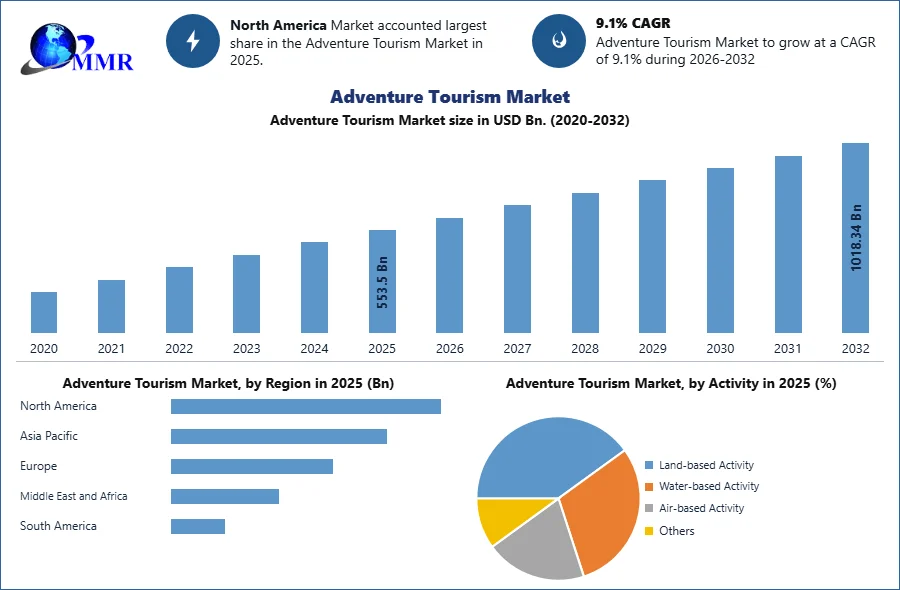
Adventure Tourism Market Size was valued at USD 553.5 Bn. in 2025 and the Adventure Tourism Market is expected to grow 9.1% from 2026 to 2032, reaching nearly USD 1018.34 Bn.
Adventure Tourism Market Overview:
Adventure Tourism Market encompasses various thrilling activities such as climbing, Cycling, Hiking, Hunting Rafting, etc. Adventure Tourism is the fastest-growing segment in the rapidly expanding Tourism industry. Travelers are attracted to the population destinations such as Australia, New Zealand, and India by their awe-inspiring landscapes, culinary offerings, and top-notch accommodation facilities. Cities such as Sydney, Melbourne, Brisbane, Lakshadweep, and Perth region’s a diverse range of terrain such as land, water, and air-based adventures for enthusiasts.
Adventure tourism operators are increasingly focusing on eco-friendly accommodations, guided wilderness tours, and community-based tourism programs to attract environmentally conscious travelers. Technological advancements in travel planning, GPS navigation, safety equipment, and online booking systems are improving accessibility and traveler confidence. Furthermore, corporate organizations and educational institutions are increasingly incorporating adventure travel into team-building programs, leadership training, and student outdoor learning activities. The growing popularity of solo travel, luxury adventure tourism, and small-group expeditions is further diversifying market demand.
To know about the Research Methodology :- Request Free Sample Report
Adventure Tourism Market Dynamics:
Adventure Tourism taps into this fundamental desire, attracting travelers seeking exhilarating experiences and pushing their boundaries. Activities such as skydiving, paragliding, rock climbing, and spelunking offer a rush of adrenaline and a sense of achievement upon overcoming challenges. The appeal lies in conquering fears and embracing the unknown, leading to an increased sense of self-confidence and empowerment, expected to boost the market growth over the forecast period. In recent years, there has been a noticeable shift in traveler preferences from material possessions to experiences. Modern consumers, particularly millennials and Gen Z, prioritize creating meaningful memories and connecting with cultures over collecting tangible mementos.
Adventure Tourism aligns perfectly with this desire for experiential travel, offering a wide range of activities such as hiking through dense forests, exploring remote landscapes, or engaging in thrilling water sports. These activities provide travelers with a deeper appreciation for the destinations they visit, fostering a sense of authenticity and emotional connection. Also, the rise in attention to health and wellness has caused a significant increase in the number of travelers seeking vacations that provide not only relaxation but also chances for physical activity and a connection with nature. Adventure Tourism, which highlights outdoor pursuits such as trekking, cycling, and diving, has become an appealing choice for health-conscious individuals.
The advent of social media platforms and the rise of influencer culture have significantly influenced travel trends, with adventure Tourism benefiting greatly from this digital landscape. Capturing and sharing visually striking experiences on platforms such as Instagram, YouTube, and TikTok have become a significant motivator for travelers. The allure of awe-inspiring landscapes, daring feats, and unique cultural encounters showcased by travel influencers drives aspiration and curiosity, pushing more people towards adventure Tourism to experience these moments first-hand is expected to boosting the market growth.
Advancements in technology have played a significant role in expanding the scope and accessibility of adventure Tourism and is expected to drive the market growth over forecast period. GPS tracking systems and satellite communication have made it safer for travelers to explore remote and challenging destinations, reducing the risks associated with venturing into unfamiliar terrain. Additionally, improvements in adventure gear and equipment, such as lightweight and durable materials, have made participation in these activities more convenient and enjoyable for travelers.
Risk Management and Safety Concerns to Restraint the Adventure Tourism Market Growth
Adventure Tourism, at its very nature, involve a certain level of risk. Activities such as mountaineering, white-water rafting, and wilderness trekking carry natural dangers, and accidents can happen even with the best precautions in place. Ensuring the safety of participants in paramount for adventure tour operators, as any incident can lead to reputational damage and legal liabilities. Striking the right balance between offering adrenaline-pumping experiences and implementing robust risk management practices is crucial to instill confidence in travelers and protect their well-being this is expected to restraint market growth over forecast period. Adventure Tourism often takes place in natural settings, national parks, and protected areas, where strict regulations and permits are in place to safeguard the environment and visitors.
Meeting these regulatory requirements can be challenging for tour operators, especially when operating in multiple destinations with varying rules and restrictions. Non-compliance can lead to fines, closure of operations, and negative environmental impacts, making it imperative for adventure tour providers to be well-informed and diligent in adhering to local laws. Tailoring experiences to suit various skill and experience levels is a constant challenge for tour operators. Striking this balance requires careful planning, clear communication, and skilled guides who can adapt to the abilities of each participant.
Adventure Tourism relies heavily on natural landscapes and fragile ecosystems, making it susceptible to causing environmental damage if not managed responsibly. Increased foot traffic, waste generation, and disruption of wildlife habitats are some of the negative consequences associated with uncontrolled adventure Tourism. Sustainable practices, such as adhering to leave-no-trace principles, limiting group sizes, and promoting environmental education, are essential to minimize the industry's impact on the environment and preserve these pristine locations for future generations.
Opportunity in Global Adventure Tourism Market:
Travelers seek deeper and more meaningful connections with the destinations they visit, the demand for experiential travel continues to surge. Adventure Tourism, with its focus on immersive and thrilling activities, perfectly aligns with this trend. By offering unique and authentic experiences that go beyond traditional sightseeing, adventure tour operators can tap into this growing market and attract a diverse group of travelers seeking transformative journeys is expected to create new opportunities in adventure Tourism market. The adventure Tourism market provides an opportunity for destinations to diversify their travel offerings.
As traditional tourist attractions become saturated, adventure Tourism allows destinations to showcase their natural landscapes, cultural heritage, and off-the-beaten-path experiences. By promoting adventure activities such as trekking in remote mountain ranges, exploring ancient ruins on challenging hikes, or diving in pristine underwater environments, destinations can attract a broader range of travelers and differentiate themselves in the competitive travel landscape.
Adventure Tourism offers the advantage of catering to niche markets and specific interest groups. Whether its extreme sports enthusiasts, nature lovers, wildlife photographers, or cultural explorers, adventure experiences can be tailored to meet the unique preferences and passions of different segments of travelers. By understanding and catering to these niche markets, tour operators can create specialized itineraries and unique packages that resonate with their target audience, fostering customer loyalty and word-of-mouth referrals.
The adventure Tourism market has the opportunity to be a leader in promoting sustainable and responsible Tourism practices. As travelers become more environmentally conscious, there is a growing demand for experiences that minimize negative impacts on the environment and local communities. By adopting eco-friendly practices, supporting conservation efforts, and engaging in community-based Tourism initiatives, adventure tour operators can attract environmentally conscious travelers and differentiate themselves as socially responsible businesses.
Adventure Tourism Market Segment Analysis:
Based on the Activity Type Segment, the market is segmented into Land-based activity, Water-based Activity, Air-based Activity and Others. The mountainous regions such as the Swiss Alps, the Himalayas, the Andes, and the Rocky Mountains attract adventure seekers interested in activities such as mountaineering, trekking, skiing, and snowboarding. This segment is expected to hold the largest adventure Tourism Market share over the forecast period. Coastal regions and islands, such as Hawaii, the Great Barrier Reef, and the Maldives, offer water-based adventures such as scuba diving, snorkeling, surfing, and sailing. Dense jungles and wilderness areas, such as the Amazon rainforest, Borneo, and the African savannah, attract travelers interested in wildlife safaris, jungle trekking, and immersive nature experiences, those activities provide raw natural experiences which is expected to boost the market growth.
Based on the Type of traveler, the market is segmented into Solo, Group and Others. Adventure Tourism attracts a significant number of solo travelers who are keen on stepping out of their comfort zones, challenging themselves, and embracing new experiences. Solo travelers are often looking for opportunities to meet like-minded adventurers and form connections on their journeys. Group includes friends with family members of various ages, this forms another important segment in the adventure Tourism market. Group adventure travel experiences focus on offering activities suitable for all group members, encouraging bonding, and creating lasting memories, and leaderships among the group.
Group travel is highly popular among families, corporate teams, educational institutions, and friend circles seeking activities such as trekking, rafting, camping, skiing, wildlife safaris, and mountain expeditions. Organized group tours provide better safety management, professional guides, transportation support, and reduced travel costs, making them attractive for both domestic and international travelers. Adventure tourism companies are increasingly designing customized group packages with flexible itineraries, team-building activities, and multi-generational experiences to enhance customer engagement.
Adventure Tourism Market Regional Insights:
North America held the largest Adventure Tourism Market share in 2025 and is expected to dominate the market over the forecast period, the regions wide and diverse landscapes offers a range of adventure activities such as hiking, exploring, surfing or wildlife in regions like rocky mountains, Grand canyon, California, and Alaska. The market is well-developed, with established adventure tour operators and a strong focus on safety standards. AThe United States and Canada offer diverse landscapes including the Rocky Mountains, Grand Canyon, Yosemite National Park, Yellowstone, Alaska, and coastal regions of California and Hawaii, which support activities such as trekking, skiing, snowboarding, kayaking, surfing, mountain biking, wildlife safaris, and camping. The region benefits from a highly organized tourism infrastructure, presence of established adventure tour operators, advanced safety regulations, and increasing adoption of digital booking platforms. Additionally, rising participation in eco-tourism, national park exploration, and wellness-oriented outdoor travel is driving market growth. Growing interest among millennials and Gen Z travelers in adventure-based experiences, combined with increasing demand for luxury adventure tourism and customized travel packages, continues to strengthen North America’s leadership position in the global adventure tourism market.
Europe is another prominent region in the adventure Tourism market, offering an array of adventure opportunities across its diverse countries. The European Alps provide an ideal playground for skiing, mountaineering, and mountain biking, while coastal regions attract water sports enthusiasts. Europe boasts cultural and historical sites, contributing to cultural adventure Tourism. The region's well-connected transportation networks and favorable safety regulations make it an attractive destination for adventure seekers of all levels.
The Asia-Pacific region is experiencing significant growth in adventure Tourism. Countries such as New Zealand, Australia, Nepal, and Thailand are known for their adventure offerings. New Zealand, in particular, is a global adventure hotspot, attracting thrill-seekers with activities such as bungee jumping, skydiving, and glacier hiking. The region's cultural diversity, lush jungles, and stunning beaches provide opportunities for cultural and nature-based adventures. The growing middle-class population in countries such as China and India is expected to fuel the domestic adventure Tourism market over the forecast period.
Adventure Tourism Market Competitive Landscape:
International Adventure Tour Operators, such as TUI Group, Intrepid Group, G Adventures, and Abercrombie & Kent, are prominent players in the adventure Tourism market. They offer a wide range of adventure packages across various destinations, catering to diverse preferences and budget levels. Their strengths include a well-established global presence, extensive distribution networks, and economies of scale. Niche Adventure Specialists focus on specific adventure experiences or niche markets. They offer tailored and unique adventures, catering to the preferences of specific traveler groups. Their expertise, deep knowledge of destinations, and passion for their chosen adventure niche set them apart.
Although they excel in providing authentic and transformative experiences, their limited reach compared to larger operators and challenges in scaling up while maintaining niche appeal can be significant hurdles. Online Travel Agencies (OTAs) such as Booking.com, Expedia, and Airbnb are also significant players. They offer a vast inventory of adventure tours and experiences, providing convenience and comparison options for travelers. Their strengths lie in global reach, user-friendly platforms, and extensive marketing capabilities. Although they cater to both leisure and adventure travelers, some adventure enthusiasts may seek a more personalized touch.
Recent Developments
November 19, 2025
Intrepid Travel partnered with REI Co-op to launch locally guided small-group active travel experiences for REI members and customers. The collaboration marked Intrepid’s largest U.S. partnership and helped REI re-enter adventure travel after exiting its Experiences business earlier in 2025. The development strengthens demand for hiking, cycling, cultural immersion, wildlife, and nature-based adventure packages across global destinations.
March 26, 2025
G Adventures announced more than 100 new trips for 2025, described as its biggest new product expansion. The portfolio included Local Living, Solo-ish, Classic, Active, and Geluxe itineraries, supporting demand from solo travelers, small groups, and premium adventure tourists. This expansion strengthened the company’s position in experiential and sustainable adventure travel
Adventure Tourism Market Scope: Inquire before buying
| Adventure Tourism Market | |||
|---|---|---|---|
| Report Coverage | Details | ||
| Base Year: | 2025 | Forecast Period: | 2026-2032 |
| Historical Data: | 2020 to 2025 | Market Size in 2025: | 553.5 USD Bn. |
| Forecast Period 2026-2032 CAGR: | 9.1% | Market Size in 2032: | 1018.34 USD Bn. |
| Segments Covered: | by Type | Hard Soft Camping Hunting Hiking Others Others |
|
| by Activity | Land-based Activity Water-based Activity Air-based Activity Others |
||
| by Age group | Below 30 years 30-41 years 42-49 years 50 years and above |
||
| by Type of Traveler | Solo Group Others |
||
| by Booking Mode | Online Booking Offline Booking |
||
| by Sales Channel | Travel Agents Direct |
||
Adventure Tourism Market, by Region
North America (United States, Canada and Mexico)
Europe (UK, France, Germany, Italy, Spain, Sweden, Austria and Rest of Europe)
Asia Pacific (China, South Korea, Japan, India, Australia, Indonesia, Malaysia, Vietnam, Taiwan, and Rest of APAC)
Middle East and Africa (South Africa, GCC, Egypt, Nigeria and Rest of ME&A)
South America (Brazil, Argentina Rest of South America)
Key players/Competitors profiles covered in the Adventure Tourism Market report in strategic perspective
- Intrepid Travel
- G Adventures
- Abercrombie & Kent Group
- TUI Group
- REI Adventures
- Exodus Travels
- Lindblad Expeditions Holdings, Inc.
- Backroads
- Butterfield & Robinson
- MT Sobek
- Austin Adventures
- Geographic Expeditions, Inc.
- Natural Habitat Adventures
- Tauck
- Adventure Life
- Row Adventures
- Contiki Holidays
- Trafalgar Travel
- Hurtigruten Group
- Quark Expeditions
- Wild Frontiers Adventure Travel
- World Expeditions Travel Group
- Scott Dunn Ltd.
- Thomas Cook India Ltd.
- Kesari Tours Pvt. Ltd.
- Thrillophilia
- MakeMyTrip Ltd.
- Expedia Group
- Booking Holdings Inc.
- Airbnb Experiences