
The Membrane That Makes Green Hydrogen and Clean Water Possible and the Company That Has Dominated It for Half a Century
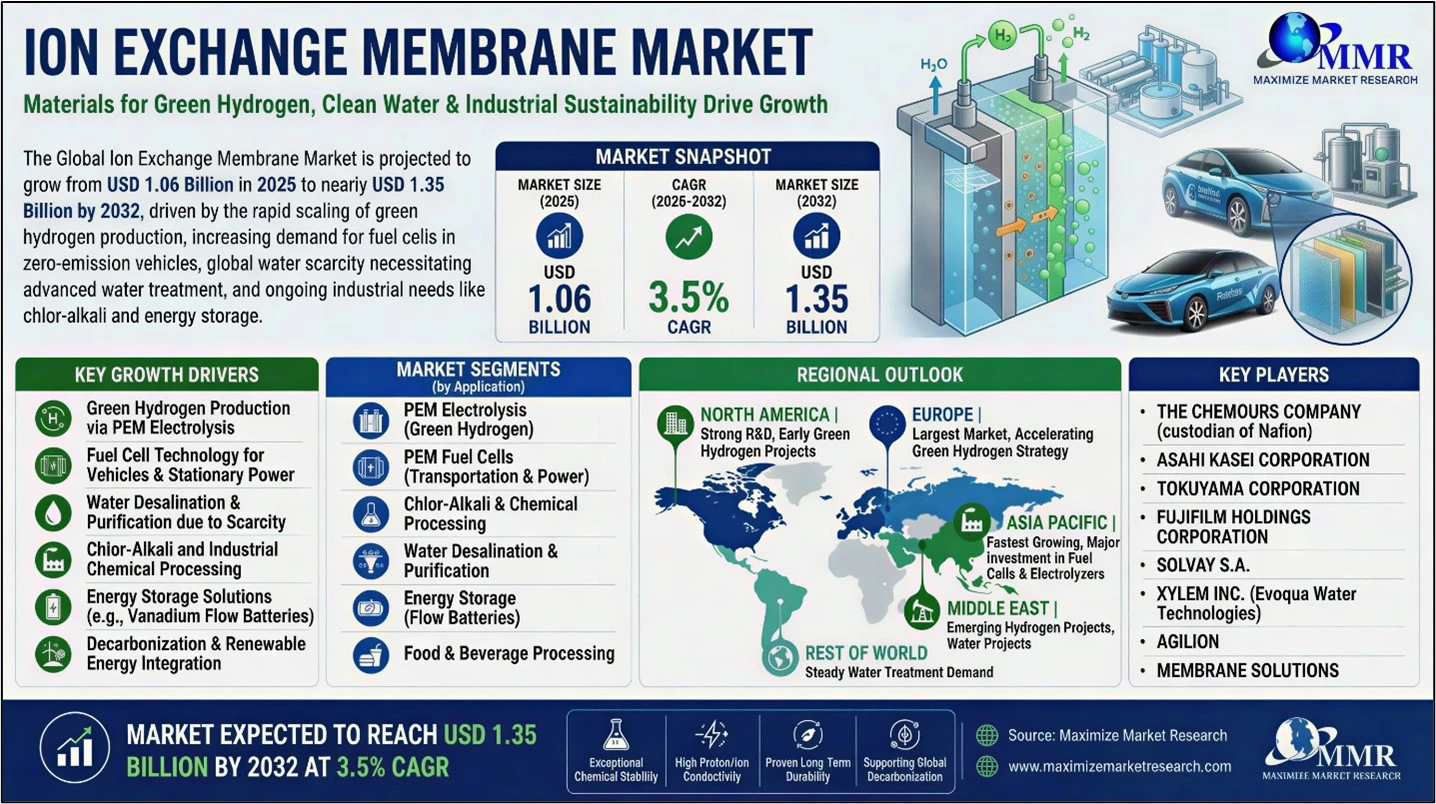
The Global Ion Exchange Membrane Market was valued at USD 1.06 Billion in 2025 and is projected to reach USD 1.35 Billion by 2032, growing at a CAGR of 3.5%, per Maximize Market Research. The Chemours Company, custodian of the legendary Nafion brand, sits at the apex of a market being reshaped by the hydrogen economy, water scarcity, and the global energy transition, with applications spanning fuel cells, electrolyzers, and industrial water treatment that are impossible without ion-selective membranes.
There is a material that makes the hydrogen economy possible. It sits inside every proton exchange membrane fuel cell ever built. It controls ion transport in chlor-alkali plants that produce the chlorine and caustic soda that industrial civilization depends upon. It enables the desalination and water purification infrastructure that billions of people rely on.
That material is the ion exchange membrane. And the Global Ion Exchange Membrane Market, valued at USD 1.06 Billion in 2025 and projected to reach USD 1.35 Billion by 2032 at a CAGR of 3.5%, per Maximize Market Research, is the quiet infrastructure layer beneath the world’s most urgent sustainability ambitions.
The Chemours Company and the Nafion Legacy
When DuPont invented Nafion in 1966, it created a material with no commercial precedent: a perfluorosulfonic acid polymer membrane that conducts protons with extraordinary efficiency while remaining chemically inert across virtually every industrial environment. The Chemours Company, which acquired the Nafion business as part of its 2015 spinoff from DuPont, has since developed it into the world’s most recognized ion exchange membrane brand, with applications in PEM electrolysis for green hydrogen production, fuel cells for zero-emission vehicles and stationary power, and chlor-alkali production for industrial chemical manufacturing.
In 2024, Chemours entered into an expanded strategic supply agreement with a leading European electrolyzer manufacturer, securing multi-year Nafion membrane supply contracts as green hydrogen infrastructure projects accelerated across Germany, the Netherlands, and Denmark under the EU Hydrogen Strategy. This agreement reflects a fundamental shift: ion exchange membranes, once primarily an industrial chemical input, are now critical infrastructure components in the global energy transition.
What Is Driving the Market Beyond Steady Growth
The Ion Exchange Membrane Market’s 3.5% CAGR masks a bifurcated reality. In legacy applications such as chlor-alkali production, growth is steady and volume-driven. In emerging applications, specifically PEM electrolysis for green hydrogen and vanadium redox flow batteries for grid-scale energy storage, demand is growing at rates that significantly exceed the market average. The cation exchange membrane segment commands the largest share of the market, driven by its dominant role in chlor-alkali, PEM fuel cells, and electrodialysis applications. Water treatment and food and beverage processing are growing end-use segments as water scarcity intensifies globally.
MMR Insight: The Ion Exchange Membrane Market is segmented by material type, including perfluorocarbon, hydrocarbon, and others. Perfluorocarbon membranes, including Nafion-based products, hold the largest market share due to superior chemical stability and conductivity. By charge type, cation exchange membranes dominate. By application, energy storage, water treatment, and chemical processing represent the largest segments. North America and Europe are the leading regional markets, driven by energy transition investments, while Asia Pacific is growing fastest, propelled by South Korean, Japanese, and Chinese investments in fuel cell and electrolyzer manufacturing.
Final Take
A market growing from USD 1.06 Billion in 2025 to USD 1.35 Billion by 2032 at a 3.5% CAGR is not a high-velocity market. But it is an exceptionally strategic one. The companies that control ion exchange membrane technology control the materials bottleneck for fuel cells, electrolyzers, and water treatment systems simultaneously. Chemours, with its Nafion portfolio, its expanded electrolyzer supply agreements, and its five-decade head start in perfluorosulfonic acid membrane science, occupies a position in this market that is both technically deep and commercially difficult to replicate. As the hydrogen economy scales, that position becomes more valuable, not less.
Related Reports
Explore related market intelligence reports from Maximize Market Research: