Wood Bio-Products Market – Global Market Size, Strategic Growth Drivers, Risk Assessment Framework, Regulatory Landscape Review, Competitive Intensity Mapping & Long-Term Industry Outlook to 2032

7.6%
CAGR (2026-2032)
360.4 USD Bn.
Market Size
318
Report Pages
122
Market Tables

Overview

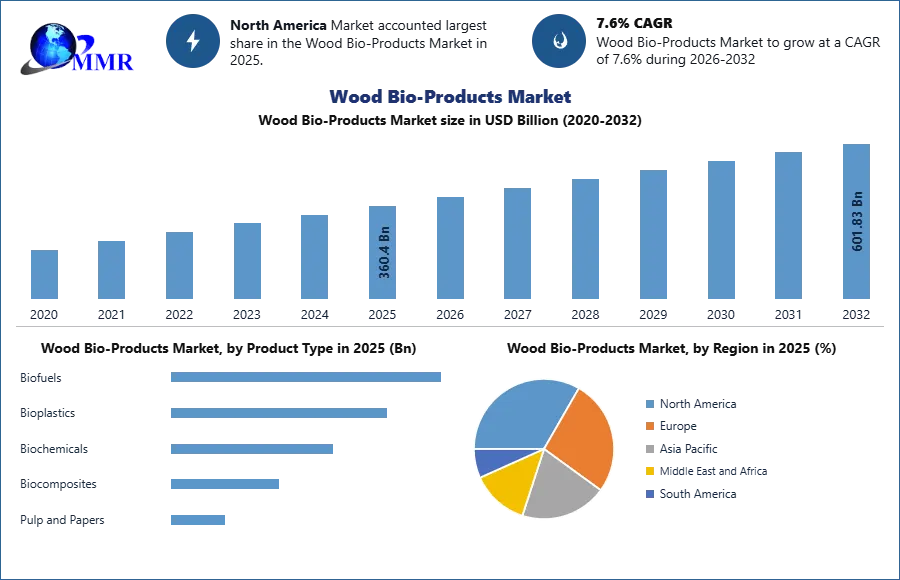
The Wood Bio-Products Market size was valued at USD 360.4 Billion in 2025 and the total Wood Bio-Products revenue is expected to grow at a CAGR of 7.6% from 2026 to 2032, reaching nearly USD 601.83 Billion.

The wood bio-products market is developing and offers sustainable alternatives to fossil fuel-based products. It includes biofuels, bioplastics, biochemicals, biocomposites, and pulp & paper. These goods are lignocellulosic. Several variables drive market expansion. Since wood is renewable, sustainability matters. Environmental concerns, government initiatives encouraging bio-based materials, and rising consumer demand for eco-friendly items also contribute.

Renewable energy targets and decarbonization measures have increased biofuel consumption. Bioplastics are in demand to combat plastic pollution and provide biodegradable alternatives. The market for bio-based chemicals is expanding, driven by the need for sustainable alternatives in various industries. Biocomposites offer lightweight and eco-friendly options for construction and automotive applications. While digitalization has impacted paper products, the industry has adapted by focusing on specialty papers and sustainable practices.

The market faces challenges such as ensuring a consistent supply chain of wood biomass, technological advancements, and competition from other renewable materials. However, with continued innovation, supportive policies, and collaboration, the wood bio-products market presents significant growth opportunities across industries seeking sustainable alternatives.
Wood Bio-Products Market

To know about the Research Methodology :- Request Free Sample Report

Wood Bio-Products Market Scope and Research Methodology:

The global Wood Bio-Products Market is analyzed through segments including Product Type, Application, End-use industry and Region. The report provides an exhaustive analysis of the segments and their sub-segments with the help of tabular and graphical representation and gives a clear business view to the Investors. The Wood Bio-Products Market report presents an analysis of market size, share, and growth, trends, cost structure, statistical and comprehensive data of the global market.

The Wood Bio-Products Market report covers the key players in the industry, including company profile, revenue, product specifications, and product sales, price, and gross margin sales, market share as well as an in-depth analysis of the market. The report covers a competitive analysis of market drivers, restraints, opportunities and growth. To analyze the impact of micro-economic and macro-economic factors on the market, PORTER and PESTLE analyses were conducted. SWOT analysis was used to study the strengths and weaknesses of the Wood Bio-Products industry. The bottom-up approach was used to estimate the Wood Bio-Products Market size.

Wood Bio-Products Market Dynamics:

Wood Bio-Products Market Drivers

Sustainability
The increasing concern about environmental sustainability is a significant driver of the wood bio-products market. Wood products are more sustainable than fossil fuel products since wood is renewable. Wood bio-products are in demand as governments, organisations, and consumers cut greenhouse gas emissions and combat climate change. These goods reduce carbon emissions and support a circular economy.

Government Policies and Incentives
Supportive regulations and incentives provided by governments play a crucial role in driving the wood bio-products market. Many countries have implemented policies to promote the use of renewable and bio-based materials, including wood bio-products. These policies may include renewable energy targets, carbon pricing mechanisms, tax incentives, grants, and subsidies for bio-based industries. By creating a favourable policy environment, governments encourage investment in the sector, stimulate innovation, and boost market growth. The existence of clear and consistent policies provides businesses with the confidence to invest in wood bio-product technologies and infrastructure, driving market expansion.

Wood Bio-Products Market Opportunities

Renewable Energy Transition
Wood bio-products, especially biofuels, have a huge possibility in the renewable energy market. Heat, power, and transportation can be powered by wood pellets, chips, and biomass. Wood biomass biofuels are in demand as renewable energy targets rise and carbon emissions fall. Wood pellet production, biomass power plants, and advanced biofuel technologies can expand.

Sustainable Packaging and Plastics
Wood bio-products, especially bioplastics and bio composites, can benefit from the global push for sustainable packaging and plastics. Biodegradable and renewable plastics are in demand due to worries about plastic pollution and the environmental impact of regular plastics. Bioplastics made from wood fibres and lignin are biodegradable, compostable, and renewable. Bio composites made from wood fibres can replace traditional materials in building, automotive, and consumer products industries.

Wood Bio-Products Market Restraints & Challenges

Supply Chain Challenges
The wood bio-products market heavily relies on a consistent and reliable supply of wood biomass. However, ensuring a steady supply can be challenging due to factors such as forest management practices, availability of sustainably sourced wood, and transportation logistics. Limited access to suitable wood biomass can pose a constraint on the scalability and cost-effectiveness of wood bio-product production. Competition for wood resources from other industries like construction and traditional pulp and paper manufacturing can further strain the supply chain.

Technological Advancements and Cost Competitiveness
While wood bio-products offer sustainable alternatives, there is a need for continued research and development to improve production processes and enhance cost competitiveness. Technological advancements are required to optimize conversion processes, increase the efficiency of biomass utilization, and reduce production costs. Without significant advancements in technology and economies of scale, wood bio-products may struggle to compete with established fossil fuel-based products, which have a well-established infrastructure and lower production costs.

Wood Bio-Products Market Trends

Circular Economy and Waste Valorization
The concept of a circular economy, where resources are used efficiently and waste is minimized, is gaining traction in the wood bio-products market. Companies are exploring ways to maximize the value extracted from wood biomass throughout its lifecycle. This includes utilizing byproducts and waste streams from wood processing operations as feedstock for bio-based chemicals, biofuels, or bio composite materials. The wood bio-products sector uses a circular approach to reduce waste, improve resource efficiency, and build a more sustainable and profitable value chain.

Advanced Biorefineries
The wood bio-products industry is trending towards advanced biorefinery technologies and integrated ideas. Advanced biorefineries can extract high-value products from wood biomass beyond pulp and paper. Biorefineries turn wood biomass into biofuels, biochemicals, bioplastics, and other products via biochemical and thermochemical processes. Integrated biorefineries maximise resource utilisation with lignin, hemicellulose, and cellulose. These advancements enhance the efficiency and profitability of wood bio-product production while reducing waste and environmental impact.

Wood Bio-Products Market Segmentation

By Product Type
Wood bio-products include biofuels, bioplastics, biochemicals, bio composites, and pulp & papers. Biofuels had 30% market share in 2025. In the approaching years, this segment will dominate the market. Biofuels, generated from wood and other biomass, replace fossil fuels. Bioplastics had 25% market share in 2025. This category will increase significantly. Bioplastics, manufactured from wood, replace petroleum-based plastics. This category should develop steadily. Biochemicals from wood and other biomass materials are utilised in food additives, fertilisers, and medications. Bio composites had 15% market share in 2025. This category will increase significantly. Bio composites—wood and other materials like polymers and metals—are utilised in construction, furniture, and packaging. In 2025, pulp and papers had 10% market share. This category should develop steadily. Books, newspapers, and periodicals require pulp and paper derived from wood and other biomass.

By Application
Energy, packaging, construction, automotive, and chemicals comprise the wood bio-products market. 30% of the market was energy in 2025. This segment will dominate in the coming years. Biofuels from wood, a renewable resource, burn cleaner than fossil fuels. 2025 packaging market share was 25%. This category will increase significantly. Boxes, crates, and pallets can be made from sustainable wood. 2024 construction market share was 20%. This category should develop steadily. Wood is robust and can be used to make houses, buildings, and bridges. In 2025, 15% was automotive. This category will increase significantly. Car seats, dashboards, and door panels can be made from lightweight wood.

Chemicals had 10% market share in 2025. This category should develop steadily. Wood produces cellulose, lignin, and furfural. Papermaking, textiles, and biofuels employ these compounds.

By End-use Industry
The wood bio-products market is segmented by end-user industry into five main categories. Residential held 35% of the market in 2025 and it will continue dominate during forecast period. Furniture, flooring, and cabinets employ wood bio-products. Commercial had 25% of the market in 2025 and is predicted to rise substantially. Office furniture, store displays, and restaurant tables use wood bio-products. Industrial had 20% market share in 2025 and is predicted to increase gradually. Pallets, crates, and transport containers utilise wood bio-products. Infrastructure had 15% market share in 2025 and is predicted to develop substantially. Bridges, buildings, and railway sleepers employ wood bio-products. Others had 5% market share in 2025 and is predicted to increase gradually. Toys, sporting equipment, and musical instruments employ wood bio-products.

Wood Bio-Products Market Regional Insights:

North America
Renewable energy and sustainability drive the wood bio-products industry in North America. With strong biomass industries and supportive policies, the US and Canada dominate the market. Biofuels, bioplastics, and biochemicals are driving the North American market, with energy, packaging, and chemicals adopting them. Wood bio-product market growth and innovation are supported by the region's superior R&D and investment climate.

Europe
Environmental legislation, sustainability programmes, and ambitious renewable energy targets make Europe a key wood bio-products market. Germany, France, Sweden, and Finland lead the market in infrastructure and technology. Biofuels, bioplastics, and bio composites made from wood biomass are in high demand due to the region's focus on carbon emissions and circular economy. Europe's packaging, building, and automotive sectors have adopted wood bio-products as sustainable alternatives.

Asia Pacific
Rising environmental consciousness, government backing, and demand for sustainable solutions are driving the wood bio-products market in Asia Pacific. China, Japan, and South Korea are regional leaders in fossil fuel reduction and renewable energy promotion. Wood pellets and biomass for heating and electricity generation drive the Asia Pacific biofuels market. Consumer awareness and a trend towards eco-friendly products are also driving bioplastics and bio composites.

Middle East and Africa
Due to vast biomass resources and a growing focus on sustainable development, the wood bio-products market in this region is young but promising. South Africa, Kenya, and Nigeria are studying bioenergy, biofuels, and bioplastics to minimise fossil fuel use and environmental issues. Renewable energy targets, waste valorization, and government bio-based industry promotion boost the market.

South America
Rich forest resources and growing demand for sustainable alternatives make South America a promising wood bio-products market. Brazil, Chile, and Argentina are important players in bioenergy and biofuels production from wood biomass. Sustainable practises and speciality papers and packaging from South America's pulp and paper industry boost the market. Due to environmental concerns, government assistance, and the desire for sustainable alternatives to fossil fuel-based products, these locations provide unique wood bio-products market dynamics.

Wood Bio-Products Market Competitive Landscape

The wood bio-products market features key players such as Stora Enso, UPM-Kymmene Corporation, International Paper, West Fraser, Borregaard, and Enviva. These companies offer a diverse range of wood-based biofuels, biochemicals, biocomposites, and sustainable packaging materials. They emphasize sustainability, circular economy principles, and responsible sourcing. Additionally, their commitment to research and development drives innovation and the adoption of advanced processing technologies. Other notable players in the market include Suzano, Metsä Group, Bracell, Danzer, and Resolute Forest Products. Overall, the market is characterized by intense competition, collaboration, and investment in technologies to enhance product efficiency and sustainability.

Recent Industry Developments (2025–2026):

Exact Date Company Development Impact
17 February 2025 Nippon Paper Group Established a joint venture, Morisora Bio Refinery LLC, to produce bioethanol and biochemicals from woody biomass residues in Japan. Accelerates the commercialization of second-generation (2G) bioethanol, reducing reliance on food-based feedstocks for industrial chemicals.
15 February 2025 AkzoNobel Launched a new waterborne wood coating containing 20% bio-based content to replace traditional petrochemical resins. Enhances the sustainability profile of finished wood products, meeting stringent VOC regulations in European and North American markets.
01 January 2025 Weyerhaeuser Commenced construction of its USD 500 million TimberStrand facility in Arkansas to expand engineered wood capacity. Significant capacity expansion will provide 10 million cubic feet of annual output to meet rising demand in the US residential housing market.

Wood Bio-Products Market Scope: Inquire Before Buying

Wood Bio-Products Market
Report Coverage Details
Base Year: 2025 Forecast Period: 2026-2032
Historical Data: 2020 to 2025 Market Size in 2025: 360.4 USD Billion
Forecast Period 2026-2032 CAGR: 7.6% Market Size in 2032: 601.83 USD Billion
Segments Covered: by Product Type Biofuels
Bioplastics
Biochemicals
Biocomposites
Pulp and Papers
by Application Energy
Packaging
Construction
Automotive
Chemicals
by End User Industry Residential
Commercial
Industrial
Infrastructure
Others

Wood Bio-Products Market, by Region:

North America (United States, Canada and Mexico)
Europe (UK, France, Germany, Italy, Spain, Sweden, Austria, Turkey, Russia and Rest of Europe)
Asia Pacific (China, India, Japan, South Korea, Australia, ASEAN and Rest of APAC)
Middle East and Africa (South Africa, GCC, Egypt, Nigeria and Rest of ME&A)
South America (Brazil, Argentina, Columbia and Rest of South America)

Key Players / Competitors Profiles Covered in Brief in Global Wood Bio-Products Market Report in Strategic Perspective:

  1. UPM-Kymmene Corporation
  2. Stora Enso
  3. Lixil Group
  4. West Fraser
  5. Weyerhaeuser
  6. UFP Industries Inc.
  7. Canfor
  8. Sappi
  9. Metsä Group
  10. JELD-WEN
  11. Borregaard
  12. Domtar Corporation
  13. Rayonier Advanced Materials Inc.
  14. Mercer International Inc.
  15. Lenzing AG
  16. Georgia-Pacific LLC
  17. Suzano S.A.
  18. Enviva Inc.
  19.  Drax Group
  20. Holmen AB
  21. Billerud AB
  22. Arauco Wood Products Inc.
  23. Södra Skogsägarna
  24. Kruger Inc.
  25. Ekman & Co AB

Table of Contents

1. Wood Bio-Products Market Introduction
1.1. Study Assumption and Market Definition
1.2. Scope of the Study
1.3. Executive Summary
2. Global Wood Bio-Products Market: Competitive Landscape
2.1. MMR Competition Matrix
2.2. Competitive Landscape
2.3. Key Players Benchmarking
2.3.1. Company Name
2.3.2. Business Segment
2.3.3. End-user Segment
2.3.4. Revenue (2025)
2.3.5. Company Locations
2.4. Leading Wood Bio-Products Market Companies, by market capitalization
2.5. Market Structure
2.5.1. Market Leaders
2.5.2. Market Followers
2.5.3. Emerging Players
2.6. Mergers and Acquisitions Details
3. Wood Bio-Products Market: Dynamics
3.1. Wood Bio-Products Market Trends by Region
3.1.1. North America Wood Bio-Products Market Trends
3.1.2. Europe Wood Bio-Products Market Trends
3.1.3. Asia Pacific Wood Bio-Products Market Trends
3.1.4. Middle East and Africa Wood Bio-Products Market Trends
3.1.5. South America Wood Bio-Products Market Trends
3.2. Wood Bio-Products Market Dynamics by Region
3.2.1. North America
3.2.1.1. North America Wood Bio-Products Market Drivers
3.2.1.2. North America Wood Bio-Products Market Restraints
3.2.1.3. North America Wood Bio-Products Market Opportunities
3.2.1.4. North America Wood Bio-Products Market Challenges
3.2.2. Europe
3.2.2.1. Europe Wood Bio-Products Market Drivers
3.2.2.2. Europe Wood Bio-Products Market Restraints
3.2.2.3. Europe Wood Bio-Products Market Opportunities
3.2.2.4. Europe Wood Bio-Products Market Challenges
3.2.3. Asia Pacific
3.2.3.1. Asia Pacific Wood Bio-Products Market Drivers
3.2.3.2. Asia Pacific Wood Bio-Products Market Restraints
3.2.3.3. Asia Pacific Wood Bio-Products Market Opportunities
3.2.3.4. Asia Pacific Wood Bio-Products Market Challenges
3.2.4. Middle East and Africa
3.2.4.1. Middle East and Africa Wood Bio-Products Market Drivers
3.2.4.2. Middle East and Africa Wood Bio-Products Market Restraints
3.2.4.3. Middle East and Africa Wood Bio-Products Market Opportunities
3.2.4.4. Middle East and Africa Wood Bio-Products Market Challenges
3.2.5. South America
3.2.5.1. South America Wood Bio-Products Market Drivers
3.2.5.2. South America Wood Bio-Products Market Restraints
3.2.5.3. South America Wood Bio-Products Market Opportunities
3.2.5.4. South America Wood Bio-Products Market Challenges
3.3. PORTER's Five Forces Analysis
3.4. PESTLE Analysis
3.5. Technology Roadmap
3.6. Regulatory Landscape by Region
3.6.1. North America
3.6.2. Europe
3.6.3. Asia Pacific
3.6.4. Middle East and Africa
3.6.5. South America
3.7. Key Opinion Leader Analysis For Wood Bio-Products Industry
3.8. Analysis of Government Schemes and Initiatives For Wood Bio-Products Industry
3.9. Wood Bio-Products Market Trade Analysis
3.10. The Global Pandemic Impact on Wood Bio-Products Market
4. Wood Bio-Products Market: Global Market Size and Forecast by Segmentation (in USD Billion) 2025-2032
4.1. Wood Bio-Products Market Size and Forecast, by Product Type (2025-2032)
4.1.1. Biofuels
4.1.2. Bioplastics
4.1.3. Biochemicals
4.1.4. Biocomposites
4.1.5. Pulp and Papers
4.2. Wood Bio-Products Market Size and Forecast, by Application (2025-2032)
4.2.1. Energy
4.2.2. Packaging
4.2.3. Construction
4.2.4. Automotive
4.2.5. Chemicals
4.3. Wood Bio-Products Market Size and Forecast, by End User Industry (2025-2032)
4.3.1. Residential
4.3.2. Commercial
4.3.3. Industrial
4.3.4. Infrastructure
4.3.5. Others
4.4. Wood Bio-Products Market Size and Forecast, by Region (2025-2032)
4.4.1. North America
4.4.2. Europe
4.4.3. Asia Pacific
4.4.4. Middle East and Africa
4.4.5. South America
5. North America Wood Bio-Products Market Size and Forecast by Segmentation (in USD Billion) 2025-2032
5.1. North America Wood Bio-Products Market Size and Forecast, by Product Type (2025-2032)
5.1.1. Biofuels
5.1.2. Bioplastics
5.1.3. Biochemicals
5.1.4. Biocomposites
5.1.5. Pulp and Papers
5.2. North America Wood Bio-Products Market Size and Forecast, by Application (2025-2032)
5.2.1. Energy
5.2.2. Packaging
5.2.3. Construction
5.2.4. Automotive
5.2.5. Chemicals
5.3. North America Wood Bio-Products Market Size and Forecast, by End User Industry (2025-2032)
5.3.1. Residential
5.3.2. Commercial
5.3.3. Industrial
5.3.4. Infrastructure
5.3.5. Others
5.4. North America Wood Bio-Products Market Size and Forecast, by Country (2025-2032)
5.4.1. United States
5.4.1.1. United States Wood Bio-Products Market Size and Forecast, by Product Type (2025-2032)
5.4.1.1.1. Biofuels
5.4.1.1.2. Bioplastics
5.4.1.1.3. Biochemicals
5.4.1.1.4. Biocomposites
5.4.1.1.5. Pulp and Papers
5.4.1.2. United States Wood Bio-Products Market Size and Forecast, by Application (2025-2032)
5.4.1.2.1. Energy
5.4.1.2.2. Packaging
5.4.1.2.3. Construction
5.4.1.2.4. Automotive
5.4.1.2.5. Chemicals
5.4.1.3. United States Wood Bio-Products Market Size and Forecast, by End User Industry (2025-2032)
5.4.1.3.1. Residential
5.4.1.3.2. Commercial
5.4.1.3.3. Industrial
5.4.1.3.4. Infrastructure
5.4.1.3.5. Others
5.4.2. Canada
5.4.2.1. Canada Wood Bio-Products Market Size and Forecast, by Product Type (2025-2032)
5.4.2.1.1. Biofuels
5.4.2.1.2. Bioplastics
5.4.2.1.3. Biochemicals
5.4.2.1.4. Biocomposites
5.4.2.1.5. Pulp and Papers
5.4.2.2. Canada Wood Bio-Products Market Size and Forecast, by Application (2025-2032)
5.4.2.2.1. Energy
5.4.2.2.2. Packaging
5.4.2.2.3. Construction
5.4.2.2.4. Automotive
5.4.2.2.5. Chemicals
5.4.2.3. Canada Wood Bio-Products Market Size and Forecast, by End User Industry (2025-2032)
5.4.2.3.1. Residential
5.4.2.3.2. Commercial
5.4.2.3.3. Industrial
5.4.2.3.4. Infrastructure
5.4.2.3.5. Others
5.4.3. Mexico
5.4.3.1. Mexico Wood Bio-Products Market Size and Forecast, by Product Type (2025-2032)
5.4.3.1.1. Biofuels
5.4.3.1.2. Bioplastics
5.4.3.1.3. Biochemicals
5.4.3.1.4. Biocomposites
5.4.3.1.5. Pulp and Papers
5.4.3.2. Mexico Wood Bio-Products Market Size and Forecast, by Application (2025-2032)
5.4.3.2.1. Energy
5.4.3.2.2. Packaging
5.4.3.2.3. Construction
5.4.3.2.4. Automotive
5.4.3.2.5. Chemicals
5.4.3.3. Mexico Wood Bio-Products Market Size and Forecast, by End User Industry (2025-2032)
5.4.3.3.1. Residential
5.4.3.3.2. Commercial
5.4.3.3.3. Industrial
5.4.3.3.4. Infrastructure
5.4.3.3.5. Others
6. Europe Wood Bio-Products Market Size and Forecast by Segmentation (in USD Billion) 2025-2032
6.1. Europe Wood Bio-Products Market Size and Forecast, by Product Type (2025-2032)
6.2. Europe Wood Bio-Products Market Size and Forecast, by Application (2025-2032)
6.3. Europe Wood Bio-Products Market Size and Forecast, by End User Industry (2025-2032)
6.4. Europe Wood Bio-Products Market Size and Forecast, by Country (2025-2032)
6.4.1. United Kingdom
6.4.1.1. United Kingdom Wood Bio-Products Market Size and Forecast, by Product Type (2025-2032)
6.4.1.2. United Kingdom Wood Bio-Products Market Size and Forecast, by Application (2025-2032)
6.4.1.3. United Kingdom Wood Bio-Products Market Size and Forecast, by End User Industry (2025-2032)
6.4.2. France
6.4.2.1. France Wood Bio-Products Market Size and Forecast, by Product Type (2025-2032)
6.4.2.2. France Wood Bio-Products Market Size and Forecast, by Application (2025-2032)
6.4.2.3. France Wood Bio-Products Market Size and Forecast, by End User Industry (2025-2032)
6.4.3. Germany
6.4.3.1. Germany Wood Bio-Products Market Size and Forecast, by Product Type (2025-2032)
6.4.3.2. Germany Wood Bio-Products Market Size and Forecast, by Application (2025-2032)
6.4.3.3. Germany Wood Bio-Products Market Size and Forecast, by End User Industry (2025-2032)
6.4.4. Italy
6.4.4.1. Italy Wood Bio-Products Market Size and Forecast, by Product Type (2025-2032)
6.4.4.2. Italy Wood Bio-Products Market Size and Forecast, by Application (2025-2032)
6.4.4.3. Italy Wood Bio-Products Market Size and Forecast, by End User Industry (2025-2032)
6.4.5. Spain
6.4.5.1. Spain Wood Bio-Products Market Size and Forecast, by Product Type (2025-2032)
6.4.5.2. Spain Wood Bio-Products Market Size and Forecast, by Application (2025-2032)
6.4.5.3. Spain Wood Bio-Products Market Size and Forecast, by End User Industry (2025-2032)
6.4.6. Sweden
6.4.6.1. Sweden Wood Bio-Products Market Size and Forecast, by Product Type (2025-2032)
6.4.6.2. Sweden Wood Bio-Products Market Size and Forecast, by Application (2025-2032)
6.4.6.3. Sweden Wood Bio-Products Market Size and Forecast, by End User Industry (2025-2032)
6.4.7. Austria
6.4.7.1. Austria Wood Bio-Products Market Size and Forecast, by Product Type (2025-2032)
6.4.7.2. Austria Wood Bio-Products Market Size and Forecast, by Application (2025-2032)
6.4.7.3. Austria Wood Bio-Products Market Size and Forecast, by End User Industry (2025-2032)
6.4.8. Rest of Europe
6.4.8.1. Rest of Europe Wood Bio-Products Market Size and Forecast, by Product Type (2025-2032)
6.4.8.2. Rest of Europe Wood Bio-Products Market Size and Forecast, by Application (2025-2032)
6.4.8.3. Rest of Europe Wood Bio-Products Market Size and Forecast, by End User Industry (2025-2032)
7. Asia Pacific Wood Bio-Products Market Size and Forecast by Segmentation (in USD Billion) 2025-2032
7.1. Asia Pacific Wood Bio-Products Market Size and Forecast, by Product Type (2025-2032)
7.2. Asia Pacific Wood Bio-Products Market Size and Forecast, by Application (2025-2032)
7.3. Asia Pacific Wood Bio-Products Market Size and Forecast, by End User Industry (2025-2032)
7.4. Asia Pacific Wood Bio-Products Market Size and Forecast, by Country (2025-2032)
7.4.1. China
7.4.1.1. China Wood Bio-Products Market Size and Forecast, by Product Type (2025-2032)
7.4.1.2. China Wood Bio-Products Market Size and Forecast, by Application (2025-2032)
7.4.1.3. China Wood Bio-Products Market Size and Forecast, by End User Industry (2025-2032)
7.4.2. S Korea
7.4.2.1. S Korea Wood Bio-Products Market Size and Forecast, by Product Type (2025-2032)
7.4.2.2. S Korea Wood Bio-Products Market Size and Forecast, by Application (2025-2032)
7.4.2.3. S Korea Wood Bio-Products Market Size and Forecast, by End User Industry (2025-2032)
7.4.3. Japan
7.4.3.1. Japan Wood Bio-Products Market Size and Forecast, by Product Type (2025-2032)
7.4.3.2. Japan Wood Bio-Products Market Size and Forecast, by Application (2025-2032)
7.4.3.3. Japan Wood Bio-Products Market Size and Forecast, by End User Industry (2025-2032)
7.4.4. India
7.4.4.1. India Wood Bio-Products Market Size and Forecast, by Product Type (2025-2032)
7.4.4.2. India Wood Bio-Products Market Size and Forecast, by Application (2025-2032)
7.4.4.3. India Wood Bio-Products Market Size and Forecast, by End User Industry (2025-2032)
7.4.5. Australia
7.4.5.1. Australia Wood Bio-Products Market Size and Forecast, by Product Type (2025-2032)
7.4.5.2. Australia Wood Bio-Products Market Size and Forecast, by Application (2025-2032)
7.4.5.3. Australia Wood Bio-Products Market Size and Forecast, by End User Industry (2025-2032)
7.4.6. Indonesia
7.4.6.1. Indonesia Wood Bio-Products Market Size and Forecast, by Product Type (2025-2032)
7.4.6.2. Indonesia Wood Bio-Products Market Size and Forecast, by Application (2025-2032)
7.4.6.3. Indonesia Wood Bio-Products Market Size and Forecast, by End User Industry (2025-2032)
7.4.7. Malaysia
7.4.7.1. Malaysia Wood Bio-Products Market Size and Forecast, by Product Type (2025-2032)
7.4.7.2. Malaysia Wood Bio-Products Market Size and Forecast, by Application (2025-2032)
7.4.7.3. Malaysia Wood Bio-Products Market Size and Forecast, by End User Industry (2025-2032)
7.4.8. Vietnam
7.4.8.1. Vietnam Wood Bio-Products Market Size and Forecast, by Product Type (2025-2032)
7.4.8.2. Vietnam Wood Bio-Products Market Size and Forecast, by Application (2025-2032)
7.4.8.3. Vietnam Wood Bio-Products Market Size and Forecast, by End User Industry (2025-2032)
7.4.9. Taiwan
7.4.9.1. Taiwan Wood Bio-Products Market Size and Forecast, by Product Type (2025-2032)
7.4.9.2. Taiwan Wood Bio-Products Market Size and Forecast, by Application (2025-2032)
7.4.9.3. Taiwan Wood Bio-Products Market Size and Forecast, by End User Industry (2025-2032)
7.4.10. Rest of Asia Pacific
7.4.10.1. Rest of Asia Pacific Wood Bio-Products Market Size and Forecast, by Product Type (2025-2032)
7.4.10.2. Rest of Asia Pacific Wood Bio-Products Market Size and Forecast, by Application (2025-2032)
7.4.10.3. Rest of Asia Pacific Wood Bio-Products Market Size and Forecast, by End User Industry (2025-2032)
8. Middle East and Africa Wood Bio-Products Market Size and Forecast by Segmentation (in USD Billion) 2025-2032
8.1. Middle East and Africa Wood Bio-Products Market Size and Forecast, by Product Type (2025-2032)
8.2. Middle East and Africa Wood Bio-Products Market Size and Forecast, by Application (2025-2032)
8.3. Middle East and Africa Wood Bio-Products Market Size and Forecast, by End User Industry (2025-2032)
8.4. Middle East and Africa Wood Bio-Products Market Size and Forecast, by Country (2025-2032)
8.4.1. South Africa
8.4.1.1. South Africa Wood Bio-Products Market Size and Forecast, by Product Type (2025-2032)
8.4.1.2. South Africa Wood Bio-Products Market Size and Forecast, by Application (2025-2032)
8.4.1.3. South Africa Wood Bio-Products Market Size and Forecast, by End User Industry (2025-2032)
8.4.2. GCC
8.4.2.1. GCC Wood Bio-Products Market Size and Forecast, by Product Type (2025-2032)
8.4.2.2. GCC Wood Bio-Products Market Size and Forecast, by Application (2025-2032)
8.4.2.3. GCC Wood Bio-Products Market Size and Forecast, by End User Industry (2025-2032)
8.4.3. Nigeria
8.4.3.1. Nigeria Wood Bio-Products Market Size and Forecast, by Product Type (2025-2032)
8.4.3.2. Nigeria Wood Bio-Products Market Size and Forecast, by Application (2025-2032)
8.4.3.3. Nigeria Wood Bio-Products Market Size and Forecast, by End User Industry (2025-2032)
8.4.4. Rest of ME&A
8.4.4.1. Rest of ME&A Wood Bio-Products Market Size and Forecast, by Product Type (2025-2032)
8.4.4.2. Rest of ME&A Wood Bio-Products Market Size and Forecast, by Application (2025-2032)
8.4.4.3. Rest of ME&A Wood Bio-Products Market Size and Forecast, by End User Industry (2025-2032)
9. South America Wood Bio-Products Market Size and Forecast by Segmentation (in USD Billion) 2025-2032
9.1. South America Wood Bio-Products Market Size and Forecast, by Product Type (2025-2032)
9.2. South America Wood Bio-Products Market Size and Forecast, by Application (2025-2032)
9.3. South America Wood Bio-Products Market Size and Forecast, by End User Industry (2025-2032)
9.4. South America Wood Bio-Products Market Size and Forecast, by Country (2025-2032)
9.4.1. Brazil
9.4.1.1. Brazil Wood Bio-Products Market Size and Forecast, by Product Type (2025-2032)
9.4.1.2. Brazil Wood Bio-Products Market Size and Forecast, by Application (2025-2032)
9.4.1.3. Brazil Wood Bio-Products Market Size and Forecast, by End User Industry (2025-2032)
9.4.2. Argentina
9.4.2.1. Argentina Wood Bio-Products Market Size and Forecast, by Product Type (2025-2032)
9.4.2.2. Argentina Wood Bio-Products Market Size and Forecast, by Application (2025-2032)
9.4.2.3. Argentina Wood Bio-Products Market Size and Forecast, by End User Industry (2025-2032)
9.4.3. Rest Of South America
9.4.3.1. Rest Of South America Wood Bio-Products Market Size and Forecast, by Product Type (2025-2032)
9.4.3.2. Rest Of South America Wood Bio-Products Market Size and Forecast, by Application (2025-2032)
9.4.3.3. Rest Of South America Wood Bio-Products Market Size and Forecast, by End User Industry (2025-2032)
10. Company Profile: Key Players
10.1. UPM-Kymmene Corporation
10.1.1. Company Overview
10.1.2. Business Portfolio
10.1.3. Financial Overview
10.1.4. SWOT Analysis
10.1.5. Strategic Analysis
10.1.6. Scale of Operation (small, medium, and large)
10.1.7. Details on Partnership
10.1.8. Regulatory Accreditations and Certifications Received by Them
10.1.9. Awards Received by the Firm
10.1.10. Recent Developments
10.2. Stora Enso
10.3. Lixil Group
10.4. West Fraser
10.5. Weyerhaeuser
10.6. UFP Industries Inc.
10.7. Canfor
10.8. Sappi
10.9. Metsä Group
10.10. JELD-WEN
10.11. Borregaard
10.12. Domtar Corporation
10.13. Rayonier Advanced Materials Inc.
10.14. Mercer International Inc.
10.15. Lenzing AG
10.16. Georgia-Pacific LLC
10.17. Suzano S.A.
10.18. Enviva Inc.
10.19. Drax Group
10.20. Holmen AB
10.21. Billerud AB
10.22. Arauco Wood Products Inc.
10.23. Södra Skogsägarna
10.24. Kruger Inc.
10.25. Ekman & Co AB
11. Key Findings
12. Industry Recommendations
13. Wood Bio-Products Market: Research Methodology
14. Terms and Glossary

Custom Market Research Services

We Will Customise The Research For You, In Case The Report Listed Above Does Not Meet With Your Requirements