
Wireless Security Camera Market by Offering, Type of Camera, Application and Region - Global Market Size Estimation, Industry-Wide Analysis, Competitive Landscape Assessment & Long-Term Forecast to 2032
Overview
Wireless Security Camera Market was valued at US$ 7.45 Bn. in 2024 and the total revenue is expected to grow at 12.5% of CAGR through 2025 to 2032, reaching nearly US$ 19.13 Bn.
Wireless Security Camera Market Overview:
Closed-circuit television cameras that broadcast a video and audio signal to a wireless receiver via a radio band are known as wireless security cameras. There must be at least one cable or wire used to supply electricity to different wireless security cameras. Batteries or a wireless transmitter can be used to power wireless security cameras. Hardware, software, and service for video monitoring are just a few of the components that make up wireless security cameras (VSaaS).
Box cameras, dome cameras, PTZ cameras, bullet cameras, IP cameras, and day/night cameras are a few of the types of wireless security cameras. Increased internet access throughout the world will help market share. The increasing availability of affordable and dependable broadband connections will allow people of all income levels to install these devices for safety.
The increasing use of IoT technologies for constructing a connected house will have an impact on market trends. To provide an integrated living experience, many people are adding smart gadgets such as locks, lights, and cameras. This also helps them improve their security and general convenience, which drive the wireless security camera market growth. To know about the Research Methodology :- Request Free Sample Report
Wireless Security Camera Market Dynamics:
Impact of challenges in the component supply chain on wireless security camera manufacturers
After the COVID-19 pandemic, the price of Bitcoin has risen enormously, resulting in severe scarcity and significant price increases. China on top of that, a new cryptocurrency has emerged, creating a new challenge to a different segment of the wireless security CCTV camera market. Chia, a new 'environmental' cryptocurrency, has eliminated the processing power and electricity requirements of standard GPU mining in favor of using extra storage space on hard drives (HDD) to validate blockchain transactions ('proof of space'). Since May of this year, the demand for this cryptocurrency has required 30 Exabytes of storage - that's 30 Billion Gigabytes of data - and it's not only HDDs that are in demand; high-capacity SSDs are as well. This is producing significant hard drive supply concerns throughout the world, driving increasing costs for those that are accessibility create new challenges for wireless camera market players.
Due to a lack of raw materials, which results in longer lead times for component manufacturers, prices for hard drives and GPUs are expected to stay high well into 2024 as factories work to catch up on the backlog and hamper the market. Every market player has had a significant influence on the security market. CCTV project manufacturers are currently dealing with the confluence of longer delivery timelines and increasing prices. Many manufacturers, integrators, and distributors are doing everything they can to withstand price rises, but this is unsustainable in the long run. Delays in component manufacture, along with rising demand, will continue to provide a significant challenge to the CCTV and security industries. Good planning and sensible design, on the other hand, will keep projects on track.
Manufacturers of security systems are not alone in this challenge, but the dual threat is maybe unique. This challenge will take time to overcome, but with careful preparation and close attention to the market, forward-thinking wireless security cameras, CCTV manufacturers may still execute projects for their customers.
Challenges faced by wireless security camera market manufacturers and customers in 2024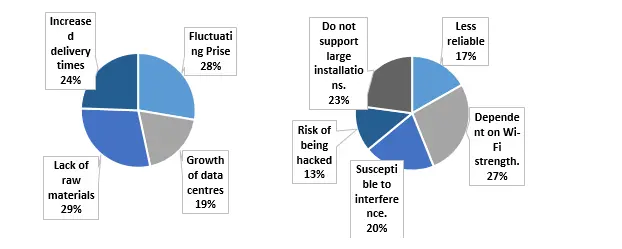 Wireless security robotic cameras started penetrating the market growth
The autonomous security robot is equipped with a panoramic video surveillance system that includes six cameras for all-around monitoring and a PTZ camera for tracking movements from a long distance. All cameras' photos are sent over WiFi to a Central Monitoring Station or a security officer's laptop. The video surveillance system includes a DVR with motion detection. In automated mode, the video surveillance system searches for sources of movement with a 360-degree camera. In manual mode, the robot's operators have complete control over the camera, which creates lucrative oppurchuinity for new wireless camera market players
The security patrol robot uses WiFi wireless data transmission technology to do remote video surveillance. The data transfer distance between the robots and the base station can exceed half a mile when using the built-in omnidirectional antennas. To broadcast video over long distances, a directional antenna on the receiving side of the Central Monitoring Station is required. When there are barriers between the robot and the monitor station, such as buildings or heavy trucks, an extra robot can be used to transmit the signal these are the key driving features of a robotic wireless camera.
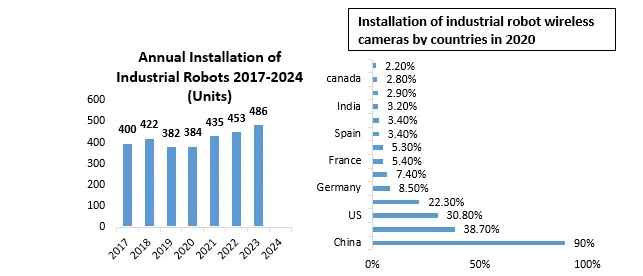
According to the Global Robotics 2024 Industrial Robots study, there are 3 million industrial robots working in industries throughout the world, a 10% increase. Despite the worldwide pandemic, new robot sales increased by 0.5%, with 384,000 units sold globally in 2023. This trend was driven by good market improvements in China, which balanced for contractions in other markets. Following 2018 and 2017, this is the third most successful year in the history of the robotics industry.
 Wireless Security Camera Market Segment Analysis:
Based on Type, the Wireless Security Camera Market is segmented into PTZ, Fixed, and other. PTZ is expected to dominate the wireless security camera market during the forecast period. PTZ cameras are used to monitor a vast area and are frequently used in combination with a fixed camera to eliminate coverage gaps. Depending on the type, cameras may move anywhere from zero to 360 degrees pan/180 degrees tilt. Some systems also include digital pan and tilt, which allows video to be modified after it has been recorded - albeit the resulting video will be a smoother texture and lower resolution. PTZ cameras may be manually and remotely adjusted to monitor suspicious activities.
Users may alter the camera's field of view without having to visit the site, which drives the wireless security camera market. The worldwide PTZ IP Camera market has grown due to a number of factors, including increased usage of video surveillance systems for security applications and rising demand for high-resolution cameras. Furthermore, the increasing demand for advanced features such as HD resolution and night vision in PTZ IP Cameras is fueling the growth of this market. The growing awareness of the advantages of employing PTZ cameras is also assisting in the growth of this market.
Based on the Application, the Wireless Security Camera Market is segmented into indoor and outdoor. Outdoor wireless security cameras are expected to grow faster during the forecast period. Outdoor cameras are security gadgets that may detect and record illegal activities in the neighborhood. These gadgets are generally resistant to high temperatures and have two-way communication, night vision, and HD resolution. Outdoor camera devices are available in both wireless and wired configurations. These devices were useful for more than just recording crime. Security cameras captured clear images in all lighting conditions; most featured infrared night vision, which increases the demand for wireless security cameras market for outdoors.
Wireless Security Camera Market Regional Insights:
North America dominated the market with a 40 % share in 2024. North America is expected to witness significant growth at a CAGR through the forecast period. Thanks to government authorities' increasing attention on upgrading current broadband infrastructure. The Ontario government announced a combined provincial and federal investment of around USD 56 million in April 2022, supporting six projects to offer high-speed internet access to over 6,500 homes in rural Southwestern and Northern Ontario.
These programs will expand the availability of reliable and inexpensive internet access to a wider variety of households, allowing them to install modern security cameras in their homes. With an increased demand for their subscription services, wireless camera manufacturers have raised their membership prices. Ring, a leading provider of smart home automation solutions in the United States, recently revealed that it has added additional capabilities to its subscription plan, upping the price of its basic plan by around $1.
Among the new features are 180 days of video, extra notifications, and up to 50 video downloads. The implementation of two-factor authentication across numerous wireless camera alternatives has increased security following a number of automated account robberies, boosting the U.S. wireless home security camera market.
Competitive Landscape
Wireless security systems are a wide concept that includes firewalls, access control protocols, video surveillance, and a variety of other measures. Wireless security systems are continuous implementation, owing to rising demand for a variety of security measures in response to increasing risks and security concerns connected to robberies. This rising adoption of wireless security systems for home security is expected to drive the wireless security system market in the coming years. Companies in the wireless home security camera market are focusing their efforts on obtaining a competitive position through strategic acquisitions and new launches.
The profitability of the larger automation system, and particularly wireless security systems, has attracted many players to enter. Amazon, for example, just purchased Blink, a startup that manufactures wireless home security cameras. Amazon's drive into wireless security cameras has put the company's main opponent in the smart home market, Google, on the defense. Furthermore, rising demand for wireless security systems is expected to provide new possibilities in the wireless security systems market.
The introduction of new companies into the market will increase demand in the industry. For example, in January 2022, TP-Link announced plans to join the home security industry in the United States with the release of two security sensors, four smart cameras, and a home security hub. This launch will increase competitiveness in the region and complement the industrial environment. The report covered more detailed analyses of strategic implementation and adoption of new advanced technology by region.
Wireless Security Camera Market Scope: Inquiry Before Buying
| Wireless Security Camera Market | |||
|---|---|---|---|
| Report Coverage | Details | ||
| Base Year: | 2024 | Forecast Period: | 2025-2032 |
| Historical Data: | 2019 to 2024 | Market Size in 2024: | US $ 7.45 Bn. |
| Forecast Period 2025 to 2032 CAGR: | 12.5% | Market Size in 2032: | US $ 19.13 Bn. |
| Segments Covered: | by Offering | 1. Hardware 2. Monitor 3. Software 4. Services 5. Other |
|
| by Type of Camera | 1. PTZ 2. Fixed 3. Other |
||
| by Application | 1. Indoor 2. Outdoor |
||
Wireless Security Camera Market, by Region
North America (United States, Canada and Mexico)
Europe (UK, France, Germany, Italy, Spain, Sweden, Austria and Rest of Europe)
Asia Pacific (China, South Korea, Japan, India, Australia, Indonesia, Malaysia, Vietnam, Taiwan, Bangladesh, Pakistan and Rest of APAC)
Middle East and Africa (South Africa, GCC, Egypt, Nigeria and Rest of ME&A)
South America (Brazil, Argentina Rest of South America)
Wireless Security Camera Market, Key Players are
1. Canon, Inc.
2. Cisco Systems Inc.
3. D-Link Systems Inc.
4. Koninklijke Philips N.V.
5. Lenovo
6. Logitech
7. FLIR Lorex
8. Night Owl Security
9. Teklink Security
10. AMCREST
11. AtomsLabs
12. CCTV Cameras Pros
13. HIK Vision
14. Q-SEE
15. DEFENDER
16. Crystal Vision.
Frequently Asked Questions:
1] What segments are covered in the Global Wireless Security Camera Market report?
Ans. The segments covered in the Wireless Security Camera Market report are based on Offring, Type of cameras, Application
2] Which region is expected to hold the highest share in the Global Wireless Security Camera Market?
Ans. The North America region is expected to hold the highest share in the Wireless Security Camera Market.
3] What is the market size of the Global Wireless Security Camera Market by 2032?
Ans. The market size of the Wireless Security Camera Market by 2032 is expected to reach US$ 19.13 Bn.
4] What is the forecast period for the Global Wireless Security Camera Market?
Ans. The forecast period for the Wireless Security Camera Market is 2025-2032.
5] What was the market size of the Global Wireless Security Camera Market in 2024?
Ans. The market size of the Wireless Security Camera Market in 2024 was valued at US$ 7.45 Bn.