
Wearable Medical Devices Market Size by Product, Device Type, Grade Type, Application and Region – Segment-Level Market Assessment, Growth Opportunity Analysis, Competitive Mapping & Forecast to 2032
Overview
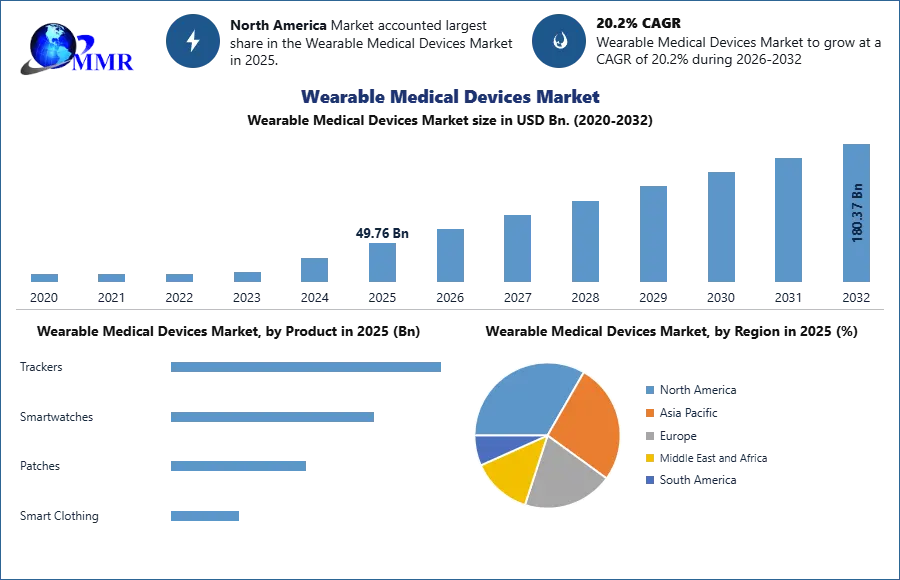
Wearable Medical Devices Market size was valued at USD 28.65 Billion in 2025 and the total Wearable Medical Devices revenue is expected to grow at 20.2% through 2026 to 2032, reaching nearly USD 180.37 Billion.
Wearable Medical Devices Market Overview:
There is no universally agreed-upon definition of wearable technology-based devices. Wearable devices are categorized according to their purpose, appearance, closeness to the human body, and other factors. The Center for Entrepreneurship and Technology at the University of California, Berkeley, classifies wearable devices into smartwatches, smart glasses, smart clothing, fitness trackers, body sensors, wearable cameras, and others. A wearable healthcare device is an electronic device with or without physical or software components that are worn by an individual to gather data about that individual's health condition and wellness habits in an active or passive manner. The device's data is frequently sent to a software platform for analysis by an individual or organization in order to track health and encourage healthy behavior.
To know about the Research Methodology :- Request Free Sample Report
In this report, the wearable medical devices market's growth reasons, as well as the market's many segments (Product, Device Type, Grade Type, Application and, Region) are discussed. Data has been given by market players, regions, and specific requirements. This market report includes a comprehensive overview of all the significant improvements that are presently prevailing in all market segments. Key data analysis is presented in the form of statistics, infographics, and presentations. The study discusses the wearable medical devices market's Drivers, Restraints, Opportunities, and Challenges. The report helps to assess the market growth drivers and determines how to use these drivers as a tool. The report also helps to rectify and resolve issues related to the global wearable medical devices market situation.
Wearable Medical Devices Market Dynamics:
A major driver of the wearable medical devices market is the increasing awareness of fitness and healthcare among consumers. The healthcare market has grown significantly in recent years, owing to the growing geriatric population, the rising incidences of chronic diseases, and the application of modern medical devices i.e. wearable medical devices that enable the delivery of high-quality care outside of hospitals.
A major restraint of the market are the unfavorable standards and regulations present in the healthcare sector. For example, In deciding compensation for mobile healthcare, national agencies play a significant role. National regulations in several European countries define medical treatment in terms of the patient and doctor's physical presence, which has an impact on payments for mobile and remote healthcare solutions. Wearables adoption in the healthcare sector is slowed by such regulations.
The key opportunity in the wearable medical devices market is the increasing endorsement of Artificial Intelligence and other technologies. Artificial intelligence can be utilized in 5G to predict a patient's potential diagnosis and treatments. Moreover, AI can assist medical systems in predicting which patients are likely to experience postoperative difficulties, allowing for early intervention. In general, real-time learning with a large amount of data necessitates reliable and high-bandwidth networks. Healthcare businesses may leverage AI technologies to give the finest treatment possible in real-time, wherever they are, thanks to 5G networks. As a result, the utilization of new tools and technologies is predicted to give high-growth prospects in the wearable medical devices market.
The main challenge in the wearable medical devices market is the patent protections need for the devices. Clinical device makers in the United States and Europe confront significant hurdles from patent reform and patent trolls. Patent trolls are firms that buy patents in order to collect royalties from businesses that purportedly infringe on trademarks held by patent claim entities or non-practicing organizations. Patent trolls made their debut in the medical technology business in the last decade, when they filed a slew of violation cases against medical device manufacturers. Companies may secure the financial and legal rewards of properly filed patents and reduce possible losses caused by patent trolls by taking precautious efforts to safeguard mobile medical technology developments through patents. The key to success in the fast-developing clinical-grade wearables business is to protect patents.
Wearable Medical Devices Market Segment Analysis:
By Device Type, the Diagnostic and Monitoring devices segment dominated the wearable medical devices market in 2025. This segment is also projected to witness the highest CAGR of 10.3% in the forecast period (2026-2032). The increasing frequency of neurological and nephrological illnesses is the primary factor influencing the segment's growth.
According to the 2024 survey, migraine was the most common neurological illness in the United States. In the United States, 92.5% of individuals suffer from migraines. Neuromodulation devices are the most commonly used to diagnose and treat migraine in this scenario. In addition, the wearable monitoring device segment is likely to grow as people become more aware of the capacity of neurological wearables to continually measure people's cognitive capacities while they go about their daily lives.
Because of the rising intake of traditional diagnostic devices, the of traditional diagnostic device sector is expected to grow at the quickest rate throughout the projected period. Furthermore, market growth is expected to be aided by a robust portfolio of medical devices such as intelligent asthma action products, smart pain reliever gadgets, and insulin management devices. Pain control devices, glucose monitoring devices, recovery devices, and respiratory therapy devices make up the monitoring device segment. Due to the large population suffering from diabetes, insulin monitoring device sub-segment was dominant in 2023 and is expected to remain dominant over the forecast period (2026-2032).
Wearable Medical Devices Market Regional Insights:
The wearable medical devices market was led by North America, with the United States emerging as the leading contributor in 2025. Due to the high incidence of heart and lifestyle-related disorders, rising acceptance of wearable medical advances, and high per capita medical spending, the United States has the greatest share of the wearable medical device market. The North American market for wearable medical devices is forecast to grow at a modest rate of 12.3% over the forecast period, because of the growing illness prevalence in the region.
The COVID-19 has influenced group and individual behavior, affecting both the workplace and healthcare. Devices are available in the form of technology to meet these new problems. Wearables have an essential part in the full continuum of care, as well as in the professional and leisure life, when it comes to health, work, and economy during COVID-19. In the United States, Philips launched another whole wearable biosensor for early health deterioration detection in 2023, including clinical surveillance for COVID-19.
Recent Industry Developments (2025–2026)
| Exact Date | Company | Development | Impact |
|---|---|---|---|
| 01 December 2025 | Dexcom | The Dexcom G7 15 Day Continuous Glucose Monitoring System officially launched in the U.S. for adults with diabetes. | The extended 15.5-day wear time improves patient compliance and reduces the monthly cost of sensor changes for Medicare beneficiaries. |
| 30 September 2025 | Abbott Laboratories | Abbott discontinued the legacy Libre 2 and Libre 3 systems in multiple regions, fully replacing them with the Libre 2+ and Libre 3+ models. | This transition mandates 15-day wear cycles and enables seamless automated insulin delivery (AID) system integration. |
| 29 April 2025 | Abbott Laboratories | Abbott successfully integrated FreeStyle Libre glucose data with the Epic Electronic Health Record (EHR) system. | This integration streamlines clinical decision-making by providing physicians with real-time wearable data directly within hospital workflows. |
The objective of the report is to present a comprehensive analysis of the Wearable Medical Devices market to the stakeholders in the industry. The past and current status of the industry with the forecasted market size and trends are presented in the report with the analysis of complicated data in simple language. The report covers all the aspects of the industry with a dedicated study of key players that include market leaders, followers, and new entrants.
PORTER, PESTEL analysis with the potential impact of micro-economic factors of the market have been presented in the report. External as well as internal factors that are supposed to affect the business positively or negatively have been analysed, which will give a clear futuristic view of the industry to the decision-makers.
The report also helps in understanding the Wearable Medical Devices market dynamics, structure by analyzing the market segments and project the market size. Clear representation of competitive analysis of key players by product, price, financial position, product portfolio, growth strategies, and regional presence in the Wearable Medical Devices market make the report investor’s guide.
Wearable Medical Devices Market Scope: Inquiry Before Buying
| Wearable Medical Devices Market | |||
|---|---|---|---|
| Report Coverage | Details | ||
| Base Year: | 2025 | Forecast Period: | 2026-2032 |
| Historical Data: | 2020 to 2025 | Market Size in 2025: | 49.76 USD Bn. |
| Forecast Period 2026-2032 CAGR: | 20.2% | Market Size in 2032: | 180.37 USD Bn. |
| Segments Covered: | by Product | Trackers Smartwatches Patches Smart Clothing |
|
| by Device Type | Diagnostic and Monitoring Devices Multiparameter Tracker ECG\Heart Rate Monitors Pulse Oximeters |
||
| by Grade Type | Traditional Diagnostic Devices Consumer-Grade Wearable Healthcare Devices Clinical-Grade Wearable Healthcare Devices |
||
| by Application | General Health and Fitness Remote Patient Monitoring Home Healthcare |
||
Wearable Medical Devices Market, by Region
North America (United States, Canada and Mexico)
Europe (UK, France, Germany, Italy, Spain, Sweden, Austria and Rest of Europe)
Asia Pacific (China, South Korea, Japan, India, Australia, Indonesia, Malaysia, Vietnam, Taiwan, Bangladesh, Pakistan and Rest of APAC)
Middle East and Africa (South Africa, GCC, Egypt, Nigeria and Rest of ME&A)
South America (Brazil, Argentina Rest of South America)
Key Players / Competitors Profiles Covered in Brief in Global Wearable Medical Devices Market Report in Strategic Perspective:
- Medtronic
- Abbott Laboratories
- GE Healthcare
- Koninklijke Philips N.V.
- Omron Corporation
- Ihealth Lab, Inc
- Alphabet Inc. (Google/Fitbit)
- DexCom, Inc.
- Garmin Ltd.
- Samsung Electronics Co., Ltd.
- Masimo Corporation
- BioTelemetry, Inc. (Philips)
- Dexcom, Inc.
- Hoffmann-La Roche Ltd.
- Ten3t Healthcare
- Bruker Corporation
- Basis Science
- Withings
- Sotera Health
- Zepp Health (Amazfit)
- Everist Health
- Lifewatch AG
- VitalConnect
- WHOOP
- Polar Electro