
Wave Energy Converter Market Size by Technology, Location, Application and Region – Segment-Level Market Assessment, Growth Opportunity Analysis, Competitive Mapping & Forecast to 2030
Overview
The Wave Energy Converter Market size was valued at USD 20.35 Million in 2023 and is expected to grow by 4.26% from 2024 to 2030, reaching nearly USD 27.25 Million.
Wave Energy Converters are devices that convert the kinetic and potential energy associated with a moving ocean wave into useful mechanical or electrical energy. Wave energy converters produce clean energy for a variety of uses, including pumping for saltwater desalination or propulsion for underwater vehicles. The energy contained in ocean waves is captured and used to generate electricity using a wave energy converter. It is a very effective technique that makes use of the enormous renewable energy found in ocean waves. The wave energy converter absorbs wave energy using a variety of methods. It is used depending on the location and the depth of the water.
The growing demand for power from renewable energy sources and the increased accessibility of wave energy supply are both favorable factors for the global market for wave energy converters, which has further increased investments in the sector. Wave energy is produced by the up-and-down motion of ocean waves. The energy from the ocean waves is captured by wave energy generators, which are then used to drive turbines and generators to produce electricity. Research & development expenditures are expected to be substantial as the wave energy sector is still in its development. Processes are expected to become more effective and cost-efficient as research and development activities increase, driving Wave Energy Converter market growth.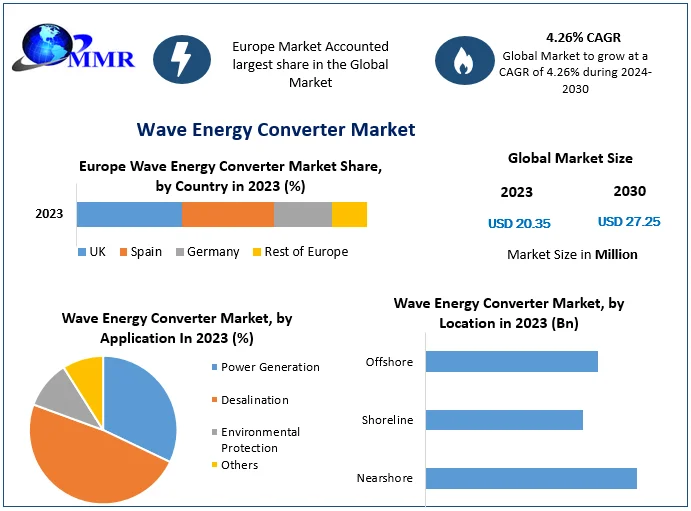 To know about the Research Methodology:- Request Free Sample Report
Wave Energy Converter Market Dynamics:
Growing Adoption of Sustainable Energy Technologies to boost Wave Energy Converter Market Growth
Interest in the potential of using ocean waves to generate sustainable electricity is increasing rapidly across the world. The advantages of switching from older, fossil fuel-dependent power generation techniques to new renewable energy technologies have lately been realized for a variety of geopolitical, environmental, economic, and practical reasons. Researchers, industry leaders, and policymakers are all actively working to develop effective, affordable, and sustainable energy technologies in order to take advantage of this paradigm change. Although the latest growth of the solar, wind, and biofuel sectors has received a lot of attention, the technology for producing power from ocean waves has been quietly developing and is about to be put into practice in coastal regions all over the world.
Untapped energy sources like ocean waves have the potential to be a power-dense, reliable, eco-friendly, and broadly accessible source of renewable energy. Around 2 terawatts (TW) of wave power output are estimated to be feasible globally, which is a sizable percentage of the 3.5 TW installed electric capacity that exists now. It is not surprising that interest in wave energy conversion (WEC) technology has increased recently because 37% of the world's population lives within 60 miles of a coastline and is enticed to use this vast resource. These factors are driving the Wave Energy Converter Market growth across the world.
Growing Electricity Demand across Coastal Countries
According to World bank estimations, the average annual electricity usage per person worldwide is more than 3,135 kWh. The US, Canada, Japan, the UK, South Korea, and Germany are a few of the main countries with the largest annual per capita energy consumption. The amount of electricity consumed in these nations is rising due to the widespread use of electric appliances including heaters, air conditioners, freezers, and other devices. The rising consumer expenditure power lends support to this as well.
The increasing population limits the amount of available land while also raising the demand for power. This results in a situation where there isn't enough space or a business case for building land-based power plants. The need for power plants in coastal areas has increased as a result of these reasons. These regions and their residents may benefit from the production of clean energy using wave energy converters, which is boosting the Wave Energy Converter Market growth.
 Growing Investment and Technological Advancement in Wave Energy Converter Market
A technology for generating renewable energy that has not been extensively studied is wave energy. The majority of the businesses that sell this technology are currently developing their pilot programs. Many researchers are looking at different factors that relate to the feasibility of WEC and how thecostsost can be reduced without sacrificing efficiency. Wave power harvesting is still an immature and underdeveloped technology. No single design for this gadget has been identified as the best one because of its complexity. The development of technologies able to survive harsh climatic conditions and intense ocean weather, energy storage, and consistency of supply in appropriate quantities are the main challenges facing the wave power business.
Many countries are making significant investments in the creation and uptake of renewable energy technology. According to the MMR analysis, more than USD 800 billion was invested globally in the power sector's production of renewable energy in 2023. Nearly USD 48.5 billion worth of renewable investments were made in the US in 2017. Since wave energy is a renewable source of energy, major nations like the US and Australia are spending heavily in R&D. As a result, these factors are expected to boost the Wave Energy Converter market growth through the forecast period.
Inadequate Infrastructure for Wave Energy Converter
Wave energy converters can be positioned offshore, close to the shore, or right next to the shore. The keys to ongoing development and supporting maintenance activities are proper grid infrastructure links and port facilities. Although choosing the best location for constructing wave energy converters is crucial for maximizing power production, it is also crucial for the power to be transmitted to the location where it will be used. Additional infrastructure is needed for this power transmission, including onshore substations, subterranean cables, and transmission lines that connect to the grid. This infrastructure must be built with additional resources and personnel. In addition, the anchoring of the wave energy converter during installation is a critical part that adds to the challenges because the mooring ropes need to be attached to the sea floor bed with drilled-in anchors. Since these additional infrastructures are needed to build up a wave energy power plant of any size, the market for wave energy converters is expected to be constrained during the forecast period.
Wave Energy Converter Market Segment Analysis:
By Technology, the Wave Energy Converter Market is segmented into Oscillating Body Converter, Oscillating Water Columns, Overtopping Devices, and Rotating Mass Converters. The Oscillating Water Columns segment accounted for the largest market share in 2023. The oscillating wave column technology, which is created by the natural flow of wind energy through a Wells turbine, generates no greenhouse gas emissions, making it a renewable and non-polluting source of energy. The main moving component, the turbine, may be easily removed for upkeep or repair thanks to the shoreline plan's on-land location. During the forecast period, the segment is expected to aid in the segment's growth.
By Location, the Wave Energy Converter Market is segmented into Nearshore, Shoreline, and Offshore. The Nearshore segment is expected to grow at a significant growth rate through the forecast period. Installations nearer to the property are frequently simpler and less expensive than those farther away. Additionally, nearshore installations are frequently found to operate more efficiently than onshore ones, giving the market a fantastic opportunity to grow in the future. These facilities can be used simultaneously for power generation and desalination. For the regulation of wave energy from nearshore facilities, numerous companies have created various patents. All of these elements have a role in the segment's growth.
By Application, the Wave Energy Converter Market is segmented into Power Generation, Desalination, Environmental Protection, and Others. The Power Generation segment held the largest market share accounting in 2023. The segment’s growth is attributed to the strong emphasis on the production of electrical energy from renewable sources. This is being done to reduce greenhouse gas emissions caused by power plant operations. The growing use of wave energy for power generation from several countries is boosting the segment growth for the wave energy converter market growth. For Instance, the annual energy potential of waves off the coasts of the United States is expected to be as 2.64 trillion kilowatt-hours or the equivalent of about 64% of total U.S. utility-scale electricity generation in 2023.
Wave Energy Converter Market Regional Insights:
Europe held the largest market share of the global Wave Energy Converter Market in 2023. Wave energy conversion devices are projected to be fully implemented and adopted in Europe due to the existence of various enterprises engaged in the research and development of wave energy converters. 12 MW of wave energy have been installed in Europe between 2010 and 2020.
At the end of 2020, 1.1 MW was still in use, while 10.3 MW had been deactivated after testing programs were completed. According to the EU Offshore Renewable Energy Strategy, Europe has set a goal of 40 GW of ocean energy for 2050 (including wave, tidal, ocean thermal, and floating solar). WAVEGEM, an autonomous hybrid solar and wave energy production platform created by GEPS TECHNO, has been hosted by SEM-REV, the offshore test facility run by Ecole Centrale de Nantes and located off the coast of Le Croisic in the Pays de la Loire region, since 2019.
Countries in Europe include the UK, Spain, Germany, the Nordic nations, and the remainder of the continent. Europe has a good standard of living yet has cold weather the entire year. The electricity demand gradually rises as a result of these factors. To cut carbon emissions from power generation activities, European nations place a high emphasis on sustainable power generation technologies.
| Company Name | Country | Device Name | Max Rated Power (Kw) | Water Column Location |
| 40 South Energy | UK | US | Null | Submerged-Bottom |
| R115 | 400 | Submerged-Mid | ||
| Able Technologies, LLC | US | EGWAP | 390 | Surface |
| Aqua-Magnetics, Inc. | US | Ocean Cell Wave Energy Conversion | 40 | Surface |
| Aquamarine Power | UK | Oyster | 800 | Submerged-Bottom |
| BioPower Systems Pty Ltd | Australia | bioWAVE | 250 | Submerged-Bottom |
| Carnegie Clean Energy | Australia | CETO 6 | 1000 | Submerged-Bottom |
| Ecomerit Technologies LLC | US | Centipod | 1000 | Surface |
North America is expected to grow at the highest growth rate during the forecast period. To fulfill the potential of marine renewable energy, the industry, several organizations, and the government are working together and doing research. MMR estimates that the US coastlines have a yearly wave energy potential of 2.64 trillion kWh. About 40% of Americans live in coastal communities, and the most reliable renewable energy source is wave energy. As a result, one of the reasons boosting the growth of the Wave Energy Converter Market in North America is the rising demand for power generation.
Wave Energy Converter Market Scope: Inquire before buying
| Wave Energy Converter Market | |||
|---|---|---|---|
| Report Coverage | Details | ||
| Base Year: | 2023 | Forecast Period: | 2024-2030 |
| Historical Data: | 2018 to 2023 | Market Size in 2023: | US $ 20.35 Mn. |
| Forecast Period 2024 to 2030 CAGR: | 4.26% | Market Size in 2030: | US $ 27.25 Mn. |
| Segments Covered: | by Technology | Oscillating Body Converter Oscillating Water Columns Overtopping Devices Rotating Mass Converters |
|
| by Location | Nearshore Shoreline Offshore |
||
| by Application | Power Generation Desalination Environmental Protection Others |
||
Wave Energy Converter Market, by Region
North America (United States, Canada and Mexico)
Europe (UK, France, Germany, Italy, Spain, Sweden, Austria and Rest of Europe)
Asia Pacific (China, South Korea, Japan, India, Australia, Indonesia, Malaysia, Vietnam, Taiwan, Bangladesh, Pakistan and Rest of APAC)
Middle East and Africa (South Africa, GCC, Egypt, Nigeria and Rest of ME&A)
South America (Brazil, Argentina Rest of South America)
Wave Energy Converter Market Key Players are:
1. Ocean Power Technologies
2. Marine Power Systems
3. Eco Wave Power
4. SINN Power GmbH
5. NEMOS GmbH
6. INGINE Inc.
7. Carnegie Clean Energy
8. CorPower Ocean
9. AW-Energy Oy
10. AWS Ocean Energy
11. Wello Oy
12. HavKraft AS
13. Wave Dragon
14. Wave Swell
15. Aquanet Power
FAQs:
1. What was the global market size of the Wave Energy Converter Market in 2023?
Ans. The Global Wave Energy Converter Market size was valued at USD 20.35 Million.
2. What is the study period for the Wave Energy Converter Market?
Ans. 2018-2030 is the study period for the Wave Energy Converter Market.
3. What is the growth rate of the Wave Energy Converter Market?
Ans. The Wave Energy Converter Market is growing at a CAGR of 4.26% over forecast the period.
4. What are the major key players in the Global Wave Energy Converter Market?
Ans. The major key players of the Global Wave Energy Converter Market are Ocean Power Technologies, Marine Power Systems, Eco Wave Power, SINN Power GmbH, NEMOS GmbH, INGINE Inc., Carnegie Clean Energy, CorPower Ocean, AW-Energy Oy, AWS Ocean Energy, Wello Oy, HavKraft AS, Wave Dragon, Wave Swell, and Aquanet Power.
5. What is the forecast period for the Wave Energy Converter Market?
Ans. The forecast period for the Wave Energy Converter Market is 2024-2030.