
Utility Poles Market Size by Material Type, Type, Pole Size, Application, Region, Industry-Wide Analysis, Competitive Landscape Assessment & Long-Term Forecast to 2032
Overview
The Utility Poles Market size was valued at USD 37.91 Billion in 2024 and the total Utility Poles revenue is expected to grow at a CAGR of 6.4% from 2025 to 2032, reaching nearly USD 62.27 Billion.
Utility Poles Market Overview
A utility pole is an upright column used to provide support to public utility and services apparatus such as power lines, cables, and wires. They are used to accommodate other equipment such as road appliances as well as decorations for events and public holidays. Utility poles are an efficient way of keeping hazardous equipment where it has the least chance of being disturbed. The overhead suspension helps to provide a reliable means of signal transmission for PCs, phones, and various telecommunication devices.
Many utility poles in various regions have surpassed their expected service life, leading to an increased demand for replacement poles. Aging infrastructure requires upgrading to ensure the reliability and safety of power and communication networks. The growth of urban areas requires the expansion and reinforcement of utility infrastructure, leading to an increased demand for utility poles and is expected to boost the Utility Poles market growth. To know about the Research Methodology :- Request Free Sample Report
Utility Poles Market Dynamics
Renewal and Replacement Needs to Boost the Utility Poles Market Growth
Many utility poles have exceeded their expected service life and require replacement or upgrades. Aging infrastructure drives the demand for new utility poles to maintain and enhance the reliability and safety of power and communication networks, which is expected to boost the Utility Poles market growth. Government initiatives and private investments in infrastructure development and expansion projects, such as power transmission lines, telecommunication networks, and rural electrification, create a strong demand for utility poles.
Growing urban populations lead to increased energy consumption and the need for expanded utility networks. Urbanization drives the demand for utility poles to cater to the infrastructure requirements of cities and urban areas. The integration of smart technologies into utility poles, such as sensors for monitoring, communication capabilities, and IoT integration, enhances the efficiency and reliability of utility networks, fostering demand for modern utility poles.
Increasing awareness of environmental issues has led to a preference for eco-friendly and sustainable materials for utility poles, such as composite poles. Sustainable solutions are sought to reduce environmental impact and ensure long-term viability, which is expected to boost the Utility Poles industry growth. The expansion of telecommunication networks, especially with the rollout of 5G technology, requires additional utility poles to support the increased number of cables and equipment.
Fluctuating Raw Material Prices to restraint the Utility Poles Market Growth
The utility poles market relies on various materials such as wood, steel, concrete, and composite materials. Fluctuations in raw material prices can significantly impact manufacturing costs and ultimately affect the final pricing of utility poles. Utility Poles manufacturers find it challenging to maintain stable pricing and profit margins in the face of volatile material costs. The manufacturers involves substantial upfront costs for manufacturing, transportation, and installation. For certain applications or specialized projects, the costs can be even higher.
As a result, utility companies and governments may be hesitant to invest in new infrastructure or upgrades, especially in financially constrained environments and is expected to restrain the Utility Poles Market growth. The increasing adoption of underground cabling for power transmission and telecommunication networks poses a competitive challenge to the utility poles market. Underground cabling offers benefits such as reduced visual impact and increased resilience to extreme weather conditions.
As a result, some utility companies may opt for underground solutions, diverting potential demand away from traditional utility poles. Stringent regulations related to utility pole placement, safety standards, and environmental compliance can pose challenges for manufacturers and utility companies. Adhering to complex regulatory frameworks requires time, resources, and expertise, which can slow down projects and increase costs. Economic downturns or uncertainties lead to reduced infrastructure spending by governments and utility companies. Financial constraints may delay or cancel projects, impacting the demand for utility poles.
Challenges in Utility Poles Market
The utility poles industry is evolving with the integration of smart technologies and advanced materials. Older utility poles are obsolete, requiring upgrades to meet modern standards and accommodate the growing demand for smart utility infrastructure and present challenge for the Utility Poles manufacturers. The utility poles market faces increasing pressure to adopt eco-friendly and sustainable materials and manufacturing processes. Traditional materials such as wood and steel raise environmental concerns, leading to a shift towards more sustainable alternatives like composite poles.
The market competes with underground cabling and other infrastructure solutions that offer reduced visual impact and increased reliability. Utility poles must find ways to differentiate themselves and prove their relevance in a changing technological landscape. The installation of utility poles involves substantial upfront costs, making it capital-intensive. The high cost of entry deters some Utility Poleskey players from entering the market or hinder infrastructure expansion projects. Installing utility poles in remote or challenging terrain areas is logistically difficult and costly. The lack of existing infrastructure and accessibility hinder extending utility networks to underserved regions.
Utility Poles Market Regional Insight
Growing Energy and Telecommunication Infrastructure to boost the Asia Pacific Utility Poles Market growth
Asia Pacific region dominated the market in 2024 and is expected to hold the largest utility poles market share over the forecast period. The rising demand for electricity and the growing telecommunications sector have driven the need for new utility poles and infrastructure upgrades in the region. The Asia-Pacific region has experienced significant urbanization, leading to increased demand for utility poles to support expanding power transmission and telecommunication networks in cities and urban areas. Government initiatives to improve energy infrastructure and increase connectivity have resulted in significant investments in utility pole projects, which is expected to increase the Utility poles market share.
Increasing awareness of environmental issues has led to a preference for sustainable and eco-friendly materials, driving the adoption of composite utility poles in markets. Population growth and electrification efforts in rural and remote areas have spurred the demand for utility poles to extend power distribution networks in the Asia Pacific. China, India, Japan, South Korea, and Australia dominated the regional market. China is one of the largest utility pole markets in the Asia Pacific region and the world. The country's massive population and ongoing infrastructure development projects contribute to a high demand for utility poles for power transmission and telecommunication networks.
North America is expected to dominate the Utility poles industry over the forecast period. Utility poles are used to support the wires that bring power to most of North America. 160 Mn of wooden poles are in service in the region. There is a huge demand for utility poles in the region due to the high degree of reliability demanded of electrical service. Commercial wooden poles species in North America include Douglas-fir, lodgepole pine, red pine, southern pine, and western redcedar. The western US is home to the top preserved wood pole producers in the world.
Tree and utility pole (TUOP) crashes account for 12–15% of all RwD fatal crashes in the U.S.Many utility poles in North America have surpassed their expected service life, leading to an increased demand for replacement poles. Aging infrastructure requires upgrading to ensure the reliability and safety of power and communication networks and is expected to fuel the Utility Poles market growth. According to the U.S. Department of Energy’s Energy Information Administration, annual spending on electricity distribution systems by major U.S. utilities continued to increase year-over-year through , with major utilities spending some $57.4 billion on electric distribution in that last pre-pandemic year.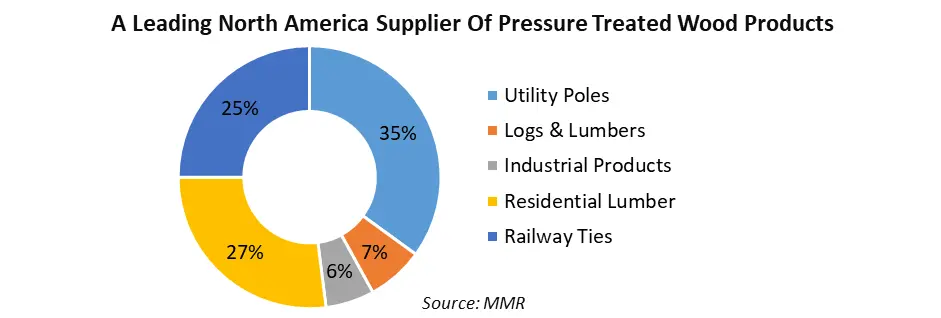
Utility Poles Market Segment Analysis
Based on Material type, the market is segmented into Concrete, Wood, Steel, and Composites. The wood segment dominated the market in 2024 and is expected to hold the largest Utility Poles market share over the forecast period. To enhance their longevity and resistance to decay and pests, many wooden utility poles undergo treatment processes. Creosote, a preservative derived from coal tar, is commonly used to protect the wood from decay and insects, extending the pole's service life. Wooden utility poles come in standardized sizes and lengths to meet the requirements of different applications and utility companies. Common heights range from 30 to 120 feet, depending on the utility and local regulations, which helps to boost the Utility Poles market penetration. Wood is relatively lightweight and easier to handle than alternative materials like steel or concrete, which reduce installation costs and simplify logistics during transportation and installation.
Based on Type, the market is segmented into Transmission Poles, and Distribution Poles. Distribution pole accounted for the largest Utility Poles market share in 2024 and is expected to dominate the market over the forecast period. Distribution poles are equipped with cross-arms, horizontal bars attached to the pole, that hold power lines or telecommunication cables. The number and arrangement of cross-arms depend on the number and types of lines to be supported. Insulators are used on the cross-arms to prevent electrical current from leaking into the pole or the ground. Insulators are typically made from porcelain or polymer materials and help maintain electrical isolation and safety.
Based on Application, the market is segmented into Energy transmission & distribution, Telecommunication, Street lighting, Heavy power lines, sub-transmission lines, and Others. The energy transmission & distribution segment is expected to dominate the Utility Poles industry over the forecast period. The continuous need for infrastructure development and modernization in the power sector drives significant demand for utility poles. Governments and utility companies invest in expanding and upgrading power distribution networks to meet the growing electricity demands of urbanization and industrialization.  Many existing utility poles in the energy transmission & distribution segment have surpassed their expected service life and require replacement or upgrades. Aging infrastructure and the need for reliability and safety leads to a substantial demand for new utility poles.
Utility Poles Market Competitive Landscape
The competitive landscape is shaped by the diversity of utility pole materials and products offered by manufacturers. Different materials such as wood, steel, concrete, and composite materials cater to varying customer preferences, cost considerations, and regulatory requirements. Companies that invest in research and development to introduce innovative utility poles with smart features, such as integrated sensors, communication capabilities, and eco-friendly materials, gain a competitive edge. These innovations enhance pole durability, performance, and safety while addressing environmental concerns. Utility pole manufacturing companies may enter into long-term contracts with utility companies, governments, or telecommunication providers.
These contracts provide a stable revenue stream and ensure a market presence for the manufacturer over an extended period. In , much of the $31.4 billion distribution system capital investment (40%) was spent on power lines, both underground (23% of investment) and overhead (17% of investment). Distribution lines are added or expanded to accommodate new neighborhood development or higher electricity flows as sales increase.
In September, Sparta announced contracting out some USD 200,000 of power pole replacements and wire work to update aging infrastructure in the U.K. The contract is to replace the wooden poles with metal poles.
Utility Poles Market Scope: Inquire before buying
| Utility Poles Market | |||
|---|---|---|---|
| Report Coverage | Details | ||
| Base Year: | 2024 | Forecast Period: | 2025-2032 |
| Historical Data: | 2019 to 2024 | Market Size in 2024: | USD 37.91 Bn. |
| Forecast Period 2025 to 2032 CAGR: | 6.4% | Market Size in 2032: | USD 62.27 Bn. |
| Segments Covered: | by Material Type | Concrete Wood Steel Composites |
|
| by Type | Transmission Poles Distribution Poles |
||
| by Pole Size | Below 40ft Between 40 & 70ft Above 70ft |
||
| by Application | Energy transmission & distribution Telecommunication Street lighting Heavy power lines Subtransmission lines Others |
||
Utility Poles Market, by Region
North America (United States, Canada and Mexico)
Europe (UK, France, Germany, Italy, Spain, Sweden, Austria and Rest of Europe)
Asia Pacific (China, South Korea, Japan, India, Australia, Indonesia, Malaysia, Vietnam, Taiwan, Bangladesh, Pakistan and Rest of APAC)
Middle East and Africa (South Africa, GCC, Egypt, Nigeria and Rest of ME&A)
South America (Brazil, Argentina Rest of South America)
Utility Poles Key Players include
1. Creative Composites Group
2. Bell Lumber & Pole
3. Wood Preservers Inc.
4. The Oeser Company
5. Autonational
6. Tencom
7. Trident Industries
8. Hitachi Energy Ltd.
9. StressCrete Group
10. Koppers Inc.
11. Wipro
12. KEC International
13. RS Technologies Inc.
14. American Timber and Steel
15. Cobb Lumber
16. Nippon Concrete Industries Co.
17. Stella-Jones
18. Valmont Industries, Inc
Frequently Asked Questions:
1] What is the growth rate of the Global Utility Poles Market?
Ans. The Global Utility Poles Market is growing at a significant rate of 6.4% over the forecast period.
2] Which region is expected to dominate the Global Utility Poles Market?
Ans. Asia Pacific region is expected to dominate the Utility Poles Market over the forecast period.
3] What is the expected Global Utility Poles Market size by 2032?
Ans. The market size of the Utility Poles Market is expected to reach USD 62.27 Bn by 2032.
4] Who are the top players in the Global Utility Poles Industry?
Ans. The major key players in the Global Utility Poles Market are Koppers Inc., Wipro, KEC International, and RS Technologies Inc.
5] What was the Global Utility Poles Market size in 2024?
Ans: The Global Utility Poles Market size was USD 37.91 Billion in 2024.