
US Robotic Manipulation Market size by Robot Type, Component, Technology, Application and Enduser
Overview
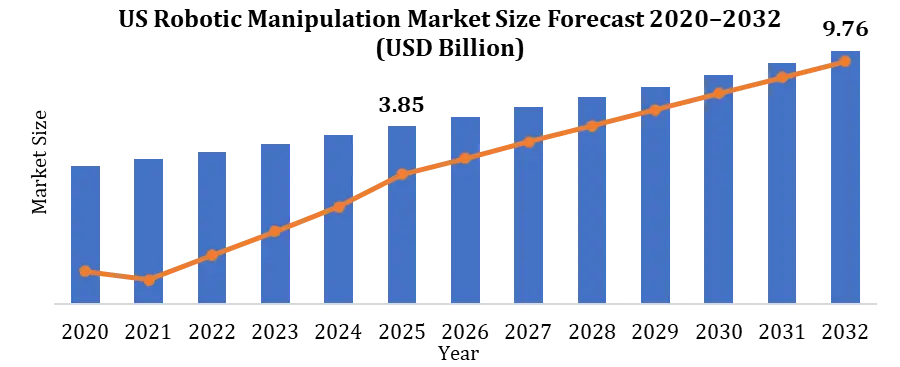
The US Robotic Manipulation Market was valued at USD 3.85 Billion in 2025 and is projected to reach around USD 9.76 Billion by 2032, growing at a CAGR of 14.2% during 2026–2032. Market growth is driven by rising adoption of AI-powered robotics, increasing warehouse automation, labor shortages, and strong demand from automotive, healthcare, logistics, and electronics industries.
To know about the Research Methodology :- Request Free Sample Report
US Robotic Manipulation Market Overview
The US robotic manipulation market is expanding rapidly due to rising adoption of automation across manufacturing, logistics, healthcare, defense, and e-commerce industries. Robotic manipulation systems enable machines to perform tasks such as picking, sorting, assembling, packaging, welding, and material handling with greater precision and efficiency.
Growth is fueled by increasing labor shortages, rising warehouse automation demand, advancements in AI vision systems, and accelerating investments in autonomous robotics. The emergence of collaborative robots (cobots), AI-powered robotic arms, and smart warehouse solutions is accelerating market growth. The integration of machine learning, computer vision, force sensing, and adaptive gripping technologies is improving robotic dexterity, enabling robots to handle fragile, irregular, and complex objects more efficiently.
US Robotic Manipulation Market Key Highlights
| Market Parameter | Value / Insight | Trend |
| Market Size (2025) | USD 3.85 Billion | Strong Growth |
| Forecast Size (2032) | USD 9.76 Billion | High Growth |
| CAGR (2026–2032) | 14.2% | Rapid Expansion |
| Dominant Segment | Industrial Robotic Arms | Market Leader |
| Fastest Growing Segment | AI Vision Manipulation Robots | High Growth |
| Leading Application | Manufacturing Automation | High Demand |
| Emerging Trend | Humanoid Robotics & Warehouse Automation | Future Opportunity |
US Robotic Manipulation Market Drivers
Increasing labor shortages in manufacturing and logistics sectors are driving robotic automation demand. Rising adoption of warehouse robotics by e-commerce companies and expanding investments in smart factories further boost market growth. AI-powered robotic systems improve productivity and operational efficiency.
US Robotic Manipulation Market Restraints
High initial deployment costs, complex integration processes, and maintenance expenses remain key barriers. Small and medium enterprises often face budget limitations in adopting advanced robotic systems.
US Robotic Manipulation Market Opportunities
Growing demand for healthcare robotics, autonomous warehouse robots, and defense applications presents strong growth opportunities. Expansion of robotic-as-a-service (RaaS) models is also creating new revenue streams.
US Robotic Manipulation Market Trends
AI-enabled robotic vision, soft gripping technologies, collaborative robots, and humanoid robotic development are major trends reshaping the market.
US Robotic Manipulation Market Segment Analysis
By Technology: AI Vision Systems lead due to strong demand for object detection and automation. Machine Learning, Force Sensing, Motion Control, and Gripping Systems are increasing penetration as robots become smarter and more precise.
By Application: Manufacturing was dominated in 2025 driven by assembly and material handling demand. Logistics & Warehousing is the fastest-growing segment, while Healthcare, Defense, Retail, and Electronics are steadily expanding.
US Robotic Manipulation Market Competitive Landscape
The U.S. robotic manipulation market is highly competitive with participation from robotics manufacturers, AI companies, and industrial automation providers. Key players include Boston Dynamics, ABB Ltd., FANUC Corporation, NVIDIA Corporation, and Amazon Robotics.
Competition is driven by advancements in AI-powered robotic vision, autonomous manipulation, warehouse automation, collaborative robots, and smart manufacturing solutions.
US Robotic Manipulation Market Recent Developments
| Date | Company | Development |
| Oct-25 | NVIDIA | Expanded Isaac AI robotics platform with Amazon Robotics and Figure AI collaborations, strengthening AI-powered warehouse and factory automation capabilities. |
| Mar-25 | Boston Dynamics | Enhanced Atlas humanoid robot AI capabilities through NVIDIA Jetson Thor integration for logistics and industrial manipulation applications. |
US Robotic Manipulation Market Scope: Inquire before buying
| US Robotic Manipulation Market | |||
|---|---|---|---|
| Report Coverage | Details | ||
| Base Year: | 2025 | Forecast Period: | 2026-2032 |
| Historical Data: | 2020 to 2025 | Market Size in 2025: | USD 3.85 Bn. |
| Forecast Period 2026 to 2032 CAGR: | 14.2% | Market Size in 2032: | USD 9.76 Bn. |
| Segments Covered: | by Robot Type | Industrial Robotic Arms Collaborative Robots Mobile Manipulation Robots Humanoid Robots Service Robots |
|
| by Component | Sensors Controllers Actuators End Effectors Software |
||
| by Technology | AI Vision Systems Machine Learning Force Sensing Motion Control Gripping Systems |
||
| by Application | Manufacturing Logistics & Warehousing Healthcare Defense Retail Electronics |
||
| by End User | Automotive E-commerce Healthcare Providers Defense Organizations Industrial Manufacturers |
||
US Robotic Manipulation Market Key Players
1. ABB Ltd.
2. Fanuc Corporation
3. Yaskawa Electric Corporation
4. KUKA AG
5. Teradyne Inc.
6. Boston Dynamics
7. NVIDIA Corporation
8. Rockwell Automation
9. Honeywell International Inc.
10. Amazon Robotics
11. GreyOrange
12. Fetch Robotics
13. Denso Robotics
14. Omron Corporation
15. Rethink Robotics
16. Geek+
17. Sarcos Technology and Robotics Corporation
18. Symbotic Inc.
19. iRobot Corporation
20. Agility Robotics
US Robotic Manipulation Market FAQs:
1. What is the current size of the US Robotic Manipulation Market?
The market was valued at USD 3.85 Billion in 2025 and is projected to reach USD 9.76 Billion by 2032.
2. What is driving growth in the US robotic manipulation market?
Growth is driven by rising automation demand, labor shortages, AI advancements, and increasing warehouse robotics adoption.
3. Which segment dominates the US robotic manipulation market?
Industrial robotic arms lead the market due to high usage in manufacturing and material handling.
4. Which application segment is growing fastest?
Logistics & warehousing is the fastest-growing segment due to e-commerce expansion and warehouse automation.
5. Who are the major players in the market?
Key players include ABB Ltd., Fanuc Corporation, KUKA AG, Amazon Robotics, and Boston Dynamics.