
US Distilled Spirits Market Industry Analysis, Demand Drivers, Segment Performance, Competitive Landscape & Market Size Forecast to 2032
Overview
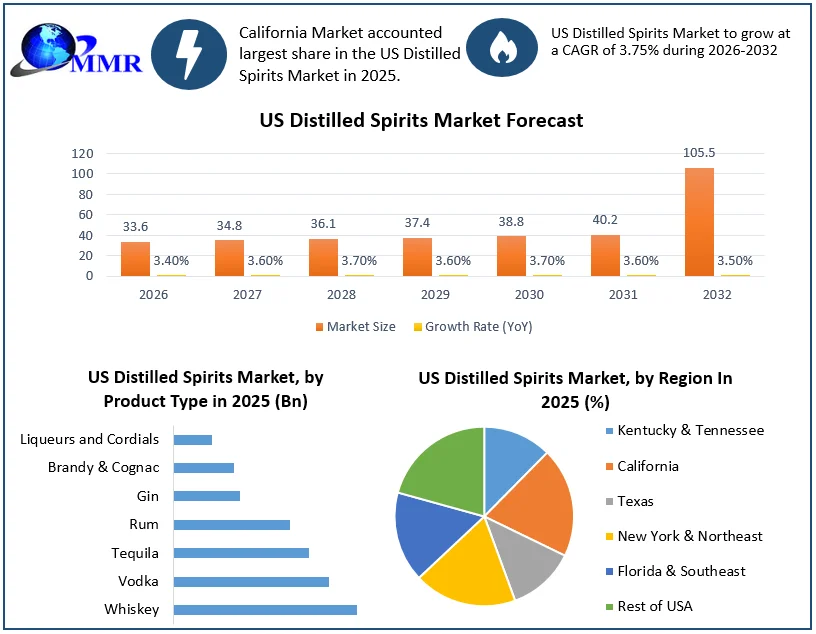
The US Distilled Spirits Market is estimated to be valued at USD 82.5 Billion in 2025 and is expected to reach USD 105.5 Billion by 2032, recording a CAGR of 3.75%. This market growth can be attributed to various factors such as sustained consumer shift toward premium and craft spirits, expanding ready-to-drink (RTD) cocktail and flavoured spirit categories, and rising demand for whiskey, tequila, and vodka across on-premise and off-premise channels.
US Distilled Spirits Market Definition
The United States Distilled Spirits Market comprises alcoholic beverages produced through the fermentation and distillation of various raw materials and sold for consumption across the country. It includes whiskey, vodka, rum, gin, tequila and mezcal, brandy and cognac, liqueurs, cordials, and other specialty spirits.
The market is supported by diverse consumer preferences, premium and craft spirit demand, cocktail culture, and product innovation. Growing interest in premium, flavored, small-batch, and ready-to-drink spirit-based cocktails is also influencing product development and consumption patterns.
| Parameter | Value |
| Market Size (Base Year 2025) | USD 82.5Billion |
| Forecast Market Size (2032) | USD 105.5Billion |
| CAGR (2026–2032) | 3.75% |
| Base Year | 2025 |
| Forecast Period | 2026–2032 |
| Historical Period | 2020–2025 |
| Key Growth Opportunity | American Whiskey (Bourbon & Rye) Global Export & Craft Distillery Premiumization |
US Distilled Spirits Market Overview
The United States distilled spirits market is the world's most lucrative premium spirits market by revenue density, anchored by American whiskey (bourbon, rye, Tennessee whiskey), premium vodka, and a rapidly growing tequila segment. The market was valued at USD 82.5 Billion in 2025 and is projected to reach USD 105.5 Billion by 2032, growing at a CAGR of 3.75%. A maturing craft distillery ecosystem with over 2,400 registered craft distilleries nationwide combined with the global bourbon export boom and premiumization across all categories, defines the competitive landscape.
The United States Distilled Spirits Market combines macroeconomic and consumer spending analysis with investment intelligence, industry competitiveness, regulatory and business environment assessment, supply chain intelligence, regional opportunity mapping, competitive benchmarking, proprietary market scoring, and strategic recommendations. The market covers key spirit categories such as whiskey, vodka, tequila, rum, gin, brandy, and other distilled beverages, with growth influenced by premiumization, craft distilling, cocktail culture, product innovation, and evolving consumer preferences. The objective is to provide a decision-support framework that enables manufacturers, investors, distributors, retailers, and policymakers to evaluate market attractiveness, identify high-growth categories and regions, assess competitive positioning, and make informed expansion, investment, and business strategy decisions.
US Distilled Spirits Market Size, Growth and Share Analysis
To know about the Research Methodology :- Request Free Sample Report
US Distilled Spirits Historical Market Size (2020–2025)
| Year | Market Size | Growth Rate (YoY) |
| 2020 | USD 68.6 Bn | 3.75% |
| 2021 | USD 71.2 Bn | 3.75% |
| 2022 | USD 73.9 Bn | 3.75% |
| 2023 | USD 76.6 Bn | 3.75% |
| 2024 | USD 79.5 Bn | 3.75% |
| 2025 | USD 82.5 Bn | 3.75% |
US Distilled Spirits Market Size Forecast (2026–2032)
| Year | Market Size | Growth Rate (YoY) |
| 2026 | USD 33.6 Bn | 3.4% |
| 2027 | USD 34.8 Bn | 3.6% |
| 2028 | USD 36.1 Bn | 3.7% |
| 2029 | USD 37.4 Bn | 3.6% |
| 2030 | USD 38.8 Bn | 3.7% |
| 2031 | USD 40.2 Bn | 3.6% |
| 2032 | USD 105.5Bn | 3.5% |
US Distilled Spirits Market Consumer Insights & Demand Analysis
| Consumer Dimension | Key Insights | Market Implication |
| Premiumization Trend | American consumers consistently trading up across all spirits categories, with premium and super-premium tier growth outpacing economy segments | Brands investing in aged expressions, limited editions, and single barrel offerings to capture premium spend |
| Tequila & Mezcal Surge | Tequila has overtaken vodka in US revenue share, driven by millennial and Gen-Z preference for agave-based spirits and celebrity brand endorsements | Significant category disruption; established spirits brands acquiring or launching tequila lines |
| Craft & Local Identity | Consumers increasingly gravitating toward locally distilled craft bourbon, rye, gin, and rum, prioritizing provenance and small-batch authenticity | Craft distillery premium positioning and distillery tourism driving direct-to-consumer revenue |
| Health-Conscious Drinking | Growing moderation trend driving demand for low-ABV spirits, non-alcoholic alternatives, and RTD cocktails with cleaner ingredient profiles | Spirits brands launching low-calorie, organic, and functional spirits lines to capture health-oriented consumers |
US Distilled Spirits Market Dynamics
US Distilled Spirits Market Drivers
• American bourbon and rye whiskey experiencing global premium export boom, with Kentucky bourbon becoming a globally recognized terroir-driven luxury product category
• Tequila and mezcal surging as the fastest-growing major spirits category, fueled by celebrity ownership (Casamigos, Teremana), cocktail culture, and perceived premiumization
• The Craft Distillery Act and state-level distillery reform enabling over 2,400 registered US craft distilleries, expanding product diversity and direct-to-consumer sales channels
US Distilled Spirits Market Restraints
• US spirits market showing signs of post-pandemic normalization and volume plateau, with premium segment growth offset by economy tier volume softness
• Competitive saturation in bourbon particularly, with inventory overhang from rapid new entrants challenging price premiums outside allocated top-tier brands
• Increasing health consciousness and the 'sober curious' movement moderating per-capita alcohol consumption among younger demographics
US Distilled Spirits Market Opportunities
• American whiskey global export expansion, particularly into Japan, Australia, and European markets, as bourbon gains recognition alongside Scotch as a global premium category
• RTD (ready-to-drink) cocktail innovation leveraging premium spirits brands in convenient formats — the fastest-growing volume segment in total beverage alcohol
• Non-alcoholic and low-ABV spirits capturing sober-curious consumers while maintaining brand engagement and premium positioning of existing portfolio architectures
US Distilled Spirits Market Challenges
• Federal Alcohol and Tobacco Tax and Trade Bureau (TTB) regulatory compliance complexity creating barriers for small craft distilleries and new product innovation
• Three-tier distribution system creating significant channel fragmentation and limiting direct-to-consumer spirits sales access in most US states
• Tariff reciprocity risks affecting Scotch whisky, Irish whiskey, and other major import categories, as well as American bourbon export markets in the EU and UK
US Distilled Spirits Market Segment Analysis
US Distilled Spirits Market by Product
The United States distilled spirits market comprises whiskey, vodka, tequila, rum, gin, brandy and cognac, liqueurs and cordials, other spirits, and spirits-based RTDs. Whiskey remains one of the leading product categories, supported by strong demand for bourbon, rye, and American whiskey, while tequila continues to benefit from premiumization and growing consumer interest. Spirits-based RTDs are also gaining popularity due to convenience and changing consumption preferences.
US Distilled Spirits Market by Price Tier
The market is categorized into economy, mid-range, premium, super-premium, and ultra-premium price tiers. Economy and mid-range products maintain broad consumer accessibility, while premium and super-premium spirits are gaining importance as consumers increasingly seek higher quality, distinctive brands, craftsmanship, and unique product experiences.

US Distilled Spirits Market by Distribution Channel
The distribution landscape includes liquor stores and specialty stores, supermarkets and hypermarkets, convenience stores, on-trade establishments, online/e-commerce, direct-to-consumer channels, and others. Liquor stores remain important for spirits purchases, while supermarkets and convenience stores provide accessibility. On-trade channels support cocktail and premium-spirit consumption, whereas e-commerce is creating additional opportunities for specialty and craft brands.
US Distilled Spirits Market Regional Analysis
| Region | Market Share | Key Demand Drivers & Trends |
| Kentucky & Tennessee | 12.4% | Global bourbon production capital; distillery tourism driving premium brand equity |
| California | 19.8% | Largest state spirits consumption market; tequila, premium vodka, and gin dominant |
| Texas | 12.2% | Fastest-growing craft distillery state; bourbon and Texas whisky producing national brands |
| New York & Northeast | 18.6% | Premium cocktail bar culture capital; high Scotch, cognac, and premium vodka demand |
| Florida & Southeast | 16.3% | High-volume rum and vodka market; tourism and hospitality driving on-trade consumption |
| Rest of US | 20.7% | Diverse regional markets with growing craft spirits and suburban retail channel expansion |
US Distilled Spirits Market Competitive Landscape
Key Players & Benchmarking
| Company | Spirit Type | Market Position |
| Diageo PLC (Johnnie Walker, Crown Royal, Bulleit) | Blended Scotch, Canadian, Bourbon, Vodka | Market Leader |
| Brown-Forman Corp. (Jack Daniel's, Woodford Reserve) | American Whiskey & Bourbon | Major Player |
| Beam Suntory (Jim Beam, Maker's Mark, Knob Creek) | Bourbon & International Spirits | Major Player |
| Constellation Brands (High West, Casa Noble) | American Whiskey, Tequila | Premium Player |
| Pernod Ricard (Jameson, Glenlivet, Absolut) | Irish Whiskey, Scotch, Vodka | Major International Player |
| Bacardi US (Bacardi Rum, Dewar's, Grey Goose) | Rum, Scotch, Vodka | Major Player |
| Heaven Hill Distilleries | Bourbon & Rye (Evan Williams, Elijah Craig) | American Whiskey Leader |
| Buffalo Trace Distillery (Sazerac) | Ultra-Premium Bourbon (Eagle Rare, Pappy Van Winkle) | Ultra-Premium Market Leader |
US Distilled Spirits Market Technology & Innovation Trends
| Innovation Area | Current Trend | Market Impact |
| AI Barrel Selection | Machine learning algorithms predicting optimal aging barrels for premium bourbon expressions, reducing maturation losses and improving quality consistency | Enhances premium product consistency and reduces costly over-aging or under-aging write-offs |
| Direct-to-Consumer E-Commerce | State-by-state DTC spirits e-commerce reform enabling distilleries to ship directly to consumers in 40+ states, bypassing traditional three-tier system constraints | Creates high-margin DTC channel and deeper consumer relationship for craft and premium brands |
| Sustainable Grain Sourcing | Regenerative agriculture partnerships with grain farmers supplying certified organic and heritage grain varieties for craft bourbon and rye production | Supports ESG commitments and enables premium heritage-grain positioning for craft expressions |
| RTD Cocktail Innovation | Canned and pouched premium RTD cocktails using full-proof spirits (not malt base), driving the fastest-growing US beverage alcohol format | Major brands launching high-ABV RTDs to capture on-the-go and home convenience occasions |
| NFT & Digital Collectibles | Limited-edition bourbon releases tied to blockchain NFTs enabling verifiable ownership, secondary market trading, and distillery loyalty programs | Creates new collector and investor segment and generates significant PR and media value |
US Distilled Spirits Market Regulatory Framework
The US distilled spirits market is federally regulated by the Alcohol and Tobacco Tax and Trade Bureau (TTB) under the Federal Alcohol Administration Act (FAA Act). The TTB governs label approval (COLA - Certificate of Label Approval), production standards, geographic indication protections (e.g., Bourbon must be produced in the US), and federal excise tax collection. The three-tier distribution system (producer → distributor → retailer) is mandated at the state level, with each of the 50 states maintaining its own ABC (Alcohol Beverage Control) regulatory framework governing retail licensing, pricing, and on-trade permissions. Control states (including Pennsylvania, Utah, Virginia) operate state-owned retail monopolies.
US Distilled Spirits Market Investor Takeaway
The US distilled spirits market offers stable, premium-oriented growth at a 3.75% CAGR toward USD 105.5 billion by 2032, with exceptional value creation opportunities concentrated in: the American bourbon global export story; the tequila & mezcal premiumization wave; RTD cocktail format disruption; and craft distillery acquisition targets with proven premium brand equity. The US remains the world's most important premium spirits consumption market for international brand building.
US Distilled Spirits Market Scope: Inquire before buying
| US Distilled Spirits Market | |
| Base Year | 2025 |
| Forecast Period | 2026–2032 |
| Historical Period | 2020–2025 |
| Market Size (Base Year) | USD 82.5 Billion |
| Forecast Market Size (2032) | USD 105.5 Billion |
| CAGR | 3.75% |
| Segment: By Product | Whiskey, Vodka, Tequila, Rum, Gin, Brandy & Cognac, Liqueurs, RTDs, Others |
| Segment: By Price Tier | Economy, Mid-Range, Premium, Super-Premium, Ultra-Premium |
| Segment: By Distribution | Specialty Stores, Supermarkets & Hypermarkets, Convenience Stores, On-Trade, Online/E-Commerce, DTC |
| Segment: By Application | Home Consumption, Social Gatherings, Restaurants, Bars, Celebrations, Gifting, Cocktails |
| Segment: By Packaging | Glass Bottles, Plastic Bottles, Cans, Other Formats |
Frequently Asked Questions:
1. What is the size of the US distilled spirits market?
The US distilled spirits market was valued at USD 82.5 billion in 2025 and is projected to reach USD 105.5 billion by 2032, growing at a CAGR of 3.75%.
2. What is the fastest-growing spirits category in the US?
Tequila and mezcal are the fastest-growing major spirits categories in the US, driven by celebrity brand ownership, premiumization, and growing cocktail culture adoption.
3. Why is bourbon significant for the US spirits market?
American bourbon is a protected geographic designation product that has achieved global luxury status. Kentucky bourbon in particular has become a global premium export category alongside Scotch whisky, driving significant export revenue.
4. How does the three-tier distribution system work in the US?
Federal and state laws require spirits to flow from producer to licensed distributor to licensed retailer, preventing direct distillery-to-retailer sales in most states. This system is being gradually reformed to allow limited direct-to-consumer e-commerce shipping.
5. Who are the largest spirits companies operating in the US?
Diageo, Brown-Forman, Beam Suntory, Pernod Ricard, Bacardi, Heaven Hill, and Constellation Brands are the major players, alongside a large and growing craft distillery ecosystem.