Ursodeoxycholic Acid Market Size by Type, Application, Manufacturing, Dosage Form, End User and Forecast 2034

10.62%
CAGR (2026-2034)
600 USD Mn.
Forecast Market Size
320
Report Pages
146
Market Tables

Overview

The Global Ursodeoxycholic Acid Market size was valued at USD 600 Million in 2025 and is projected to grow at a CAGR of 10.62% from 2025 to 2034, reaching USD 1,488.18 Million by 2034.

Ursodeoxycholic Acid Market Overview

Ursodeoxycholic acid (UDCA) is a naturally occurring bile acid that has become a standard therapy for managing cholesterol gallstones and, more significantly, for treating primary biliary cholangitis (PBC), a chronic liver condition in which UDCA continues to serve as the first-line treatment of choice. The market's steady growth is largely explained by a few consistent factors: an ageing global population, a rising number of diagnosed liver and gallbladder cases, and clinical guidelines that have not identified a reason to move away from UDCA as the preferred therapy. This keeps demand stable across pharmaceutical companies, hospitals, specialty pharmacies, and hepatology clinics, particularly across North America. On the manufacturing side, production is also becoming more efficient, with chicken-bile-derived processes and enzymatic synthesis routes allowing API manufacturers to produce UDCA faster, with lower costs and reduced environmental impact compared to conventional chemical synthesis methods.

Ursodeoxycholic acid market report provides a comprehensive analysis of the Global Ursodeoxycholic Acid Market, covering the current market landscape, key growth drivers, emerging trends, market dynamics, segmentation, regional opportunities, competitive developments, and leading industry players. It examines the market across its full value chain, from raw-material sourcing and API manufacturing through to formulation and distribution, while assessing the impact of evolving PBC treatment protocols, manufacturing advancements, and shifting healthcare priorities. The report further presents detailed market size estimates, share data, and growth projections through 2034, highlighting the key opportunities expected to shape the future of the global UDCA market.

“The Ursodeoxycholic Acid Market is more than a pharmaceutical molecule—it is a story of trusted therapy, evolving manufacturing, and expanding access to liver care. This report looks beyond the numbers to understand where the market is heading, where opportunities are emerging, and what could shape its next chapter.”

- Mrunal Chikte

Ursodeoxycholic Acid Market Key Highlights

• The Global Ursodeoxycholic Acid Market size was valued at USD 620.10 Million in 2025 and is expected to reach USD 1,488.18 Million by 2034, growing at a CAGR of 10.62% during the forecast period.
• Growing adoption of combination therapies pairing UDCA with newer second-line agents is reinforcing its role as the clinical backbone of cholestatic liver disease treatment, rather than displacing its demand.
• The Ursodeoxycholic acid market is transitioning from a purely cost-driven generic business toward one shaped by GMP compliance, production efficiency, formulation innovation, and secure raw-material sourcing.

Global Ursodeoxycholic Acid Market Size and Forecast
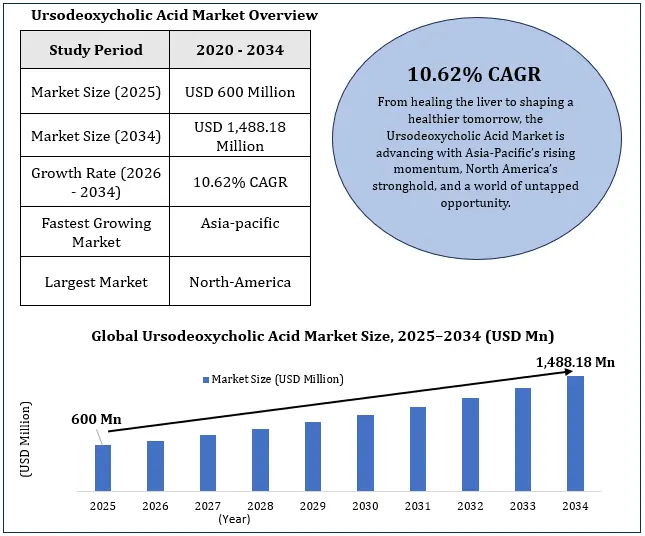
Ursodeoxycholic Acid Market Size
To know about the Research Methodology :- Request Free Sample Report

Ursodeoxycholic Acid Market Dynamics:

Growing Prevalence and Diagnosis of Hepatobiliary Disorders to Drive Ursodeoxycholic Acid Market Growth

The growing prevalence and diagnosis of hepatobiliary disorders, particularly Primary Biliary Cholangitis (PBC), is driving demand for ursodeoxycholic acid (UDCA) worldwide. UDCA remains a standard first-line therapy for PBC, with long-term treatment recommended for patients who tolerate it. Rising healthcare awareness, improved diagnosis, and continued use of UDCA alongside newer second-line therapies are further supporting market growth.

Intense Generic Competition and Production Costs to Restraints the Ursodeoxycholic Acid Market

Generic competition remains one of the most significant pressures on the Ursodeoxycholic Acid Market. The top five API manufacturers currently control close to 81% of global UDCA supply, and this concentration pushes smaller formulators into tender-based pricing battles where margins are already thin. Because production still depends heavily on bile-derived raw materials, sourcing costs can fluctuate sharply whenever supply from bovine or chicken-bile extraction is disrupted. On top of that, meeting FDA, EMA, and other regional GMP and Drug Master File requirements adds meaningful compliance overhead, a cost burden that mid-sized and smaller manufacturers absorb far less easily than the handful of vertically integrated players who dominate the category.

Generic Competition and Raw-Material Dependence Create Challenges for the Ursodeoxycholic Acid Market

The global Ursodeoxycholic Acid production due to its cost and scalability advantages, price competition among generic manufacturers continues to intensify, gradually compressing profit margins across the industry. This is compounded by the market's reliance on a narrow raw-material base since roughly four out of every five units of API supply comes from just five producers, any disruption in bile-derived sourcing can quickly affect pricing and availability downstream. Regulatory and GMP compliance costs add a further layer of pressure, particularly for manufacturers without the scale to spread these costs across large production volumes.

Market Trends – Ursodeoxycholic Acid Market
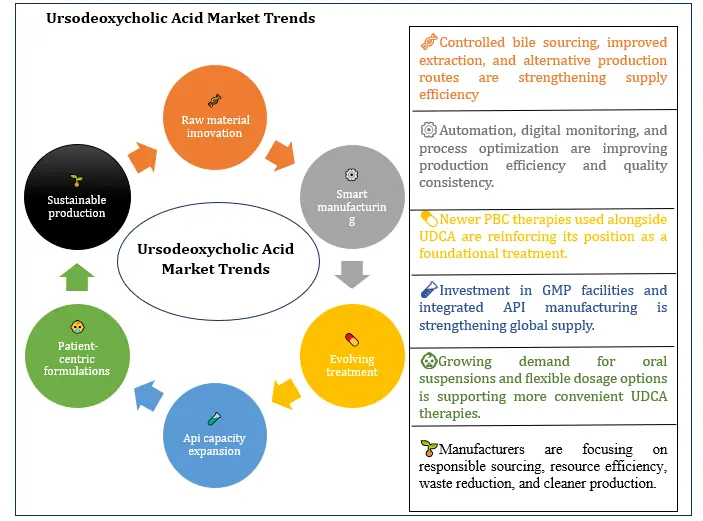
Ursodeoxycholic Acid Market Trends

Ursodeoxycholic Acid Market Segment Analysis

Ursodeoxycholic Acid Market, By Dosage Form

The tablets segment held the largest share of the global ursodeoxycholic acid market in 2025. Its strong position is supported by widespread prescription use, established manufacturing capabilities, convenient oral administration, and the availability of commonly used 250 mg and 500 mg strengths. Ursodiol tablets are widely used in the management of primary biliary cholangitis and are generally administered in divided doses, supporting their continued adoption for long-term treatment. Capsules account for about 22% of the market, supported by their availability in commonly prescribed strengths such as 300 mg and their convenience for patients requiring regular oral therapy. Oral suspensions represent approximately 6% of the market, primarily catering to pediatric patients and individuals who experience difficulty swallowing tablets or capsules. Overall, the continued preference for convenient and established solid oral formulations is expected to keep tablets and capsules as the dominant dosage forms throughout the forecast period.
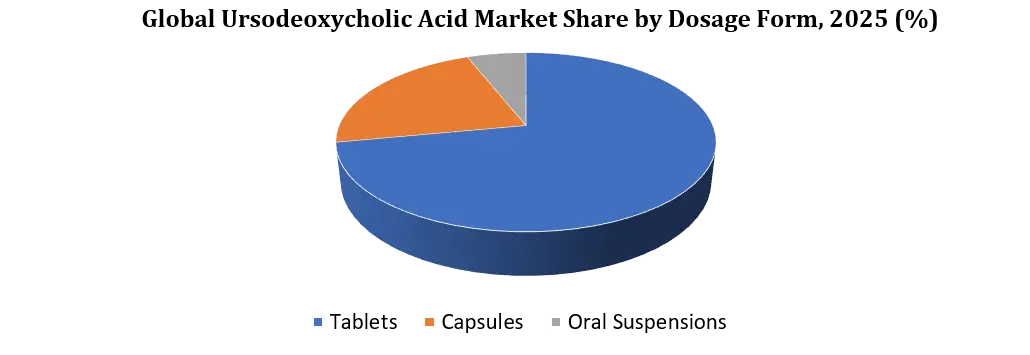
Ursodeoxycholic Acid Market by Dosage Form
Ursodeoxycholic Acid Market, by Manufacturing Type

The Global Ursodeoxycholic Acid (UDCA) Market is segmented into Bile-Derived/Extraction-Based Production, Synthetic Production, Semi-Synthetic Production, and Enzymatic Production. In 2025, Synthetic Production is expected to dominate the market, supported by consistent quality, scalable manufacturing, pharmaceutical-grade purity, and reliable supply for UDCA-based medicines. Synthetic and semi-synthetic routes also offer manufacturers greater control over production efficiency and product specifications, while bile-derived and enzymatic production continue to serve specific applications. The manufacturing landscape is expected to evolve during 2026–2034 as companies adopt advanced purification, process optimization, and enzymatic technologies to improve cost efficiency, production capacity, and supply reliability.

Ursodeoxycholic Acid Manufacturing Routes
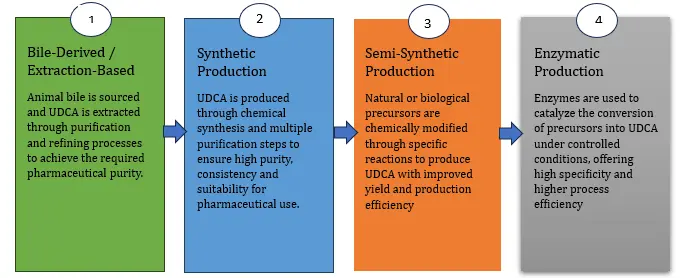
Ursodeoxycholic Acid Manufacturing Route

Global Ursodeoxycholic Acid Market Regional Insights

North America — Leading Market Supported by Established Hepatology Care

North America dominated Ursodeoxycholic Acid Market in 2025, supported by advanced healthcare infrastructure, established diagnosis of hepatobiliary disorders, specialty-care facilities, and strong pharmaceutical distribution networks. Continued UDCA use in Primary Biliary Cholangitis (PBC) and the availability of branded and generic products support regional demand. The United States leads among individual countries in spending on ursodeoxycholic acid, supported by its high healthcare spending and the growing diagnosis and treatment of liver-related diseases. In North America, approximately 700,000 to 1 million people are actively prescribed Ursodeoxycholic Acid each year.

Key opportunity: Advanced hepatology care, established PBC treatment, specialty pharmacies, and combination therapies.

Europe — Established Pharmaceutical and Regulatory Ecosystem

Europe remains an important UDCA market, supported by its advanced pharmaceutical industry, specialist liver-care infrastructure, and strong GMP and regulatory standards. Established PBC treatment, UDCA availability, and a strong API and finished-dose manufacturing base continue to support regional growth. In Europe, approximately 800,000 to 1 million people are actively prescribed Ursodeoxycholic Acid (UDCA) annually.

Asia-Pacific — Manufacturing Expansion and Rising Healthcare Access

Asia-Pacific is the fastest-growing UDCA market, driven by expanding pharmaceutical manufacturing, rising healthcare expenditure, improved diagnosis, and growing access to generic medicines. China and India are key for API production, while Japan and South Korea support advanced pharmaceutical capabilities and manufacturing innovation. In the Asia-Pacific (APAC) region, approximately 1.2 million to 1.5 million people are actively prescribed Ursodeoxycholic Acid (UDCA) each year.

Key opportunity: API manufacturing, capacity expansion, cost-efficient production, healthcare access, and emerging-market demand.

Global Ursodeoxycholic Acid Market Competitive Landscape

The API and generic pharmaceutical business are evolving into a more integrated industry, where manufacturing efficiency, supply security, and formulation quality now carry as much weight as pricing. Competitive differentiation is increasingly built around API purity, GMP compliance, secure access to raw materials, production capacity, and the ability to serve markets across multiple regions. While several manufacturers continue to rely on traditional bile-derived extraction, others have transitioned to synthetic or semi-synthetic production routes. Companies gaining the strongest market position are those exercising greater control over their own sourcing and manufacturing, rather than depending on third-party suppliers.

Ursodeoxycholic Acid Market leaders invest in advanced purification technology, expand GMP-compliant production capacity, and maintain reliable global distribution. Manufacturers producing tablets, capsules, and oral suspensions have a meaningful opportunity to differentiate through product quality and patient-centric formulation development. As treatment approaches for conditions such as PBC continue to advance, companies that combine consistent quality, cost-efficient production, regulatory compliance, secure raw-material sourcing, and strong global reach are best positioned to strengthen their standing through capacity expansion, technological innovation, and strategic partnerships.

Global Ursodeoxycholic Acid Market Scope: Inquire before buying

Ursodeoxycholic Acid Market
Report Coverage Details
Base Year: 2025 Forecast Period: 2026-2034
Historical Data: 2020 to 2025 Market Size in 2025: USD 600 Mn.
Forecast Period 2026 to 2034 CAGR: 10.62% Market Size in 2034: USD 1,488.18 Mn.
Segments Covered: by Manufacturing Chemical Production
Bile-Derived/Semi-Synthetic Production
Enzymatic/Biosynthetic Production
Other Emerging Production Routes
by Dosage Form Tablets
Capsules
Oral Suspensions
by Application Primary Biliary Cholangitis (PBC)
Dissolution and Prophylaxis
Cholestatic Liver Diseases
Primary Sclerosing Cholangitis (PSC)
Other Hepatobiliary Disorders
by End-Use Industry Hospitals
Specialty Clinics
Home Care
Other End Users

Global Ursodeoxycholic Acid Market By region:

North America (United States ,Canada and Mexico)
Europe (United Kingdom, France, Germany, Italy ,Spain ,Sweden ,Russia ,Rest of Europe)
Asia Pacific ( China, South Korea, India, Japan, Australia ,Indonesia, Philippines ,Malaysia Vietnam, Thailand, Rest of Asia Pacific)
Middle East and Africa (Saudi Arabia, United Arab Emirates (UAE), Qatar Kuwait Oman Bahrain, Rest of ME&A)
South America (Brazil, Argentina, Chile, Colombia, Rest of South America)

Global Ursodeoxycholic Acid key players:

North America
1. Abbott Laboratories
2. Teva Pharmaceutical Industries Ltd.
3. Viatris Inc.
4. Amneal Pharmaceuticals, Inc.
5. Apotex Inc.
6. Epic Pharma, LLC

Europe
7. ICE Pharma S.p.A.
8. JSC Grindeks
9. Dipharma Francis S.r.l.
10. Axplora
11. PharmaZell GmbH
12. Dr. Falk Pharma GmbH
13. Bruschettini S.r.l.
14. Erregierre S.p.A.

Asia-Pacific
15. Daewoong Pharmaceutical Co., Ltd.
16. Mitsubishi Tanabe Pharma Corporation
17. Glenmark Pharmaceuticals Ltd.
18. Sun Pharmaceutical Industries Ltd.
19. Cipla Ltd.
20. Lupin Ltd.
21. Mankind Pharma Ltd.
22. Aurobindo Pharma Ltd.
23. Arch Pharmalabs Ltd.
24. Kimia Biosciences Ltd.
25. Suzhou Tianlu Bio-Pharmaceutical Co., Ltd.
26. Zhongshan Belling Biotechnology Co., Ltd.

South America
27. Eurofarma Laboratórios S.A.
28. EMS S.A.
29. Hypera Pharma
30. Laboratorios Roemmers
31. Bagó

Middle East & Africa
32. Julphar (Gulf Pharmaceutical Industries)
33. Tabuk Pharmaceuticals
34. Hikma Pharmaceuticals
35. Aspen Pharmacare
36. Jamjoom Pharma

Frequently Asked Questions

1)What is the size of the Global Ursodeoxycholic Acid Market?
The global Ursodeoxycholic Acid market was valued at USD 600 million in 2025 and is expected to reach around USD 1,488.18 million by 2034, growing at an estimated CAGR of 10.62% during the forecast period

2)Which segment includes the Global Ursodeoxycholic Acid Market?
The Primary Biliary Cholangitis (PBC) segment is expected to hold a dominant position by application, supported by the continued use of UDCA as an established first-line treatment for PBC. By dosage form, Tablets represent a major segment due to their widespread use, convenient administration, and availability across generic pharmaceutical markets.

3)Which region held the largest share of the Global Ursodeoxycholic Acid Market in 2025?
North America is maintaining a leading position during the forecast period, supported by advanced healthcare infrastructure, established hepatology services, high diagnosis rates, and strong access to prescription medicines and specialty pharmacy networks.

4)What are the major trends shaping the Global Ursodeoxycholic Acid Market?
Major trends include UDCA API capacity expansion, vertical integration of raw-material sourcing and manufacturing, advanced extraction and purification technologies, combination therapies for PBC, patient-friendly oral formulations, digitalized pharmaceutical manufacturing, and increasing focus on sustainable production practices.

Table of Contents

1. Executive Market Landscape and Industry Overview 1.1. Global Ursodeoxycholic Acid Market Size (USD Mn & Volume in Metric Tons), 2025–2034 1.2. Market Definition, Scope, and Key Segmentation Criteria for Global Ursodeoxycholic Acid Market 1.3. Global Ursodeoxycholic Acid Industry Structure and Ecosystem Overview 1.4. Evolution of Ursodeoxycholic Acid from Traditional Bile-Derived Production to Advanced Extraction, Synthetic, and Enzymatic Production Routes 1.5. Competitive Landscape Overview (UDCA API Manufacturers, Pharmaceutical Companies, Generic Drug Manufacturers, Formulation Providers, and Regional Distributors) 1.6. Key Stakeholder Mapping across API Manufacturers, Pharmaceutical Companies, Hospitals, Specialty Clinics, Pharmacies, Healthcare Providers, and Distribution Networks 1.7. Role of Ursodeoxycholic Acid in the Treatment of Primary Biliary Cholangitis, Gallstones, and Cholestatic Liver Disorders 1.8. Transition Toward Integrated UDCA API Manufacturing, Formulation Development, and Global Pharmaceutical Distribution 2. Global Ursodeoxycholic Acid Market Dynamics 2.1. Global Ursodeoxycholic Acid Market Trends 2.2. Global Ursodeoxycholic Acid Market DROC Analysis 2.2.1. Drivers 2.2.2. Restraints 2.2.3. Opportunities 2.2.4. Challenges 2.3. PORTER’s Five Forces Analysis 2.3.1. Supplier Power 2.3.2. Buyer Power 2.3.3. Threat of Substitutes 2.3.4. Threat of New Entrants 2.3.5. Competitive Rivalry 2.4. PESTLE Analysis 2.4.1. Political Factors 2.4.2. Economic Factors 2.4.3. Social Factors 2.4.4. Technological Factors 2.4.5. Legal Factors 2.4.6. Environmental Factors 3. Industry Ecosystem and Value Chain 3.1. End-to-End Ursodeoxycholic Acid Value Chain Overview 3.2. UDCA Raw-Material Sourcing and Manufacturing Lifecycle 3.3. Bile-Derived Raw-Material Sourcing, Extraction, and Purification Ecosystem 3.4. Synthetic and Semi-Synthetic UDCA Production Value Chain 3.5. Enzymatic and Advanced UDCA Production Ecosystem 3.6. UDCA API Manufacturing and Pharmaceutical Formulation Value Chain 3.7. UDCA Tablet, Capsule, and Oral Suspension Manufacturing Ecosystem 3.8. Pharmaceutical Distribution and Specialty Pharmacy Ecosystem 3.9. Key Ecosystem Participants 3.9.1. UDCA API Manufacturers 3.9.2. Pharmaceutical Manufacturers 3.9.3. Hospitals and Specialty Clinics 3.9.4. Pharmacies and Distribution Networks 3.9.5. Healthcare Providers and Treatment Centers 4. Vendor Ecosystem in Ursodeoxycholic Acid 4.1. Global Ursodeoxycholic Acid Manufacturer Landscape 4.2. UDCA API and Pharmaceutical Manufacturer Market Structure 4.3. Bile-Derived UDCA Manufacturers and Suppliers 4.4. Synthetic and Semi-Synthetic UDCA Manufacturers 4.5. Pharmaceutical Formulation and Finished-Dose Manufacturers 4.6. Regional Pharmaceutical Distribution and Supply Networks 4.7. Integrated UDCA API Manufacturing and Pharmaceutical Supply Ecosystem 5. Manufacturing Technology, Technological Innovations & Advancements 5.1. Evolution of UDCA Manufacturing Technologies 5.2. Controlled Bile Sourcing and Advanced Extraction Technologies 5.3. UDCA Purification and Quality-Consistency Improvements 5.4. Synthetic and Semi-Synthetic UDCA Production Technologies 5.5. Enzymatic Synthesis and Biotransformation of UDCA 5.6. Automation and Digital Monitoring in UDCA Manufacturing 5.7. Manufacturing Process Optimization and Production Efficiency Improvements 5.8. GMP-Compliant Manufacturing Technologies and Quality Control 5.9. Cleaner Production, Resource Efficiency, and Waste Reduction in UDCA Manufacturing 6. Adoption and Market Penetration Analysis (2025) 6.1. UDCA Adoption Across Primary Biliary Cholangitis (PBC) Treatment 6.2. UDCA Adoption for Gallstone Dissolution and Prophylaxis 6.3. Adoption Across Cholestatic Liver Diseases and Other Hepatobiliary Disorders 6.4. UDCA Adoption Across Hospitals and Specialty Clinics 6.5. Adoption of UDCA-Based Oral Formulations 6.6. Generic UDCA Adoption Across Emerging Pharmaceutical Markets 7. Current Ursodeoxycholic Acid Market Landscape (2025) 7.1. Continued Role of UDCA as an Established Therapy for Primary Biliary Cholangitis 7.2. Growing Diagnosis and Treatment of Hepatobiliary Disorders 7.3. Increasing Demand for UDCA-Based Pharmaceutical Products 7.4. Expansion of UDCA API Manufacturing Capacity 7.5. Increasing Focus on Supply Security and Raw-Material Sourcing 7.6. Growing Use of Advanced Extraction, Purification, and Production Technologies 7.7. Increasing Development of Patient-Friendly Oral UDCA Formulations 8. Manufacturing Cost Structure and Supply Analysis (2025) 8.1. UDCA Raw-Material Sourcing and Cost Structure 8.2. Bile-Derived UDCA Extraction and Purification Cost Considerations 8.3. Synthetic and Semi-Synthetic UDCA Production Cost Structure 8.4. Enzymatic Production and Process-Efficiency Considerations 8.5. API Manufacturing and GMP Compliance Cost Factors 8.6. Pharmaceutical Formulation and Finished-Dose Manufacturing Costs 8.7. Impact of Raw-Material Availability on UDCA Production Costs 8.8. Pricing Pressure and Generic Competition in the UDCA Market 9. Growth of Ursodeoxycholic Acid by Application (2025–2034) 9.1. Primary Biliary Cholangitis (PBC) Treatment Growth Outlook 9.2. Gallstone Dissolution and Prophylaxis Growth Outlook 9.3. Cholestatic Liver Diseases Treatment Outlook 9.4. Primary Sclerosing Cholangitis (PSC) Application Outlook 9.5. Other Hepatobiliary Disorders Application Outlook 9.6. Impact of Newer PBC Therapies and Combination Treatment Approaches 10. Global Ursodeoxycholic Acid Market Dosage Form Analysis 10.1. Adoption Trends Across Tablets, Capsules, and Oral Suspensions 10.2. Tablet-Based UDCA Formulations and Market Adoption 10.3. Capsule-Based UDCA Formulations and Market Adoption 10.4. Oral Suspension Demand and Patient-Friendly Formulation Trends 10.5. Flexible Dosage Options and Treatment Convenience 10.6. Formulation Development Opportunities in Emerging Markets 11. Distribution and Pharmaceutical Supply Chain Analysis 11.1. Global UDCA Pharmaceutical Distribution Network 11.2. Hospital and Specialty Clinic Supply Channels 11.3. Pharmacy and Pharmaceutical Distribution Networks 11.4. Specialty Pharmacy and Hepatology Treatment Distribution 11.5. Regional Pharmaceutical Supply and Market Access 11.6. Supply Security and UDCA API Availability 11.7. Impact of Raw-Material Sourcing on Pharmaceutical Supply 12. Workforce and Manufacturing Capability Analysis 12.1. Skilled Workforce Requirements for UDCA API Manufacturing 12.2. Manufacturing Expertise in Extraction and Purification Processes 12.3. Technical Capabilities in Synthetic and Semi-Synthetic UDCA Production 12.4. Enzymatic Manufacturing and Process-Optimization Expertise 12.5. GMP, Quality Control, and Pharmaceutical Manufacturing Capabilities 13. Digital Transformation in Ursodeoxycholic Acid Manufacturing 13.1. Role of Digital Transformation in UDCA Manufacturing Processes 13.2. Automation and Digital Monitoring in API Manufacturing 13.3. Process Optimization and Production Efficiency Improvement 13.4. Digital Quality Monitoring and Manufacturing Consistency 13.5. Technology-Enabled Supply and Production Management 14. Advanced Manufacturing and Production Efficiency Analysis 14.1. Advanced Bile Extraction and Purification Technologies 14.2. Synthetic and Semi-Synthetic UDCA Manufacturing Developments 14.3. Enzymatic UDCA Production and Biotransformation Technologies 14.4. Automation in UDCA API Manufacturing 14.5. Process Optimization for Improved Yield and Quality Consistency 14.6. Integrated GMP Manufacturing Facilities and Capacity Expansion 15. Ursodeoxycholic Acid Formulation and Treatment Ecosystem Analysis 15.1. Role of UDCA in Primary Biliary Cholangitis Treatment 15.2. UDCA-Based Treatment for Gallstones and Biliary Disorders 15.3. Tablet and Capsule Formulation Ecosystem 15.4. Oral Suspension Development and Patient-Friendly Treatment Options 15.5. Combination Therapy Opportunities in PBC Treatment 15.6. Impact of Newer PBC Therapies on the UDCA Treatment Landscape 16. Regional Comparative Analysis of Ursodeoxycholic Acid Market 16.1. Market Share Comparison Across North America, Europe, Asia-Pacific, Middle East & Africa, and South America 16.2. Growth Rate Comparison (2025–2034) by Region 16.3. UDCA Manufacturing and Pharmaceutical Supply Comparison by Region 16.4. Hepatology Care and UDCA Treatment Access Across Regions 16.5. Generic UDCA Availability and Pharmaceutical Distribution Comparison 16.6. Regional Comparison of API Manufacturing Capacity and Healthcare Access 17. Investment and Capacity Expansion Trends 17.1. Investment in UDCA API Manufacturing Capacity 17.2. Expansion of GMP-Compliant UDCA Manufacturing Facilities 17.3. Investment in Advanced Bile Extraction and Purification Technologies 17.4. Investment in Synthetic, Semi-Synthetic, and Enzymatic Production Technologies 17.5. Pharmaceutical Formulation and Patient-Friendly Dosage Development 17.6. Investment Opportunities in Emerging Asia-Pacific Markets 18. Customer Insights & Treatment Adoption Analysis 18.1. Demand for UDCA in Primary Biliary Cholangitis Treatment 18.2. Demand for UDCA in Gallstone Management 18.3. Treatment Preference for Established UDCA Therapies 18.4. Demand for Generic and Affordable UDCA Products 18.5. Preference for Patient-Friendly Oral Formulations 18.6. Impact of Newer PBC Therapies and Combination Treatments on UDCA Demand 19. Overview of Regulatory and GMP Landscape 19.1. Global Regulatory Environment for UDCA Pharmaceutical Products 19.2. GMP Requirements for UDCA API Manufacturing 19.3. Quality and Purity Requirements for Pharmaceutical-Grade UDCA 19.4. Regulatory Considerations for Bile-Derived UDCA Production 19.5. Regulatory Considerations for Synthetic and Enzymatic UDCA Production 19.6. Impact of Regulatory Compliance on Manufacturing Costs and Market Entry 20. Global Ursodeoxycholic Acid Market: Market Size and Forecast by Segmentation (by Value USD Mn and volume Metric Tons ) (2025–2034) 20.1. Global Ursodeoxycholic Acid Market Size and Forecast, By Manufacturing Mode 20.1.1. Chemical/Synthetic Production 20.1.2. Bile-Derived/Semi-Synthetic Production 20.1.3. Enzymatic/Biosynthetic Production 20.1.4. Other Emerging Production Routes 20.2. Global Ursodeoxycholic Acid Market Size and Forecast, By Dosage Form 20.2.1. Tablets 20.2.2. Capsules 20.2.3. Oral Suspensions 20.3 . Global Ursodeoxycholic Acid Market Size and Forecast, By Application 20.3 .1. Primary Biliary Cholangitis (PBC) 20.3 .2. Dissolution and Prophylaxis 20.3 .3. Cholestatic Liver Diseases 20.3 .4. Primary Sclerosing Cholangitis (PSC) 20.3 .5. Other Hepatobiliary Disorders 20.4. Global Ursodeoxycholic Acid Market Size and Forecast, By End User 20.4.1. Hospitals 20.4.2. Specialty Clinics 20.4.3. Home Care 20.4.4. Other End Users 20.5. Global Ursodeoxycholic Acid Market Size and Forecast, By Region 20.5.1North America 20.5.1.1United States 20.5.1.2Canada 20.5.1.3Mexico 20.5.2.Europe 20.5.2.2United Kingdom 20.5.2.3France 20.5.2.4Germany 20.5.2.5Italy 20.5.2.6Spain 20.5.2.7Sweden 20.5.2.8Russia 20.5.2.9Rest of Europe 20.5.3Asia Pacific 20.5.3.1China 20.5.3.2South Korea 20.5.3.3India 20.5.3.4Japan 20.5.3.5Australia 20.5.3.6Indonesia 20.5.3.7Philippines 20.5.3.8Malaysia 20.5.3.9Vietnam 20.5.3.10Thailand 20.5.3.11Rest of Asia Pacific 20.5.4Middle East and Africa 20.5.4.1Saudi Arabia 20.5.4.2United Arab Emirates (UAE) 20.5.4.3Qatar 20.5.4.4Kuwait 20.5.4.5Oman 20.5.4.6Bahrain 20.5.4.7Rest of ME&A 20.5.5South America 20.5.5.1Brazil 20.5.5.2Argentina 20.5.5.3Chile 20.5.5.4Colombia 20.5.5.5Rest of South America 21. Company Profiles: Key Players 21.1Abbott Laboratories 21.1. Overview 21.1.2. Business Portfolio 21.1.3. Financial Overview 21.1.4. SWOT Analysis 21.1.5 Strategic Analysis 21.1.6. Recent Developments 21.2Abbott Laboratories 21.3 Teva Pharmaceutical Industries Ltd. 21.4 Viatris Inc. 21.5 Amneal Pharmaceuticals, Inc. 21.6 Apotex Inc. 21.7 Epic Pharma, LLC 21.8 ICE Pharma S.p.A. 21.9 JSC Grindeks 21.10 Dipharma Francis S.r.l. 21.11 Axplora 21.12 PharmaZell GmbH 21.13 Dr. Falk Pharma GmbH 21.14 Bruschettini S.r.l. 21.15 Erregierre S.p.A. 21.16 Daewoong Pharmaceutical Co., Ltd. 21.17 Mitsubishi Tanabe Pharma Corporation 21.18 Glenmark Pharmaceuticals Ltd. 21.19 Sun Pharmaceutical Industries Ltd. 21.20 Cipla Ltd. 21.21 Lupin Ltd. 21.22 Mankind Pharma Ltd. 21.23 Aurobindo Pharma Ltd. 21.24 Arch Pharmalabs Ltd. 21.25 Kimia Biosciences Ltd. 21.26Suzhou Tianlu Bio-Pharmaceutical Co., Ltd. 21.27 Zhongshan Belling Biotechnology Co., Ltd. 21.28Eurofarma Laboratórios S.A. 21.29EMS S.A. 21.30Hypera Pharma 21.31Laboratorios Roemmers 21.32Bagó 21.33Julphar (Gulf Pharmaceutical Industries) 21.34Tabuk Pharmaceuticals 21.35Hikma Pharmaceuticals 21.36Aspen Pharmacare 21.37Jamjoom Pharma 22. Top OEM and Tier-1/Tier-2 Supplier Market Share Analysis 22.1. UDCA API Manufacturer Competitive Structure 22.2. Strategic Partnerships Across UDCA API and Pharmaceutical Manufacturing 22.3. Integration of Raw-Material Sourcing and UDCA Manufacturing 22.4. Expansion of GMP-Compliant UDCA API Manufacturing Capacity 22.5. Development of Advanced Extraction, Purification, and Production Technologies 22.6. Expansion of Pharmaceutical Formulation and Distribution Capabilities 23. Market Share & Competitive Positioning Analysis (2025) 23.1. Global UDCA Market Competitive Structure 23.2. Market Share Distribution Among Leading UDCA Manufacturers and Pharmaceutical Companies 23.3. Competitive Positioning Based on API Purity, Manufacturing Capacity, and GMP Compliance 23.4. Competitive Positioning Based on Raw-Material Security and Supply Reliability 23.5. Competitive Positioning Based on Formulation Capabilities and Geographic Reach 24. Technology & Innovation Comparison Across Key Players (2025) 24.1. Advanced Bile Extraction and Purification Capabilities 24.2. Synthetic and Semi-Synthetic UDCA Production Capabilities 24.3. Enzymatic Production and Biotransformation Capabilities 24.4. Automation and Digital Manufacturing Capabilities 24.5. GMP Manufacturing and Quality-Control Capabilities 24.6. Sustainable Production, Resource Efficiency, and Waste-Reduction Practices 25. Product Offerings & UDCA Manufacturing Capabilities Benchmarking (2025) 25.1. UDCA API Products and Pharmaceutical-Grade Supply 25.2. Tablet-Based UDCA Products 25.3. Capsule-Based UDCA Products 25.4. Oral Suspension UDCA Products 25.5. Bile-Derived, Synthetic, and Semi-Synthetic UDCA Manufacturing Capabilities 25.6. API Manufacturing, Formulation, and Distribution Capabilities 26. Emerging Players and Manufacturing Ecosystem Analysis 26.1. Emerging UDCA API Manufacturers 26.2. Regional Pharmaceutical Manufacturers and Generic UDCA Suppliers 26.3. Advanced Extraction and Purification Technology Providers 26.4. Synthetic, Semi-Synthetic, and Enzymatic UDCA Production Ecosystem 26.5. Emerging Pharmaceutical Formulation and Distribution Opportunities 27. Global Ursodeoxycholic Acid Market Share Evolution Analysis 27.1. Historical Market Share Shift Among Leading UDCA Manufacturers (2020–2025) 27.2. Market Share Evolution Between Synthetic and Extraction-Based UDCA 27.3. Growth of Integrated UDCA API and Pharmaceutical Manufacturing Ecosystems 27.4. Increasing Adoption of Advanced Extraction, Purification, and Manufacturing Technologies 27.5. Impact of Generic Competition and Pricing Pressure on Market Positioning 28. Revenue Performance and Financial Analysis (2025) 28.1. Comparative Financial Performance of Leading UDCA Pharmaceutical Companies 28.2. Revenue Comparison Across Global Regions 28.3. Segment-Wise Revenue Contribution by Type, Dosage Form, Application, and End User 28.4. API Manufacturing and Finished-Dose Pharmaceutical Revenue Contribution 28.5. Margin and Pricing Pressure Analysis Across UDCA Manufacturers 28.6. Revenue Growth Benchmarking Across Established Pharmaceutical Companies and Regional Manufacturers 29. Mergers, Acquisitions & Consolidation Strategy Analysis 29.1. M&A Activity Across UDCA API and Pharmaceutical Manufacturing 29.2. Acquisition and Consolidation of Pharmaceutical and API Manufacturing Capabilities 29.3. Horizontal Consolidation Among Pharmaceutical and UDCA Manufacturers 29.4. Vertical Integration Across Raw-Material Sourcing, API Manufacturing, and Formulation 29.5. Regional Expansion and Manufacturing Capacity Strategies 30. Strategic Alliances & Ecosystem Partnerships Analysis 30.1. Partnerships Between UDCA API Manufacturers and Pharmaceutical Companies 30.2. Raw-Material Sourcing and Supply Partnerships 30.3. Partnerships for Advanced Extraction and Purification Technologies 30.4. Collaboration in Synthetic, Semi-Synthetic, and Enzymatic UDCA Production 30.5. Partnerships with Hospitals, Specialty Clinics, and Pharmaceutical Distribution Networks 30.6. Regional Distribution and Market-Access Partnerships 30.7. Integrated UDCA Manufacturing and Pharmaceutical Ecosystem Strategies 31. Key Findings 32. Strategic Moves & Industry Outlook 33. Research Methodology

Custom Market Research Services

We Will Customise The Research For You, In Case The Report Listed Above Does Not Meet With Your Requirements