Tower Crane Market by Lifting Capacity, Type, End-Use Industry, and Region - Global Market Size Estimation, Industry-Wide Analysis, Competitive Landscape Assessment & Long-Term Forecast to 2032

6.2%
CAGR (2026-2032)
6.64 USD Bn.
Forecast Market Size
311
Report Pages
149
Market Tables

Overview

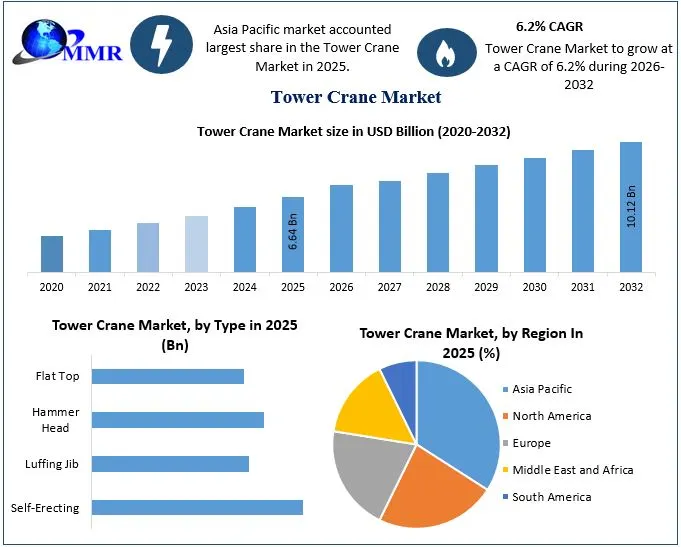
Tower Crane Market was valued at USD 6.64 Billion in 2025, and total Global Tower Crane Market revenue is expected to grow at a CAGR of 6.2% and reach nearly USD 10.12 Billion from 2026 to 2032.

Tower Crane Market Overview:

The Tower Crane Market plays a crucial role in the global construction industry by providing efficient and effective lifting and material handling solutions for high-rise buildings, commercial complexes, industrial facilities, infrastructure projects, bridges, dams, and energy developments. Tower cranes are manufactured to lift heavy loads with precision at measured heights, making them indispensable and non-replaceable for modern urban construction and large-scale engineering projects. The market includes a range of crane types, including hammerhead cranes, luffing jib cranes, self-erecting cranes, and flat-top cranes, each  of these cranes are designed designed to meet specific construction requirements and site constraints.

Growing investments in urbanization, smart city initiatives, transportation infrastructure, and renewable energy projects are driving demand for advanced tower cranes across the world. The increase in  adoption of Building Information Modeling (BIM), telematics, IoT-enabled fleet management, and automation technologies is improving crane safety, operational efficiency, and predictive maintenance capabilities. Coupled with this, the development of electric and energy-efficient tower cranes, remote monitoring systems, and anti-collision technologies is supporting the industry's transformation  toward sustainable and digitally connected construction equipment. Emerging economies are experiencing  high demand due to rapid industrialization and infrastructure growth, while developed regions are continuously investing in advanced tower crane systems to improve productivity and  reduce malfunctioning while complying with the stringent safety regulations

Tower Crane Market GrowthTo know about the Research Methodology :- Request Free Sample Report

Tower Crane Market Dynamics:

Rising Investments in Urban Infrastructure and High-Rise Construction Accelerate Market Growth

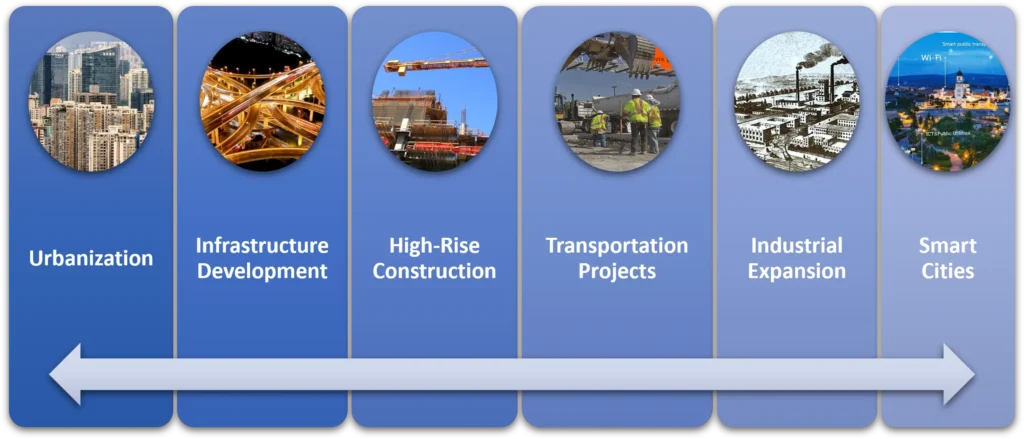
Rapid urbanization, increasing population density, and rising investments in commercial complexes, residential skyscrapers, airports, metro rail projects, bridges, and industrial facilities are increasing the demand for tower cranes. Governments in emerging economies are allocating substantial budgets to smart city initiatives as well as public infrastructure building and modernization. Private developers are also expanding mixed-use developments. Tower cranes have become irreplaceable for vertical construction because they provide superior lifting capacity, greater operational height, and improved material handling efficiency which enables faster project execution  and lower labor dependency. The continues expansion of urban infrastructure projects is expected to remain the primary growth factor for the Tower Crane Market.

High Equipment Costs and Skilled Operator Shortages Restrain Market Expansion

Although there is strong demand, the market encounters difficulties because of the requirement of huge capital for buying , transporting, installing and maintaining tower cranes. Contractors need to comply to strict safety guidelines, and have to undergo inspections to meet certification standards which leads to higher operational cost.  The lack of qualified crane operators and technicians in many developing countries , project holdup due to variable construction activity and funding limitations creates a barrier in broader acceptance among small and medium construction firms.

Growing Rental Market and Infrastructure Development Create New Growth Opportunities

The preference for equipment rental  is increasing rather than outright ownership which creates  significant opportunities for tower crane manufacturers and rental service providers. Rental solutions reduce upfront capital expenditure and  provide contractors access to   technologically advanced equipment for short-term projects. Additionally, increasing investments in renewable energy facilities, industrial manufacturing plants, logistics hubs, ports, and transportation infrastructure are broadening the application scope of tower cranes beyond conventional building construction. Emerging economies across Asia-Pacific, the Middle East, and Latin America are expected to offer substantial long-term growth opportunities due to sustained infrastructure investments.

Tower Crane Market Trends:

Smart and Connected Tower Cranes Transform Construction Site Operations - Manufacturers are increasingly integrating IoT sensors, telematics, GPS tracking, remote diagnostics, and cloud-based fleet management platforms into tower cranes. These technologies enable real-time monitoring of crane utilization, predictive maintenance, equipment health analysis, and operational efficiency, helping contractors minimize downtime, improve fleet productivity, and reduce maintenance costs. Digital monitoring systems are also enhancing project planning and equipment utilization across large construction sites.

Automation and AI-Based Safety Systems Gain Industry Adoption - The tower crane industry is witnessing rapid adoption of automation technologies, including anti-collision systems, automated load positioning, anti-sway control, machine vision, LiDAR-based monitoring, and AI-assisted safety management. These innovations improve lifting precision, reduce human error, enhance worker safety, and support autonomous or semi-autonomous crane operations. As construction companies prioritize workplace safety and productivity, intelligent tower cranes are becoming an increasingly important investment across major infrastructure projects.

Electric and Energy-Efficient Crane Technologies Support Sustainable Construction

Sustainability goals and stricter environmental rules are pushing manufacturers to create energy-efficient and low-emission tower cranes. Modern cranes now use drives, better power management systems and lighter designs that use less energy and cost less to run. There's a focus on green building and reducing carbon emissions, which should increase demand for eco-friendly lifting equipment especially in Europe and other developed construction markets.

Tower Crane Market Segment Analysis:

The By Type segment is divided into Self-Erecting, Luffing Jib, Hammer Head, and Flat Top.

Hammer Head tower cranes dominated the market in 2025 because of their high lifting capacity, long horizontal jib, and ability to  handle heavy construction materials efficiently. They operate  across large-scale residential, commercial, industrial, and infrastructure projects. They are preferred choice for high rise buildings , bridges ,factories and power plant construction due to their structural stability , cost effectiveness and suitability for repetitive lifting. The widespread use of hammer head cranes by major construction contractors continues to strengthen their market leadership.

Flat Top tower cranes are projected to register the fastest CAGR during the forecast period due to their simplified modular design, easier transportation and assembly, reduced installation time, and improved safety in congested urban construction sites. These cranes eliminate the tower head, enabling multiple cranes to operate simultaneously without jib interference, making them highly suitable for dense metropolitan developments. Meanwhile, Luffing Jib cranes are gaining popularity in cities with restricted working space because of their adjustable jib angle and compact operating radius, while Self-Erecting tower cranes continue to witness demand for low-rise residential buildings, small commercial projects, and short-duration construction activities where quick installation and mobility are key advantages.

The By Lifting Capacity segment comprises Less than 5 Ton, 6 to 10 Ton, and More than 10 Ton.

The 6 to 10 Ton segment accounted for the largest market share in 2025, driven by its versatility across medium- and high-rise residential buildings, commercial complexes, industrial facilities, and infrastructure projects. This lifting capacity offers an optimal balance between operational efficiency, lifting performance, and cost, making it the preferred choice for contractors undertaking a wide variety of construction projects. Its broad applicability across both developed and emerging markets continues to support its market dominance.

The More than 10 Ton segment is anticipated to witness the fastest growth over the forecast period, fueled by increasing investments in mega infrastructure projects, skyscrapers, metro rail systems, airports, bridges, ports, and energy facilities that require heavy-duty lifting capabilities. These cranes are increasingly equipped with advanced automation, anti-collision systems, and IoT-enabled monitoring features to improve productivity and safety. Meanwhile, the Less than 5 Ton segment maintains steady demand from low-rise residential construction, renovation projects, and small commercial developments where compact size, lower operating costs, and ease of deployment are major advantages.

Global Construction Industry Snapshot

Global Construction Industry Snapshot-2025

Tower Crane Market Regional Insights:

Asia Pacific is dominating the Tower Crane Market and is expected to maintain its leading position throughout the forecast period. The  leadership of region  is supported by rapid urbanization, large-scale residential and commercial construction, expanding industrial facilities, and government investments in transportation infrastructure . governments across this countries  are investing in  high-speed rail, metro systems, airports, and smart cities. China  is world's largest construction market, while India is experiencing strong demand driven by infrastructure initiatives including Smart Cities Mission, PM Gati Shakti, and affordable housing projects. Japan and South Korea are continuously investing  in urban redevelopment and advanced construction technologies, further supporting tower crane adoption.

Europe represents a significant market owing to the modernization of infrastructure, increasing renovation of aging buildings, and stringent workplace safety regulations. Countries such as Germany, France, the United Kingdom, Italy, and Spain are investing in commercial developments, renewable energy projects, and public infrastructure upgrades. The region is also witnessing increasing adoption of electric, energy-efficient, and digitally connected tower cranes as contractors focus on sustainability, automation, and compliance with environmental standards.

North America is experiencing steady growth due to rising investments in commercial buildings, industrial manufacturing facilities, data centers, logistics warehouses, and transportation infrastructure. The United States accounts for the largest regional share, supported by federal infrastructure funding, increasing high-rise construction, and growing demand for technologically advanced lifting equipment. Canada is also contributing to market expansion through residential developments, mining projects, and urban infrastructure modernization.

Middle East & Africa is emerging as a high-growth region, driven by mega infrastructure developments, smart city projects, tourism investments, and commercial real estate expansion. Countries such as Saudi Arabia and the United Arab Emirates are witnessing strong demand for tower cranes through projects including NEOM, The Line, Red Sea Global developments, and large-scale mixed-use construction. Increasing investments in ports, industrial zones, and transportation networks across Africa are further creating opportunities for market growth.

Latin America is gradually expanding, supported by investments in residential construction, commercial buildings, mining, and public infrastructure. Brazil leads the regional market due to ongoing urban development and industrial construction activities, while Mexico benefits from manufacturing expansion, logistics infrastructure, and nearshoring investments. Government initiatives aimed at improving transportation networks and public infrastructure are expected to support long-term demand for tower cranes.

Tower Crane Market Recent Developments

Date Recent Development
18 Dec 2025 The Manitowoc Company (Potain) unveiled the Potain MCT 105 topless tower crane at EXCON 2025. Manufactured at its Pune facility, the new crane features a 60 m jib, 5-ton lifting capacity, improved transport efficiency, and is designed for dense urban construction projects
2025 Liebherr Group introduced the 43 K fast-erecting tower crane, incorporating the Tower Crane Operating System 2 and advanced assistance features such as Positioning Pilot, Guided Hook, Sway Control Plus, and Vertical Line Finder to enhance safety and operational efficiency.
2025 Liebherr Group announced a nine-figure investment program through 2034 to modernize its tower crane manufacturing facilities in Germany while strategically integrating its Spain and India production sites to support next-generation crane production.
Feb 2024 Terex Corporation expanded its City Class portfolio with the launch of the CTT 152-6 Flat Top tower crane, offering improved lifting speeds and enhanced flexibility for urban construction projects.
Mar 2024 launThe Manitowoc Company (Potain) ched the MCR 625 luffing jib tower crane, targeting high-rise construction projects across Asia, the Middle East, and Latin America with enhanced lifting performance and operational efficiency.

Tower Crane Market Competitive Landscape:

The Global Tower Crane Market is highly competitive with characterization such as presence of established international manufacturers, regional construction equipment companies, and specialized crane engineering firms. Leading market participants are focusing on expanding their product portfolios through continuous technological innovation, strategic partnerships, manufacturing capacity expansion, and global distribution network strengthening. Companies are increasingly investing in smart tower cranes equipped with IoT-enabled monitoring, telematics, remote diagnostics, anti-collision systems, and automated lifting controls to enhance operational efficiency, safety, and productivity.  Manufacturers are also developing modular, flat-top, and luffing jib cranes that offer faster assembly, easier transportation, and improved performance for high-rise and urban construction projects.

Major companies including Liebherr Group, The Manitowoc Company (Potain), Zoomlion Heavy Industry Science & Technology Co., Ltd., SANY Group, XCMG Group, Terex Corporation, Comansa, Wolffkran International AG, Raimondi Cranes, and JASO Tower Cranes continue to strengthen their market positions through new product launches, investments in digital technologies, and expansion into emerging construction markets. These companies are focusing on increasing lifting capacities, improving energy efficiency, integrating predictive maintenance and fleet management solutions, and expanding manufacturing facilities to meet growing global demand. Strategic collaborations with construction contractors, rental equipment providers, and infrastructure developers, coupled with strong after-sales service networks, are enabling manufacturers to enhance customer reach and capitalize on the increasing investments in residential, commercial, industrial, and infrastructure construction projects.

Tower Crane Market Scope: Inquiry Before Buying

Tower Crane Market
Report Coverage Details
Base Year: 2025 Forecast Period: 2026-2032
Historical Data: 2020 to 2025 Market Size in 2025: USD  6.64 Bn.
Forecast Period 2026 to 2032 CAGR: 6.2% Market Size in 2032: USD 10.12 Bn.
Segments Covered: By Type Self-Erecting
Luffing Jib
Hammer Head
Flat Top
By Lifting capacity Less than 5 Ton
6 to 10 Ton
More than 10 Ton
By End-Use industry Building Construction
Industrial Construction
Infrastructure Projects
Others

Tower Crane Market, by Region

Asia Pacific (China, South Korea, Japan, India, Australia, Indonesia, Malaysia, Vietnam, Taiwan, Bangladesh, Pakistan and Rest of APAC)
Europe (UK, France, Germany, Italy, Spain, Sweden, Austria and Rest of Europe)
North America (United States, Canada and Mexico)
Middle East and Africa (South Africa, GCC, Egypt, Nigeria and Rest of ME&A)
South America (Brazil, Argentina Rest of South America)

Tower Crane Market, Key Players

North America

  1. Manitowoc Company (United States) (Potain Tower Cranes)
  2. Terex Corporation (United States)
  3. Morrow Equipment Company (United States) (Leading distributor and fleet owner of Liebherr tower cranes in North America; not an OEM manufacturer.)
  4. Broadwind, Inc. (United States)
  5. Specialty Crane & Rigging (United States)
  6. Sims Crane & Equipment Co. (United States)
  7. ALL Crane (United States)
  8. W.O. Grubb Crane Rental (United States)

Europe

  1. Liebherr Group (Switzerland)
  2. Wolffkran International AG (Germany)
  3. Comansa S.A. (Spain)
  4. Raimondi Cranes S.p.A. (Italy)
  5. JASO Tower Cranes (Spain)
  6. Sáez Cranes (Spain)
  7. FM Gru S.r.l. (Italy)

Asia Pacific

  1. Zoomlion Heavy Industry Science & Technology Co., Ltd. (China)
  2. XCMG Group (China)
  3. SANY Group (China)
  4. Fushun Yongmao Construction Machinery Co., Ltd. (China)
  5. Zhejiang Construction Machinery Group Co., Ltd. (China)
  6. Dalian Huarui Heavy Industry Group Co., Ltd. (China)
  7. Guangxi Construction Engineering Group Construction Machinery Manufacturing Co., Ltd. (China)
  8. Tadano Ltd. (Japan)
  9. Kobelco Construction Machinery Co., Ltd. (Japan)
  10. Favelle Favco Berhad (Malaysia)
  11. SYM Hoist & Tower Crane Equipment Co., Ltd. (South Korea)

Others

Frequently Asked Questions:

1. Which region dominated the tower crane market?
Ans: Asia Pacific region dominated the tower crane market.

2. Key tower crane manufacturers?
Ans: Liebherr, Manitowoc, Terex, Zoomlion and XCMG are the key tower crane manufacturers.

3. How do smart cranes improve construction efficiency?
Ans: IoT-enabled and AI-powered cranes allow real-time monitoring, predictive maintenance, and precise load control, minimizing downtime and accidents.

4. What safety features are common in modern tower cranes?
Ans: Modern cranes include load sensors, anti-collision systems, wind monitoring, and automated controls for safer operations.

5. What innovations are shaping the future of tower cranes?
Ans: Key innovations include digital twin simulations, modular components, remote operation, and integration with renewable energy sources.

Table of Contents

1. Tower Crane Market Introduction 1.1. Study Assumption and Market Definition 1.2. Scope of the Study 1.3. Executive Summary 2. Global Tower Crane Market: Competitive Landscape 2.1. MMR Competition Matrix 2.2. Competitive Landscape 2.3. Key Players Benchmarking 2.3.1. Company Name 2.3.2. Business Segment 2.3.3. End-user Segment 2.3.4. Revenue (2025) 2.3.5. Company Locations 2.4. Leading Tower Crane Market Companies, by market capitalization 2.5. Market Structure 2.5.1. Market Leaders 2.5.2. Market Followers 2.5.3. Emerging Players 2.6. Mergers and Acquisitions Details 3. Tower Crane Market: Dynamics 3.1. Tower Crane Market Trends by Region 3.1.1. North America Tower Crane Market Trends 3.1.2. Europe Tower Crane Market Trends 3.1.3. Asia Pacific Tower Crane Market Trends 3.1.4. Middle East and Africa Tower Crane Market Trends 3.1.5. South America Tower Crane Market Trends 3.2. Tower Crane Market Dynamics by Region 3.2.1. North America 3.2.1.1. North America Tower Crane Market Drivers 3.2.1.2. North America Tower Crane Market Restraints 3.2.1.3. North America Tower Crane Market Opportunities 3.2.1.4. North America Tower Crane Market Challenges 3.2.2. Europe 3.2.2.1. Europe Tower Crane Market Drivers 3.2.2.2. Europe Tower Crane Market Restraints 3.2.2.3. Europe Tower Crane Market Opportunities 3.2.2.4. Europe Tower Crane Market Challenges 3.2.3. Asia Pacific 3.2.3.1. Asia Pacific Tower Crane Market Drivers 3.2.3.2. Asia Pacific Tower Crane Market Restraints 3.2.3.3. Asia Pacific Tower Crane Market Opportunities 3.2.3.4. Asia Pacific Tower Crane Market Challenges 3.2.4. Middle East and Africa 3.2.4.1. Middle East and Africa Tower Crane Market Drivers 3.2.4.2. Middle East and Africa Tower Crane Market Restraints 3.2.4.3. Middle East and Africa Tower Crane Market Opportunities 3.2.4.4. Middle East and Africa Tower Crane Market Challenges 3.2.5. South America 3.2.5.1. South America Tower Crane Market Drivers 3.2.5.2. South America Tower Crane Market Restraints 3.2.5.3. South America Tower Crane Market Opportunities 3.2.5.4. South America Tower Crane Market Challenges 3.3. PORTER's Five Forces Analysis 3.4. PESTLE Analysis 3.5. Technology Roadmap 3.6. Regulatory Landscape by Region 3.6.1. North America 3.6.2. Europe 3.6.3. Asia Pacific 3.6.4. Middle East and Africa 3.6.5. South America 3.7. Key Opinion Leader Analysis For Tower Crane Industry 3.8. Analysis of Government Schemes and Initiatives For Tower Crane Industry 3.9. Tower Crane Market Trade Analysis 3.10. The Global Pandemic Impact on Tower Crane Market 4. Tower Crane Market: Global Market Size and Forecast by Segmentation (in USD Billion) 2025-2032 4.1. Tower Crane Market Size and Forecast, by Type (2025-2032) 4.1.1. Self-Erecting 4.1.2. Luffing Jib 4.1.3. Hammer Head 4.1.4. Flat Top 4.2. Tower Crane Market Size and Forecast, by Lifting capacity (2025-2032) 4.2.1. Less than 5 Ton 4.2.2. 6 to 10 Ton 4.2.3. More than 10 Ton 4.3. Tower Crane Market Size and Forecast, by End-Use industry (2025-2032) 4.3.1. Building Construction 4.3.2. Industrial Construction 4.3.3. Infrastructure Projects 4.3.4. Others 4.4. Tower Crane Market Size and Forecast, by Region (2025-2032) 4.4.1. North America 4.4.2. Europe 4.4.3. Asia Pacific 4.4.4. Middle East and Africa 4.4.5. South America 5. North America Tower Crane Market Size and Forecast by Segmentation (in USD Billion) 2025-2032 5.1. North America Tower Crane Market Size and Forecast, by Type (2025-2032) 5.1.1. Self-Erecting 5.1.2. Luffing Jib 5.1.3. Hammer Head 5.1.4. Flat Top 5.2. North America Tower Crane Market Size and Forecast, by Lifting capacity (2025-2032) 5.2.1. Less than 5 Ton 5.2.2. 6 to 10 Ton 5.2.3. More than 10 Ton 5.3. North America Tower Crane Market Size and Forecast, by End-Use industry (2025-2032) 5.3.1. Building Construction 5.3.2. Industrial Construction 5.3.3. Infrastructure Projects 5.3.4. Others 5.4. North America Tower Crane Market Size and Forecast, by Country (2025-2032) 5.4.1. United States 5.4.1.1. United States Tower Crane Market Size and Forecast, by Type (2025-2032) 5.4.1.1.1. Self-Erecting 5.4.1.1.2. Luffing Jib 5.4.1.1.3. Hammer Head 5.4.1.1.4. Flat Top 5.4.1.2. United States Tower Crane Market Size and Forecast, by Lifting capacity (2025-2032) 5.4.1.2.1. Less than 5 Ton 5.4.1.2.2. 6 to 10 Ton 5.4.1.2.3. More than 10 Ton 5.4.1.3. United States Tower Crane Market Size and Forecast, by End-Use industry (2025-2032) 5.4.1.3.1. Building Construction 5.4.1.3.2. Industrial Construction 5.4.1.3.3. Infrastructure Projects 5.4.1.3.4. Others 5.4.2. Canada 5.4.2.1. Canada Tower Crane Market Size and Forecast, by Type (2025-2032) 5.4.2.1.1. Self-Erecting 5.4.2.1.2. Luffing Jib 5.4.2.1.3. Hammer Head 5.4.2.1.4. Flat Top 5.4.2.2. Canada Tower Crane Market Size and Forecast, by Lifting capacity (2025-2032) 5.4.2.2.1. Less than 5 Ton 5.4.2.2.2. 6 to 10 Ton 5.4.2.2.3. More than 10 Ton 5.4.2.3. Canada Tower Crane Market Size and Forecast, by End-Use industry (2025-2032) 5.4.2.3.1. Building Construction 5.4.2.3.2. Industrial Construction 5.4.2.3.3. Infrastructure Projects 5.4.2.3.4. Others 5.4.3. Mexico 5.4.3.1. Mexico Tower Crane Market Size and Forecast, by Type (2025-2032) 5.4.3.1.1. Self-Erecting 5.4.3.1.2. Luffing Jib 5.4.3.1.3. Hammer Head 5.4.3.1.4. Flat Top 5.4.3.2. Mexico Tower Crane Market Size and Forecast, by Lifting capacity (2025-2032) 5.4.3.2.1. Less than 5 Ton 5.4.3.2.2. 6 to 10 Ton 5.4.3.2.3. More than 10 Ton 5.4.3.3. Mexico Tower Crane Market Size and Forecast, by End-Use industry (2025-2032) 5.4.3.3.1. Building Construction 5.4.3.3.2. Industrial Construction 5.4.3.3.3. Infrastructure Projects 5.4.3.3.4. Others 6. Europe Tower Crane Market Size and Forecast by Segmentation (in USD Billion) 2025-2032 6.1. Europe Tower Crane Market Size and Forecast, by Type (2025-2032) 6.2. Europe Tower Crane Market Size and Forecast, by Lifting capacity (2025-2032) 6.3. Europe Tower Crane Market Size and Forecast, by End-Use industry (2025-2032) 6.4. Europe Tower Crane Market Size and Forecast, by Country (2025-2032) 6.4.1. United Kingdom 6.4.1.1. United Kingdom Tower Crane Market Size and Forecast, by Type (2025-2032) 6.4.1.2. United Kingdom Tower Crane Market Size and Forecast, by Lifting capacity (2025-2032) 6.4.1.3. United Kingdom Tower Crane Market Size and Forecast, by End-Use industry (2025-2032) 6.4.2. France 6.4.2.1. France Tower Crane Market Size and Forecast, by Type (2025-2032) 6.4.2.2. France Tower Crane Market Size and Forecast, by Lifting capacity (2025-2032) 6.4.2.3. France Tower Crane Market Size and Forecast, by End-Use industry (2025-2032) 6.4.3. Germany 6.4.3.1. Germany Tower Crane Market Size and Forecast, by Type (2025-2032) 6.4.3.2. Germany Tower Crane Market Size and Forecast, by Lifting capacity (2025-2032) 6.4.3.3. Germany Tower Crane Market Size and Forecast, by End-Use industry (2025-2032) 6.4.4. Italy 6.4.4.1. Italy Tower Crane Market Size and Forecast, by Type (2025-2032) 6.4.4.2. Italy Tower Crane Market Size and Forecast, by Lifting capacity (2025-2032) 6.4.4.3. Italy Tower Crane Market Size and Forecast, by End-Use industry (2025-2032) 6.4.5. Spain 6.4.5.1. Spain Tower Crane Market Size and Forecast, by Type (2025-2032) 6.4.5.2. Spain Tower Crane Market Size and Forecast, by Lifting capacity (2025-2032) 6.4.5.3. Spain Tower Crane Market Size and Forecast, by End-Use industry (2025-2032) 6.4.6. Sweden 6.4.6.1. Sweden Tower Crane Market Size and Forecast, by Type (2025-2032) 6.4.6.2. Sweden Tower Crane Market Size and Forecast, by Lifting capacity (2025-2032) 6.4.6.3. Sweden Tower Crane Market Size and Forecast, by End-Use industry (2025-2032) 6.4.7. Austria 6.4.7.1. Austria Tower Crane Market Size and Forecast, by Type (2025-2032) 6.4.7.2. Austria Tower Crane Market Size and Forecast, by Lifting capacity (2025-2032) 6.4.7.3. Austria Tower Crane Market Size and Forecast, by End-Use industry (2025-2032) 6.4.8. Rest of Europe 6.4.8.1. Rest of Europe Tower Crane Market Size and Forecast, by Type (2025-2032) 6.4.8.2. Rest of Europe Tower Crane Market Size and Forecast, by Lifting capacity (2025-2032) 6.4.8.3. Rest of Europe Tower Crane Market Size and Forecast, by End-Use industry (2025-2032) 7. Asia Pacific Tower Crane Market Size and Forecast by Segmentation (in USD Billion) 2025-2032 7.1. Asia Pacific Tower Crane Market Size and Forecast, by Type (2025-2032) 7.2. Asia Pacific Tower Crane Market Size and Forecast, by Lifting capacity (2025-2032) 7.3. Asia Pacific Tower Crane Market Size and Forecast, by End-Use industry (2025-2032) 7.4. Asia Pacific Tower Crane Market Size and Forecast, by Country (2025-2032) 7.4.1. China 7.4.1.1. China Tower Crane Market Size and Forecast, by Type (2025-2032) 7.4.1.2. China Tower Crane Market Size and Forecast, by Lifting capacity (2025-2032) 7.4.1.3. China Tower Crane Market Size and Forecast, by End-Use industry (2025-2032) 7.4.2. S Korea 7.4.2.1. S Korea Tower Crane Market Size and Forecast, by Type (2025-2032) 7.4.2.2. S Korea Tower Crane Market Size and Forecast, by Lifting capacity (2025-2032) 7.4.2.3. S Korea Tower Crane Market Size and Forecast, by End-Use industry (2025-2032) 7.4.3. Japan 7.4.3.1. Japan Tower Crane Market Size and Forecast, by Type (2025-2032) 7.4.3.2. Japan Tower Crane Market Size and Forecast, by Lifting capacity (2025-2032) 7.4.3.3. Japan Tower Crane Market Size and Forecast, by End-Use industry (2025-2032) 7.4.4. India 7.4.4.1. India Tower Crane Market Size and Forecast, by Type (2025-2032) 7.4.4.2. India Tower Crane Market Size and Forecast, by Lifting capacity (2025-2032) 7.4.4.3. India Tower Crane Market Size and Forecast, by End-Use industry (2025-2032) 7.4.5. Australia 7.4.5.1. Australia Tower Crane Market Size and Forecast, by Type (2025-2032) 7.4.5.2. Australia Tower Crane Market Size and Forecast, by Lifting capacity (2025-2032) 7.4.5.3. Australia Tower Crane Market Size and Forecast, by End-Use industry (2025-2032) 7.4.6. Indonesia 7.4.6.1. Indonesia Tower Crane Market Size and Forecast, by Type (2025-2032) 7.4.6.2. Indonesia Tower Crane Market Size and Forecast, by Lifting capacity (2025-2032) 7.4.6.3. Indonesia Tower Crane Market Size and Forecast, by End-Use industry (2025-2032) 7.4.7. Malaysia 7.4.7.1. Malaysia Tower Crane Market Size and Forecast, by Type (2025-2032) 7.4.7.2. Malaysia Tower Crane Market Size and Forecast, by Lifting capacity (2025-2032) 7.4.7.3. Malaysia Tower Crane Market Size and Forecast, by End-Use industry (2025-2032) 7.4.8. Vietnam 7.4.8.1. Vietnam Tower Crane Market Size and Forecast, by Type (2025-2032) 7.4.8.2. Vietnam Tower Crane Market Size and Forecast, by Lifting capacity (2025-2032) 7.4.8.3. Vietnam Tower Crane Market Size and Forecast, by End-Use industry (2025-2032) 7.4.9. Taiwan 7.4.9.1. Taiwan Tower Crane Market Size and Forecast, by Type (2025-2032) 7.4.9.2. Taiwan Tower Crane Market Size and Forecast, by Lifting capacity (2025-2032) 7.4.9.3. Taiwan Tower Crane Market Size and Forecast, by End-Use industry (2025-2032) 7.4.10. Rest of Asia Pacific 7.4.10.1. Rest of Asia Pacific Tower Crane Market Size and Forecast, by Type (2025-2032) 7.4.10.2. Rest of Asia Pacific Tower Crane Market Size and Forecast, by Lifting capacity (2025-2032) 7.4.10.3. Rest of Asia Pacific Tower Crane Market Size and Forecast, by End-Use industry (2025-2032) 8. Middle East and Africa Tower Crane Market Size and Forecast by Segmentation (in USD Billion) 2025-2032 8.1. Middle East and Africa Tower Crane Market Size and Forecast, by Type (2025-2032) 8.2. Middle East and Africa Tower Crane Market Size and Forecast, by Lifting capacity (2025-2032) 8.3. Middle East and Africa Tower Crane Market Size and Forecast, by End-Use industry (2025-2032) 8.4. Middle East and Africa Tower Crane Market Size and Forecast, by Country (2025-2032) 8.4.1. South Africa 8.4.1.1. South Africa Tower Crane Market Size and Forecast, by Type (2025-2032) 8.4.1.2. South Africa Tower Crane Market Size and Forecast, by Lifting capacity (2025-2032) 8.4.1.3. South Africa Tower Crane Market Size and Forecast, by End-Use industry (2025-2032) 8.4.2. GCC 8.4.2.1. GCC Tower Crane Market Size and Forecast, by Type (2025-2032) 8.4.2.2. GCC Tower Crane Market Size and Forecast, by Lifting capacity (2025-2032) 8.4.2.3. GCC Tower Crane Market Size and Forecast, by End-Use industry (2025-2032) 8.4.3. Nigeria 8.4.3.1. Nigeria Tower Crane Market Size and Forecast, by Type (2025-2032) 8.4.3.2. Nigeria Tower Crane Market Size and Forecast, by Lifting capacity (2025-2032) 8.4.3.3. Nigeria Tower Crane Market Size and Forecast, by End-Use industry (2025-2032) 8.4.4. Rest of ME&A 8.4.4.1. Rest of ME&A Tower Crane Market Size and Forecast, by Type (2025-2032) 8.4.4.2. Rest of ME&A Tower Crane Market Size and Forecast, by Lifting capacity (2025-2032) 8.4.4.3. Rest of ME&A Tower Crane Market Size and Forecast, by End-Use industry (2025-2032) 9. South America Tower Crane Market Size and Forecast by Segmentation (in USD Billion) 2025-2032 9.1. South America Tower Crane Market Size and Forecast, by Type (2025-2032) 9.2. South America Tower Crane Market Size and Forecast, by Lifting capacity (2025-2032) 9.3. South America Tower Crane Market Size and Forecast, by End-Use industry (2025-2032) 9.4. South America Tower Crane Market Size and Forecast, by Country (2025-2032) 9.4.1. Brazil 9.4.1.1. Brazil Tower Crane Market Size and Forecast, by Type (2025-2032) 9.4.1.2. Brazil Tower Crane Market Size and Forecast, by Lifting capacity (2025-2032) 9.4.1.3. Brazil Tower Crane Market Size and Forecast, by End-Use industry (2025-2032) 9.4.2. Argentina 9.4.2.1. Argentina Tower Crane Market Size and Forecast, by Type (2025-2032) 9.4.2.2. Argentina Tower Crane Market Size and Forecast, by Lifting capacity (2025-2032) 9.4.2.3. Argentina Tower Crane Market Size and Forecast, by End-Use industry (2025-2032) 9.4.3. Rest Of South America 9.4.3.1. Rest Of South America Tower Crane Market Size and Forecast, by Type (2025-2032) 9.4.3.2. Rest Of South America Tower Crane Market Size and Forecast, by Lifting capacity (2025-2032) 9.4.3.3. Rest Of South America Tower Crane Market Size and Forecast, by End-Use industry (2025-2032) 10. Company Profile: Key Players 10.1. Manitowoc (United States) 10.1.1. Company Overview 10.1.2. Business Portfolio 10.1.3. Financial Overview 10.1.4. SWOT Analysis 10.1.5. Strategic Analysis 10.1.6. Scale of Operation (small, medium, and large) 10.1.7. Details on Partnership 10.1.8. Regulatory Accreditations and Certifications Received by Them 10.1.9. Awards Received by the Firm 10.1.10. Recent Developments 10.2. Terex (United States) 10.3. Morrow Equipment Company (United States) 10.4. Maxim Crane Works (Texas) 10.5. H&E Equipment Services (United States) 10.6. Bigge Crane & Rigging Company (California) 10.7. United Crane & Rigging (Chicago) 10.8. Crane Works 10.9. Inc. California 10.10. Liebherr (Switzerland) 10.11. Wolffkran (Germany) 10.12. Jost (Germany) 10.13. Raimondi (Germany) 10.14. Zoomlion (China) 10.15. XCMG Group(China) 10.16. SANY (China) 10.17. Dalian Heavy Industries (China) 10.18. Fushun Yongmao (China) 10.19. Zhejiang Construction Machinery (China) 10.20. Tadano Limited (Japan) 10.21. Kobelco Construction Machinery Co. 10.22. Ltd. (Japan) 11. Key Findings 12. Industry Recommendations 13. Tower Crane Market: Research Methodology 14. Terms and Glossary

Custom Market Research Services

We Will Customise The Research For You, In Case The Report Listed Above Does Not Meet With Your Requirements