
Global Torula Yeast Market Size by Form, Source and Application
Overview
The Global Torula Yeast Market was valued at approximately US$3.646 billion in 2025 and is estimated to reach US$3.880 billion in 2026. The market is projected to reach around US$6.42 billion by 2034, growing at a CAGR of 6.35% during the forecast period.
Torula Yeast Market Overview:
The Global Torula Yeast Market is undergoing steady growth as demand for natural flavor enhancers, clean-label food ingredients, and sustainable protein sources across the food, animal nutrition, and biotechnology industries is continuously increasing. Torula yeast (Candida utilis or Cyberlindnera jadinii) is a non-fermentative yeast produced traditionally by using lignocellulosic substrates and pulp industry by-products. The Torula yeast is widely known for its umami-rich flavor profile, high protein content, B vitamins, amino acids, and glutamic acid. Torula yeast typically contains 45–55% protein (dry weight), making it an attractive microbial protein source for plant-based foods and animal nutrition. These enrichments make torula yeast a popular choice as an effective natural alternative to monosodium glutamate (MSG) in soups, sauces, snacks, plant-based meat products, seasonings, and ready-to-eat foods.
Apart from these, torula yeast is extensively utilized in pet food and animal feed due to its nutritional value and palatability. Torula yeast contains microbial protein, which expands its use in biotechnology and fermentation-based applications. The product is also recognized for being gluten-free and suitable for vegan and vegetarian formulations, aligning with evolving consumer preferences for healthier and minimally processed ingredients. Torula yeast (Candida utilis) has been granted Generally Recognized as Safe (GRAS) status for specified food uses in the United States, supporting its commercial adoption in food formulations. Dried torula yeast is permitted for use in food under the U.S. FDA's 21 CFR §172.896, supporting its commercial use as a flavor enhancer and food ingredient.
The growth of the global torula yeast market is equally supported by the rapid expansion of the global plant-based food industry and the increasing replacement of synthetic flavor enhancers with naturally derived ingredients.
Advancements in new fermentation technologies like precision fermentation, biomass fermentation, AI and Digital twins, and continuous processing are creating new commercial opportunities for manufacturers to enter this market. Regionally, North America remains at a leading position in the torula yeast market owing to the strong presence of processed food manufacturers as well as consumers' inclination towards clean-label ingredients, while Asia Pacific is expected to witness the fastest growth due to expanding processed food production, rising demand for plant-based nutrition, and increasing investments in food biotechnology.
Global Torula Yeast Market Growth and Share Analysis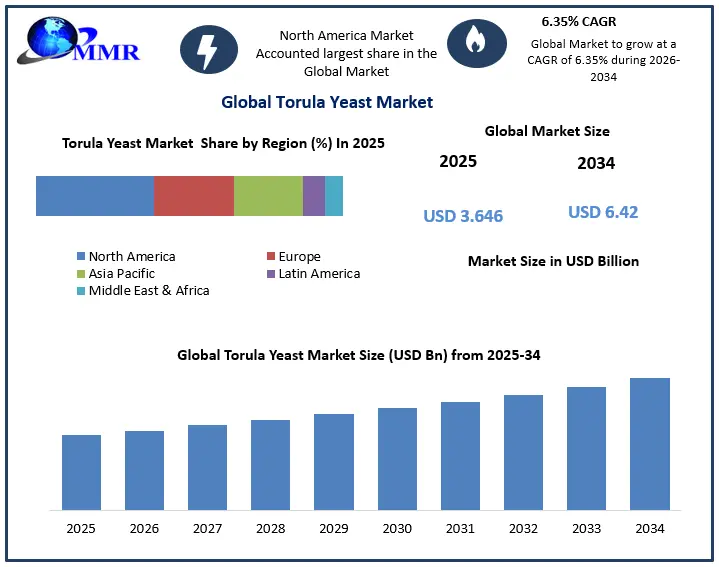
To know about the Research Methodology :- Request Free Sample Report
Global Torula Yeast Market Dynamics:
Rising Demand for Clean-Label and Natural Flavor Enhancers is to Drive the Torula Yeast Market
The growing consumer preference for clean-label foods and naturally derived ingredients is a key driver of the global torula yeast market. Food manufacturers are focusing on the replacement of synthetic flavor enhancers such as monosodium glutamate (MSG) with torula yeast because of its natural umami flavor, high protein content, and ability to improve taste without artificial additives.
The growing preference from consumers for plant-based alternatives, savory snacks, soups, sauces, and ready-to-eat meals has further accelerated its adoption. Regulatory acceptance in the United States for dried torula yeast(Candida Utilis) is permitted for use in food under 21 CFR §172.896, strengthening manufacturer confidence in its use as a food ingredient. Moreover, torula yeast typically contains approximately 46–49% crude protein, making it an attractive microbial protein source for both human and animal nutrition. These factors are collectively driving sustained market growth.
High Production Costs and Limited Raw Material Availability to Restrain the Market
Though the adoption of torula yeast is growing, its production depends on fermentation processes, specialized downstream processing, and consistent access to suitable substrates, all of which increase production costs. Fluctuations in the availability of lignocellulosic feedstocks and rising energy prices can further impact manufacturing economics. Compared with conventional flavor enhancers and commodity yeast products, torula yeast remains relatively expensive, limiting its adoption in price-sensitive food and feed applications. Smaller manufacturers also face challenges in scaling production while maintaining product quality and regulatory compliance.
Expansion of Sustainable Microbial Protein and Plant-Based Foods Creates Significant Growth Opportunities
Growing investments in alternative proteins and sustainable food production are creating substantial opportunities for torula yeast manufacturers. As governments and food companies seek environmentally sustainable protein sources, microbial proteins produced through fermentation are gaining greater commercial attention. Torula yeast's high protein content, favorable amino acid profile, and natural flavor-enhancing properties position it as an attractive ingredient for plant-based foods, nutritional supplements, and animal feed. Amino acid (AA) dialysis shows estimated bioaccessibility between 41 and 58%, indicating good digestibility of all test products. Continuous advances in precision fermentation, biomass processing, and circular bioeconomy initiatives are expected to expand commercial applications and improve production efficiency in the coming years.
Competition from Alternative Yeast Ingredients and Flavor Enhancers Remains a Key Challenge for the Torula Yeast Market
The torula yeast market faces strong competition from nutritional yeast, yeast extracts, hydrolyzed vegetable proteins, and other natural flavor enhancers that are already well established in the global food industry. Many food manufacturers continue to use these alternatives because of their broader availability, lower production costs, and established supply chains. In addition, differences in flavor intensity, formulation compatibility, and regional regulatory requirements may limit torula yeast adoption in certain applications. Maintaining competitive pricing while expanding production capacity and meeting evolving clean-label expectations remains a significant challenge for manufacturers.
Global Torula Market Trends:
• Rising Adoption of Torula Yeast in Plant-Based Meat Alternatives - The rapid growth of the plant-based food industry is significantly increasing the use of torula yeast as a natural umami ingredient in meat analogs, vegan snacks, soups, sauces, and ready-to-eat meals. Its ability to impart a rich, savory flavor while enhancing the nutritional profile makes it a preferred ingredient in clean-label formulations. Food manufacturers are increasingly incorporating torula yeast to improve taste without relying on artificial flavor enhancers or animal-derived ingredients.
• Growing Preference for Clean-Label and Natural Food Ingredients - Consumers are increasingly seeking products made with recognizable, minimally processed ingredients, driving demand for natural flavor enhancers such as torula yeast. Manufacturers are reformulating processed foods to eliminate synthetic additives, including monosodium glutamate (MSG), while maintaining flavor quality. This trend is accelerating the adoption of torula yeast across seasonings, savory foods, convenience products, and functional food formulations.
• Advancements in Fermentation and Sustainable Microbial Protein Production - Continuous improvements in industrial fermentation technologies are enabling manufacturers to enhance torula yeast yield, production efficiency, and product consistency. The utilization of renewable biomass and lignocellulosic feedstocks is supporting more sustainable production processes while reducing environmental impact. These technological advancements are strengthening the commercial viability of torula yeast as an alternative microbial protein source for food and feed applications.
• Expanding Applications in Premium Pet Food and Animal Nutrition – the high protein content, amino acid profile, and palatability is widening the acceptance of torula yeast in premium pet food and animal feed. Pet food manufacturers are incorporating torula yeast into formulations to improve flavor, digestibility, and overall nutritional value while responding to the growing consumer demand for natural, high-quality pet nutrition. This trend is expected to create additional growth opportunities beyond the human food sector for the torula yeast market.
Global Torula Yeast Market Segment Analysis:
The By Form segment is divided into Powder, Flakes, Granules, and Paste. The Powder segment held the largest market share of around 61.8% in 2025, owing to its excellent solubility, long shelf life, ease of handling, and widespread use across food processing, seasonings, soups, sauces, snack products, plant-based meat formulations, and pet food. Powdered torula yeast also offers superior blending characteristics, making it the preferred format for industrial food manufacturers and ingredient suppliers. Flakes are expected to witness steady growth due to their increasing use in vegan seasonings and direct-to-consumer food products where a stronger texture and visual appeal are preferred. Granules are gaining traction in dry mixes, functional foods, and specialty seasonings because of their controlled dispersion and ease of storage. Paste is anticipated to maintain a niche but growing market, particularly in industrial food processing and fermentation applications where concentrated flavor enhancement is required.
The By Application segment is divided into Food & Beverages, Animal Feed & Pet Food, Nutraceuticals & Dietary Supplements, Pharmaceuticals, Biotechnology & Fermentation, and Cosmetics & Personal Care. Food & Beverages is projected to dominate the market with a substantial share of 48.5% in 2025, driven by the increasing use of torula yeast as a natural umami flavor enhancer and clean-label ingredient in soups, sauces, seasonings, snacks, ready-to-eat meals, and plant-based meat alternatives. Growing consumer demand for natural ingredients and MSG substitutes continues to strengthen this segment's leadership. Animal Feed & Pet Food is expected to register strong growth due to the rising demand for protein-rich and palatable feed ingredients in premium pet nutrition.
Nutraceuticals & Dietary Supplements are anticipated to gain momentum as manufacturers utilize torula yeast's protein, amino acids, and B-vitamin content in functional nutrition products. Pharmaceuticals and Biotechnology & Fermentation are expected to witness gradual expansion with increasing research into microbial proteins and fermentation-derived ingredients, while Cosmetics & Personal Care will experience steady demand owing to the growing use of yeast-derived bioactive compounds in skin and personal care formulations.
Global Torula Yeast Market Regional Insights:
North America is expected to dominate the global Torula Yeast market during the forecast period, accounting for around 38.5% market share in 2025, driven by strong demand for clean-label ingredients, plant-based foods, and premium pet nutrition. The region has a well-established processed food industry and a high level of consumer awareness regarding natural flavor enhancers and alternative proteins. The regulatory framework also supports market growth, as the U.S. Food and Drug Administration (FDA) permits the use of dried torula yeast (Candida utilis) as a food ingredient under 21 CFR §172.896, providing manufacturers with a recognized regulatory pathway for commercial applications. Consumption is highest in savory foods, meat alternatives, soups, seasonings, snacks, and premium pet food, where torula yeast is increasingly used as a natural umami ingredient and an alternative to synthetic flavor enhancers.
Europe represents a mature market, supported by stringent food safety standards and a rapidly expanding clean-label food industry. The region's regulatory environment is governed by the European Food Safety Authority (EFSA) and the European Commission's Novel Food Regulation (EU) 2015/2283, which evaluates the safety of novel food ingredients before commercialization where applicable. Growing consumer preference for natural, sustainable, and minimally processed ingredients is encouraging manufacturers to incorporate torula yeast into plant-based foods, flavoring systems, and nutritional formulations. Consumption is particularly strong in vegan food products, bakery, savory snacks, soups, sauces, and functional food applications, reflecting the region's emphasis on sustainable and transparent food production.
Asia Pacific is projected to be the fastest-growing regional market, driven by rapid expansion of the processed food industry, increasing disposable incomes, and growing demand for natural food ingredients across China, Japan, South Korea, India, and Southeast Asia. Regulatory oversight is provided through country-specific food safety authorities such as Japan's Ministry of Health, Labour and Welfare (MHLW), China's National Health Commission (NHC), and Food Safety and Standards Authority of India (FSSAI), which regulate food additives and novel ingredients. Consumption is rising across instant noodles, seasoning blends, convenience foods, meat alternatives, and animal feed, while increasing investments in fermentation technology and biotechnology are further supporting regional market expansion.
South America is experiencing steady growth in the Torula Yeast Market supported by expanding food processing industries and rising demand for affordable protein-rich ingredients. Countries such as Brazil and Mexico are witnessing increased adoption of clean-label food formulations and improved livestock and pet nutrition products. Regulatory oversight is led by agencies such as ANVISA in Brazil and COFEPRIS in Mexico, which oversee the safety and approval of food ingredients. Regional consumption is primarily concentrated in processed foods, seasonings, meat products, and animal feed, with manufacturers increasingly incorporating natural flavor enhancers to meet evolving consumer preferences.
The Middle East & Africa market is at an emerging stage but is expected to grow steadily due to increasing urbanization, expansion of the food processing sector, and rising demand for premium pet food and convenience foods. Food ingredient regulations are governed by authorities such as the Saudi Food and Drug Authority (SFDA) and the UAE Ministry of Industry and Advanced Technology (MoIAT) through Gulf standards for food safety and additives. Consumption is gradually increasing in processed foods, seasonings, snacks, and animal nutrition, while the region's growing focus on food security, sustainable protein sources, and local food manufacturing is expected to create long-term opportunities for torula yeast suppliers.
End-Use Industry Landscape – Global Torula Market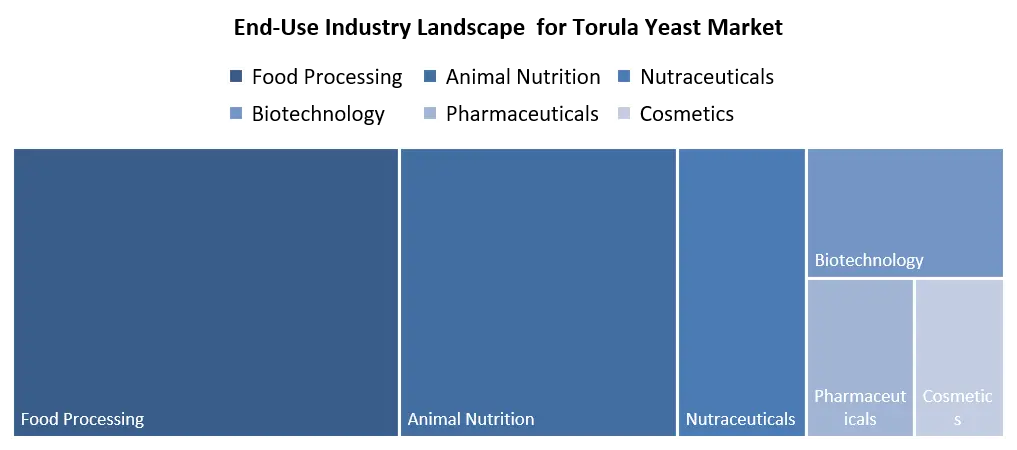
Food processing remains the largest commercial consumer of torula yeast.
Global Torula Yeast Market Recent Developments:
| Date | Recent Development |
| 11 May 2026 | Researchers published a study identifying a new Candida utilis (torula yeast) strain (LM-1) capable of tolerating up to 1.0% (w/v) Kraft lignin and rapidly converting lignin-derived phenolics, highlighting its potential for sustainable biorefinery and industrial fermentation applications. |
| 1 June 2026 | A study published in the Journal of Animal Physiology and Animal Nutrition demonstrated that torula yeast single-cell protein can partially replace soybean meal in broiler diets while maintaining productive performance and meat quality, supporting its use as a sustainable alternative protein ingredient in animal nutrition. |
| 15 March 2026 | A study in Aquaculture reported that torula yeast can replace up to 20% of plant-based proteins in Atlantic salmon diets without affecting protein digestibility, reinforcing its commercial potential in aquaculture feed formulations. |
| 17 May 2024 | A comprehensive review highlighted advances in genetic engineering and molecular tools for xylose-fermenting yeasts, including Candida utilis, to improve industrial fermentation efficiency and the production of bio-based chemicals and microbial proteins. |
| 2024 | Food ingredient manufacturers continued expanding the use of torula yeast as a clean-label, natural umami ingredient in plant-based meat alternatives, savory seasonings, soups, and snack products to replace synthetic flavor enhancers such as monosodium glutamate (MSG), driven by growing consumer demand for natural ingredients. |
Global Torula Yeast Market Competitive Landscape:
The Global Torula Yeast Market is moderately consolidated, and competition revolves around yeast manufacturers, fermentation technology providers, and specialty ingredient companies that cater to the food, beverage, animal nutrition, and biotechnology industries. Global players such as Lallemand Inc., Lesaffre Group, Angel Yeast Co., Ltd., Leiber GmbH, Ohly GmbH, ADM, and Kerry Group plc offer torula yeast and other yeast-derived ingredients in powdered and specialty formulations for clean-label food products, savory seasonings, plant-based meat alternatives, and premium pet food. Lallemand Inc. and Lesaffre Group provide a broad portfolio of yeast-derived ingredients for clean-label foods, savory seasonings, and nutritional applications. Angel Yeast Co., Ltd. has strengthened its global presence through continuous expansion of yeast extract and specialty yeast production for food processing and plant-based formulations. These companies compete by providing high-quality fermentation-derived ingredients with consistent flavor profiles, nutritional value, and regulatory compliance while serving both industrial manufacturers and ingredient distributors through well-established global supply networks.
Regional and specialty manufacturers are strengthening their Torula Yeast market presence by expanding fermentation capacity, investing in sustainable production technologies, and developing customized torula yeast formulations for specific end-use applications. Companies are increasingly utilizing renewable raw materials and advanced fermentation processes to improve production efficiency and reduce environmental impact. Their products are supplied through direct business-to-business partnerships, food ingredient distributors, and specialized nutrition channels, enabling broad market penetration across North America, Europe, and the rapidly growing Asia Pacific region. Competitive pricing strategies, technical support, and application-specific product development continue to differentiate suppliers in the global marketplace. Companies typically offer food-grade torula yeast at premium prices due to stringent quality, purity, and regulatory requirements for human consumption. Feed-grade torula yeast is generally supplied at lower bulk prices for livestock and pet food manufacturers, with prices varying according to protein concentration, order volume, and formulation specifications.
Strategic collaborations with food manufacturers, investments in sustainable fermentation technologies, capacity expansions, and geographic distribution networks are expected to remain the primary competitive strategies as companies seek to strengthen their position in the rapidly evolving global specialty yeast ingredients market.
Global Torula Yeast Market Scope: Inquire before buying
| Torula Yeast Market | |||
|---|---|---|---|
| Report Coverage | Details | ||
| Base Year: | 2025 | Forecast Period: | 2026-2034 |
| Historical Data: | 2020 to 2025 | Market Size in 2025: | 3.64 USD Billion |
| Forecast Period 2026-2034 CAGR: | 6.35% | Market Size in 2034: | 6.42 USD Billion |
| Segments Covered: | by Form | Powder Flakes Granules Paste |
|
| by Source | Wood-Based Molasses-Based Other Fermentation Substrates |
||
| by Application | Food & Beverages Animal Feed & Pet Food Nutraceuticals & Dietary Supplements Pharmaceuticals Biotechnology & Fermentation Cosmetics & Personal Care |
||
Torula Yeast Market, by Region
North America (United States, Canada, and Mexico)
Europe (UK, France, Germany, Italy, Spain, Sweden, Austria, and the Rest of Europe)
Asia Pacific (China, South Korea, Japan, India, Australia, Indonesia, Malaysia, Vietnam, Taiwan, Bangladesh, Pakistan, and the Rest of APAC)
Middle East and Africa (South Africa, GCC, Egypt, Nigeria, and the Rest of ME&A)
South America (Brazil, Argentina Rest of South America)
Torula Yeast Market Key Payers:
North America
1. Lallemand Inc. (Canada)
2. ADM (Archer Daniels Midland Company) (U.S.)
3. Sensient Technologies Corporation (U.S.)
4. BioSpringer North America Corporation (U.S.)
5. Diamond V (U.S.)
6. Balchem Corporation (U.S.)
7. Kemin Industries, Inc. (U.S.)
8. Nutreco USA (U.S.)
Europe
9. Lesaffre Group (France)
10. Ohly GmbH (Germany)
11. Leiber GmbH (Germany)
12. AB Mauri (United Kingdom)
13. DSM-Firmenich (Netherlands/Switzerland)
14. Kerry Group plc (Ireland)
15. Lallemand Bio-Ingredients (France)
16. Chr. Hansen Holding A/S (Denmark)
Asia Pacific
17. Angel Yeast Co., Ltd. (China)
18. Zhuhai TXY Biotech Holding Co., Ltd. (China)
19. Mitsubishi Corporation Life Sciences Limited (Japan)
20. Oriental Yeast Co., Ltd. (Japan)
21. Specialty Biotech Co., Ltd. (China)
22. Biorigin Asia (Singapore)
23. Halcyon Proteins Pty Ltd. (Australia)
24. Foodchem International Corporation (China)
South America
25. Biorigin (Brazil)
26. ICC Brazil (Ingredion/ICC Group) (Brazil)
27. Prozyn Biosolutions (Brazil)
28. LeSaffre do Brasil (Brazil)
Middle East & Africa
29. Angel Yeast Egypt (Egypt)
30. Lallemand South Africa (South Africa)
31. Kerry Ingredients Middle East (United Arab Emirates)
32. Lesaffre Gulf FZE (United Arab Emirates)
Frequently Asked Questions in Torula Yeast Market
1. What is the size of the Global Torula Yeast Market?
The Global Torula Yeast Market was valued at US$3.646 billion in 2025 and is projected to reach US$ 6.42 billion by 2034, growing at a CAGR of 6.35% during the forecast period (2026–2034).
2. Which segment dominates the Global Torula Yeast Market?
The Powder segment dominates the market by form due to its ease of handling, long shelf life, and extensive use in food processing, while Food & Beverages holds the largest share by application owing to the growing demand for natural umami flavor enhancers and clean-label ingredients.
3. Which region holds the largest share of the Global Torula Yeast Market?
North America holds the largest market share, supported by strong demand for clean-label foods, a well-established processed food industry, increasing adoption of plant-based products, and favorable regulatory approvals for torula yeast in food applications.
4. Which region is expected to grow at the fastest rate in the Global Torula Yeast Market?
Asia Pacific is expected to witness the fastest growth during the forecast period due to expanding food processing industries, rising consumption of convenience and plant-based foods, increasing investments in fermentation technologies, and growing demand for sustainable protein ingredients.
5. What are the major trends shaping the Global Torula Yeast Market?
Key trends include the increasing adoption of torula yeast in plant-based meat alternatives, growing demand for clean-label and natural flavor enhancers, advancements in sustainable fermentation technologies, and expanding use of torula yeast in premium pet food and animal nutrition products.