Global Tensor Processing Unit Market Size by Type, Deployment Mode, Application and End User

31.64%
CAGR (2026-2034)
5.21 USD Bn.
Forecast Market Size
330
Report Pages
149
Market Tables

Overview

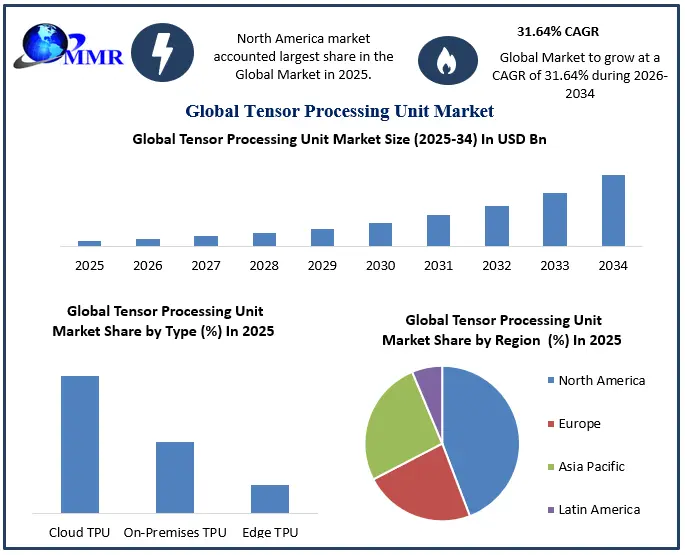
The Global Tensor Processing Unit (TPU) Market was valued at US$5.218 billion in 2025 and is estimated to reach US$6.868 billion in 2026. The market is projected to grow significantly through 2034, reaching US$60.41 billion, at a CAGR of 31.64% during the forecast period,

Global Tensor Processing Unit Market Overview:

A Tensor Processing Unit (TPU) is an AI accelerator that efficiently executes tensor and matrix-based computations associated with deep learning and neural network models. This TPU is developed by Google for its TensorFlow ecosystem. TPUs provide high-throughput processing for computationally intensive AI workloads by leveraging specialized matrix multiplication and parallel processing capabilities. Global data-center electricity demand increased 17% in 2025, while electricity consumption from AI-focused data centers grew substantially faster than overall data-center demand. These rising AI compute requirements are increasing demand for specialized, efficient accelerators such as TPUs.

The Global Tensor Processing Unit (TPU) Market is expanding as the rapid adoption of artificial intelligence (AI), machine learning (ML), generative AI, and large-scale neural networks increases demand for specialized computing architectures. TPUs are optimized to accelerate matrix operations, improve computational efficiency, and reduce the time required to train and deploy complex models as compared to conventional CPUs and, in specific AI workloads, general-purpose GPUs. The Tensor processing market is primarily driven by growing deployment of large language models (LLMs), generative AI applications, computer vision, natural language processing, recommendation systems, and high-performance data-center workloads. Google's Trillium TPU delivers over 4× higher training performance, up to 3× higher inference throughput, and 67% greater energy efficiency compared with the previous generation, demonstrating continuous TPU innovation and growing demand for high-performance, energy-efficient AI accelerators.

Therefore, increasing AI workloads is an opportunity for cloud service providers and technology companies to invest in specialized accelerators capable of delivering higher performance and energy efficiency. The tensor processing market is experiencing continuous technological evolution as AI infrastructure moves toward specialized accelerators, heterogeneous computing, and AI-optimized data centers. North America remains a key market due to its strong concentration of AI technology companies, cloud providers, and data-center infrastructure, while Asia Pacific is emerging as an important growth region owing to expanding AI investments and semiconductor ecosystem development. TPU market is positioned for strong growth as organizations seek faster AI model training, efficient inference, scalable computing, and improved performance-per-watt for next-generation AI workloads.

Tensor Processing Unit Market Growth and Share AnalysisTensor Processing Unit Market Growth
To know about the Research Methodology :- Request Free Sample Report

Global Tensor Processing Unit Market Dynamics:

Rising AI and Generative AI Workloads are to drive the Market

The rapid expansion of generative AI, large language models (LLMs), deep learning, and machine learning applications is increasing demand for specialized AI accelerators capable of processing large volumes of matrix and tensor operations efficiently. TPUs are designed specifically for these workloads, enabling faster model training and inference compared with general-purpose processors in suitable applications. The growing deployment of AI services across cloud computing, healthcare, financial services, autonomous systems, and enterprise applications is therefore creating sustained demand for TPU-based infrastructure.

High Development and Infrastructure Costs Restrain Market Growth

The development and deployment of TPU-based systems require significant investments in advanced semiconductor design, fabrication, high-bandwidth memory, data-center infrastructure, and specialized software ecosystems. These high upfront costs can limit adoption among smaller organizations and increase dependence on major cloud and technology companies with the financial resources to develop and operate large-scale AI accelerator infrastructure. The specialized nature of TPU architectures may also require additional investments in software optimization and skilled technical expertise.

Growing Demand for Energy-Efficient AI Computing Creates Opportunities

The increasing energy consumption of AI workloads and data centers is creating opportunities for high-performance, energy-efficient AI accelerators such as TPUs. The global data-center electricity consumption increased by 17% in 2025, while electricity demand from AI-focused data centers grew significantly faster. This rising focus on computational efficiency is encouraging technology providers and data-center operators to adopt specialized accelerators that can deliver higher AI performance per unit of energy, creating opportunities for TPU deployment in large-scale AI infrastructure.

Competition from GPUs and Emerging AI Accelerators Challenges the Market

The TPU market is facing strong competition from GPUs and other specialized AI accelerators, particularly those offered by established semiconductor and technology companies. GPUs benefit from broad ecosystem support, extensive developer adoption, and compatibility with a wide range of AI and high-performance computing workloads. Alongside, custom AI chips and emerging accelerator architectures are increasing competitive pressure. The availability of alternative hardware and the ongoing development of more flexible AI computing platforms may limit TPU adoption outside workloads and environments where TPU architectures provide clear performance or efficiency advantages.

Global Tensor Processing Unit (TPU) Market Trends:

• Shift Toward Generative AI and Large Language Model Workloads - The rapid development of generative AI, large language models (LLMs), and multimodal AI is increasing demand for specialized accelerators capable of handling intensive training and inference workloads. TPUs are increasingly being optimized for large-scale AI models, supporting higher computational throughput and enabling faster model development and deployment.

• Increasing Adoption of Cloud-Based TPU Infrastructure - Cloud-based access to TPU resources is becoming an important trend as enterprises and AI developers are seeking scalable computing without investing in dedicated hardware. Major cloud platforms are making TPU-based infrastructure available through on-demand and managed cloud services, allowing organizations to scale AI workloads according to computational requirements while reducing the complexity of maintaining specialized infrastructure.

• Growing Focus on Energy-Efficient AI Computing - The increasing electricity requirements of AI workloads and data centers are driving greater emphasis on performance-per-watt and energy-efficient computing. TPU architectures are evolving to deliver higher computational performance while improving energy efficiency, making specialized AI accelerators increasingly relevant for large-scale AI data centers where power consumption and operating costs are major considerations.

• Evolution Toward Advanced TPU Architectures and Scalable AI Clusters - TPU development focuses on higher processing performance, advanced memory technologies, faster interconnects, and large-scale accelerator clusters. Modern TPU systems are designed to work as interconnected computing environments rather than standalone chips, enabling organizations to train increasingly complex AI models across thousands of accelerators. This trend is supporting the development of scalable AI infrastructure for LLM training, inference, and other computationally intensive workloads.

TPU Adoption by AI Workload in Global Tensor Processing Unit MarketTPU Adoption by AI Workload Share

Generative AI and LLM workloads represent the greatest demand for TPU infrastructure due to their intensive tensor computation requirements.

Global Tensor Processing Unit Market Segment Analysis:

The By Type segment is divided into Cloud TPU, On-Premises TPU, and Edge TPU. Cloud TPU is expected to hold the largest market share, accounting for 58.0% of the global TPU market in 2025. The segments' growth is supported by the increasing adoption of cloud-based AI infrastructure and the ability of enterprises and AI developers to access scalable TPU computing without making substantial investments in specialized hardware. Cloud TPUs are particularly suited to large-scale machine learning, generative AI, and LLM workloads that require flexible computing capacity. On-Premises TPU demand is expected to remain relevant among large technology companies, research institutions, and organizations requiring greater control over AI infrastructure, data, and security. Edge TPU is expected to witness growing demand as AI inference increasingly moves closer to end users and devices, particularly in applications involving computer vision, smart devices, industrial automation, and IoT.

The By Deployment segment is divided into Cloud-Based, On-Premises, and Hybrid deployment models. Cloud-Based held 64% of the global tensor processing unit market in 2025, and is anticipated to dominate the segment due to the growing preference for scalable AI infrastructure, flexible resource allocation, and reduced upfront investment. The increasing availability of TPU computing through cloud platforms is further supporting adoption among enterprises and AI developers.Tensor Processing Unit by deployment Mode

On-Premises deployment is expected to maintain demand in organizations with strict data privacy, security, compliance, and latency requirements, particularly in sectors handling sensitive information. Hybrid deployment is projected to gain traction as organizations seek to combine the scalability of cloud TPU resources with the control and security of on-premises infrastructure, enabling businesses to manage diverse AI workloads across multiple computing environments.

Global Tensor Processing Unit Market Regional Insights:

North America is expected to dominate the global Tensor Processing Unit (TPU) market, supported by the region's strong concentration of AI technology companies, hyperscale cloud providers, semiconductor innovators, and advanced data-center infrastructure. The presence of Google and Google Cloud, which developed and commercialized TPU technology, provides the region with a strong technological advantage. Increasing investments in generative AI, large language models, and AI-optimized data centers are further driving demand for specialized AI accelerators. The region's mature cloud ecosystem and early adoption of AI infrastructure are expected to sustain its leading position.

Europe is witnessing increasing demand for AI accelerators as governments and enterprises strengthen investments in AI sovereignty, high-performance computing, and energy-efficient data centers. The implementation of the EU AI Act is encouraging organizations to establish stronger governance and infrastructure for AI applications, while the region's focus on sustainable digital infrastructure is supporting demand for energy-efficient computing technologies. Growth in industrial AI, healthcare AI, automotive applications, and scientific research is expected to create additional opportunities for TPU deployment.

Asia Pacific is anticipated to be the fastest-growing regional market, driven by rapid AI adoption, expanding cloud infrastructure, increasing data-center investments, and the development of domestic semiconductor capabilities. Countries such as China, Japan, South Korea, India, Singapore, and Taiwan are strengthening their AI ecosystems, while growing demand for generative AI, robotics, smart manufacturing, and digital services is increasing the need for high-performance AI computing. The region's developing technology sector and large consumer base are expected to accelerate adoption of specialized AI accelerators.

South America is an emerging market for TPU technologies, supported by increasing cloud adoption, digital transformation, and the gradual expansion of AI applications across financial services, telecommunications, retail, and e-commerce. Brazil and Mexico are among the key markets, with enterprises increasingly shifting workloads toward cloud-based infrastructure. The region’s lower AI infrastructure maturity and limited high-performance capacity may moderate near-term adoption.

The Middle East & Africa market is expected to experience gradual growth as governments and businesses invest in AI strategies, cloud computing, smart-city infrastructure, and data centers. Countries such as the United Arab Emirates and Saudi Arabia are emerging as important AI investment hubs, supported by national digital transformation initiatives and large-scale technology investments. Increasing demand for AI-driven services and the development of regional data-center infrastructure are expected to create opportunities for TPU and other specialized AI accelerator technologies.

Global Tensor Processing Unit Market Recent Developments:

Date Recent Development
22 April 2026 Google introduced its eighth-generation TPU family, TPU 8t and TPU 8i, designed specifically for the emerging agentic AI era. TPU 8t is optimized for high-throughput AI model training, while TPU 8i targets low-latency inference for AI agents and multi-step workloads.
27 April 2026 Cloud TPU availability in AI zones became generally available, expanding access to TPU infrastructure and enabling customers to deploy TPU resources across Google's AI-focused cloud infrastructure.
6 April 2026 Google reported that its seventh-generation Ironwood TPU achieved approximately 3.7× improvement in Compute Carbon Intensity (CCI) compared with TPU v5p, highlighting the industry's increasing focus on energy-efficient AI infrastructure.
31 March 2026 TPU7x (Ironwood) became generally available on Google Cloud. The seventh-generation TPU is designed for large-scale AI training and inference workloads, including LLMs, mixture-of-experts (MoE) models, and diffusion models.
25 November 2025 Google announced the broader availability of Ironwood, its seventh-generation TPU, designed for high-volume, low-latency AI inference and model serving. The platform can scale to 9,216 chips in a single superpod, targeting increasingly demanding AI workloads.
9 April 2025 Google introduced Ironwood, its seventh-generation TPU and first TPU specifically designed with a strong focus on AI inference. The architecture was developed to support large-scale inference for advanced AI models, including reasoning-oriented models and mixture-of-experts architectures.

Global Tensor Processing Unit Market Competitive Landscape:

The Global Tensor Processing Unit (TPU) Market is characterized by competition among major technology companies and specialized semiconductor providers developing AI accelerators for large-scale machine learning, generative AI, and data-center workloads. Google holds a distinctive position due to its development of TPU architecture and its integration across Google Cloud and its internal AI infrastructure. Other major global competitors, including NVIDIA, AMD, Intel, Amazon Web Services (AWS), and Microsoft, are strengthening their AI computing portfolios through GPUs, custom AI accelerators, and cloud-based infrastructure. Competition is increasingly focused on delivering higher AI performance, memory bandwidth, scalability, energy efficiency, and optimized software ecosystems for training and inference workloads.

The market is also experiencing increasing competition from custom silicon and application-specific AI accelerators developed by major cloud and technology companies. AWS provides its Trainium and Inferentia accelerators for AI training and inference, while Microsoft has developed Azure Maia AI accelerator technology for cloud workloads. Meta is also developing custom AI silicon to support its expanding AI infrastructure requirements. These companies are increasingly integrating their proprietary accelerators with cloud platforms, allowing customers to access specialized AI computing without directly purchasing or managing physical hardware. This is intensifying competition around cloud accessibility, cost efficiency, performance-per-watt, and scalability.

At the regional level, Asia Pacific is becoming increasingly competitive as semiconductor and technology companies expand their AI accelerator capabilities. Players such as Huawei, Alibaba, Baidu, and Cambricon Technologies are developing AI computing solutions to support domestic AI ecosystems and reduce dependence on foreign semiconductor technologies. Companies compete through improvements in accelerator architecture, high-bandwidth memory, interconnect technologies, AI software frameworks, and cloud integration. Eventually, the competitive landscape is shifting from a traditional CPU-versus-GPU model toward a broader ecosystem of specialized AI accelerators, with vendors differentiating through processing performance, energy efficiency, software compatibility, cloud availability, and the ability to support increasingly complex AI and generative AI workloads.

Tensor Processing Unit Market Scope: Inquire before buying

Tensor Processing Unit Market
Report Coverage Details
Base Year: 2025 Forecast Period: 2026-2034
Historical Data: 2020 to 2025 Market Size in 2025: 5.12 USD Billion
Forecast Period 2026-2034 CAGR: 31.64% Market Size in 2034: 60.41 USD Billion
Segments Covered: by Type Cloud TPU
On-Premises TPU
Edge TPU
by Deployment Mode Cloud-Based
On-Premises
Hybrid
by Application Machine Learning & Deep Learning
Generative AI & Large Language Models (LLMs)
Natural Language Processing (NLP)
Computer Vision
Recommendation Systems
Speech Recognition
Autonomous Systems & Robotics
Scientific Computing
by End-User Technology & Cloud Service Providers
Data Centers
Healthcare & Life Sciences
BFSI
Automotive & Transportation
Retail & E-commerce
Telecommunications
Media & Entertainment
Government & Defense
Research & Academia
Other Industries

Tensor Processing Unit Market by Region

North America (United States, Canada, and Mexico)
Europe (UK, France, Germany, Italy, Spain, Sweden, Austria, and the Rest of Europe)
Asia Pacific (China, South Korea, Japan, India, Australia, Indonesia, Malaysia, Vietnam, Taiwan, Bangladesh, Pakistan, and the Rest of APAC)
Middle East and Africa (South Africa, GCC, Egypt, Nigeria, and the Rest of ME&A)
South America (Brazil, Argentina Rest of South America)

Global Tensor Processing Unit Market Key Players:

North America
1. Google LLC
2. NVIDIA Corporation
3. Advanced Micro Devices, Inc. (AMD)
4. Intel Corporation
5. Amazon Web Services, Inc. (AWS)
6. Microsoft Corporation
7. Meta Platforms, Inc.
8. Qualcomm Incorporated
9. Cerebras Systems
10. Groq, Inc.
11. SambaNova Systems, Inc.
12. Tenstorrent Inc.

Europe
13. Graphcore Limited
14. Axelera AI
15. SiPearl
16. Blaize, Inc.
17. Arm Holdings plc
18. Imagination Technologies
19. Kalray
20. d-Matrix

Asia Pacific
21. Huawei Technologies Co., Ltd.
22. Alibaba Group Holding Limited
23. Baidu, Inc.
24. Cambricon Technologies Corporation Limited
25. Samsung Electronics Co., Ltd.
26. SK hynix Inc.
27. Fujitsu Limited
28. Preferred Networks, Inc.
29. Kneron, Inc.
30. Rebellions Inc.
31. FuriosaAI
32. Groq Japan
33. Horizon Robotics
34. Biren Technology
35. Enflame Technology

South America
36. Intelbras S.A.
37. Positivo Tecnologia S.A.
38. TOTVS S.A.

Middle East & Africa
39. G42
40. Presight AI
41. AIQ
42. DataVolt

Frequently Asked Questions:

1. What is the size of the global Tensor Processing Unit (TPU) market?
The global TPU market was valued at approximately US$5.218 billion in 2025 and is projected to reach US$60.41 billion by 2034, expanding at a 31.64% CAGR during the forecast period.

2. Which segment dominates the Global TPU Market?
The Cloud TPU segment dominates the market by type, while Cloud-Based deployment holds the leading position by deployment due to the scalability and flexibility offered by cloud AI infrastructure.

3. Which region dominates the Global TPU Market?
North America is expected to hold the dominant market position due to the presence of leading AI technology companies, cloud service providers, advanced data centers, and strong investments in AI infrastructure.

4. Which region is expected to grow fastest in the TPU market?
Asia Pacific is expected to register the fastest growth, driven by expanding AI adoption, increasing data-center investments, rapid cloud computing development, and growing investments in AI and semiconductor technologies.

5. What are the major trends shaping the global TPU market?
Key trends include the growing use of TPUs for generative AI and large language models, increasing cloud-based TPU adoption, demand for energy-efficient AI computing, and the development of advanced TPU architectures for large-scale AI training and inference.

Table of Contents

1. Tensor Processing Unit Market Introduction 1.1. Study Assumption and Market Definition 1.2. Scope of the Study 1.3. Executive Summary 2. Global Tensor Processing Unit Market: Competitive Landscape 2.1. MMR Competition Matrix 2.2. Competitive Landscape 2.3. Key Players Benchmarking 2.3.1. Company Name 2.3.2. Business Segment 2.3.3. End-user Segment 2.3.4. Revenue (2025) 2.3.5. Company Locations 2.4. Leading Tensor Processing Unit Market Companies, by market capitalization 2.5. Market Structure 2.5.1. Market Leaders 2.5.2. Market Followers 2.5.3. Emerging Players 2.6. Mergers and Acquisitions Details 3. Tensor Processing Unit Market: Dynamics 3.1. Tensor Processing Unit Market Trends by Region 3.1.1. North America Tensor Processing Unit Market Trends 3.1.2. Europe Tensor Processing Unit Market Trends 3.1.3. Asia Pacific Tensor Processing Unit Market Trends 3.1.4. Middle East and Africa Tensor Processing Unit Market Trends 3.1.5. South America Tensor Processing Unit Market Trends 3.2. Tensor Processing Unit Market Dynamics by Region 3.2.1. North America 3.2.1.1. North America Tensor Processing Unit Market Drivers 3.2.1.2. North America Tensor Processing Unit Market Restraints 3.2.1.3. North America Tensor Processing Unit Market Opportunities 3.2.1.4. North America Tensor Processing Unit Market Challenges 3.2.2. Europe 3.2.2.1. Europe Tensor Processing Unit Market Drivers 3.2.2.2. Europe Tensor Processing Unit Market Restraints 3.2.2.3. Europe Tensor Processing Unit Market Opportunities 3.2.2.4. Europe Tensor Processing Unit Market Challenges 3.2.3. Asia Pacific 3.2.3.1. Asia Pacific Tensor Processing Unit Market Drivers 3.2.3.2. Asia Pacific Tensor Processing Unit Market Restraints 3.2.3.3. Asia Pacific Tensor Processing Unit Market Opportunities 3.2.3.4. Asia Pacific Tensor Processing Unit Market Challenges 3.2.4. Middle East and Africa 3.2.4.1. Middle East and Africa Tensor Processing Unit Market Drivers 3.2.4.2. Middle East and Africa Tensor Processing Unit Market Restraints 3.2.4.3. Middle East and Africa Tensor Processing Unit Market Opportunities 3.2.4.4. Middle East and Africa Tensor Processing Unit Market Challenges 3.2.5. South America 3.2.5.1. South America Tensor Processing Unit Market Drivers 3.2.5.2. South America Tensor Processing Unit Market Restraints 3.2.5.3. South America Tensor Processing Unit Market Opportunities 3.2.5.4. South America Tensor Processing Unit Market Challenges 3.3. PORTER's Five Forces Analysis 3.4. PESTLE Analysis 3.5. Technology Roadmap 3.6. Regulatory Landscape by Region 3.6.1. North America 3.6.2. Europe 3.6.3. Asia Pacific 3.6.4. Middle East and Africa 3.6.5. South America 3.7. Key Opinion Leader Analysis For Tensor Processing Unit Industry 3.8. Analysis of Government Schemes and Initiatives For Tensor Processing Unit Industry 3.9. Tensor Processing Unit Market Trade Analysis 3.10. The Global Pandemic Impact on Tensor Processing Unit Market 4. Tensor Processing Unit Market: Global Market Size and Forecast by Segmentation (in USD Billion) 2025-2034 4.1. Tensor Processing Unit Market Size and Forecast, by Type (2025-2034) 4.1.1. Cloud TPU 4.1.2. On-Premises TPU 4.1.3. Edge TPU 4.2. Tensor Processing Unit Market Size and Forecast, by Deployment Mode (2025-2034) 4.2.1. Cloud-Based 4.2.2. On-Premises 4.2.3. Hybrid 4.3. Tensor Processing Unit Market Size and Forecast, by Application (2025-2034) 4.3.1. Machine Learning & Deep Learning 4.3.2. Generative AI & Large Language Models (LLMs) 4.3.3. Natural Language Processing (NLP) 4.3.4. Computer Vision 4.3.5. Recommendation Systems 4.3.6. Speech Recognition 4.3.7. Autonomous Systems & Robotics 4.3.8. Scientific Computing 4.4. Tensor Processing Unit Market Size and Forecast, by End-User (2025-2034) 4.4.1. Technology & Cloud Service Providers 4.4.2. Data Centers 4.4.3. Healthcare & Life Sciences 4.4.4. BFSI 4.4.5. Automotive & Transportation 4.4.6. Retail & E-commerce 4.4.7. Telecommunications 4.4.8. Media & Entertainment 4.4.9. Government & Defense 4.4.10. Research & Academia 4.4.11. Other Industries 4.5. Tensor Processing Unit Market Size and Forecast, by Region (2025-2034) 4.5.1. North America 4.5.2. Europe 4.5.3. Asia Pacific 4.5.4. Middle East and Africa 4.5.5. South America 5. North America Tensor Processing Unit Market Size and Forecast by Segmentation (in USD Billion) 2025-2034 5.1. North America Tensor Processing Unit Market Size and Forecast, by Type (2025-2034) 5.1.1. Cloud TPU 5.1.2. On-Premises TPU 5.1.3. Edge TPU 5.2. North America Tensor Processing Unit Market Size and Forecast, by Deployment Mode (2025-2034) 5.2.1. Cloud-Based 5.2.2. On-Premises 5.2.3. Hybrid 5.3. North America Tensor Processing Unit Market Size and Forecast, by Application (2025-2034) 5.3.1. Machine Learning & Deep Learning 5.3.2. Generative AI & Large Language Models (LLMs) 5.3.3. Natural Language Processing (NLP) 5.3.4. Computer Vision 5.3.5. Recommendation Systems 5.3.6. Speech Recognition 5.3.7. Autonomous Systems & Robotics 5.3.8. Scientific Computing 5.4. North America Tensor Processing Unit Market Size and Forecast, by End-User (2025-2034) 5.4.1. Technology & Cloud Service Providers 5.4.2. Data Centers 5.4.3. Healthcare & Life Sciences 5.4.4. BFSI 5.4.5. Automotive & Transportation 5.4.6. Retail & E-commerce 5.4.7. Telecommunications 5.4.8. Media & Entertainment 5.4.9. Government & Defense 5.4.10. Research & Academia 5.4.11. Other Industries 5.5. North America Tensor Processing Unit Market Size and Forecast, by Country (2025-2034) 5.5.1. United States 5.5.1.1. United States Tensor Processing Unit Market Size and Forecast, by Type (2025-2034) 5.5.1.1.1. Cloud TPU 5.5.1.1.2. On-Premises TPU 5.5.1.1.3. Edge TPU 5.5.1.2. United States Tensor Processing Unit Market Size and Forecast, by Deployment Mode (2025-2034) 5.5.1.2.1. Cloud-Based 5.5.1.2.2. On-Premises 5.5.1.2.3. Hybrid 5.5.1.3. United States Tensor Processing Unit Market Size and Forecast, by Application (2025-2034) 5.5.1.3.1. Machine Learning & Deep Learning 5.5.1.3.2. Generative AI & Large Language Models (LLMs) 5.5.1.3.3. Natural Language Processing (NLP) 5.5.1.3.4. Computer Vision 5.5.1.3.5. Recommendation Systems 5.5.1.3.6. Speech Recognition 5.5.1.3.7. Autonomous Systems & Robotics 5.5.1.3.8. Scientific Computing 5.5.1.4. United States Tensor Processing Unit Market Size and Forecast, by End-User (2025-2034) 5.5.1.4.1. Technology & Cloud Service Providers 5.5.1.4.2. Data Centers 5.5.1.4.3. Healthcare & Life Sciences 5.5.1.4.4. BFSI 5.5.1.4.5. Automotive & Transportation 5.5.1.4.6. Retail & E-commerce 5.5.1.4.7. Telecommunications 5.5.1.4.8. Media & Entertainment 5.5.1.4.9. Government & Defense 5.5.1.4.10. Research & Academia 5.5.1.4.11. Other Industries 5.5.2. Canada 5.5.2.1. Canada Tensor Processing Unit Market Size and Forecast, by Type (2025-2034) 5.5.2.1.1. Cloud TPU 5.5.2.1.2. On-Premises TPU 5.5.2.1.3. Edge TPU 5.5.2.2. Canada Tensor Processing Unit Market Size and Forecast, by Deployment Mode (2025-2034) 5.5.2.2.1. Cloud-Based 5.5.2.2.2. On-Premises 5.5.2.2.3. Hybrid 5.5.2.3. Canada Tensor Processing Unit Market Size and Forecast, by Application (2025-2034) 5.5.2.3.1. Machine Learning & Deep Learning 5.5.2.3.2. Generative AI & Large Language Models (LLMs) 5.5.2.3.3. Natural Language Processing (NLP) 5.5.2.3.4. Computer Vision 5.5.2.3.5. Recommendation Systems 5.5.2.3.6. Speech Recognition 5.5.2.3.7. Autonomous Systems & Robotics 5.5.2.3.8. Scientific Computing 5.5.2.4. Canada Tensor Processing Unit Market Size and Forecast, by End-User (2025-2034) 5.5.2.4.1. Technology & Cloud Service Providers 5.5.2.4.2. Data Centers 5.5.2.4.3. Healthcare & Life Sciences 5.5.2.4.4. BFSI 5.5.2.4.5. Automotive & Transportation 5.5.2.4.6. Retail & E-commerce 5.5.2.4.7. Telecommunications 5.5.2.4.8. Media & Entertainment 5.5.2.4.9. Government & Defense 5.5.2.4.10. Research & Academia 5.5.2.4.11. Other Industries 5.5.3. Mexico 5.5.3.1. Mexico Tensor Processing Unit Market Size and Forecast, by Type (2025-2034) 5.5.3.1.1. Cloud TPU 5.5.3.1.2. On-Premises TPU 5.5.3.1.3. Edge TPU 5.5.3.2. Mexico Tensor Processing Unit Market Size and Forecast, by Deployment Mode (2025-2034) 5.5.3.2.1. Cloud-Based 5.5.3.2.2. On-Premises 5.5.3.2.3. Hybrid 5.5.3.3. Mexico Tensor Processing Unit Market Size and Forecast, by Application (2025-2034) 5.5.3.3.1. Machine Learning & Deep Learning 5.5.3.3.2. Generative AI & Large Language Models (LLMs) 5.5.3.3.3. Natural Language Processing (NLP) 5.5.3.3.4. Computer Vision 5.5.3.3.5. Recommendation Systems 5.5.3.3.6. Speech Recognition 5.5.3.3.7. Autonomous Systems & Robotics 5.5.3.3.8. Scientific Computing 5.5.3.4. Mexico Tensor Processing Unit Market Size and Forecast, by End-User (2025-2034) 5.5.3.4.1. Technology & Cloud Service Providers 5.5.3.4.2. Data Centers 5.5.3.4.3. Healthcare & Life Sciences 5.5.3.4.4. BFSI 5.5.3.4.5. Automotive & Transportation 5.5.3.4.6. Retail & E-commerce 5.5.3.4.7. Telecommunications 5.5.3.4.8. Media & Entertainment 5.5.3.4.9. Government & Defense 5.5.3.4.10. Research & Academia 5.5.3.4.11. Other Industries 6. Europe Tensor Processing Unit Market Size and Forecast by Segmentation (in USD Billion) 2025-2034 6.1. Europe Tensor Processing Unit Market Size and Forecast, by Type (2025-2034) 6.2. Europe Tensor Processing Unit Market Size and Forecast, by Deployment Mode (2025-2034) 6.3. Europe Tensor Processing Unit Market Size and Forecast, by Application (2025-2034) 6.4. Europe Tensor Processing Unit Market Size and Forecast, by End-User (2025-2034) 6.5. Europe Tensor Processing Unit Market Size and Forecast, by Country (2025-2034) 6.5.1. United Kingdom 6.5.1.1. United Kingdom Tensor Processing Unit Market Size and Forecast, by Type (2025-2034) 6.5.1.2. United Kingdom Tensor Processing Unit Market Size and Forecast, by Deployment Mode (2025-2034) 6.5.1.3. United Kingdom Tensor Processing Unit Market Size and Forecast, by Application (2025-2034) 6.5.1.4. United Kingdom Tensor Processing Unit Market Size and Forecast, by End-User (2025-2034) 6.5.2. France 6.5.2.1. France Tensor Processing Unit Market Size and Forecast, by Type (2025-2034) 6.5.2.2. France Tensor Processing Unit Market Size and Forecast, by Deployment Mode (2025-2034) 6.5.2.3. France Tensor Processing Unit Market Size and Forecast, by Application (2025-2034) 6.5.2.4. France Tensor Processing Unit Market Size and Forecast, by End-User (2025-2034) 6.5.3. Germany 6.5.3.1. Germany Tensor Processing Unit Market Size and Forecast, by Type (2025-2034) 6.5.3.2. Germany Tensor Processing Unit Market Size and Forecast, by Deployment Mode (2025-2034) 6.5.3.3. Germany Tensor Processing Unit Market Size and Forecast, by Application (2025-2034) 6.5.3.4. Germany Tensor Processing Unit Market Size and Forecast, by End-User (2025-2034) 6.5.4. Italy 6.5.4.1. Italy Tensor Processing Unit Market Size and Forecast, by Type (2025-2034) 6.5.4.2. Italy Tensor Processing Unit Market Size and Forecast, by Deployment Mode (2025-2034) 6.5.4.3. Italy Tensor Processing Unit Market Size and Forecast, by Application (2025-2034) 6.5.4.4. Italy Tensor Processing Unit Market Size and Forecast, by End-User (2025-2034) 6.5.5. Spain 6.5.5.1. Spain Tensor Processing Unit Market Size and Forecast, by Type (2025-2034) 6.5.5.2. Spain Tensor Processing Unit Market Size and Forecast, by Deployment Mode (2025-2034) 6.5.5.3. Spain Tensor Processing Unit Market Size and Forecast, by Application (2025-2034) 6.5.5.4. Spain Tensor Processing Unit Market Size and Forecast, by End-User (2025-2034) 6.5.6. Sweden 6.5.6.1. Sweden Tensor Processing Unit Market Size and Forecast, by Type (2025-2034) 6.5.6.2. Sweden Tensor Processing Unit Market Size and Forecast, by Deployment Mode (2025-2034) 6.5.6.3. Sweden Tensor Processing Unit Market Size and Forecast, by Application (2025-2034) 6.5.6.4. Sweden Tensor Processing Unit Market Size and Forecast, by End-User (2025-2034) 6.5.7. Austria 6.5.7.1. Austria Tensor Processing Unit Market Size and Forecast, by Type (2025-2034) 6.5.7.2. Austria Tensor Processing Unit Market Size and Forecast, by Deployment Mode (2025-2034) 6.5.7.3. Austria Tensor Processing Unit Market Size and Forecast, by Application (2025-2034) 6.5.7.4. Austria Tensor Processing Unit Market Size and Forecast, by End-User (2025-2034) 6.5.8. Rest of Europe 6.5.8.1. Rest of Europe Tensor Processing Unit Market Size and Forecast, by Type (2025-2034) 6.5.8.2. Rest of Europe Tensor Processing Unit Market Size and Forecast, by Deployment Mode (2025-2034) 6.5.8.3. Rest of Europe Tensor Processing Unit Market Size and Forecast, by Application (2025-2034) 6.5.8.4. Rest of Europe Tensor Processing Unit Market Size and Forecast, by End-User (2025-2034) 7. Asia Pacific Tensor Processing Unit Market Size and Forecast by Segmentation (in USD Billion) 2025-2034 7.1. Asia Pacific Tensor Processing Unit Market Size and Forecast, by Type (2025-2034) 7.2. Asia Pacific Tensor Processing Unit Market Size and Forecast, by Deployment Mode (2025-2034) 7.3. Asia Pacific Tensor Processing Unit Market Size and Forecast, by Application (2025-2034) 7.4. Asia Pacific Tensor Processing Unit Market Size and Forecast, by End-User (2025-2034) 7.5. Asia Pacific Tensor Processing Unit Market Size and Forecast, by Country (2025-2034) 7.5.1. China 7.5.1.1. China Tensor Processing Unit Market Size and Forecast, by Type (2025-2034) 7.5.1.2. China Tensor Processing Unit Market Size and Forecast, by Deployment Mode (2025-2034) 7.5.1.3. China Tensor Processing Unit Market Size and Forecast, by Application (2025-2034) 7.5.1.4. China Tensor Processing Unit Market Size and Forecast, by End-User (2025-2034) 7.5.2. S Korea 7.5.2.1. S Korea Tensor Processing Unit Market Size and Forecast, by Type (2025-2034) 7.5.2.2. S Korea Tensor Processing Unit Market Size and Forecast, by Deployment Mode (2025-2034) 7.5.2.3. S Korea Tensor Processing Unit Market Size and Forecast, by Application (2025-2034) 7.5.2.4. S Korea Tensor Processing Unit Market Size and Forecast, by End-User (2025-2034) 7.5.3. Japan 7.5.3.1. Japan Tensor Processing Unit Market Size and Forecast, by Type (2025-2034) 7.5.3.2. Japan Tensor Processing Unit Market Size and Forecast, by Deployment Mode (2025-2034) 7.5.3.3. Japan Tensor Processing Unit Market Size and Forecast, by Application (2025-2034) 7.5.3.4. Japan Tensor Processing Unit Market Size and Forecast, by End-User (2025-2034) 7.5.4. India 7.5.4.1. India Tensor Processing Unit Market Size and Forecast, by Type (2025-2034) 7.5.4.2. India Tensor Processing Unit Market Size and Forecast, by Deployment Mode (2025-2034) 7.5.4.3. India Tensor Processing Unit Market Size and Forecast, by Application (2025-2034) 7.5.4.4. India Tensor Processing Unit Market Size and Forecast, by End-User (2025-2034) 7.5.5. Australia 7.5.5.1. Australia Tensor Processing Unit Market Size and Forecast, by Type (2025-2034) 7.5.5.2. Australia Tensor Processing Unit Market Size and Forecast, by Deployment Mode (2025-2034) 7.5.5.3. Australia Tensor Processing Unit Market Size and Forecast, by Application (2025-2034) 7.5.5.4. Australia Tensor Processing Unit Market Size and Forecast, by End-User (2025-2034) 7.5.6. Indonesia 7.5.6.1. Indonesia Tensor Processing Unit Market Size and Forecast, by Type (2025-2034) 7.5.6.2. Indonesia Tensor Processing Unit Market Size and Forecast, by Deployment Mode (2025-2034) 7.5.6.3. Indonesia Tensor Processing Unit Market Size and Forecast, by Application (2025-2034) 7.5.6.4. Indonesia Tensor Processing Unit Market Size and Forecast, by End-User (2025-2034) 7.5.7. Malaysia 7.5.7.1. Malaysia Tensor Processing Unit Market Size and Forecast, by Type (2025-2034) 7.5.7.2. Malaysia Tensor Processing Unit Market Size and Forecast, by Deployment Mode (2025-2034) 7.5.7.3. Malaysia Tensor Processing Unit Market Size and Forecast, by Application (2025-2034) 7.5.7.4. Malaysia Tensor Processing Unit Market Size and Forecast, by End-User (2025-2034) 7.5.8. Vietnam 7.5.8.1. Vietnam Tensor Processing Unit Market Size and Forecast, by Type (2025-2034) 7.5.8.2. Vietnam Tensor Processing Unit Market Size and Forecast, by Deployment Mode (2025-2034) 7.5.8.3. Vietnam Tensor Processing Unit Market Size and Forecast, by Application (2025-2034) 7.5.8.4. Vietnam Tensor Processing Unit Market Size and Forecast, by End-User (2025-2034) 7.5.9. Taiwan 7.5.9.1. Taiwan Tensor Processing Unit Market Size and Forecast, by Type (2025-2034) 7.5.9.2. Taiwan Tensor Processing Unit Market Size and Forecast, by Deployment Mode (2025-2034) 7.5.9.3. Taiwan Tensor Processing Unit Market Size and Forecast, by Application (2025-2034) 7.5.9.4. Taiwan Tensor Processing Unit Market Size and Forecast, by End-User (2025-2034) 7.5.10. Rest of Asia Pacific 7.5.10.1. Rest of Asia Pacific Tensor Processing Unit Market Size and Forecast, by Type (2025-2034) 7.5.10.2. Rest of Asia Pacific Tensor Processing Unit Market Size and Forecast, by Deployment Mode (2025-2034) 7.5.10.3. Rest of Asia Pacific Tensor Processing Unit Market Size and Forecast, by Application (2025-2034) 7.5.10.4. Rest of Asia Pacific Tensor Processing Unit Market Size and Forecast, by End-User (2025-2034) 8. Middle East and Africa Tensor Processing Unit Market Size and Forecast by Segmentation (in USD Billion) 2025-2034 8.1. Middle East and Africa Tensor Processing Unit Market Size and Forecast, by Type (2025-2034) 8.2. Middle East and Africa Tensor Processing Unit Market Size and Forecast, by Deployment Mode (2025-2034) 8.3. Middle East and Africa Tensor Processing Unit Market Size and Forecast, by Application (2025-2034) 8.4. Middle East and Africa Tensor Processing Unit Market Size and Forecast, by End-User (2025-2034) 8.5. Middle East and Africa Tensor Processing Unit Market Size and Forecast, by Country (2025-2034) 8.5.1. South Africa 8.5.1.1. South Africa Tensor Processing Unit Market Size and Forecast, by Type (2025-2034) 8.5.1.2. South Africa Tensor Processing Unit Market Size and Forecast, by Deployment Mode (2025-2034) 8.5.1.3. South Africa Tensor Processing Unit Market Size and Forecast, by Application (2025-2034) 8.5.1.4. South Africa Tensor Processing Unit Market Size and Forecast, by End-User (2025-2034) 8.5.2. GCC 8.5.2.1. GCC Tensor Processing Unit Market Size and Forecast, by Type (2025-2034) 8.5.2.2. GCC Tensor Processing Unit Market Size and Forecast, by Deployment Mode (2025-2034) 8.5.2.3. GCC Tensor Processing Unit Market Size and Forecast, by Application (2025-2034) 8.5.2.4. GCC Tensor Processing Unit Market Size and Forecast, by End-User (2025-2034) 8.5.3. Nigeria 8.5.3.1. Nigeria Tensor Processing Unit Market Size and Forecast, by Type (2025-2034) 8.5.3.2. Nigeria Tensor Processing Unit Market Size and Forecast, by Deployment Mode (2025-2034) 8.5.3.3. Nigeria Tensor Processing Unit Market Size and Forecast, by Application (2025-2034) 8.5.3.4. Nigeria Tensor Processing Unit Market Size and Forecast, by End-User (2025-2034) 8.5.4. Rest of ME&A 8.5.4.1. Rest of ME&A Tensor Processing Unit Market Size and Forecast, by Type (2025-2034) 8.5.4.2. Rest of ME&A Tensor Processing Unit Market Size and Forecast, by Deployment Mode (2025-2034) 8.5.4.3. Rest of ME&A Tensor Processing Unit Market Size and Forecast, by Application (2025-2034) 8.5.4.4. Rest of ME&A Tensor Processing Unit Market Size and Forecast, by End-User (2025-2034) 9. South America Tensor Processing Unit Market Size and Forecast by Segmentation (in USD Billion) 2025-2034 9.1. South America Tensor Processing Unit Market Size and Forecast, by Type (2025-2034) 9.2. South America Tensor Processing Unit Market Size and Forecast, by Deployment Mode (2025-2034) 9.3. South America Tensor Processing Unit Market Size and Forecast, by Application (2025-2034) 9.4. South America Tensor Processing Unit Market Size and Forecast, by End-User (2025-2034) 9.5. South America Tensor Processing Unit Market Size and Forecast, by Country (2025-2034) 9.5.1. Brazil 9.5.1.1. Brazil Tensor Processing Unit Market Size and Forecast, by Type (2025-2034) 9.5.1.2. Brazil Tensor Processing Unit Market Size and Forecast, by Deployment Mode (2025-2034) 9.5.1.3. Brazil Tensor Processing Unit Market Size and Forecast, by Application (2025-2034) 9.5.1.4. Brazil Tensor Processing Unit Market Size and Forecast, by End-User (2025-2034) 9.5.2. Argentina 9.5.2.1. Argentina Tensor Processing Unit Market Size and Forecast, by Type (2025-2034) 9.5.2.2. Argentina Tensor Processing Unit Market Size and Forecast, by Deployment Mode (2025-2034) 9.5.2.3. Argentina Tensor Processing Unit Market Size and Forecast, by Application (2025-2034) 9.5.2.4. Argentina Tensor Processing Unit Market Size and Forecast, by End-User (2025-2034) 9.5.3. Rest Of South America 9.5.3.1. Rest Of South America Tensor Processing Unit Market Size and Forecast, by Type (2025-2034) 9.5.3.2. Rest Of South America Tensor Processing Unit Market Size and Forecast, by Deployment Mode (2025-2034) 9.5.3.3. Rest Of South America Tensor Processing Unit Market Size and Forecast, by Application (2025-2034) 9.5.3.4. Rest Of South America Tensor Processing Unit Market Size and Forecast, by End-User (2025-2034) 10. Company Profile: Key Players 10.1. Google LLC 10.1.1. Company Overview 10.1.2. Business Portfolio 10.1.3. Financial Overview 10.1.4. SWOT Analysis 10.1.5. Strategic Analysis 10.1.6. Scale of Operation (small, medium, and large) 10.1.7. Details on Partnership 10.1.8. Regulatory Accreditations and Certifications Received by Them 10.1.9. Awards Received by the Firm 10.1.10. Recent Developments 10.2. NVIDIA Corporation 10.3. Advanced Micro Devices 10.4. Inc. (AMD) 10.5. Intel Corporation 10.6. Amazon Web Services 10.7. Inc. (AWS) 10.8. Microsoft Corporation 10.9. Meta Platforms 10.10. Inc. 10.11. Qualcomm Incorporated 10.12. Cerebras Systems 10.13. Groq 10.14. SambaNova Systems 10.15. Tenstorrent Inc. 10.16. Graphcore Limited 10.17. Axelera AI 10.18. SiPearl 10.19. Blaize 10.20. Arm Holdings plc 10.21. Imagination Technologies 10.22. Kalray 10.23. d-Matrix 10.24. Huawei Technologies Co. 10.25. Ltd. 10.26. Alibaba Group Holding Limited 10.27. Baidu 10.28. Cambricon Technologies Corporation Limited 10.29. Samsung Electronics Co. 10.30. SK hynix Inc. 10.31. Fujitsu Limited 10.32. Preferred Networks 10.33. Kneron 10.34. Rebellions Inc. 10.35. FuriosaAI 10.36. Groq Japan 10.37. Horizon Robotics 10.38. Biren Technology 10.39. Enflame Technology 10.40. Intelbras S.A. 11. Key Findings 12. Industry Recommendations 13. Tensor Processing Unit Market: Research Methodology 14. Terms and Glossary

Custom Market Research Services

We Will Customise The Research For You, In Case The Report Listed Above Does Not Meet With Your Requirements