
Spa Market- Industry Structure Evaluation, Demand Drivers Analysis, Regional Growth Analysis and Identification, Competitive Positioning Review & Global Market Size Forecast to 2034
Overview
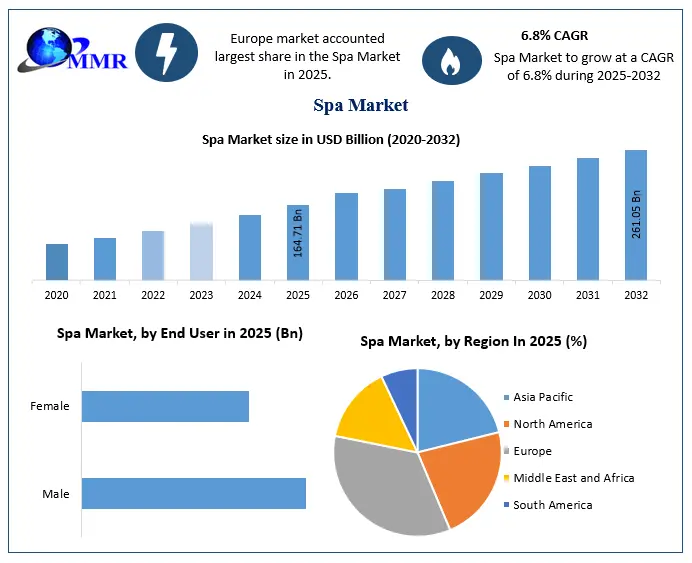
The Spa Market size was valued at USD 164.71 Billion in 2025 and the total Spa revenue is expected to grow at a CAGR of 6.8% from 2026 to 2032, reaching nearly USD 261.05 Billion by 2034.
Spa Market Overview
 To know about the Research Methodology :- Request Free Sample Report
Spa Market Segment Analysis
By Type , Medical Spa is expected to hold the largest market share during the 2025–2032 forecast period, driven by increasing demand for minimally invasive cosmetic procedures, anti-aging treatments, laser therapies, Botox, dermal fillers, and IV therapy. Rising consumer preference for preventive healthcare and aesthetic wellness, coupled with advancements in medical technologies, continues to fuel the growth of this segment.
Hotel & Resort Spa represents another significant segment, supported by the expansion of wellness tourism, luxury travel, and hospitality investments. Premium resorts and hotels are increasingly integrating comprehensive wellness offerings to enhance guest experiences and attract high-spending travelers.
Salon Spa continues to witness steady demand due to its affordability, convenience, and growing urban population seeking regular beauty and relaxation services such as massages, facials, and body treatments.
Destination Spa is gaining traction as consumers increasingly seek immersive wellness retreats focused on holistic health, stress management, fitness, and mindfulness. The segment benefits from the rising popularity of wellness vacations and experiential travel.
Mineral Spa is experiencing moderate growth, driven by growing interest in natural healing therapies, hydrotherapy, and thermal spring treatments, particularly in regions with established wellness tourism infrastructure.
The Others segment, including cruise spas, airport spas, and wellness centers, is expected to expand steadily as consumers seek convenient and specialized wellness services.
By Service Type , Massage Therapies are expected to dominate the market throughout the forecast period owing to their widespread adoption for stress relief, pain management, muscle recovery, and overall wellness. Increasing awareness of mental health and preventive healthcare continues to support demand.
Medical & Cosmetic Procedures are projected to register the fastest growth during the forecast period. Rising demand for non-surgical aesthetic treatments, including Botox, dermal fillers, laser skin rejuvenation, chemical peels, and IV therapy, is driving strong expansion in this segment.

Facial Treatments account for a substantial market share, supported by increasing consumer focus on skincare, anti-aging solutions, and personalized beauty treatments. Technological advancements in skin diagnostics and facial therapies further contribute to segment growth.
Body Scrubs & Wraps continue to gain popularity as consumers increasingly seek detoxification, skin rejuvenation, and premium body care treatments, particularly in luxury spas and wellness resorts.
The Others segment, comprising aromatherapy, hydrotherapy, reflexology, wellness counseling, and complementary therapies, is expected to witness steady growth due to the rising preference for holistic and customized wellness experiences.
Spa Market Regional Insights
Europe (Dominant Region)
Europe dominated the global spa market in 2025 and is expected to maintain its leadership throughout the forecast period. The region benefits from a well-established wellness culture, extensive thermal and mineral spring infrastructure, and a mature wellness tourism industry. Countries such as Germany, France, Italy, Switzerland, and the UK continue to drive market growth through strong demand for hotel and resort spas, destination spas, medical spas, and thermal wellness centers. Rising investments in luxury wellness tourism, sustainable spa facilities, and preventive healthcare further strengthen Europe's market position.
Asia-Pacific (Fastest-Growing Region)
Asia-Pacific is projected to register the highest CAGR during the forecast period, supported by rapid urbanization, rising disposable incomes, expanding wellness tourism, and growing awareness of preventive healthcare. China, Japan, India, South Korea, and Thailand are major contributors, driven by increasing demand for traditional wellness therapies, medical spas, and luxury wellness retreats. Government initiatives promoting tourism and wellness infrastructure are also supporting regional expansion.
North America
North America represents a significant share of the global spa market due to strong consumer spending on wellness, increasing adoption of medical spa services, and growing demand for non-invasive aesthetic procedures. The United States remains the region's largest market, supported by advanced spa technologies, a well-developed hospitality sector, and increasing investments in personalized wellness experiences.
Middle East & Africa
The Middle East & Africa market is expanding steadily, fueled by the growth of luxury hospitality, wellness tourism, and government investments in tourism diversification. The UAE and Saudi Arabia are emerging as leading destinations for premium wellness resorts and integrated spa experiences, while South Africa continues to contribute through its established hospitality sector.
South America
South America is expected to witness moderate growth, driven by increasing consumer awareness of wellness, rising demand for beauty and personal care services, and the expansion of spa facilities in Brazil, Argentina, and Chile. Growing wellness tourism and improving healthcare infrastructure are expected to support future market growth.
Top 10 Destination Spas in the UK
| Destination Spa | Country | Specialty |
| Chiva-Som | Thailand | Integrative wellness, fitness, nutrition, and holistic therapies |
| Ananda in the Himalayas | India | Ayurveda, yoga, meditation, and luxury wellness |
| Golden Door | United States | Personalized wellness retreats, fitness, and nutrition |
| Mii amo | United States | Spiritual healing, desert wellness, and mindfulness |
| Rancho La Puerta | Mexico | Holistic wellness, fitness, and farm-to-table nutrition |
| Kamalaya | Thailand | Integrative medicine, emotional wellness, and detox programs |
| COMO Shambhala Estate | Indonesia | Wellness immersion, nutrition, and hydrotherapy |
| Lanserhof Sylt | Germany | Preventive medicine, diagnostics, and longevity programs |
| Palazzo Fiuggi | Italy | Medical wellness, longevity, nutrition, and rehabilitation |
| Zulal Wellness Resort by Chiva-Som | Qatar | Family wellness and Traditional Arabic & Islamic Medicine (TAIM) |
Spa Market Competitive Landscape
The global spa market is highly competitive and fragmented, dominated by international hotel chains, luxury wellness resorts, medical spa operators, and large day spa franchises. Leading players such as Marriott International, Four Seasons, Hilton, Mandarin Oriental, Accor, Six Senses, and Hyatt strengthen their market position through premium hotel and resort spa services, wellness retreats, and personalized treatment innovations. The medical spa industry is led by brands such as Lanserhof, Canyon Ranch, Therme Group, and Mandara Spa, focusing on advanced aesthetic and anti-aging treatments. Mass-market franchises such as Massage Envy and regional chains in Asia and Europe offer affordable spa services, intensifying price competition.
Spa Market Scope: Inquiry Before Buying
| Global Spa Market | |||
|---|---|---|---|
| Report Coverage | Details | ||
| Base Year: | 2025 | Forecast Period: | 2026-2032 |
| Historical Data: | 2020 to 2025 | Market Size in 2025: | USD 164.71 Bn. |
| Forecast Period 2026 to 2032 CAGR: | 6.8% | Market Size in 2032: | USD 261.05 Bn. |
| Segments Covered: | by Type | Salon Spa Hotel & Resort Spa Medical Spa Destination Spa Mineral Spa Others |
|
| by Service Type | Massage Therapies Facial Treatments Body Scrubs & Wraps Medical & Cosmetic Procedures Others |
||
| by End User | Male Female |
||
| by Distribution Channel | Offline/On-site Bookings Online/ Mobile App Bookings |
||
Spa Market, by Region
North America (United States, Canada, and Mexico)
Europe (UK, France, Germany, Italy, Spain, Sweden, Austria, and the Rest of Europe)
Asia Pacific (China, South Korea, Japan, India, Australia, Indonesia, Malaysia, Vietnam, Taiwan, Bangladesh, Pakistan, and the Rest of APAC)
Middle East and Africa (South Africa, GCC, Egypt, Nigeria, and the Rest of ME&A)
South America (Brazil, Argentina Rest of South America)
Spa Key Players
1. Marriott International
2. Four Seasons Hotels & Resorts
3. Mandarin Oriental Hotel Group
4. Hilton Worldwide Holdings
5. Hyatt Hotels Corporation
6. InterContinental Hotels Group
7. Starwood Hotels & Resorts Worldwide
8. Ritz Carlton Hotel Company
9. Shangri La Hotels and Resorts
10. Rosewood Hotels & Resorts
11. Six Senses Hotels Resorts Spas
12. COMO Hotels & Resorts
13. Banyan Tree Holdings
14. Anantara Hotels, Resorts & Spas
15. Waldorf Astoria Hotels & Resorts
16. St. Regis Hotels & Resorts
17. Canyon Ranch
18. ESPA International
19. Mandara Spa
20. Massage Envy Franchising LLC
21. Lanserhof Group
22. Siam Wellness Group
23. Therme Group
24. Kempinski Hotels S.A.
25. Radisson Hotel Group
26. Accor S.A.
27. Fairmont Hotels & Resorts
28. Clarins Group
29. Gaia Retreat & Spa
30. Rancho La Puerta
Frequently Asked Questions:
1] What is the growth rate of the Global Spa Market?
Ans. The Global Spa Market is growing at a significant rate of 6.8 % during the forecast period.
2] Which region is expected to dominate the Global Spa Market?
Ans. Europe is expected to dominate the Spa Market during the forecast period.
3] What was the Global Spa Market size in 2025?
Ans. The Spa Market size is expected to reach USD 164.71 billion in 2025.
4] What is the expected Global Spa Market size by 2032?
Ans. The Spa Market size is expected to reach USD 261.05 billion by 2032.
5] Which are the top players in the Global Spa Market?
Ans. The major players in the Global Spa Market are Marriott International, Four Seasons Hotels & Resorts, Mandarin Oriental Hotel Group, Hilton Worldwide Holdings, Hyatt Hotels Corporation and Others.
6] What are the factors driving the Global Spa Market growth?
Ans. The Global Spa Market is driven by rising wellness tourism, growing demand for medical and aesthetic treatments, increasing disposable income, digital spa bookings, holistic wellness trends, and expanding luxury hotel and resort spa offerings.