
South Korea Distilled Spirits Market size by Product, Price Tier and Distribution channel
Overview
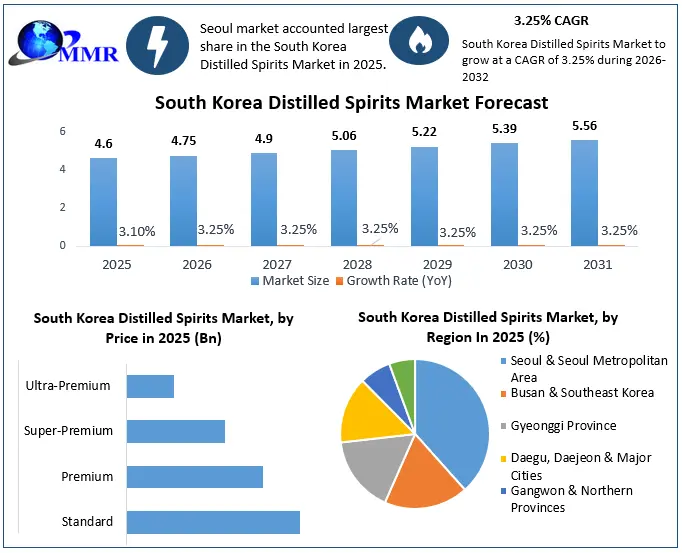
The South Korea Distilled Spirits Market is estimated to be valued at USD 4.6 billion in 2025 and is expected to reach USD 5.7 billion by 2032, recording a CAGR of 3.25%. This market growth can be attributed to various factors such as rising demand for premium and craft spirits, increasing adoption of low- and no-alcohol variants, expanding e-commerce and modern retail distribution, and growing exposure to international drinking trends among younger consumers
South Korea Distilled Spirits Market Definition
The South Korea distilled spirits market comprises all locally produced and imported distilled alcoholic beverages sold for consumption within the country spanning soju, whiskey, brandy/Cognac, white spirits (vodka, gin), rum, tequila, liqueurs, and other spirits and is measured by retail value and volume across on-premise (bars, restaurants) and off-premise (retail, e-commerce) channels. In practice, soju dominates this market accounting for the majority of liquor consumption so many reports either treat soju as the core sub-segment or present a broader “spirits” aggregation that explicitly includes it alongside other categories.
| Parameter | Value |
| Market Size (Base Year 2025) | USD 4.6 Billion |
| Forecast Market Size (2032) | USD 5.7 Billion |
| CAGR (2026–2032) | 3.25% |
| Base Year | 2025 |
| Forecast Period | 2026–2032 |
| Historical Period | 2020–2025 |
| Key Growth Opportunity | Craft Soju Premiumization, K-Wave Global Soju Expansion & Premium Whisky Import Growth |
South Korea Distilled Spirits Market Overview
South Korea's distilled spirits market is uniquely anchored by soju the world's best-selling spirit by global units, with HiteJinro's Jinro brand claiming the No. 1 selling spirit title globally for over 24 consecutive years. The market was valued at USD 4.6 Billion in 2025 and is projected to reach USD 5.7 Billion by 2032, growing at a CAGR of 3.25%. While mass-market diluted soju continues to dominate volume, the market is experiencing structural transformation driven by: the global 'Hallyu' (Korean Wave) culture amplifying international soju demand; a government-mandated policy shift enabling small distilleries to produce craft soju and whisky; and accelerating premiumization in imported whisky and Scotch among young urban professionals.
The future of distilled spirits market intelligence in South Korea lies not in delivering more data points, but in enabling better investment and expansion decisions. To remain competitive and strengthen our positioning as a strategic research and advisory firm, we propose the development of a new flagship offering: the South Korea Distilled Spirits Strategic Intelligence Series. Unlike traditional market reports, this product will combine macroeconomic and consumption trend analysis with investment intelligence, brand and channel competitiveness, regulatory and tax environment assessment, supply chain and distribution mapping, regional opportunity hotspots, benchmarking against peer markets, proprietary attractiveness and risk scoring models, and clear strategic recommendations. The objective is to create a decision-support product that enables spirits producers, distributors, investors, and policymakers to make informed entry, portfolio, and capacity decisions in a rapidly evolving market.
This initiative represents a strategic evolution of our research portfolio from publishing descriptive overviews of soju and spirits volumes to delivering actionable intelligence that remains valuable in an AI-enabled world. By integrating proprietary data, scenario modeling, and executive-level insights, the series will help clients navigate premiumization, health-driven product shifts, channel disruption, and import dynamics, turning complex market signals into confident, evidence-based strategies.
South Korea Distilled Spirits Market Growth Outlook
To know about the Research Methodology :- Request Free Sample Report
South Korea Distilled Spirits Market Historical Size (2020–2025)
| Year | Market Size | Growth Rate (YoY) |
| 2020 | USD 3.8 Bn | 0.9% |
| 2021 | USD 4.0 Bn | 5.4% |
| 2022 | USD 4.2 Bn | 5.1% |
| 2023 | USD 4.3 Bn | 3.2% |
| 2024 | USD 4.5 Bn | 2.3% |
| 2025 | USD 4.6 Bn | 3.1% |
South Korea Distilled Spirits Market Size Forecast (2026–2032)
| Year | Market Size | Growth Rate (YoY) |
| 2025 | USD 4.60 Bn | 3.1% |
| 2026 | USD 4.75 Bn | 3.25% |
| 2027 | USD 4.90 Bn | 3.25% |
| 2028 | USD 5.06 Bn | 3.25% |
| 2029 | USD 5.22 Bn | 3.25% |
| 2030 | USD 5.39 Bn | 3.25% |
| 2031 | USD 5.56 Bn | 3.25% |
South Korea Distilled Spirits Market Key Highlights
• Market Size (2025): USD 4.6 Billion, indicating steady market growth.
• Projected Market Size (2032): USD 5.7 Billion, supported by the K-Wave effect and ongoing premiumization.
• CAGR (2026–2032): 3.25%, reflecting sustained market expansion.
• Dominant Type Segment: Soju (Diluted & Distilled), accounting for approximately 55% of the volume share.
• Fastest-Growing Type: Craft Soju and Premium Imported Whisky, driven by rising consumer interest in premium and differentiated spirits.
• Dominant Application: On-Trade, particularly restaurants and bars, holding more than 65% of the market share.
• Leading Distribution Channel: On-Trade channels, including convenience stores and restaurants, representing approximately 65% share.
South Korea Distilled Spirits Market Consumer Insights & Demand Analysis
| Consumer Dimension | Key Insights | Market Implication |
| K-Wave Cultural Export | Hallyu (Korean Wave) culture K-pop, K-dramas, Korean cuisine driving global consumer awareness and demand for soju internationally across Asia, North America, and Europe | International soju export volumes growing; HiteJinro expanding global retail distribution and on-trade partnerships |
| Craft & Premium Shift | Government's 2025 policy enabling small distilleries to produce craft soju and whisky accelerating differentiation: artisanal, premium expressions commanding 3-5x price premiums vs mass-market soju | Craft soju and Korean whisky emerging as a new category vertical with premium bar and retail shelf space opportunities |
| Youth Moderation | Younger South Korean consumers moderating alcohol intake, preferring lower-ABV soju versions (new HiteJinro 16.9% expression), flavoured soju, and RTD cocktails | Lower-ABV and flavoured soju segments fastest growing; somaek (soju + beer bomb) cultural ritual maintaining on-trade volume |
| Imported Whisky Aspiration | Urban young professionals increasingly adopting Scotch whisky, bourbon, and Japanese whisky as luxury lifestyle accessories in premium bars and home consumption | Imported whisky growing fastest in value; premium whisky brands investing in Korea on-trade brand building and ambassador programs |
South Korea Distilled Spirits Market Dynamics
South Korea Distilled Spirits Market Drivers
• HiteJinro Jinro soju the world's best-selling spirit for 24 consecutive years maintaining unassailable domestic volume dominance while accelerating international export growth powered by Hallyu cultural momentum
• Government's February 2025 policy reform enabling small distilleries to produce craft soju and whisky, creating a new premium domestic spirits category vertical
• Imported whisky premiumization: growing urban professional class adopting Scotch whisky, Japanese whisky, and bourbon as aspirational status beverages, driving significant value growth in the import category
South Korea Distilled Spirits Market Restraints
• Intensifying competition from craft beer, low-alcohol beverages, and RTD cocktails targeting the same young adult consumer segments that historically drove soju volume growth
• Demographic aging and low birth rate creating structural population headwinds for domestic spirits consumption volume over the 2026-2032 forecast horizon
• Market dominance by HiteJinro and Lotte Liquor limiting shelf space and distribution access for new craft and premium domestic spirits entrants
South Korea Distilled Spirits Market Opportunities
• Global soju export market expansion: Hallyu-driven international demand for soju growing significantly in the USA, Japan, Southeast Asia, and Europe as Korean cuisine becomes mainstream globally
• Craft soju and Korean whisky category development: the 2025 small distillery licensing reform creates a potential category moment similar to the craft beer movement of the 2000s-2010s
• Flavoured and low-ABV soju innovation: targeting health-conscious and moderation-oriented consumers with fruit-flavoured, lower-alcohol soju expressions in premium packaging
South Korea Distilled Spirits Market Challenges
• Korea's spirits market highly concentrated: HiteJinro and Lotte Liquor control the majority of retail distribution and on-trade tap handles, creating significant structural barriers for new entrants
• Regulatory complexity for import spirits: high customs duties on foreign spirits limit import category growth and maintain a significant price differential versus domestic soju
• Social health campaigns and government-led anti-alcohol messaging moderating overall per-capita consumption, creating headwinds for volume-driven market growth
South Korea Distilled Spirits Market Segment Analysis
South Korea Distilled Spirits Market, by Product Type
The market can be segmented into Soju, Whisky, Vodka, Brandy, Rum, Gin, Tequila, Liqueurs, Traditional Korean Spirits, and Others. Soju remains the dominant domestic spirit because of its affordability, cultural importance, and extensive availability. Whisky represents the leading imported-spirit opportunity, particularly in premium and single-malt categories, while gin, tequila, and other specialty spirits are benefiting from cocktail and highball culture.
South Korea Distilled Spirits Market, by Price Tier
The market can be divided into Standard, Premium, Super-Premium, and Ultra-Premium categories. Standard spirits, particularly mass-market soju, benefit from affordability and frequent consumption. In contrast, premium and super-premium categories are supported by rising interest in imported whisky, premium soju, craft spirits, gifting, and experiential consumption. Ultra-premium products are concentrated among affluent consumers and luxury-oriented consumption occasions.

South Korea Distilled Spirits Market by, Distribution Channel
Distribution can be segmented into Specialty Liquor Stores/Food & Drinks Specialists, Convenience Stores, Supermarkets & Hypermarkets, On-Trade, E-Commerce/Online Retail, and Other Retailers. Convenience stores have become particularly important for off-trade alcohol purchases because of their accessibility and wide selection. Hypermarkets and supermarkets also maintain significant distribution, while online channels are becoming increasingly relevant for premium and specialty products.
South Korea Distilled Spirits Market Regional Analysis
| Region | Market Share | Key Demand Drivers & Trends |
| Seoul & Seoul Metropolitan Area | 38.4% | Dominant market for premium and craft spirits; cocktail bar hub and imported whisky growth center |
| Busan & Southeast Korea | 18.2% | Second-largest market; strong on-trade and port city hospitality sector driving spirits consumption |
| Gyeonggi Province | 16.6% | Suburban premium market; rising middle-class aspirational spirits consumption |
| Daegu, Daejeon & Major Cities | 14.4% | Regional commercial centers with growing premium bar culture and whisky demand |
| Gangwon & Northern Provinces | 6.8% | Tourism-driven spirits; makgeolli and traditional spirits alongside mainstream soju |
| Other Provinces | 5.6% | Traditional soju consumption dominant; minimal craft or premium spirits penetration |
South Korea Distilled Spirits Market Competitive Landscape
Key Players & Benchmarking
| Company | Spirit Type | Market Position |
| HiteJinro Co., Ltd. (Jinro, Chamisul) | Soju (Mass-Market & Premium) | Undisputed Market Leader (World's #1 Spirit by Volume) |
| Lotte Chilsung Beverage (Chum-Churum) | Soju (Mass-Market) | Major Player |
| Muhak Co., Ltd. (Good Day Soju) | Soju (Regional) | Regional Market Leader (Busan & Southeast) |
| Diageo Korea (Johnnie Walker, Windsor) | Scotch Whisky | Imported Whisky Leader |
| Pernod Ricard Korea (Chivas, Ballantine's, Glenlivet) | Scotch Whisky & Single Malt | Major International Player |
| Beam Suntory Korea (Jim Beam, Bowmore) | Bourbon & Scotch | Major International Player |
| Daesun Distilling (C1 Soju) | Soju (Busan Region) | Regional Challenger |
| Kumbokju (Like Soju) | Craft & Traditional Spirits | Emerging Craft Player |
South Korea Distilled Spirits Market Technology & Innovation Trends
| Innovation Area | Current Trend | Market Impact |
| Craft Soju Artisanal Production | Small distilleries leveraging the 2025 government policy reform to produce traditional-method distilled soju from rice, barley, and sweet potato with premium positioning and limited annual releases | Creates a new premium soju category tier with significantly higher unit economics than mass-market diluted soju |
| RTD Soju Innovation | HiteJinro and Lotte developing premium RTD soju-based cocktails (soju + fruit juice, soju + tonic) in premium canned formats for convenience store and home consumption | RTD soju cocktails fastest-growing format in convenience channel; aligns with youth moderation and convenience trends |
| Flavor Innovation R&D | Continuous flavoured soju portfolio expansion (strawberry, peach, grape, yuzu, green plum) targeting female and younger consumers seeking approachable low-ABV sweet spirits | Flavoured soju maintaining volume relevance among demographics reducing straight alcohol intake |
| Global K-Culture Digital Marketing | HiteJinro leveraging K-pop collaborations, K-drama product placement, and social media influencer campaigns to accelerate soju brand awareness in international markets | K-culture digital marketing delivering high international brand awareness ROI at low incremental cost |
| Whisky Import Platform Digitalization | Korean e-commerce platforms (Coupang, Kakao Commerce) facilitating legal spirits delivery services expanding premium whisky accessibility in home consumption occasions | Digital whisky retail growing rapidly; drives premiumization by enabling discovery of niche imported expressions |
South Korea Distilled Spirits Market Regulatory Framework
South Korea's distilled spirits market is regulated by the National Tax Service (NTS) under the Liquor Tax Act (Jusebeop). The NTS classifies spirits by type, raw material, and production method, determining applicable excise tax rates. In February 2025, the Korean government announced a landmark policy reform allowing small-scale distilleries to produce distilled spirits including craft soju and whisky, previously restricted to large licensed producers. Alcohol advertising is regulated by the Korea Communications Standards Commission (KCSC), prohibiting advertising before 10 PM on broadcast media. Import duties on foreign spirits are governed under the Korea-EU and Korea-US FTA frameworks, with progressive tariff reduction schedules benefiting Scotch whisky and bourbon imports.
South Korea Distilled Spirits Market Investor Takeaway
South Korea's distilled spirits market presents a compelling combination of global cultural momentum and domestic category evolution: a market growing at 4.01% CAGR toward USD 17.8 billion by 2032, powered by Hallyu's global reach amplifying Korean spirits awareness internationally and a structural market reform enabling craft soju and whisky production. The intersection of global K-culture momentum, craft spirits category nascency, and premium import growth creates multiple vectors for brand equity creation and distribution partnership value.
South Korea Distilled Spirits Market Scope: Inquire before buying
| South Korea Distilled Spirits Market | |||
|---|---|---|---|
| Report Coverage | Details | ||
| Base Year: | 2025 | Forecast Period: | 2026-2032 |
| Historical Data: | 2020 to 2025 | Market Size in 2025: | USD 4.6 Bn. |
| Forecast Period 2026 to 2032 CAGR: | 3.25% | Market Size in 2032: | USD 5.7 Bn. |
| Segments Covered: | by Product | Whisky Soju Vodka Brandy Rum Gin Liqueurs Others |
|
| by Price Tier | Ultra-Premium Super-Premium Premium Mid-Range Economy |
||
| by Distribution Channel | Specialty Liquor Stores Supermarkets & Hypermarkets Convenience Stores On-Trade (Restaurants, Bars, Hotels) Online / E-Commerce Others |
||
South Korea Distilled Spirits Market by Geography
Seoul Capital Area
Yeongnam
Honam
Hoseo
Rest of South Korea
Frequently Asked Questions (FAQs)
1. What is the size of South Korea's distilled spirits market?
South Korea's distilled spirits market was valued at USD 4.6 billion in 2025 and is projected to reach USD 5.7 billion by 2032, growing at a CAGR of 3.25%.
2. Why is soju the world's best-selling spirit?
HiteJinro's Jinro soju has been the world's best-selling spirit by volume for over 24 consecutive years. Soju's dominance is driven by South Korea's large on-trade consumption culture, deeply embedded social drinking traditions, and HiteJinro's unrivalled domestic distribution network reaching virtually every restaurant, bar, and convenience store in South Korea.
3. What is the difference between distilled soju and diluted soju?
Traditional distilled soju (known as single-malt or premium soju) is pot-distilled from grains and typically carries 40%+ ABV with complex flavor profiles. Modern mass-market diluted soju is produced by diluting high-strength neutral spirit with water and sweeteners to ~16-25% ABV it is more affordable and accessible, and represents the majority of volume.
4. How does the Korean Wave (Hallyu) affect the soju market?
Hallyu the global spread of Korean pop culture through K-pop, K-dramas, and Korean cuisine has significantly elevated international consumer awareness of soju. Korean restaurants globally serve soju, and major international retailers are expanding soju shelf presence to meet growing consumer demand.
5. Who are the key players in South Korea's spirits market?
HiteJinro (Jinro, Chamisul), Lotte Chilsung (Chum-Churum), Muhak (Good Day), Diageo Korea (Johnnie Walker, Windsor), Pernod Ricard Korea (Chivas, Ballantine's), and Beam Suntory Korea are the major players.