
Solar Powered Drones Market 2025–2032: Next-Generation UAV, Sustainable Technologies, and Real-Time Intelligence Reshaping Commercial and Military Applications
Overview
The Global Solar Powered Drones Market was valued at USD 1.34 Billion in 2025 and is projected to reach USD 3.24 Billion by 2032, registering a robust CAGR of 13.45% during the forecast period.
The Solar Powered Drones Market is witnessing significant growth, driven by the increasing demand for long-endurance UAV platforms across sectors such as agriculture, defense, surveillance, and environmental monitoring. As AI-powered drones and autonomous flight systems gain traction, solar-powered UAVs offer a sustainable alternative to conventional fuel-based systems, providing extended operational capabilities without the need for frequent recharging. With innovations in photovoltaic technology and lightweight composite materials, solar-powered drones are becoming increasingly viable for military applications, border security, and disaster management.
The ability to operate in remote and hostile environments for extended periods without the need for refuelling makes these drones ideal for ISR (Intelligence, Surveillance, and Reconnaissance) missions, telecommunications, and precision farming. As countries and organizations seek to reduce carbon emissions, solar UAVs are positioned as key components in green aviation strategies.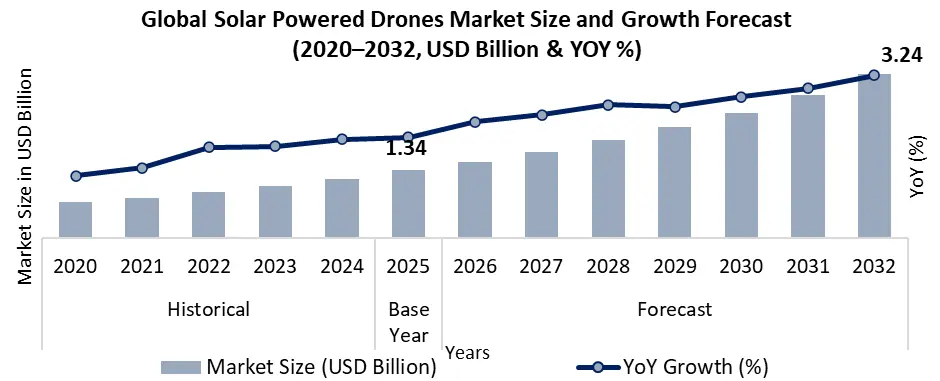
To know about the Research Methodology :- Request Free Sample Report
North America, primarily the U.S., is at the forefront of the Solar Powered Drones Market, driven by robust defense budgets and continuous advancements in autonomous drone systems. The Pentagon's significant investment in unmanned systems, focusing on AI integration and hybrid solar-electric propulsion systems, underscores the strategic shift towards more sustainable and autonomous aerial platforms. In parallel, government-funded research programs by agencies like DARPA and NASA are accelerating the development of solar-powered UAV technologies for defense and surveillance applications.
As military forces globally adopt these systems for border patrol, emergency response, and combat reconnaissance, the market for solar-powered drones is set to expand rapidly. The growth of the Solar Powered Drones Market is further supported by increasing demand for real-time aerial intelligence, the development of high-efficiency solar panels for UAVs, and the integration of these platforms into commercial sectors such as aerial inspection, monitoring, and data collection.
Solar Powered Drones Market Overview:
Solar-powered drones, also known as solar-powered unmanned aerial vehicles (UAVs), are aerial platforms that utilize solar energy for propulsion, offering significant advantages in terms of long-endurance and sustainability. These drones are equipped with photovoltaic cells that harness solar power, enabling them to operate for extended periods without the need for frequent recharging or fuel refills. With advancements in hybrid propulsion systems, hydrogen fuel cells, and lightweight composite materials, solar-powered UAVs are becoming increasingly viable for a wide range of applications. These include military surveillance, border security, environmental monitoring, and precision agriculture, where their ability to cover large areas autonomously and provide real-time data is highly valued. The growing demand for unmanned aerial systems (UAS), coupled with the drive for energy-efficient technologies and the shift toward reducing carbon emissions, is expected to fuel significant Solar Powered Drones Market growth in the coming years.
How Solar-Powered Drones are Changing the Game:
• Extended Flight Time: The Solar Powered Drones Market benefits from solar panels that enable extended flight durations, even achieving multi-day flights, making them ideal for long-term environmental monitoring and providing communication networks.
• Reduced Operating Costs: By relying on solar power, these drones cut operational expenses, offering cost-effective solutions for businesses.
• Environmentally Friendly: Solar drones reduce carbon emissions, supporting sustainability and eco-friendly operations.
• Access to Remote Areas: They operate in isolated areas where traditional infrastructure is unavailable, aiding disaster relief and scientific research.
• Improved Efficiency: Longer flight times reduce downtime, improving operations in border patrol, wildfire monitoring, and covert operations.
Solar Powered Drones Market Key Highlights:
| Market Parameter | Value / Insight | Trend |
| Global Solar Powered Drones Market Size (2025) | USD 1.34 Billion | ↑ Strong Growth |
| Projected Market Size (2032) | USD 3.24 Billion | ↑ Accelerating Expansion |
| Forecast CAGR (2025–2032) | 13.45% | ↑ High-Growth Industry |
| Dominant Product Type (2025) | Fixed-Wing Drones | ↑ Market Leader |
| Second Largest Segment | Rotary-Wing (Multi-Rotor) Drones | ↑ Rapid Deployment |
| Third Largest Segment | Hybrid Wing Drones | ↑ Strategic Expansion |
| Primary Application | Environmental Monitoring | ↑ Core Demand Driver |
| Commercial Sector Growth | Agriculture & Precision Farming | ↑ Expanding Market |
| AI and Autonomous Systems Integration | AI-enabled Autonomous Drones | ↑ Driving Efficiency & Growth |
Challenges and Opportunities for the Solar Powered Drones Market
The Solar Powered Drones Market faces challenges in regulatory frameworks, integration costs, and operational efficiency. Regulatory issues, such as airspace integration and privacy concerns, require the creation of clear guidelines for drone usage and data management. Additionally, high integration costs for advanced technologies, like solar cells and propulsion systems, can limit affordability. Standardization and international cooperation are needed to ensure safety and smooth operations, especially for high-altitude or long-distance flights.
However, technological advancements present significant opportunities for growth. Research into more efficient solar cells, like perovskite solar cells, and the development of lightweight materials and improved propulsion systems will enhance performance and energy efficiency. Overcoming challenges related to weather resistance and developing long-range communication systems will broaden operational capabilities, enabling solar drones to function in diverse conditions and remote areas. These advancements will help make solar-powered drones more accessible and cost-effective, driving Solar Powered Drones Market growth.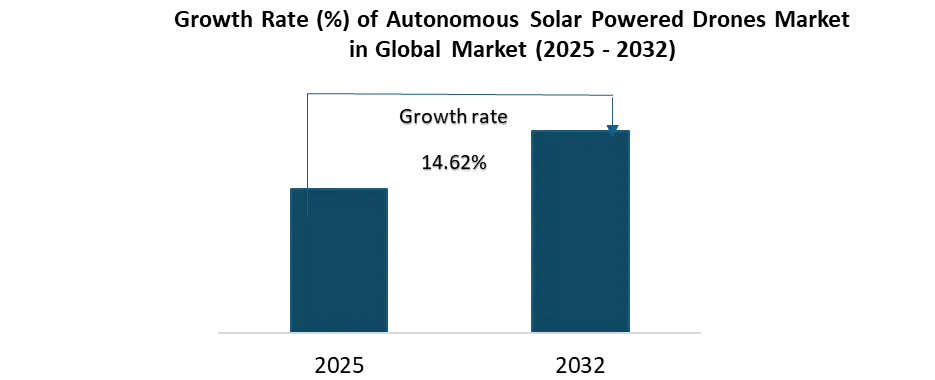
Emerging Trends Shaping the Solar Powered Drones Market Industry:
• Advancements in Solar Technology: High-efficiency solar cells and lightweight materials are boosting flight endurance and payload capacity, enabling solar-powered drones for commercial and defense applications.
• AI Integration for Enhanced Efficiency: AI-driven navigation and autonomous systems are improving mission efficiency in sectors like precision agriculture, surveillance, and infrastructure inspection.
• Military and Defense Adoption: Solar-powered UAVs are increasingly used for long-duration reconnaissance, border security, and battlefield surveillance, supported by government investments.
• Agriculture and Environmental Applications: Solar drones are enhancing crop monitoring, climate analysis, and disaster management, replacing traditional methods with sustainable solutions.
• Sustainability and Green Technology: The Solar Powered Drones Market benefits from a global push towards renewable energy and carbon reduction, aligning with green aviation initiatives.
Solar Powered Drones Market – Manufacturing Cost & Pricing Analysis
Manufacturing Costs:
The Solar Powered Drones Market faces high manufacturing costs driven by lightweight materials, high-efficiency solar cells, and advanced propulsion systems. Key cost components include energy storage systems, photovoltaic panels, autonomous navigation technology, and AI-enabled avionics. These components are essential for long-endurance and autonomous operations, but they increase production costs compared to conventional UAVs.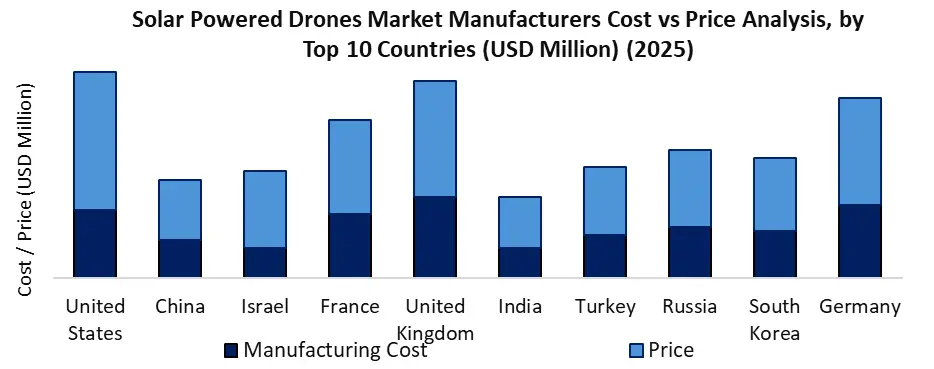
Solar Powered Drones Market Pricing Trends:
Solar-powered drones follow a value-based pricing model, with prices reflecting performance and capabilities.
• Cost Evolution: The high initial costs of solar-powered UAVs are largely due to advanced components such as solar cells, energy storage systems, and hybrid propulsion systems. However, as technology improves—especially in AI, lightweight materials, and solar efficiency—costs are expected to decrease over time, making solar UAVs more accessible to commercial sectors like agriculture, surveillance, and environmental monitoring.
• Commercial vs. Defense Pricing: Prices for high-end military systems with solar-electric propulsion and AI integration can exceed several million dollars, while entry-level models for commercial use (like agriculture or telecommunications) are priced in the mid-tier range, offering good flight endurance and basic autonomous capabilities.
Solar Powered Drones Market Segment Analysis
Based on Product Type, the Fixed-Wing Drones segment commands the largest revenue share at 54.4% in 2025 driven by long endurance and greater range. Fixed-wing drones are designed for long-range operations, offering significant flight endurance and efficiency, making them ideal for applications that require extended flight times, such as military surveillance, border security, and environmental monitoring. Their aerodynamic efficiency allows them to cover large geographic areas with minimal energy consumption, which is particularly advantageous in solar-powered UAVs. This efficiency is crucial for missions like remote sensing and climate observation, where long-duration flights are essential.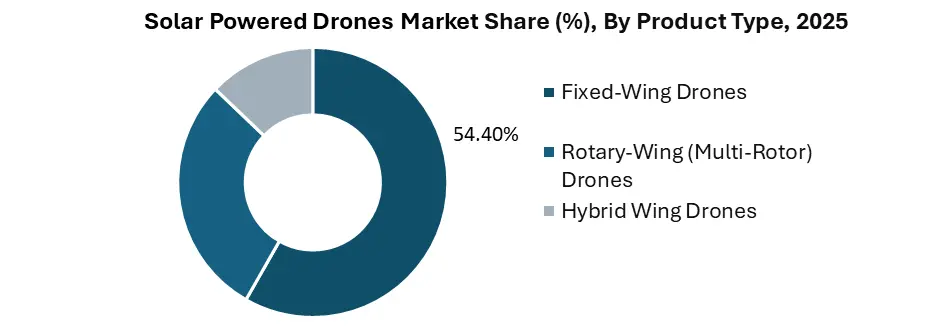 By Range, Short Range segment is positioned to lead the Solar Powered Drones Market, capturing a 45.18% revenue share in 2025. This growth is attributed to their high-endurance capabilities, which make them ideal for disaster management, military reconnaissance, and telecommunications relay. These drones are increasingly preferred for persistent surveillance and long-duration operations in areas where conventional UAVs would require frequent recharging or refuelling. Their ability to remain airborne for extended periods is a critical advantage in applications that demand continuous, reliable coverage, further driving demand in both defense and commercial sectors.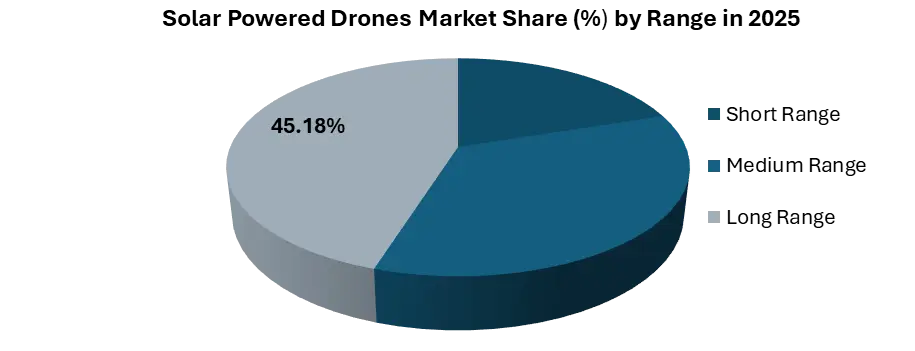
Solar Powered Drones Market Regional Insights:
North America leads the market with a 37.45% share in 2025:
North America leads the Solar Powered Drones Market, driven by high defense spending, AI-powered UAVs, and military modernization. The U.S. dominates with demand for solar-powered drones in border security, military reconnaissance, and telecommunications. Government-backed research from DARPA and NASA supports the development of long-endurance UAV systems.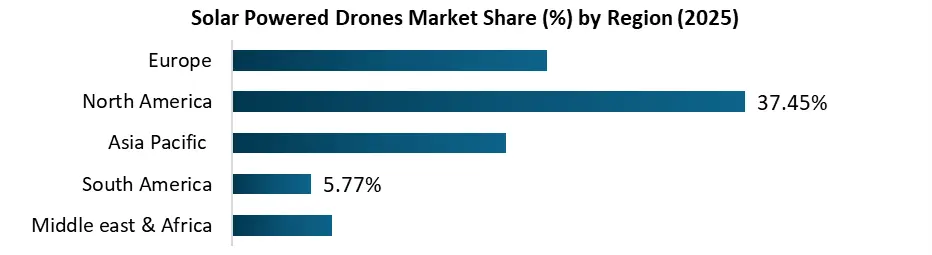 Asia Pacific Solar Powered Drones Market expected to grow highest CAGR of 15.03% over 2026-2032
Asia-Pacific: The Asia-Pacific region is rapidly emerging as a key player in the Solar Powered Drones Market, with countries like China, India, and Japan investing heavily in UAV technologies. Government support for military applications and border security is driving this demand, with initiatives to integrate solar UAVs into national defense programs. China's military modernization and India's defense push are particularly noteworthy, with these nations looking to leverage solar-powered UAVs for extended reconnaissance and surveillance operations.
Europe Solar Powered Drones Market – Sustainability Focus
Europe’s Solar Powered Drones Market is driven by a strong focus on sustainability, environmental monitoring, and regulatory support from organizations like EASA. The region is investing in solar UAVs for military intelligence, border surveillance, and disaster management, aligning with green aviation goals and reducing carbon emissions.
Solar Powered Drones Market Competitive Landscape
The Solar Powered Drones Market is highly competitive, with a rising number of companies investing in advanced solar technology, autonomous systems, and long-endurance UAV solutions. Leading players in the Solar Powered Drones Market include Garuda Aerospace, which recently introduced the SURAJ drone featuring solar-powered wings, designed for long-duration missions. Titan Aerospace, known for its Solara 50, has established a strong foothold with its high-altitude UAVs capable of stratospheric flights powered entirely by solar energy.
Airbus and Israel Aerospace Industries (IAI) are also making strides in developing high-efficiency solar-powered UAVs for defense applications and environmental monitoring. These companies are investing heavily in AI integration, energy-efficient solar cells, and hybrid propulsion systems to enhance the capabilities of solar UAVs in both commercial and military sectors. As demand for sustainable aerial solutions grows, these key players are shaping the competitive dynamics of the solar-powered drone industry, setting the stage for further advancements and expansion.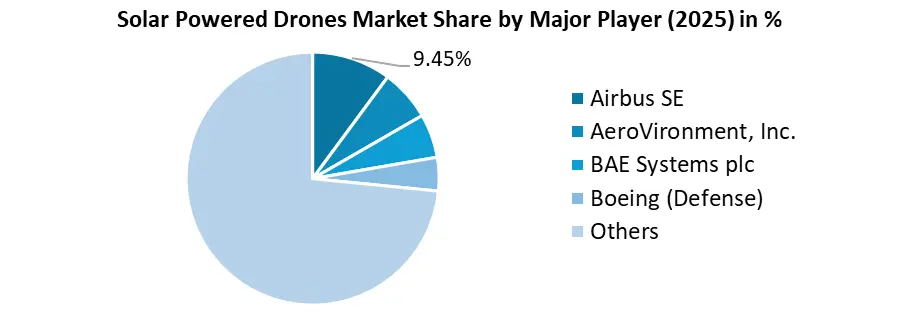
Solar Powered Drones Market Recent Developments:
| Date | Company | Development | Impact |
| Jan-25 | Skydweller Aero & Thales | Signed MoU to integrate AI radar systems for solar-powered drones aimed at long-duration maritime patrols. | Strengthens market position for solar-powered UAVs in defense surveillance. |
| Mar-25 | Skydweller Aero (US Navy) | Completed a three-day continuous solar flight test demonstrating high-endurance autonomous solar flight. | Establishes solar UAVs as a reliable choice for maritime ISR and military operations. |
| May-25 | Airbus (Zephyr UAV) | Successfully launched Zephyr solar-powered UAV for stratospheric flight in Kenya with extended operational range. | Demonstrates long-endurance capability for environmental and telecom monitoring applications. |
| Jun-25 | Industry-wide Development | Market research projects the Solar Powered Drones Market growing from USD 2.58B in 2025 to USD 3.08B in 2026, with a ~19% CAGR. | Reflects strong growth trajectory driven by solar technology advancements. |
| Feb-26 | Solar UAV Technology Advancements | Advancements in solar cell efficiency, AI navigation, and energy storage systems identified as major market trends. | Opens new opportunities for autonomous operations and extended endurance solar UAV missions. |
Solar Powered Drones Market Scope: Inquire Before Buying
| Solar Powered Drones Market | |||
|---|---|---|---|
| Report Coverage | Details | ||
| Base Year: | 2025 | Forecast Period: | 2026-2032 |
| Historical Data: | 2020 to 2025 | Market Size in 2025: | USD 1.34 Bn. |
| Forecast Period 2026 to 2032 CAGR: | 13.45% | Market Size in 2032: | USD 3.24 Bn. |
| Segments Covered: | by Product Type | Fixed-Wing Drones Rotary-Wing (Multi-Rotor) Drones Hybrid Wing Drones |
|
| by Type | Short Range Medium Range Long Range |
||
| by Mode of Operation | Autonomous Semi-Autonomous Remotely Operated |
||
| by Application | Filming and Photography Inspection and Maintenance Environmental Monitoring Surveying and Mapping Others |
||
| by End Use | Agriculture Energy Military & Defense Telecommunication Delivery and Logistics Others |
||
Solar Powered Drones Market by Region:
• North America (United States, Canada, and Mexico)
• Europe (United Kingdom, France, Germany, Italy, Spain, Sweden, Russia, Ukraine, Austria, Poland, Portugal, Ireland, Switzerland, Romania, and Rest of Europe)
• Asia Pacific (China, India, Japan, South Korea, Australia, Indonesia, Denmark, Malaysia, Philippines, Thailand, Vietnam, and Rest of Asia Pacific)
• Middle East and Africa (UAE, South Africa, Saudi Arabia, Bahrain, Kuwait, Oman, Qatar, Egypt, Nigeria, Israel, Turkey, Rest of ME&A)
• South America (Brazil, Argentina, Chile, Colombia, and Rest of South America)
Key Players/Competitors Profiles Covered in the Solar Powered Drones Market Report in Strategic Perspective
North America
1. United States Solar Powered Drones Key Players
1.1. AeroVironment, Inc.
1.2. Lockheed Martin Corporation
1.3. Northrop Grumman Corporation
1.4. The Boeing Company
1.5. HES Energy Systems
1.6. Skyfront Corp.
1.7. Alta Devices
2. Canada
2.1. Magellan Aerospace,
2.2. MDA
2.3. Drone Delivery Canada
2.4. Aeryon Labs (FLIR/Teledyne)
2.5. SkyX
2.6. Red Cat / Flightcore, etc.
3. Mexico
3.1. KAVAK Aero,
3.2. SkyEye Aerial Systems,
3.3. SITZ Drones,
3.4. UAVision México,
Europe
1. United Kingdom
1.1. BAE Systems
1.2. QinetiQ Group
2. Germany
2.1. Quantum-Systems GmbH
2.2. Lilium GmbH
3. France
3.1. Airbus SE
3.2. Thales Group
3.3. Dassault Aviation
4. Sweden
4.1. Saab AB
4.2. H2FLY
5. Spain
5.1. Indra Sistemas
5.2. GMV Aerospace
6. Russia
6.1. Kalashnikov Group UAV Division
6.2. Kronshtadt Group
Asia-Pacific
1. China
1.1. DJI (Enterprise/Defense)
1.2. Ziyan UAV
1.3. CASIC – China Aerospace Science & Industry Corp.
1.4. AVIC Chengdu Aircraft Industry Group
2. India
2.1. Tata Advanced Systems
2.2. DRDO (TAPAS-BH-201 / Rustom Program)
3. Japan
3.1. Mitsubishi Heavy Industries
3.2. Yamaha Motor (FAZER / FAZER R series)
4. South Korea
4.1. Korea Aerospace Industries (KAI)
4.2. LIG Nex1
5. Australia
5.1. Insitu Pacific (Boeing subsidiary)
Middle East & Africa
1. Israel
1.1. Israel Aerospace Industries (IAI)
1.2. Elbit Systems
2. United Arab Emirates
2.1. EDGE Group
2.2. Barzan Holdings
3. Saudi Arabia
3.1. Saudi Arabian Military Industries (SAMI)
3.2. Advanced Electronics Company (AEC)
4. South Africa
4.1. Denel Dynamics
South America
1. Brazil
1.1. Embraer Defense & Security
1.2. Harpia Sistemas (IACIT Group)
2. Argentina
2.1. INVAP S.E.
2.2. FAdeA – Fábrica Argentina de Aviones
FAQ – Solar Powered Drones Market
Q. What is the current size and outlook of the Solar Powered Drones Market?
Ans. The Solar Powered Drones Market is projected to be valued at approximately USD 1.34 Billion in 2025, with an expected growth to USD 3.24 Billion by 2032, growing at a CAGR of 13.45% Over 2026-2032. The growth is driven by the rising demand for long-endurance UAVs, environmental monitoring, and sustainable aerial platforms across military, commercial, and industrial applications.
Q. What are the key factors driving the growth of the Solar Powered Drones Market?
Ans. The market is primarily driven by the increasing demand for extended flight times in defense, agriculture, and telecommunications. Technological advancements in solar cells, AI-enabled navigation, and energy management systems are reducing operational costs and enhancing the capabilities of solar drones. Additionally, the global push for sustainability and carbon reduction supports the adoption of solar-powered UAVs as a greener alternative.
Q. Which UAV types and applications dominate the Solar Powered Drones Market?
Ans. Fixed-Wing Drones dominate the Solar Powered Drones Market owing to their superior flight endurance and aerodynamic efficiency. The primary applications are in military surveillance, border security, and environmental monitoring. Solar-powered UAVs are also gaining traction in precision agriculture, telecommunications, and disaster management due to their extended flight capabilities.
Q. What are the major challenges faced by the Solar Powered Drones Market?
Ans. Key challenges include high initial manufacturing costs due to advanced solar technology, integration complexities, and the need for standardization across platforms. Weather resistance and the ability to operate in harsh environments remain significant hurdles.
Q. What are the emerging trends shaping the Solar Powered Drones Industry?
Ans. Major trends include the growing integration of AI-driven autonomous systems, advancements in solar cell efficiency, and the development of hybrid propulsion systems. Military applications are expanding with the demand for long-endurance ISR drones, while commercial applications are driven by the need for green technologies in sectors like agriculture and telecommunications.