
Smart Oven Market by Type, by Structure, by Connectivity, by Distribution Channel, by Application, Regional Insights and Forecast 2034
Overview
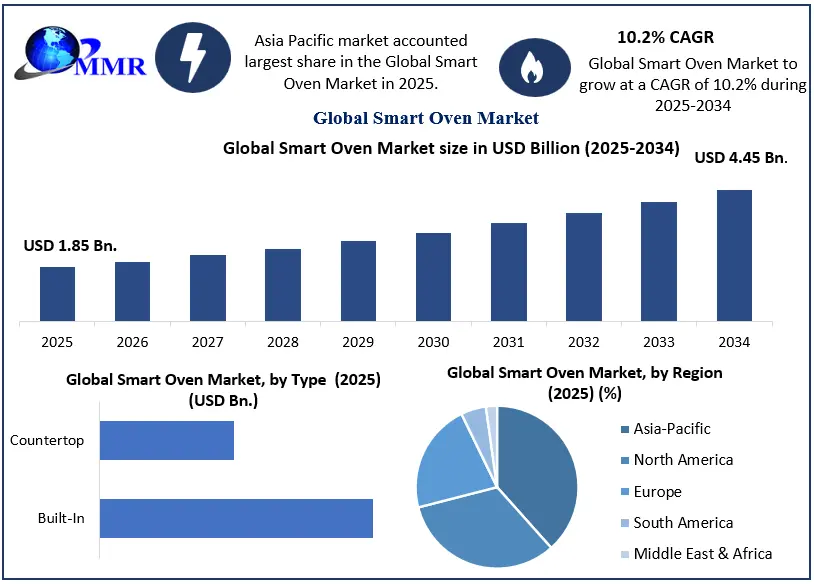
Global Smart Oven Market size was valued at USD 1.85 Billion in 2025 and the total Smart Oven revenue is expected to grow at 10.2% from 2026 to 2034, reaching USD 4.45 Billion by 2034
Smart Oven Market Overview:
A smart oven is a type of kitchen equipment that combines the function of conventional and microwave ovens with the extra advantages of Wi-Fi and Bluetooth for improved connectivity. Some of these ovens also come with flexible cooktops and voice control features that can be accessed via the accompanying app or smart home assistants such as Google Home and Amazon Alexa. These ovens contain all of the features of conventional ovens, plus additional settings and combinations. Smart ovens give users more control by allowing them to change the temperature and cooking settings from afar. They also have more cooking modes and cycle settings, which include everything from reheating frozen foods to baking and roasting.
The market growth is supported by increasing smart home adoption, rising disposable income, urbanization, kitchen modernization, growing consumer preference for connected appliances, increasing demand for cooking convenience, and technological advancements in kitchen appliances. The integration of Internet of Things (IoT), artificial intelligence (AI), smart sensors, machine learning, automated cooking controls, digital recipe assistance, remote monitoring, and intelligent temperature management is strengthening the functionality and adoption of smart ovens.
Key Highlights of the Global Smart Oven Market
• Market Growth: The Global Smart Oven Market is valued at USD 1.85 billion in 2025 and is projected to reach USD 4.45 billion by 2034, registering a 10.2% CAGR during 2025–2034.
• Smart Technology Integration: The market is driven by the integration of IoT, AI, smart sensors, Wi-Fi, Bluetooth, automated cooking controls, remote monitoring, and intelligent temperature management.
• Key Market Driver: Rising adoption of connected kitchen appliances and smart home technology increases demand for smart ovens with smartphone controls, voice assistants, and remote cooking capabilities.
• Connectivity Leadership: Wi-Fi connectivity records the fastest CAGR as consumers increasingly prefer remote monitoring, smartphone control, smart home integration, and convenient connectivity.
• Residential Demand: The residential segment grows rapidly due to urbanization, rising living standards, smart home adoption, and increasing demand for convenient and multifunctional cooking appliances.
• Distribution Shift: Offline channels maintain a significant share, while online distribution gains traction through e-commerce, wider product availability, competitive pricing, customer reviews, and doorstep delivery.
• Regional Leadership: North America dominates the Smart Oven Market due to advanced infrastructure, high disposable income, smart home adoption, and strong demand for connected kitchen appliances. Asia-Pacific records the fastest growth, supported by urbanization, rising disposable income, and smart home adoption
• Competitive Landscape: The market remains highly competitive, with major players including Breville, Electrolux, GE Appliances, LG Electronics, Panasonic, Samsung, Sharp, Tovala, Whirlpool, Bosch, Miele, Smeg, Midea, and Haier.
• Future Market Direction: The Smart Oven Industry is moving toward AI-powered personalized cooking, voice-controlled appliances, smartphone connectivity, energy-efficient cooking, multifunctionality, and fully connected smart kitchen ecosystems.
Smart Oven Market Growth and Share Analysis
To know about the Research Methodology :- Request Free Sample Report
In this report, the Smart Oven market's growth reasons, as well as the market's many segments (Type, Structure, connectivity, Distribution channel, Application, and Region), are discussed. Data has been given by market players, regions, and specific requirements. This market report includes a comprehensive overview of all the significant improvements that are presently prevailing in all market segments.
Key data analysis is presented in the form of statistics, infographics, and presentations. The study discusses the Smart Oven market's Drivers, Restraints, Opportunities, and Challenges. The report helps to assess the market growth drivers and determines how to use these drivers as a tool. The report also helps to rectify and resolve issues related to the global Smart Oven market situation.
Smart Oven Market Dynamics:
Smart Oven Market Driver:
• Rising Demand for Connected Kitchen Appliances and Smart Home Integration: The Smart Oven Market is growing as consumers increasingly adopt connected kitchen appliances and smart home appliances. Wi-Fi, Bluetooth, smartphone controls, and voice assistants enable remote cooking and monitoring. IoT-enabled ovens allow users to control temperature, cooking time, preheating, and notifications remotely. This integration strengthens demand for smart kitchen technology and connected cooking appliances.
• Growing Focus on Health and Wellness: Consumers increasingly prefer healthy cooking methods that use less oil and support better meal preparation. Smart ovens offer air frying, steaming, grilling, and other health-oriented cooking functions. A recent market analysis reports that North America holds more than 38.7% of the global smart oven market in 2025, with demand supported partly by interest in energy-efficient and healthy cooking solutions. The trend increases demand for multifunctional smart ovens and smart cooking appliances.
• Urbanization and Changing Consumer Lifestyles: Urbanization and busy lifestyles increase the demand for compact, multifunctional, and time-saving kitchen appliances. Smart ovens combine baking, roasting, grilling, reheating, air frying, and steaming in a single appliance. Automated cooking functions reduce preparation time and improve convenience for busy consumers. This lifestyle shift supports the expansion of the Global Smart Oven Market.
Smart Oven Market Restraints
• High Initial Cost and Installation Expenses: Smart ovens generally involve higher purchase and installation costs than conventional ovens. Advanced IoT hardware, sensors, touchscreens, AI features, and smart home integration increase manufacturing and product costs. Installation and connectivity requirements can further increase the overall investment. These factors can limit adoption among price-sensitive consumers.
• High Power Consumption and Energy Concerns: Smart ovens can consume considerable electricity, particularly when multiple advanced cooking functions operate simultaneously. High energy consumption increases operating costs for households and can reduce consumer interest in some markets For example, Electrolux's February 5, 2026 CamCook and AI TasteAssist technology recommends steam-based and energy-efficient cooking programs and is designed to reduce unnecessary energy use and food waste.
• Data Privacy and Cybersecurity Concerns: Connected smart ovens collect and exchange data through Wi-Fi, smartphones, cloud platforms, and smart home ecosystems. This connectivity creates concerns regarding data privacy, cybersecurity, and unauthorized access. Consumers may hesitate to adopt IoT-enabled ovens when they are uncertain about data protection. Strong security systems are therefore essential for Smart Oven Technology adoption.
Smart Oven Market Opportunities
• Integration with Food Brands, Recipe Platforms, and Meal-Kit Services: Smart oven manufacturers have opportunities to collaborate with food brands, recipe platforms, and meal-kit providers. These partnerships can connect recipes directly with automated cooking programs and recommended settings. Such integration improves consumer convenience and creates differentiated smart cooking experiences. It also supports ecosystem development within the Smart Oven Industry. Pasted text
• Expansion in Emerging Markets: Emerging markets provide significant opportunities as smart home adoption, urbanization, disposable income, and digital connectivity increase. Countries such as India, China, and Brazil present potential demand for connected kitchen appliances. Manufacturers can introduce affordable and locally adapted smart oven models in these markets. This expansion can strengthen the global presence of the Smart Oven Market.
Smart Oven Market Challenges
• Market Saturation and Intense Competition: The Smart Oven Industry faces intense competition as established appliance manufacturers introduce increasingly advanced connected products. Market saturation can make it difficult for companies to differentiate their offerings. Brands compete through AI features, connectivity, cooking functions, design, energy efficiency, and pricing. Continuous product innovation is therefore necessary to maintain market position. Pasted text
• Lack of Standardization and Interoperability: Different smart ovens and smart home platforms may use different communication standards and technologies. Limited interoperability can make it difficult for consumers to connect appliances across different brands. This reduces the effectiveness of connected smart kitchen ecosystems. Greater standardization is important for improving compatibility and consumer adoption.
Smart Oven Market Trends
• Increasing Integration of IoT and AI: IoT and AI are becoming core technologies in modern smart ovens. These technologies support automated cooking, intelligent temperature control, personalized recommendations, and remote monitoring. AI-powered Smart Ovens increasingly learn from cooking preferences and provide customized experiences. This trend strengthens the development of intelligent cooking appliances.
• Voice-Controlled and Smartphone-Connected Cooking: Voice-controlled ovens and smartphone-connected cooking are becoming increasingly popular within smart kitchen environments. Consumers can use smartphones or voice assistants to preheat ovens, adjust settings, monitor cooking, and receive alerts. Integration with Alexa, Google Assistant, and other platforms improves convenience. This trend supports the growth of Wi-Fi-enabled ovens and connected cooking appliances.
• Health-Oriented Smart Cooking: Smart ovens increasingly support healthier cooking through air frying, steaming, grilling, and reduced-oil preparation. Automated programs help consumers prepare meals with greater consistency and convenience. Health-focused features align with growing consumer interest in wellness and balanced diets. This trend strengthens demand for health-oriented smart cooking appliances.
Smart Oven Market Segment Analysis:
By Structure, The countertop segment dominates the Smart Oven Market and records the fastest CAGR during the forecast period. Countertop smart ovens are more affordable and compact than built-in models, making them highly suitable for residential kitchens. Their space-saving design supports adoption among urban consumers and households with limited kitchen space. Growing demand for convenient and multifunctional smart kitchen appliances further drives segment growth.
By Connectivity, The Wi-Fi connectivity segment records the fastest CAGR in the Smart Oven Market. Wi-Fi provides convenient communication between smart ovens, smartphones, smart home systems, and connected kitchen appliances. Consumers remotely monitor and control cooking functions, improving convenience and flexibility. The increasing adoption of user-friendly smart home technology continues to support demand for Wi-Fi-enabled ovens.
By Application, The residential segment grows rapidly, supported by increasing urbanization and the adoption of smart appliances in modern kitchens. Rising consumer awareness and improving living standards increase household demand for advanced cooking appliances. Smart ovens provide multifunctional cooking, automation, connectivity, and convenience for everyday meal preparation. These factors strengthen residential demand across the Global Smart Oven Market.
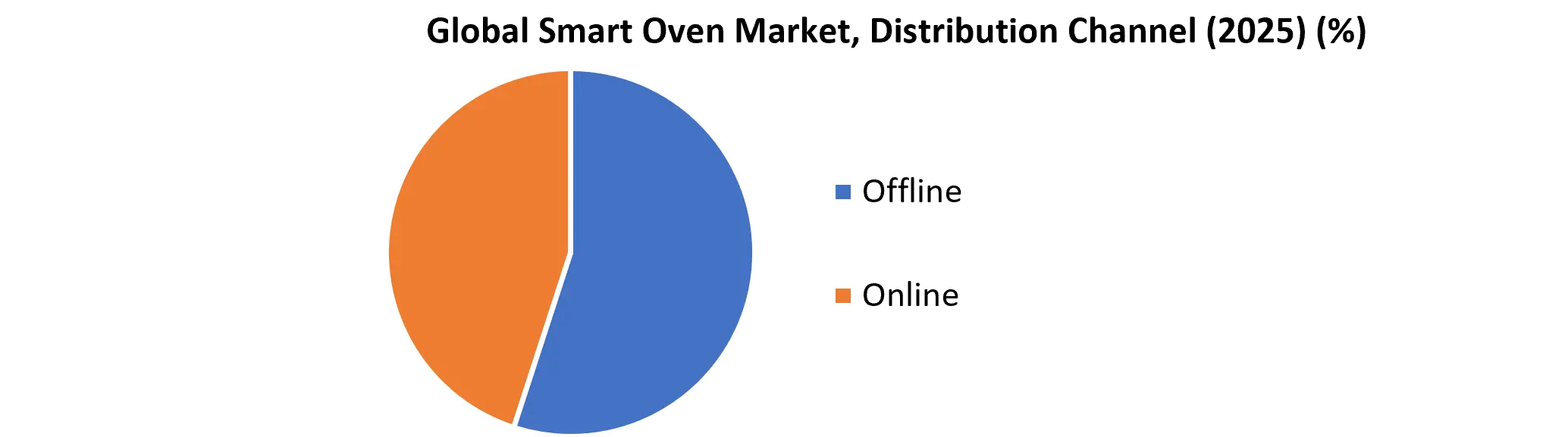
By Distribution Channel, The offline distribution channel holds a significant market share, as consumers prefer physical stores for evaluating kitchen appliances before purchase. However, the online distribution channel gains strong traction with increasing e-commerce adoption and consumer preference for convenient purchasing. Online platforms provide wider product choices, competitive pricing, customer reviews, and doorstep delivery. This shift toward digital retail supports the growth of online Smart Oven Market sales.
Smart Oven Market Regional Insights:
North America dominates the Smart Oven Market, supported by advanced infrastructure, high disposable incomes, and rapid technological advancements. Consumers increasingly prefer intelligent kitchen appliances that integrate with smart home ecosystems and provide convenience, energy efficiency, and cooking automation. The United States leads regional demand due to strong adoption of connected kitchen appliances, voice-controlled devices, and smart home technologies. Mexico also shows increasing demand as middle-class income levels and awareness of smart kitchen appliances continue to rise.
Europe represents a significant Smart Oven Market, supported by strong adoption of smart home technology and increasing consumer demand for energy-efficient appliances. Consumers increasingly prefer ovens with remote control, precise cooking settings, IoT connectivity, and smart home integration. Germany and France remain important markets due to advanced technological infrastructure, higher disposable incomes, and growing environmental awareness. Energy-efficiency regulations and urban lifestyles further support regional demand.
Asia-Pacific records the fastest growth in the Smart Oven Market, supported by rising disposable incomes, rapid urbanization, and increasing adoption of smart home technologies. Consumers in China, India, and Japan increasingly seek advanced kitchen appliances that provide convenience, automation, remote monitoring, and energy efficiency. Expanding consumer electronics production and improving living standards further support market growth. Government initiatives promoting smart homes and energy conservation also encourage adoption.
South America presents emerging growth opportunities in the Smart Oven Market as consumer awareness of smart appliances increases. Rising urbanization, improving living standards, and increasing disposable income support demand for connected kitchen appliances. Consumers increasingly seek convenient and energy-efficient cooking technologies. Greater adoption of smart home solutions creates additional opportunities for smart oven manufacturers.
The Middle East and Africa Smart Oven Market shows steady growth, supported by rising urbanization, increasing disposable incomes, and growing adoption of smart home solutions. Saudi Arabia represents an important market as consumers increasingly spend on sophisticated kitchen appliances. Government initiatives supporting smart cities, technological innovation, and IoT-enabled home appliances further strengthen market opportunities. The expansion of smart home infrastructure continues to support smart oven adoption.
The objective of the report is to present a comprehensive analysis of the Smart Oven market to the stakeholders in the industry. The past and current status of the industry with the forecasted market size and trends are presented in the report with the analysis of complicated data in simple language. The report covers all the aspects of the industry with a dedicated study of key players that include market leaders, followers, and new entrants.
PORTER, PESTEL analysis with the potential impact of micro-economic factors of the market have been presented in the report. External as well as internal factors that are supposed to affect the business positively or negatively have been analyzed, which will give a clear futuristic view of the industry to the decision-makers.
The report also helps in understanding the Smart Oven market dynamics, and structure by analyzing the market segments and projecting the Smart Oven market size. Clear representation of competitive analysis of key players by product, price, financial position, product portfolio, growth strategies, and regional presence in the Smart Oven market make the report investor’s guide.
Smart Oven Market Competitive Landscape
Whirlpool Corporation: Whirlpool focuses strongly on smart home integration, IoT-enabled appliances, innovation, and sustainability. Its portfolio includes established brands such as KitchenAid and Maytag, strengthening its presence in household appliances. The company incorporates connectivity features into smart ovens and supports integration with platforms such as Google Home and Amazon Alexa.
Panasonic Corporation:Panasonic emphasizes innovation, energy efficiency, eco-friendly products, and smart home technology across its diversified business portfolio. Its smart ovens incorporate sensor cooking technology to improve cooking precision and user convenience. The company also strengthens its smart home ecosystem through connected technologies and strategic partnerships.
Smart Oven Market Recent Developments
| Date | Company / Market | Recent Development | Market Significance |
| February 5, 2026 | Electrolux Group | Electrolux introduces CamCook® and AI TasteAssist, combining an integrated camera with AI to recognize food and convert online recipes into optimized oven settings. | Strengthens AI-powered cooking, food recognition, recipe automation, and energy-efficient cooking in the Smart Oven Market. |
| February 10, 2026 | KitchenAid / Whirlpool Corporation | KitchenAid announces its new Smart Double Wall Oven with Intelligent Cooking Camera. The camera recognizes supported foods, while Doneness Detection monitors cooking and adjusts cooking time. | Accelerates adoption of AI cooking cameras, automated cooking, and intelligent food recognition in premium smart ovens. |
| February 17, 2026 | GE Appliances | GE Appliances introduces 39 new smart wall oven models across Monogram, GE Profile, and CAFÉ brands, featuring smart controls, adaptive functions, recipes, and precision cooking modes. | Expands the smart wall oven portfolio and strengthens AI-assisted cooking and connected kitchen technology. |
| April 10, 2026 | LG Electronics | LG announces its LG Built-in full kitchen package for EuroCucina 2026, including a Camera Oven with AI Gourmet, No Preheat Air Cooking, and a 6-in-1 Compact Oven. | Strengthens the trend toward AI-enabled built-in kitchens, multifunctional ovens, energy efficiency, and integrated smart kitchen ecosystems. |
| May 2026 | Fresco | Fresco expands its AI Cooking Companion with Recipe Import and Guided Cooking, allowing recipes from different sources to become step-by-step cooking programs across partner appliances. | Supports AI-guided cooking, recipe automation, cross-brand interoperability, and software-driven smart ovens. |
| June 2026 | Sharp Corporation | Sharp launches four new Healsio superheated steam oven models in Japan with its CookTalk AI service for automatic recipe generation and schedule optimization. | Highlights the growing integration of AI, steam cooking, recipe generation, and automated cooking assistance. |
| July 2026 | upliance.ai | upliance.ai launches a 12L AI-powered Smart Oven in India with an AI camera and sensors that identify ingredients and adjust cooking settings. | Strengthens the emerging-market opportunity, particularly for AI-enabled smart ovens and intelligent cooking appliances in India. |
| September 8, 2026 | Tovala | Tovala introduces its Smart Oven Air Fryer, featuring 5-in-1 functionality including air fry, bake, broil, toast, and reheat. | Reinforces demand for compact, multifunctional, air-frying, and countertop smart ovens. |
| September 16, 2026 | Samsung India | Samsung launches its 2026 Bespoke AI appliance lineup, connecting kitchen and other home appliances through the SmartThings ecosystem with AI, voice intelligence, and energy optimization. | Strengthens the shift toward AI-enabled smart homes, connected kitchen ecosystems, voice control, and intelligent energy management. |
Smart Oven Market Scope: Inquiry Before Buying
| Smart Oven Market | |||
|---|---|---|---|
| Report Coverage | Details | ||
| Base Year: | 2025 | Forecast Period: | 2026-2034 |
| Historical Data: | 2020 to 2025 | Market Size in 2025: | US $ 1.85 Bn. |
| Forecast Period 2026 to 2034 CAGR: | 10.2% | Market Size in 2034: | US $ 4.45 Bn. |
| Segments Covered: | by Type | Single Function Multiple Functions |
|
| by Structure | Built-In Counter Top |
||
| by Connectivity | Bluetooth Wi-Fi NFC Others |
||
| by Distribution Channel | Online Offline |
||
| by Application | Residential Commercial |
||
Smart Oven Market, by region
North America (United States, Canada, and Mexico)
Europe (UK, France, Germany, Italy, Spain, Sweden, Austria, and the Rest of Europe)
Asia Pacific (China, South Korea, Japan, India, Australia, ASEAN, Indonesia, Philippines, Malaysia, Vietnam, Thailand, ASEAN, Rest of Asia Pacific)
Middle East & Africa (South Africa, GCC, Nigeria, Rest of ME&A)
South America (Brazil, Argentina, Rest of South America)
Key Players are:
1. Breville
2. BSH Home Appliances Group
3. Candy Hoover Group S.r.l.
4. Dacor, Inc.
5. Electrolux
6. GE Appliances
7. Haier Inc.
8. June Life Inc.
9. LG Electronics
10. Panasonic
11. Samsung
12. Sharp Corporation
13. Tovala
14. TTK Prestige Ltd
15. Whirlpool
16. Sub-Zero Group, Inc.
17. Alto-Shaam, Inc.
18. Illinois Tool Works Inc.
19. Galanz
20. Midea Group
21. Brandt
22. Moulinex
23. Robert Bosch GmbH
24. Miele & Cie. KG
25. Smeg S.p.A.
26. Oster
27. Cuisinart
28. Hamilton Beach Brands Holding Company
29. Shinil Industrial Co., Ltd.
30. Morphy Richards
31. Russell Hobbs
32. Kenmore
33. Wolf Gourmet
34. Anova Culinary
35. Brava Home Inc.
36. June Oven
37. Fotile
38. Gorenje
39. Arçelik A.Ş.
40. V-ZUG AG
FAQs:
1. Which is the key driving factor for the Smart Oven market during the forecast period?
Ans. Technological advancements are the major key factors for the growth of the Smart Oven market during the forecast period.
2. What is the restraint for the Smart Oven market?
Ans. The high-power consumption associated with its use is a restraint for the Smart Oven market.
3. What is the projected market size & growth rate of the Smart Oven Market?
Ans. Smart Oven Market size was valued at USD 1.85 Billion in 2025 and the total Smart Oven revenue is expected to grow at 10.2% from 2025 to 2034, reaching USD 4.45 Billion by 2034.
4. What segments are covered in the Smart Oven Market report?
Ans. The segments covered are Offering, End-Users, Resolution, Application, and, Region.
5. Which region has the largest share in Global Smart Oven Market?
Ans. Asia Pacific region held the highest share in 2025.